Crafting an effective meeting invitation is a critical, yet often overlooked, skill. A well-constructed invitation does more than just secure a spot on someone's calendar; it sets the tone, manages expectations, and ensures everyone arrives prepared and ready to contribute. A poorly written one, however, can cause confusion, lead to low attendance, and ultimately waste everyone's time. Think of your meeting invitation as the first step toward a productive outcome. It's the pre-work that guarantees the actual work gets done efficiently.
This article provides a curated collection of practical, copy-and-paste template meeting invitation examples designed for various professional scenarios. We won't just give you the templates; we will break down the strategic elements of each one. You will learn precisely why they work and how to adapt them for your specific needs.
From standard team check-ins to urgent client discussions, you'll find a template that fits. Our goal is to equip you with the tools to write invitations that boost attendance, clarify objectives, and drive results. By the end of this guide, you'll be able to create compelling meeting requests that streamline your entire workflow and make every scheduled event more impactful.
1. The Standard Business Meeting Invitation Template
The Standard Business Meeting Invitation Template is the cornerstone of professional communication, a formal and structured format designed for clarity and efficiency in corporate settings. Rooted in the methodologies of consultancies like McKinsey & Company and reinforced by corporate governance best practices, this template ensures all critical information is conveyed upfront, minimizing confusion and maximizing attendee preparation. It’s the default for a reason: it works.
This approach is ideal for any formal business context where structure and professionalism are paramount. Think of board meetings at a Fortune 500 company, client consultations at a law firm, or stakeholder updates in the banking sector. The goal is to create an invitation that is not just a calendar entry but a comprehensive briefing document for the upcoming discussion.
Strategic Breakdown
The power of this template meeting invitation lies in its completeness. It moves beyond a simple "let's meet" and provides a full framework for the conversation. By including a detailed agenda, participants list, and pre-read materials, it sets a clear expectation that the meeting will be productive and outcome-oriented.
A key strategic element is defining attendee status. Distinguishing between required and optional participants respects everyone's time. Required attendees are essential for decision-making, while optional ones can join for informational purposes without being a bottleneck if they are unavailable. This simple act drastically improves scheduling efficiency and meeting effectiveness.
The following infographic highlights the essential components that make this template a standard for professional correspondence.
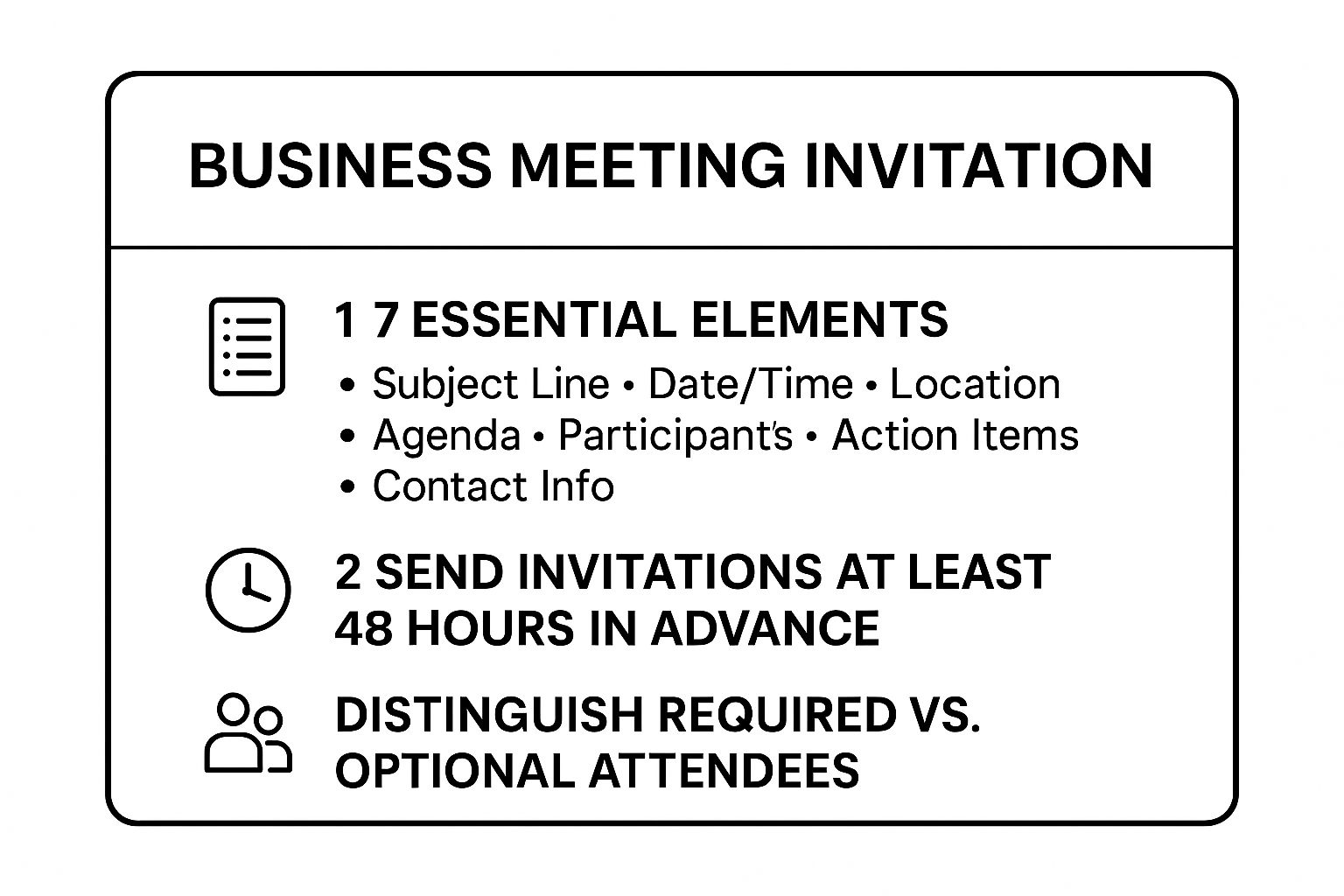
As the visualization shows, the structure is built around seven core elements, a specific sending timeline, and a clear distinction between attendee types, creating a comprehensive yet easy-to-digest invitation.
Actionable Takeaways & Best Practices
To effectively implement this template, follow these best practices:
- Specify Decision-Making Authority: Clearly state the purpose of the meeting. Is it to brainstorm, to inform, or to make a specific decision? Knowing this helps attendees prepare their contributions accordingly.
- Integrate with Calendars: Use calendar integrations (like Google Calendar or Outlook) to send the invitation. This allows for easy RSVP tracking, automatic reminders, and simple updates if details change.
- Attach Documents Directly: Link or attach all relevant documents, reports, or presentations mentioned in the agenda. Sending materials at least 48 hours in advance gives attendees ample time to review them.
Mastering this foundational template is a critical first step. For a deeper dive into optimizing your scheduling process, you can find the best way to schedule meetings and further enhance your team's productivity.
2. The Agile Sprint Meeting Invitation Template
The Agile Sprint Meeting Invitation Template is a streamlined, recurring format built for the high-tempo, iterative nature of modern development teams. Popularized by agile pioneers like Jeff Sutherland and adopted by tech giants such as Spotify and Atlassian, this template prioritizes speed, clarity, and collaboration over formal procedure. It’s designed to facilitate key ceremonies like sprint planning, daily standups, reviews, and retrospectives with minimal administrative overhead.
This approach is essential for any team operating within an agile or scrum framework, from software development at GitHub to product innovation cycles at Shopify. The goal is to create a lightweight, consistent, and instantly recognizable invitation that keeps the team synchronized and focused on sprint goals without creating unnecessary distractions.

Strategic Breakdown
The effectiveness of this template meeting invitation comes from its predictability and focus on action. For daily standups, the invitation is often a recurring calendar block with a simple, unchanging title like "Daily Standup: [Team Name]". This removes cognitive load; team members know exactly what the meeting is for without needing to read a detailed description each day.
A key strategic element is embedding links to dynamic resources directly within the invitation body. Including persistent links to the team's sprint backlog, Kanban board, or burndown chart transforms the calendar event into a central hub for the sprint. It ensures everyone arrives at the meeting with immediate access to the same data, facilitating a quick and productive conversation focused on progress and impediments. For a comprehensive understanding of various Agile ceremonies, consult an Essential Guide to Scrum Meetings to inform your invitation strategy.
Actionable Takeaways & Best Practices
To successfully deploy this agile template, consider these best practices:
- Automate Recurring Meetings: Set up invitations for the entire sprint or project duration at once. Use your calendar tool to create a recurring event for daily standups, sprint planning, and retrospectives to ensure consistency and reduce manual scheduling.
- Keep It Concise: For daily standups, the invitation body should be minimal. A simple prompt like "Ready to discuss: What did you do yesterday? What will you do today? Any blockers?" is often sufficient.
- Link to Living Documents: Always include direct links to the agile board (e.g., Jira, Trello) and other relevant dashboards. This practice ensures all participants are looking at the most current information, which is critical for making informed, real-time decisions.
3. The One-on-One Meeting Invitation Template
The One-on-One Meeting Invitation Template is a personalized format designed for individual check-ins, fostering direct communication and relationship building. Popularized by management pioneers like Intel’s Andy Grove and refined through modern leadership philosophies like Kim Scott's Radical Candor, this template prioritizes development, feedback, and alignment over simple status updates. It is the bedrock of effective management and mentorship.
This approach is essential for recurring meetings between managers and direct reports, mentors and mentees, or even close collaborators. Its value lies in creating a dedicated, private space for open dialogue. Companies like Google and Netflix integrate this practice into their core management culture to ensure employees feel heard, supported, and aligned with broader goals, moving beyond task-level supervision to holistic professional growth.
Strategic Breakdown
The power of this template meeting invitation comes from its collaborative and forward-looking nature. Unlike a directive, it signals a partnership where both parties contribute to the agenda. This shared ownership is critical for building trust and encouraging transparency, allowing sensitive topics or creative ideas to surface without fear of judgment.
A key strategic element is placing the onus of agenda-setting on the employee or mentee. By asking them to add their talking points in advance, the manager empowers them to guide the conversation toward what is most important to them. This simple shift transforms the meeting from a managerial inspection into a valuable resource for the employee, ensuring the time is spent on their challenges, career aspirations, and well-being.
Actionable Takeaways & Best Practices
To effectively implement this template, follow these best practices:
- Let the Employee Drive: The invitation should explicitly ask the employee to prepare their agenda items. Frame it as their meeting, with you there to support them. A simple line like, "Please add your topics to our shared document before we meet," works perfectly.
- Maintain Continuity: Use a shared, running document (like a Google Doc or OneNote page) for notes and agenda items. This creates a continuous record of discussions, decisions, and action items, preventing conversations from being lost and demonstrating long-term commitment.
- Focus on Development, Not Just Tasks: While it's fine to touch on project status, dedicate the majority of the time to bigger-picture topics. Use the invitation to prompt discussions around career growth, skill development, and overcoming challenges. Questions like, "What are you most proud of this week?" or "What roadblocks are you facing?" can be included in the template.
By establishing a regular cadence for these meetings, you create a reliable and predictable touchpoint. For managing schedules across a team, understanding different scheduling methods is key. Exploring strategies like those used in round robin meeting distribution can help ensure fair and balanced workloads, even when applied to one-on-one scheduling.
4. The Client Meeting Invitation Template
The Client Meeting Invitation Template strikes a crucial balance between professional decorum and personal relationship building. It is specifically crafted to communicate value, respect the client's time, and set clear expectations while maintaining a service-oriented tone. Pioneered by professional services firms like Deloitte and KPMG and refined by customer success platforms like Salesforce, this template prioritizes the client experience above all else.
This approach is essential for any interaction where the client relationship is the primary asset. It's the go-to format for account management check-ins, new client onboarding sessions, and project milestone reviews. The goal is to make the client feel valued and well-informed, transforming a simple meeting request into a positive touchpoint that reinforces their decision to work with you.

As the visualization highlights, this template is structured to be client-centric, focusing on flexibility, clarity, and providing value even before the meeting begins.
Strategic Breakdown
The strategic power of this template meeting invitation comes from its focus on client psychology. It proactively addresses potential client concerns, such as who they will be meeting and what the meeting aims to achieve. This preemptive clarity reduces friction and builds trust from the very first interaction.
A key strategic element is framing the meeting around the client’s goals, not your own. Instead of an agenda item like "Discuss Upsell Opportunities," use client-centric language like "Exploring Avenues to Enhance Your ROI." This positions the meeting as a collaborative session aimed at delivering more value, which is a core tenet of modern customer success and account management methodologies. The invitation should feel less like a demand on their time and more like an opportunity you are providing.
Actionable Takeaways & Best Practices
To deploy this template effectively, focus on personalization and convenience:
- Offer Flexible Scheduling: Instead of proposing a single time, provide a few options or, even better, share a link to your scheduling tool (like Calendly or HubSpot Meetings). This respects the client's busy schedule and empowers them to choose what works best.
- Introduce Your Team: Briefly introduce any colleagues who will be attending the meeting, including their role and why their presence is valuable to the client. For instance, "Sarah, our lead technician, will join to answer any in-depth technical questions."
- Confirm Technical Details: For virtual meetings, clearly state the platform (e.g., Zoom, Google Meet) and provide a direct link. Proactively ask if they need any assistance with the software beforehand to ensure a smooth start. This small step shows you are considerate of their experience.
5. The Emergency/Urgent Meeting Invitation Template
The Emergency/Urgent Meeting Invitation Template is a concise, action-oriented format designed for time-sensitive situations that demand immediate attention. Drawing from protocols established by crisis management firms and emergency response systems, this template cuts through the noise. It prioritizes clarity, urgency, and swift decision-making, providing just enough context for participants to act effectively on short notice.
This approach is essential for scenarios where a rapid, coordinated response is critical to mitigate risk or resolve an issue. Examples include IT security breach response meetings, product recall coordination, financial crisis management calls, or PR crisis communication briefings. The goal is not comprehensive planning but immediate alignment and action.
Strategic Breakdown
The power of this template meeting invitation lies in its directness and authority. It bypasses standard pleasantries to convey the gravity of the situation, compelling immediate attention from recipients. The subject line itself, often prefixed with "URGENT:" or "ACTION REQUIRED:", acts as a high-priority flag in a crowded inbox.
A key strategic element is the focus on immediacy over exhaustive detail. Unlike standard invitations, this one intentionally limits background information to a one or two-sentence summary of the crisis. The purpose is to get the right people into a room (virtual or physical) as quickly as possible, not to provide a detailed pre-read. It communicates that the details will be discussed live, reinforcing the need for attendance.
The template also establishes a clear chain of command and communication. By including direct contact numbers and a single point person, it streamlines communication channels when time is of the essence, preventing confusion and duplicated efforts during a critical event.
Actionable Takeaways & Best Practices
To effectively deploy this template during a crisis, follow these best practices:
- Use High-Priority Subject Lines: Start your subject line with "URGENT," "EMERGENCY," or "ACTION REQUIRED" to ensure it is seen immediately. Follow with a concise description of the issue (e.g., "URGENT: Security Incident Response Meeting").
- Keep it Brief and Focused: The meeting should be strictly time-boxed, ideally to 30 minutes. The invitation should state the single, critical objective, such as "Objective: To approve the external communication plan."
- Provide an Immediate Call-to-Action: Clearly state what is expected. This includes the meeting link and a dial-in number for those who may be away from their computer. Specify that attendance is mandatory for all required personnel.
- Plan a Follow-Up: Acknowledge the short notice and promise a detailed summary and action-item list immediately following the meeting. This manages expectations and ensures alignment continues after the initial call.
6. The Virtual/Remote Meeting Invitation Template
The Virtual/Remote Meeting Invitation Template is a modern necessity, specifically engineered to address the unique challenges of online collaboration. Popularized by remote-first pioneers like GitLab and Buffer, and accelerated by the global shift to remote work, this template prioritizes technical clarity and digital engagement. It goes beyond a simple link, ensuring every participant, regardless of their location or technical savvy, can join, participate, and contribute effectively.
This technology-focused approach is essential for any meeting not held in person. It's the standard for daily stand-ups on Slack, client presentations via Microsoft Teams, or global team syncs on Zoom. The core objective is to preemptively solve technical issues and set clear expectations for digital conduct, turning potential online friction into a seamless collaborative experience.

Strategic Breakdown
The strength of this template meeting invitation is its proactive, tech-first communication. It acknowledges that virtual meetings have more potential failure points than in-person ones, from bad connections to timezone confusion. By embedding all necessary technical details directly into the invitation, you remove ambiguity and reduce the chance of a late start due to a missing link or password.
A key strategic element is the explicit inclusion of time zones. Simply stating "9:00 AM" is insufficient for a distributed team. Best practice, as seen in GitLab's handbook, is to list the time in UTC and key local time zones (e.g., 2:00 PM UTC / 9:00 AM CST / 7:00 AM PST). This simple addition prevents scheduling mishaps and shows respect for a global team's time.
The visualization highlights the critical components that differentiate a virtual invitation, focusing on technology, time zone clarity, and contingency planning.
Actionable Takeaways & Best Practices
To optimize your virtual meeting invitations, adopt these best practices:
- Provide Multiple Access Options: Always include a primary link (e.g., Zoom, Teams) and a backup dial-in phone number. This provides a crucial fallback for attendees experiencing internet connectivity issues.
- Embed Links and Passwords: Place the meeting link directly in the calendar event's location field and the body. If a password is required, state it clearly next to the link to avoid last-minute scrambling.
- Set Digital Etiquette: Briefly mention guidelines for participation. This can include camera-on/off policies, microphone muting rules, or how to use the "raise hand" feature, ensuring the meeting runs smoothly.
Managing distributed teams requires mastering the art of asynchronous and synchronous communication. For more insights on this, explore our guide on scheduling meetings across time zones to further streamline your remote operations.
Comparison of 6 Meeting Invitation Templates
| Meeting Invitation Template | Implementation Complexity 🔄 | Resource Requirements ⚡ | Expected Outcomes 📊 | Ideal Use Cases 💡 | Key Advantages ⭐ |
|---|---|---|---|---|---|
| Standard Business Meeting Invitation | Medium – requires thorough details and formal tone | Moderate – prep time and document attachments | Clear communication and reduced confusion | Formal corporate meetings, external clients | Professional, comprehensive, customizable |
| Agile Sprint Meeting Invitation | Low – streamlined, recurring setup | Low – integrates with agile tools | Efficient team collaboration and quick decisions | Agile teams, sprint planning, standups | Streamlined, encourages participation |
| One-on-One Meeting Invitation | Medium – personalized and flexible | Moderate – regular scheduling, prep | Strong relationships and employee development | Manager-employee, mentorship, coaching | Builds trust, enables feedback & growth |
| Client Meeting Invitation | Medium – balancing professionalism and client focus | Moderate – customization per client | Strengthened client relationships and clarity | Client engagements, service-oriented meetings | Demonstrates respect, builds rapport |
| Emergency/Urgent Meeting Invitation | Low – concise and urgent focused | Low – minimal but critical info | Rapid response and decision-making | Crisis situations, urgent issues | Clear urgency, action-oriented, minimizes confusion |
| Virtual/Remote Meeting Invitation | Medium – includes tech and etiquette | Moderate – technology setup | Inclusive, efficient remote collaboration | Remote teams, hybrid meetings, global participants | Reduces tech issues, accommodates remote work |
From Invitation to Conversion: Mastering Your Meetings
Throughout this guide, we've deconstructed various meeting invitation templates, moving far beyond simple copy-paste solutions. We've explored the strategic nuances that transform a basic request into a powerful tool for engagement, efficiency, and conversion. The core takeaway is clear: a meeting invitation isn't just a logistical necessity; it's the first tangible step in a professional relationship and a critical opportunity to set the tone for success.
From the clarity of a standard business meeting to the urgency of an emergency session, each template meeting invitation serves a unique strategic purpose. The most effective invitations share foundational elements: a compelling subject line, a crystal-clear purpose, a concise agenda, and unambiguous logistics. Mastering these components is the first step toward reducing no-shows and ensuring every participant arrives prepared and aligned.
Key Strategic Pillars Revisited
To elevate your approach from simply scheduling to strategically engaging, remember these core principles we've discussed:
- Clarity is King: Ambiguity is the enemy of productivity. Your invitation must answer the "who, what, when, where, and why" without forcing the recipient to search for details. This respect for their time builds immediate goodwill.
- Context Dictates Content: A one-size-fits-all approach fails. A casual one-on-one requires a different tone and structure than a formal client-facing presentation. Tailoring your
template meeting invitationto the specific context and audience is non-negotiable for maximum impact. - The Agenda is Your Roadmap: Never send an invitation without an agenda, even a brief one. It frames the conversation, manages expectations, and demonstrates that you have a clear plan for the allotted time. This single element can dramatically increase the perceived value of your meeting.
- Post-Meeting Momentum is Crucial: The meeting itself is only one part of the process. Effective follow-up and action item tracking are what turn discussion into results. To truly master your meetings from start to finish, consider integrating tools like a robust meeting minutes template for efficient follow-up and record-keeping.
Your Actionable Next Steps
Moving forward, don't just use these templates; adapt them. Start by auditing your current meeting invitation process. Are you consistently including a clear purpose and agenda? Is your subject line optimized for clarity and action?
Begin by selecting one template from this article that aligns with your most frequent meeting type, whether it's client demos or internal agile ceremonies. Implement it for the next two weeks, paying close attention to recipient responses and meeting attendance rates. This focused effort will build the muscle memory needed to make strategic, well-crafted invitations your new standard. By treating every invitation as a micro-opportunity to demonstrate professionalism and drive outcomes, you will not only fill your calendar but also accelerate your entire pipeline from initial request to successful conversion.
Ready to turn more inbound demo requests into scheduled meetings? Distro helps revenue teams instantly qualify, route, and book meetings with your highest-value leads directly from your form. Stop letting valuable opportunities get lost in the shuffle and start converting leads at peak intent with Distro.