In marketing and sales, a landing page is never just a landing page. It's a specialized tool engineered for a single, crucial purpose: conversion. Sending qualified traffic to a generic homepage is like using a sledgehammer for a task that requires a scalpel. It’s inefficient and wastes valuable opportunities. The key to unlocking higher conversion rates lies in matching the right tool to the right job, and that means selecting the correct type of landing page for your specific campaign goal.
This guide moves beyond generic advice to provide a comprehensive breakdown of the most effective types of landing pages used by top-performing teams. We will dissect each one, exploring its unique purpose, core components, and the specific scenarios where it excels. You will learn not just what each page is, but how and when to deploy it to transform interest into measurable action, whether that's generating a lead, securing a sale, or registering a new user. For any page to be truly effective, its structure must be supported by solid visual principles. To ensure your chosen landing page type maximizes its impact, review these essential landing page design tips for optimal performance. Let's dive into the strategic playbook for building conversion-focused digital experiences.
1. Lead Generation Landing Page
A lead generation landing page, often called a "lead gen" page, is one of the most fundamental types of landing pages a business can create. Its sole purpose is to capture a visitor's contact information, such as their name and email address, effectively converting an anonymous visitor into a qualified lead. This is achieved by offering something of value, known as a lead magnet, in exchange for their details.
These pages are the workhorses of inbound marketing, forming the critical bridge between your content and your sales funnel. By providing a compelling reason for users to share their information, you can build a robust email list, nurture prospects, and segment your audience for future campaigns. Examples include HubSpot's extensive library of downloadable marketing templates or Neil Patel's free SEO analyzer tool, both of which offer immediate value for a simple data exchange.
When to Use a Lead Generation Landing Page
This type of landing page is essential when your primary goal is to grow your contact database for future marketing. Use it to:
- Build an email newsletter list by offering exclusive content or updates.
- Distribute high-value content like ebooks, white papers, or comprehensive guides.
- Drive registrations for events such as webinars, workshops, or online courses.
- Offer access to a free tool or resource that solves a specific problem for your audience.
Best Practices for High Conversion
To maximize the effectiveness of your lead gen page, focus on clarity, value, and trust. Keep the form as short as possible, asking only for essential information; typically, 3-5 fields is the sweet spot. Use a strong, action-oriented call-to-action (CTA) on your button, like "Download Your Free Guide" instead of a generic "Submit."
For a quick reference, here are the key performance indicators for a successful lead generation page.
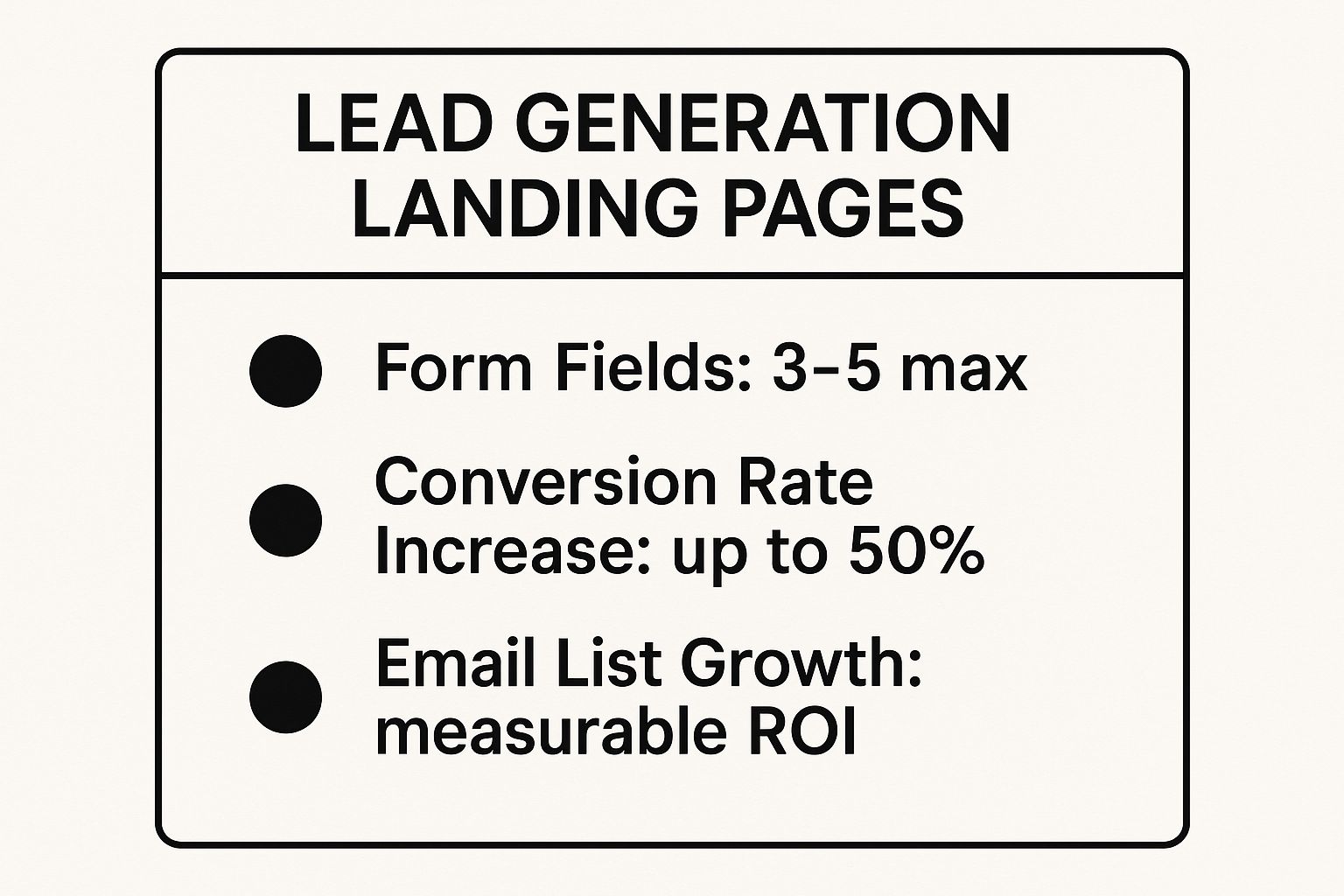
These metrics highlight how optimizing small elements, like form length, can directly contribute to measurable ROI and substantial list growth. Furthermore, integrating dynamic content can significantly boost engagement. For lead generation landing pages, integrating dynamic content like video can significantly boost conversion rates. Explore modern strategies for video for lead generation to enhance your approach. Learn more about how to power your marketing efforts with a strong inbound lead generation strategy.
2. Sales Page Landing Page
A sales page landing page is a specialized, long-form page meticulously crafted with a single, direct objective: to persuade a visitor to make a purchase. Unlike other types of landing pages that might capture leads, this page is the final step in the customer journey, designed to close the deal by providing all the necessary information, building trust, and creating a compelling case for the product or service.

These pages are the digital equivalent of a dedicated salesperson. They guide the prospect through a persuasive narrative, addressing pain points, showcasing benefits, presenting social proof, and overcoming objections before asking for the sale. Famous examples include the high-converting pages used by Russell Brunson for ClickFunnels or Apple's sleek, benefit-driven product pages for the latest iPhone, both of which masterfully blend storytelling with a strong call-to-action.
When to Use a Sales Page Landing Page
This type of landing page is mission-critical when your campaign goal is immediate revenue generation. Deploy a sales page to:
- Launch a new product or service and drive initial sales directly.
- Sell tickets to a paid event, such as a premium workshop or conference.
- Promote a high-ticket item that requires detailed explanation and persuasion.
- Offer a limited-time discount or special bundle to drive urgent purchases.
Best Practices for High Conversion
To create an effective sales page, focus on building a powerful narrative that connects emotionally with the visitor. Use compelling storytelling to frame the problem and position your product as the ideal solution. Include multiple trust signals like testimonials, case studies, and security badges to alleviate purchasing anxiety.
Creating urgency without being deceptive is key; use real scarcity, like a countdown timer for a sale, to encourage immediate action. A video demonstration can dramatically increase engagement and conversions by showing the product in action. Furthermore, optimizing the checkout experience is a crucial part of the conversion process. Find out how to streamline your pipeline with sales process automation to ensure no lead is lost.
3. Click-Through Landing Page
A click-through landing page acts as a crucial intermediary step, designed to "warm up" a visitor before sending them to a final transaction page. Unlike a lead gen page, its goal isn't to capture information but to persuade a user to click through to another page, typically a shopping cart or registration form. It does this by providing just enough information to build desire and explain the value proposition without overwhelming the user with a direct purchase decision.
These pages are essential in e-commerce and SaaS marketing, serving as a pre-sell environment. They bridge the gap between an ad and the checkout process, providing more context, benefits, and trust signals than an ad can contain. This focused approach helps increase the likelihood of a final conversion. For instance, Amazon often uses click-through pages for its "Deal of the Day" promotions, detailing the product's benefits before leading users to the main product page to complete the purchase.
When to Use a Click-Through Landing Page
This type of landing page is most effective when the final conversion step requires a more significant commitment, like a purchase or a detailed sign-up. Use it to:
- Warm up traffic for an e-commerce product by detailing features, benefits, and reviews before sending them to the cart.
- Provide more information about a complex SaaS offer or free trial before directing users to the sign-up page.
- Drive traffic to a primary sales or booking page from a promotional ad, ensuring the visitor is well-informed.
- Segment traffic before the final conversion, allowing you to present different offers or funnels based on user interest.
Best Practices for High Conversion
To maximize the effectiveness of a click-through page, the focus should be on creating a seamless and persuasive journey. Ensure the messaging is perfectly consistent from the initial ad to the landing page and all the way to the final checkout. Use compelling, benefit-driven headlines and clear, concise copy that highlights the value.
For a quick reference, here are the key performance indicators for a successful click-through page. Incorporating social proof like customer testimonials or reviews is critical for building trust. Always ensure your page loads quickly, as slow speeds can cause visitors to abandon the page before they even see the offer. Test different calls-to-action on your button, such as "See Plans and Pricing" or "Shop the Collection," to see what resonates best with your audience.
4. Squeeze Page Landing Page
A squeeze page is an ultra-focused subtype of a lead generation page, designed with the singular goal of capturing an email address. Characterized by its minimalist design and extreme brevity, a squeeze page intentionally removes all distractions like navigation menus, footers, and external links. It presents a visitor with a simple, binary choice: provide their email address to receive a specific incentive, or leave the page.
This direct-response marketing tool is built on a foundation of high-impact simplicity. By eliminating every element that does not contribute to the email capture, it forces the visitor to focus solely on the value exchange being offered. Examples range from signing up for Tim Ferriss's popular "5-Bullet Friday" newsletter to accessing a preview of a digital marketing course. The common thread is a compelling offer that makes the decision to subscribe feel urgent and valuable.
When to Use a Squeeze Page Landing Page
This highly specialized page is ideal when your primary, and often only, objective is rapid email list growth. It's less about educating the prospect and more about securing the subscription. Use it to:
- Promote a single, high-value lead magnet like a cheat sheet, template, or exclusive video.
- Gate a "content upgrade" within a blog post, offering bonus material related to the article.
- Build a pre-launch or waitlist for a new product, course, or service to gauge interest.
- Serve as a simple entry point to a multi-part email course or challenge.
Best Practices for High Conversion
Success with a squeeze page hinges on a powerful hook and zero friction. The copy must be incredibly concise, often under 100 words, to be absorbed in seconds. Use curiosity-driven headlines that make visitors eager to discover what's on the other side of the subscription form, such as "The One Tweak That Doubled My Productivity."
To maximize your conversion rate, focus on creating a sense of urgency, perhaps with a countdown timer for a limited-time bonus. Crucially, ensure the promised content is delivered instantly upon signup to build immediate trust. A/B testing different incentive offers, from a free ebook to a webinar seat, is key to identifying what resonates most with your audience and solidifying its place among the most effective types of landing pages for list building.
5. Product Detail Landing Page
A product detail landing page is the digital storefront for a single item. Its primary function is to provide a comprehensive, persuasive overview of a specific product to guide a visitor toward making a purchase. This page acts as the final conversion point in an e-commerce journey, consolidating all necessary information into one focused space.
These pages are critical for any business selling physical or digital goods online. They combine rich media, detailed descriptions, customer reviews, and a clear call-to-action to build trust and drive sales. Think of Amazon's highly optimized product pages or a specific Nike shoe page; they present everything a customer needs to know, from high-resolution images to size guides and user-generated feedback, making the buying decision as seamless as possible.
When to Use a Product Detail Landing Page
This type of landing page is non-negotiable for e-commerce and is the destination for most product-related marketing efforts. Use it when you need to:
- Sell a specific item directly from an online ad or social media campaign.
- Showcase a new product launch with detailed features and benefits.
- Provide an in-depth resource for shoppers comparing different options.
- Drive traffic from search engines for specific product-related keywords.
Best Practices for High Conversion
To create a product detail page that converts browsers into buyers, your focus should be on clarity, detail, and social proof. Use high-quality, professional product photography from multiple angles, and include a zoom function. Clearly present specifications, dimensions, and materials to answer potential questions upfront. Integrating a Q&A section and customer reviews is essential for building trust and addressing common concerns. Also, optimize your product titles and descriptions with relevant keywords to improve your visibility in search results. A well-executed page addresses user intent completely, leaving no reason for them to navigate away before purchasing.
6. Webinar Registration Landing Page
A webinar registration landing page is a specialized type of lead generation page created for a single, focused purpose: to persuade visitors to sign up for an upcoming live or on-demand webinar. These pages go beyond a simple form by building anticipation and clearly communicating the value proposition of the event. They aim to convince a visitor that investing their time in the webinar will provide them with exclusive knowledge, solve a pressing problem, or offer valuable industry insights.
This type of landing page is a cornerstone for B2B marketing and expert-led education, popularized by figures like Amy Porterfield and Russell Brunson. The page functions as the primary marketing asset for the event, combining compelling copy, social proof, and presenter authority to drive registrations. Successful examples include HubSpot’s extensive marketing webinar series or GoToWebinar's promotional pages, which effectively highlight the educational benefits and speaker credentials to maximize attendee sign-ups.
When to Use a Webinar Registration Landing Page
This is the ideal landing page when you are using an educational event as a top-of-funnel or mid-funnel marketing tool. Deploy it to:
- Generate high-quality leads by attracting an audience genuinely interested in a specific topic.
- Demonstrate product value in a live, interactive setting without a hard sales pitch.
- Establish thought leadership and build authority in your industry.
- Nurture existing leads by providing them with advanced, valuable content to move them down the sales funnel.
Best Practices for High Conversion
To maximize registrations, your page must quickly answer "what's in it for me?" for the visitor. Clearly list the key takeaways or specific skills attendees will gain. Use high-quality photos and brief bios of the presenters to build a personal connection and establish credibility. Including a countdown timer can create a sense of urgency, while testimonials from past attendees provide powerful social proof.
For a quick reference, here are the key elements for a successful webinar registration page.
- Offer Replay Access: Mention that a recording will be available to those who register, which can capture sign-ups from people with scheduling conflicts.
- Strong, Benefit-Oriented Headline: Focus on the outcome or solution the webinar provides.
- Bulleted Learning Objectives: Clearly outline what attendees will learn.
- Presenter Authority: Include photos, titles, and credentials of the speakers.
- Clear Call-to-Action (CTA): Use action-driven text like "Save My Spot" or "Register for Free."
By optimizing these elements, you can significantly increase your registration rate. The process mirrors structuring an effective meeting request, where clarity and value are paramount. You can explore best practices for crafting compelling invitations and see how the principles overlap when you learn more about a successful meeting invitation format.
7. App Download Landing Page
An app download landing page is a specialized, mobile-optimized page designed with one clear objective: to persuade visitors to download a mobile application. Rather than sending traffic directly to a crowded app store page, this landing page acts as a focused sales pitch, giving you full control over the narrative. It bridges the gap between a marketing campaign and the app store, warming up potential users by showcasing the app's core value proposition, key features, and user interface.
These pages are critical in the competitive mobile app market. They allow you to present a curated experience, highlighting the most compelling benefits and social proof that might get lost on a standard App Store or Google Play page. For instance, Uber often uses city-specific landing pages that not only prompt a download but also frame the app's benefits within a local context, while Spotify’s pages effectively use visuals and concise copy to sell the experience of limitless music before asking for the download.
When to Use an App Download Landing Page
This type of landing page is indispensable when your primary business goal is to increase mobile application installs. Use it to:
- Support paid ad campaigns on social media or search engines, providing a consistent message from ad to download.
- Showcase new features or major updates to re-engage past users or attract new ones.
- Promote a single, powerful benefit that solves a specific user problem, like "Effortless Budgeting" or "Instant Photo Editing."
- Target specific user segments with tailored messaging and visuals that resonate with their unique needs.
Best Practices for High Conversion
To drive maximum downloads, your app landing page must be visually engaging and incredibly straightforward. Prioritize a mobile-first design, as most users will be visiting from their phones. Feature a prominent, high-quality video or a series of dynamic screenshots that give a real feel for the user experience inside the app. Your call-to-action (CTA) buttons should be unmistakable, using app store badges ("Download on the App Store," "Get it on Google Play") to create instant recognition and trust. Finally, incorporate user testimonials or ratings to build credibility and ease any hesitation.
8. Event Registration Landing Page
An event registration landing page is a specialized page designed with a single, clear objective: to persuade visitors to sign up for an event. Whether it's a virtual webinar, an in-person conference, a workshop, or a local networking meet-up, this page serves as the central hub for all event-related information and the primary gateway for securing attendees. It goes beyond a simple form by building excitement and communicating the event's unique value proposition.
These pages are critical for event marketing, as they directly impact ticket sales, attendance numbers, and overall ROI. They must effectively convey key details like the agenda, speaker lineup, and logistical information while making the registration process as seamless as possible. Successful examples include the compelling registration pages for large-scale events like Salesforce's Dreamforce, which masterfully blends detailed session information with a strong sense of community and urgency, or the clean, focused pages for TED conferences.
When to Use an Event Registration Landing Page
This is one of the essential types of landing pages for any organization hosting a live or virtual gathering. Use it when you need to:
- Drive sign-ups for a webinar or online summit to generate leads and educate your audience.
- Sell tickets for a conference, trade show, or workshop by highlighting speakers and content.
- Manage registrations for a free networking event or community meet-up to gauge interest.
- Promote an exclusive product launch event or a limited-seating training session.
Best Practices for High Conversion
To maximize registrations, your page must build trust and create a sense of FOMO (fear of missing out). Provide detailed speaker bios with professional photos to establish credibility. A clear, visible countdown timer or a "seats remaining" counter can effectively instill urgency. Make the registration form easy to complete and consider adding one-click calendar integrations ("Add to Google Calendar") to help attendees remember the date.
For in-person events, including helpful logistical details like venue maps, parking instructions, or recommended hotel information removes friction and shows you've considered the attendee's entire experience. Finally, offering an "early bird" discount is a proven tactic to encourage prompt sign-ups and build momentum for your event marketing campaign.
Types of Landing Pages: Features Comparison
| Landing Page Type | Implementation Complexity 🔄 | Resource Requirements ⚡ | Expected Outcomes 📊 | Ideal Use Cases 💡 | Key Advantages ⭐ |
|---|---|---|---|---|---|
| Lead Generation Landing Page | Moderate: Requires form integration and follow-ups | Moderate: Need lead magnets and email sequence | Builds qualified email lists, measurable ROI | B2B lead capture, email list building | Nurture campaigns, ongoing relationships |
| Sales Page Landing Page | High: Extensive copywriting and design needed | High: Product assets, copy, payment systems | Direct revenue generation, detailed tracking | Direct product/service sales | Control sales message, strong CTAs |
| Click-Through Landing Page | Moderate: Simple page linking to conversion page | Low to Moderate: Focus on persuasive copy | Increases final conversion rates, reduces cart abandonment | Pre-selling, warming up visitors | Message matching, additional persuasion |
| Squeeze Page Landing Page | Low: Minimalist design, single opt-in form | Low: Basic form and incentive needed | High email capture rates, cost-effective | Quick list building with minimal info | High conversion due to simplicity |
| Product Detail Landing Page | High: Rich content and images, SEO optimization | High: Product photography, detailed specs | Informed purchase decisions, SEO benefits | E-commerce product showcase | Builds trust, supports research phase |
| Webinar Registration Landing Page | Moderate: Registration form and content prep | Moderate: Event promotion, presenter assets | Generates engaged leads, positions authority | Educational webinar sign-ups | Expert positioning, direct sales via webinars |
| App Download Landing Page | Moderate: Mobile-optimized with store links | Moderate: Media assets, app store integration | Drives app downloads, tracks attribution | Mobile app promotion | Showcases features, drives installs |
| Event Registration Landing Page | High: Registration/payment forms, detailed info | High: Event logistics, content, payment system | Centralized event info, streamlined registration | Conferences, workshops, seminars | Builds excitement, enables follow-up |
From Page to Pipeline: Activating Your Landing Page Strategy
We've journeyed through the diverse landscape of landing pages, from the direct-response power of a Sales Page to the targeted efficiency of a Squeeze Page. The key takeaway is clear: a one-size-fits-all approach to landing pages is a recipe for missed opportunities and wasted ad spend. The true power lies in strategic alignment, matching the right page type to the right audience, offer, and campaign goal. Understanding the different types of landing pages isn't just an academic exercise; it's the foundational skill for building a high-performance conversion engine.
The most successful B2B teams don't just build pages; they build pathways. They see each landing page not as an endpoint, but as the critical first handshake in a longer conversation. A well-executed Webinar Registration page seamlessly transitions a prospect into a nurturing sequence. A meticulously crafted Product Detail page provides the exact information a buyer needs before engaging with sales. This strategic thinking transforms your website from a passive brochure into an active, revenue-generating pipeline.
Activating Your Strategy: Your Next Steps
To move from theory to implementation, you must internalize the core purpose behind each page. The difference between a Lead Generation page and a Click-Through page, for instance, is the difference between capturing a future relationship and warming up an immediate transaction. Choosing correctly means respecting the user's intent and their position in the buyer's journey.
Here are your actionable next steps to put these insights into practice:
- Audit Your Current Funnel: Map out your customer's journey. Identify every touchpoint where you ask a prospect to take action. Are you using the optimal landing page type for each specific request? A common mistake is using a generic lead gen form where a focused Webinar or Event Registration page would perform better.
- Segment and Personalize: Don't send high-intent traffic from a targeted ad campaign to a generic homepage. Create dedicated Sales Pages or Product Detail Pages tailored to the ad's specific promise. This continuity builds trust and dramatically increases conversion rates.
- Test with Purpose: Instead of randomly changing button colors, test the core format. Pit a long-form Sales Page against a concise Lead Generation page for a bottom-of-funnel offer. The results will provide deep insights into your audience's preferences and buying psychology.
Mastering these different types of landing pages empowers your sales and marketing teams to build a more efficient, predictable, and scalable pipeline. It’s about more than just boosting conversion rates on a single campaign; it's about architecting a system that consistently turns clicks into qualified leads, demos, and ultimately, revenue. By selecting the right tool for the job every time, you create a frictionless experience for your prospects and a powerful growth engine for your business.
Once you've optimized your landing pages to capture high-intent leads, the next challenge is ensuring they are routed instantly to the right sales rep. Distro automates this crucial handoff, using advanced routing rules to qualify and distribute leads from any source, including your landing page forms. Stop letting valuable leads go cold and start booking more meetings by visiting Distro to see how our platform bridges the gap between marketing conversion and sales acceleration.