
Beyond the Inbox: The New Rules of Outbound Lead Generation
In a world saturated with digital noise, standing out is harder than ever. Generic outreach is dead, and success in outbound lead generation now hinges on precision, personalization, and genuine value. Forget what you think you know about casting a wide net; today's top-performing sales teams win by building targeted, multi-channel campaigns that resonate on a human level. This guide moves beyond the basics to provide a strategic blueprint for mastering modern outbound prospecting.
We will dissect seven powerful strategies that high-growth companies are using right now to not just find, but meaningfully engage high-value prospects. This isn't theoretical advice. You will get actionable frameworks and specific examples for implementing each tactic, including:
- Cold Email Outreach: Crafting hyper-personalized messages that cut through the clutter.
- LinkedIn Social Selling: Building authority and initiating valuable conversations.
- Cold Calling: Reviving a classic channel with data-driven scripting and timing.
- Account-Based Marketing (ABM): Coordinating sales and marketing for a unified attack on key accounts.
- Video Prospecting: Using personalized video to capture attention and build rapport.
- Referral Programs: Systematically turning happy customers into a source of warm leads.
- Direct Mail Campaigns: Combining physical touchpoints with digital follow-up for maximum impact.
This article provides the specific playbooks, tools, and metrics needed to build a predictable and scalable pipeline. To truly master outbound, it's also essential to understand the full spectrum of comprehensive lead generation strategies and how they fit together. Prepare to transform your approach from simply sending messages to starting valuable conversations that drive revenue.
1. Cold Email Outreach
Cold email outreach remains a cornerstone of effective outbound lead generation due to its scalability, directness, and potential for high ROI. At its core, this strategy involves a systematic approach to initiating conversations with potential customers who have no prior relationship with your company. Unlike spam, which is generic and untargeted, a successful cold email campaign is built on deep prospect research, hyper-personalization, and a value-first mindset.
Pioneered by sales leaders like Aaron Ross, author of 'Predictable Revenue,' this method moves beyond simply inserting a prospect's name. It's about demonstrating a genuine understanding of their role, company challenges, and industry landscape. Companies like Salesforce have mastered this with multi-touch email sequences that nurture enterprise prospects over time, while ZoomInfo leverages its own data insights to craft exceptionally relevant and timely messages that cut through the noise.
Implementing a Successful Cold Email Campaign
To execute this strategy effectively, focus on three key areas: list building, messaging, and follow-up.
- List Building: Your campaign is only as good as your prospect list. Use tools like LinkedIn Sales Navigator or ZoomInfo to build a highly targeted list based on specific firmographic and technographic data. The goal is to identify individuals who are most likely to benefit from your solution.
- Crafting the Message: Your initial email should be concise, personalized, and centered on a single, clear call-to-action (CTA). Avoid lengthy pitches. Instead, focus on a specific pain point or offer immediate value. Personalization should go beyond
[First_Name]. Reference a recent company announcement, a shared connection, or a piece of content they published. To streamline your efforts and maximize impact, exploring effective B2B cold email templates can be incredibly beneficial. - Strategic Follow-Up: Most deals are not closed on the first email. A persistent yet respectful follow-up cadence is critical. Plan for 5-7 touchpoints, with each email providing new value or a different angle. Automating this sequence ensures consistency and efficiency. Learn more about how to streamline your sales process with automation.
The following summary box highlights the key performance indicators you should track for your cold email campaigns.
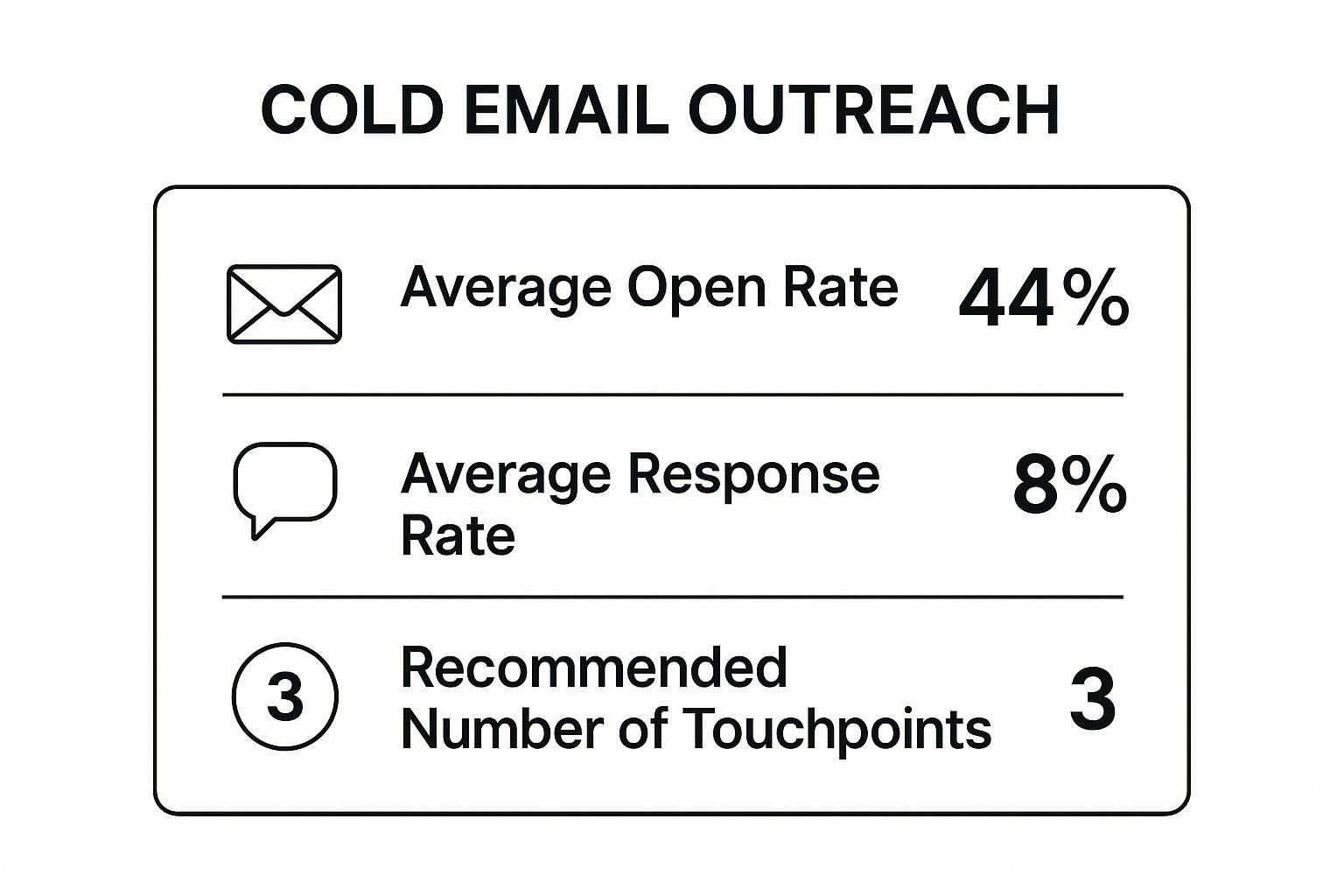
These metrics underscore the importance of persistence and compelling messaging. A low response rate often indicates a need to refine your value proposition or CTA, while the recommended number of touchpoints reinforces that consistent follow-up is non-negotiable for success. By continuously A/B testing subject lines, body copy, and send times, you can optimize these numbers and turn cold outreach into a predictable revenue engine.
2. LinkedIn Social Selling
LinkedIn social selling has evolved into a vital pillar of modern outbound lead generation, shifting the focus from aggressive pitching to strategic relationship-building. At its core, this approach leverages LinkedIn's professional network to identify, connect with, and nurture prospects by providing value long before a sale is ever mentioned. Unlike traditional cold calling, social selling is about establishing credibility and trust through thoughtful engagement and content sharing, turning a cold outreach into a warm conversation.
Pioneered by evangelists like Jill Rowley and Jamie Shanks, this methodology has proven its immense power. For instance, IBM's internal social selling initiative reportedly contributed to a massive increase in revenue by empowering its sales teams to build authentic relationships online. Similarly, Dale Carnegie's program saw a 300% surge in qualified opportunities by training its teams to use LinkedIn as a primary tool for engagement and nurturing, demonstrating the strategy's scalability and impact on the sales pipeline.
Implementing a Successful Social Selling Strategy
To effectively integrate social selling into your outbound process, concentrate on three core activities: profile optimization, content engagement, and strategic outreach.
- Profile Optimization & Content Sharing: Your LinkedIn profile is your digital storefront. Optimize it with a customer-centric headline, a detailed "About" section that speaks to your ideal client's pain points, and professional media. Consistently share valuable, industry-relevant content to position yourself as a thought leader and attract inbound interest.
- Meaningful Engagement: Before sending a connection request, engage with your prospect's activity. Comment thoughtfully on their posts, share their content, or participate in groups they are active in. This builds familiarity and demonstrates genuine interest, warming up the eventual outreach.
- Strategic Outreach & Nurturing: Use tools like LinkedIn Sales Navigator to identify high-fit prospects with advanced filters. When you connect, send a personalized request that references a shared interest or recent engagement. Once connected, continue the value-driven conversation and avoid an immediate sales pitch. For a deeper dive into converting your LinkedIn network into valuable prospects, explore these proven LinkedIn lead generation strategies.
The following summary box highlights the key performance indicators you should track for your LinkedIn social selling efforts.
These metrics highlight the importance of building a strong personal brand and engaging authentically. A low connection acceptance rate might signal that your profile isn't resonating or your connection requests lack personalization. By monitoring these KPIs, you can refine your approach, build a powerful professional network, and transform LinkedIn from a simple resume site into a dynamic engine for outbound lead generation.
3. Cold Calling
Despite its reputation, cold calling remains a powerful and direct pillar of outbound lead generation, offering an immediate, human connection that digital channels cannot replicate. At its core, this strategy involves proactively telephoning potential customers who have not previously expressed interest in your company. Modern cold calling has evolved far beyond aggressive, untargeted dialing; today’s successful approach is rooted in meticulous research, a consultative mindset, and a clear strategic purpose for every call.
This method has been championed by sales titans like Jeb Blount, author of 'Fanatical Prospecting,' and Mike Weinberg, who advocates for its disciplined application in 'New Sales Simplified'. Its effectiveness is proven by industry giants. For instance, Salesforce built a significant portion of its early empire on the back of a robust inside sales team skilled in strategic cold calling. Similarly, companies using platforms like ConnectAndSell can achieve up to eight times more live conversations, demonstrating how technology can amplify this classic technique for modern B2B sales.

Implementing a Successful Cold Calling Strategy
To transform cold calls from interruptions into valuable conversations, concentrate on three fundamental components: preparation, execution, and analysis.
- Pre-Call Preparation: Success starts long before you pick up the phone. Research your prospect on LinkedIn to understand their role, recent activities, and company priorities. Prepare a flexible call guide, not a rigid script, with a compelling opening statement, key talking points, and thoughtful questions. Your primary goal is not to sell but to secure a follow-up meeting.
- Executing the Call: Your opening is critical. Use a warm-up question or reference a shared connection or relevant company trigger event to build immediate rapport. State the purpose of your call clearly and concisely. Be prepared to handle common objections with empathy and confidence, redirecting the conversation back to the value you can provide. Focus on listening more than you talk to uncover key pain points.
- Post-Call Analysis and Follow-Up: A call is just one touchpoint. Immediately after the call, send a summary email referencing your conversation and confirming the next steps. Diligently track your activity and outcomes in a CRM. Analyzing metrics like call-to-conversation ratio and conversation-to-appointment rate is essential for continuous improvement.
The following summary box highlights the key performance indicators you should track for your cold calling campaigns.
| Metric | Industry Benchmark/Target | Rationale |
|---|---|---|
| Dials to Conversation Rate | 2-3% | Measures the efficiency of your list and timing. A low rate may signal poor data or calling at the wrong times. |
| Conversation to Appointment Rate | 20-30% | Indicates the effectiveness of your pitch and value proposition. A low rate suggests your messaging needs refinement. |
| Calls Per Day | 50-60 Dials | A baseline activity level required for consistent pipeline generation in most B2B environments. |
These metrics reveal the realities of cold calling as a numbers game that is heavily influenced by skill. A low conversation rate points to issues at the top of the funnel, such as list quality, while a poor appointment rate signals a need to improve your in-call technique and objection handling. By mastering preparation and analyzing performance, you can turn one of the oldest outbound lead generation tactics into a reliable source of high-quality opportunities.
4. Account-Based Marketing (ABM)
Account-Based Marketing (ABM) flips the traditional sales funnel on its head, making it an essential outbound lead generation strategy for B2B companies targeting high-value clients. Instead of casting a wide net, ABM concentrates sales and marketing resources on a predetermined set of target accounts, treating each account as its own market. This approach is built on extreme personalization and deep alignment between sales and marketing teams to create coordinated, high-touch outreach campaigns.
This strategic focus ensures that every interaction is relevant and impactful. Pioneers like Sangram Vajre of Terminus and Jon Miller of Demandbase have championed ABM as a way to cut through the noise and engage key decision-makers within specific organizations. Success stories are plentiful: 6sense used its own platform to achieve a 300% increase in enterprise deals, while Demandbase has recorded engagement rates as high as 97% from its target accounts by delivering hyper-relevant content and messaging.
Launching a Powerful ABM Initiative
Executing a successful ABM strategy requires a disciplined, multi-stage approach that integrates marketing and sales efforts seamlessly.
- Account Selection and Alignment: The first step is to collaboratively identify your Ideal Customer Profile (ICP) and select a small number of high-value target accounts. Sales and marketing must agree on firmographic criteria like industry, company size, and revenue. This alignment is critical for focusing resources where they will have the most impact.
- Deep Research and Personalization: Once accounts are selected, conduct in-depth research to understand their specific challenges, goals, and internal structure. Develop detailed buyer personas for key stakeholders within each account. This intelligence fuels the creation of account-specific content, custom value propositions, and personalized outreach that resonates deeply.
- Orchestrated Multi-Channel Outreach: ABM is not a single-channel play. Coordinate your outreach across multiple touchpoints, including personalized emails, targeted social media ads, direct mail, and strategic cold calls. This orchestrated "air and ground" attack ensures your message is consistently seen by the right people at the right time. To refine your targeting, it is vital to understand the nuances of implementing effective lead scoring models for your high-value accounts.
The success of an ABM program is not measured by traditional lead volume but by the quality of engagement within target accounts. Key metrics include account penetration (the number of engaged contacts within an account), pipeline velocity, and ultimately, the revenue generated from your selected list. By focusing intensely on the accounts that matter most, ABM transforms outbound efforts into a precise and highly effective revenue-driving machine.
5. Video Prospecting
Video prospecting elevates outbound lead generation by replacing or supplementing text-based communication with short, personalized video messages. This strategy humanizes the sales process in a way that text cannot, allowing prospects to see and hear the salesperson. This direct, visual connection builds rapport and trust much faster, leading to significantly higher engagement and response rates compared to traditional outreach methods.
The power of video lies in its ability to cut through the digital noise and capture attention. Sales strategists like Jill Konrath and video evangelists such as Ethan Beute of BombBomb have championed this method for its effectiveness in creating memorable first impressions. Companies like Vidyard have seen their sales teams achieve up to 16x higher response rates using video. Similarly, HubSpot sales reps have successfully used personalized videos to book 35% more meetings, demonstrating the tangible impact of a more personal, visual approach.
Implementing a Successful Video Prospecting Campaign
To execute this strategy effectively, focus on the production, personalization, and a clear call-to-action.
- Keep it Short and Focused: Attention spans are limited. Aim for a video length of 30-90 seconds. The goal is to deliver a concise, high-impact message that respects the prospect's time while clearly communicating your value.
- Personalize Your Opening: Start your video by addressing the prospect by name and mentioning their company. Holding up a small whiteboard with their name is a popular and effective tactic. This immediately signals that the video was created specifically for them, not a mass-market blast.
- Deliver Value and End with a CTA: Reference a specific challenge, a recent company event, or a piece of content they shared to show you've done your research. For example, use a screen recording to quickly show how your tool can solve a problem on their website. End with a simple, clear call-to-action, such as "Does this sound interesting? Reply to this email and let me know."
The following video provides an excellent overview of how to get started with video prospecting and make a lasting impression.
To ensure success, technical quality is just as important as the message. Use a good webcam and microphone, ensure you have good lighting, and practice your delivery so you sound confident and natural. By combining genuine personalization with a clear, value-driven message, video prospecting can transform your outreach efforts and become a powerful engine for generating qualified leads.
6. Referral Programs
Referral programs represent a powerful and often overlooked channel for outbound lead generation, transforming your existing customer base into a proactive sales force. This strategy systematizes word-of-mouth marketing by incentivizing satisfied customers, partners, and network connections to recommend your services. By leveraging the trust inherent in existing relationships, referral programs generate exceptionally high-quality leads that often convert faster and have a higher lifetime value.
This method, championed by growth experts like Sean Ellis and Andrew Chen, is rooted in creating a win-win-win scenario for the referrer, the new lead, and your company. Dropbox famously used a dual-incentive program to fuel its explosive growth, driving 35% of daily sign-ups. Similarly, Tesla's program generated thousands of high-value leads by rewarding both the referrer and the buyer, while Airbnb's system was a cornerstone of its early user acquisition, contributing to its exponential growth by making it easy and rewarding for users to invite friends.
Implementing a Successful Referral Program
To turn referrals from a sporadic occurrence into a predictable pipeline, focus on structure, incentives, and communication.
- Simplify the Process: The easier it is to refer someone, the more likely people are to do it. Create a simple, dedicated landing page or an in-app feature where referrers can easily share a unique link or submit contact information. Remove all friction from the process.
- Offer Meaningful Incentives: The reward must be compelling enough to motivate action. Offer value to both the referrer (e.g., account credits, discounts, cash bonuses) and the new referee (e.g., a welcome discount, extended trial). Continuously test and optimize these incentives based on performance data to see what resonates most with your audience.
- Promote and Equip Your Advocates: Don't just build the program and hope they come. Actively promote it through email newsletters, social media, and in-app notifications. Provide your advocates with pre-written email templates, social media posts, and key talking points to make it effortless for them to spread the word effectively.
While often seen as a blend of inbound and outbound tactics, a proactive referral program is a distinct form of outbound effort. You are actively encouraging and equipping your network to perform outreach on your behalf. To better understand how these strategies complement each other, explore this comparison of inbound vs. outbound lead generation. Regularly celebrating top referrers publicly can also create a positive feedback loop, encouraging more participation and turning your customer base into a reliable engine for growth.
7. Direct Mail Campaigns
In a world saturated with digital communication, direct mail re-emerges as a powerful outbound lead generation tactic by offering a tangible, physical touchpoint. This strategy involves sending carefully selected physical items, from personalized letters and high-value reports to dimensional mailers and corporate gifts, directly to a prospect's office. Unlike a fleeting email, a physical package commands attention, creating a memorable and multi-sensory brand experience that can effectively cut through the digital noise and foster a sense of reciprocity.
This isn't your average junk mail. Modern direct mail is hyper-targeted, automated, and seamlessly integrated into broader sales cadences. Platforms like Sendoso and Lob have revolutionized the approach, enabling sales teams to trigger mailings based on specific actions or stages in the buyer's journey. For instance, Sendoso has helped companies like Outreach achieve a 6x higher response rate by integrating physical sends into their digital sequences, while PFL has reported generating impressive 30% response rates for its B2B clients by using high-impact mail.
Implementing a Successful Direct Mail Campaign
To elevate direct mail from a simple novelty to a strategic revenue driver, focus on integration, personalization, and follow-up.
- Strategic Integration: Your direct mail efforts should not exist in a vacuum. Integrate them with your digital campaigns. For example, send an email notifying a prospect that a package is on its way, and then trigger a follow-up call or LinkedIn message a day after it's delivered. This multi-channel approach amplifies your message and increases the likelihood of a response.
- Deep Personalization and Quality: Go beyond just adding a name. Personalize the item itself to reflect the prospect's industry, role, or a known pain point. The quality of the materials must reflect the quality of your brand; a cheap-feeling mailer can do more harm than good. A clear and compelling call-to-action (CTA) is essential, such as directing them to a personalized landing page or suggesting a specific next step.
- Timely and Persistent Follow-Up: Use tracking to know exactly when your package arrives. Prompt follow-up is critical to capitalize on the moment of impact. Reference the item you sent to create an immediate, warm connection. For example, "Hi [First_Name], hope you're enjoying the coffee I sent. I thought it might be useful while you're tackling [specific company initiative]."
By combining the physical with the digital, direct mail becomes a high-impact component of any sophisticated outbound lead generation strategy. It’s particularly effective for high-value accounts where a standout gesture can open doors that digital methods alone cannot. This approach demonstrates a level of investment and thoughtfulness that signals to a prospect that they are a priority, significantly increasing your chances of securing a meeting.
Outbound Lead Generation Methods Comparison
| Method | Implementation Complexity 🔄 | Resource Requirements ⚡ | Expected Outcomes 📊 | Ideal Use Cases 💡 | Key Advantages ⭐ |
|---|---|---|---|---|---|
| Cold Email Outreach | Moderate 🔄 Requires research & personalization | Low ⚡ Scalable, can be automated | Lead generation, measurable ROI 📊 | Broad B2B outreach, lead generation | Cost-effective, personalized, scalable ⭐ |
| LinkedIn Social Selling | High 🔄 Time-intensive relationship building | Moderate ⚡ Premium tools can be costly | Long-term relationships, trust building 📊 | Professional networking, thought leadership | High-quality leads, less intrusive ⭐ |
| Cold Calling | High 🔄 Requires prep and real-time effort | Moderate ⚡ Time-consuming | Immediate feedback and results 📊 | Complex or high-value sales, quick qualification | Personal rapport, real-time objection handling ⭐ |
| Account-Based Marketing | Very High 🔄 Resource and research intensive | High ⚡ Requires sophisticated tools | Higher ROI, shorter sales cycles 📊 | Targeted high-value accounts | Highly personalized, sales-marketing alignment ⭐ |
| Video Prospecting | High 🔄 Time-consuming video creation | Moderate ⚡ Investment in video tools | Higher engagement and trust 📊 | Personalized outreach, complex info sharing | Stands out, builds rapport quickly ⭐ |
| Referral Programs | Moderate 🔄 Needs program management | Low to Moderate ⚡ Incentive costs vary | High-quality leads, viral growth 📊 | Customer-driven growth, trust-based leads | High conversion, lower acquisition cost ⭐ |
| Direct Mail Campaigns | Moderate to High 🔄 Physical materials & coordination | High ⚡ Costly and slower execution | Memorable impressions, attention 📊 | Account-based marketing, branding & awareness | High attention, less competition ⭐ |
Integrating Your Outbound and Inbound Funnels for Maximum Impact
Throughout this guide, we've explored the most potent strategies for proactive, effective outbound lead generation. From the precision targeting of Account-Based Marketing and the classic effectiveness of cold calling to the modern flair of video prospecting and social selling on LinkedIn, you now have a comprehensive toolkit. We have dissected the mechanics of building high-quality lists, crafting compelling messages, executing multichannel outreach, and measuring what truly matters.
The core lesson is clear: successful outbound is not about brute force. It's a sophisticated blend of art and science, requiring personalization, persistence, and a deep understanding of your ideal customer's pain points. Whether you're sending a physical direct mail piece to a high-value account or running a broad-scale cold email campaign, the principles of value-first engagement and strategic follow-up remain paramount. Mastering these individual channels is the first critical step toward building a predictable revenue engine.
From Proactive Outreach to Seamless Conversion
However, the journey doesn't end when a prospect raises their hand. In fact, that's where the most critical transition occurs. The ultimate goal of any outbound lead generation effort is to seamlessly convert a cold or lukewarm prospect into a warm, engaged lead who is actively moving through your sales funnel. The handoff from your outbound touchpoint to the next step, typically a scheduled meeting or demo, must be frictionless.
This is where many well-executed outbound strategies falter. A prospect, intrigued by your personalized outreach, clicks your call-to-action link only to be met with a generic "thank you, we'll be in touch" page. The momentum is lost. The peak interest fades. The lead cools down while waiting for a manual follow-up. True pipeline acceleration requires bridging the gap between your outbound and inbound systems, creating a unified and immediate response mechanism.
Key Takeaways for Your Outbound Strategy
As you refine your approach, keep these central pillars of outbound lead generation at the forefront of your planning:
- Hyper-Personalization is Non-Negotiable: Generic templates are the enemy of engagement. Invest the time to research your prospects and tailor your messaging to their specific role, company, and industry challenges. This applies across all channels, from the first line of an email to the talking points in a cold call.
- Embrace a Multichannel Cadence: Relying on a single channel is a recipe for being ignored. An effective cadence might start with a LinkedIn connection request, followed by an email, a value-driven video message, and then a well-timed phone call. This persistence across platforms dramatically increases your chances of cutting through the noise.
- Data is Your North Star: Don't just execute; analyze. Track your open rates, reply rates, meeting booked rates, and lead-to-opportunity conversion rates. Use this data to A/B test your messaging, identify your most effective channels, and continuously optimize your entire outbound process.
- The Handoff is Everything: The moment a lead expresses interest is the moment of maximum opportunity. Your process for capturing that interest and immediately routing them to the correct sales representative for a scheduled meeting must be automated and instantaneous. This is where you capitalize on the hard work of your outreach.
Your Actionable Next Steps
Mastering outbound lead generation is an ongoing process of refinement and optimization. To put these concepts into action, start by selecting one or two strategies from this guide that align best with your ideal customer profile and resources.
- Audit Your Current Process: Where are the leaks in your funnel? Are your lists clean? Is your messaging compelling? Most importantly, what happens after a lead says "yes" to a meeting?
- Implement a Pilot Program: Choose a small segment of your target market and launch a focused multichannel campaign. Test your assumptions, gather data, and identify what works before scaling up.
- Automate the Handoff: The single most impactful improvement you can make is to automate the lead-to-meeting process. When a prospect clicks to book a demo from an outbound email, they should be able to instantly schedule on the correct rep's calendar based on intelligent routing rules.
By viewing your outbound and inbound funnels not as separate entities but as two halves of a single, cohesive revenue machine, you unlock exponential growth. The power of a great outbound strategy is fully realized only when it leads to a flawless inbound conversion experience, shortening sales cycles and creating delighted future customers from the very first interaction.
Ready to eliminate the friction between your outbound efforts and scheduled meetings? Distro automatically qualifies and routes leads from your forms to the right sales rep in real time, enabling instant scheduling and eliminating frustrating delays. See how you can capitalize on peak prospect interest and accelerate your pipeline by exploring Distro today.