Every business has a sales funnel, but not all are engineered for maximum conversion. A leaky funnel is a silent profit killer, leading to squandered marketing budgets, lost revenue, and stagnant growth. The gap between a high-performing organization and an average one often comes down to the meticulous process of guiding prospects from initial awareness to the final purchase decision. Simply having a funnel isn't enough; it requires constant refinement to stay effective.
This article cuts through the noise of generic advice. We will provide a deep dive into 10 proven sales funnel optimization strategies you can implement immediately. To truly address these "leaks" and build a robust system, you'll need a comprehensive guide to B2B sales funnel optimization. Our focus here is on actionable tactics for every stage, from top-of-funnel lead capture to bottom-of-funnel deal closing, complete with practical examples and step-by-step guidance.
We will cover specific, high-impact techniques, including:
- A/B and multivariate testing to validate assumptions with data.
- Automating email sequences for consistent lead nurturing.
- Optimizing landing pages to boost conversion rates.
- Implementing retargeting campaigns to re-engage lost prospects.
Get ready to transform your sales process from a passive pathway into a finely-tuned conversion engine and stop leaving money on the table.
1. A/B Testing and Multivariate Testing
A cornerstone of modern sales funnel optimization strategies is systematic, data-driven testing. A/B testing, also known as split testing, involves comparing two versions of a single element (e.g., a headline, call-to-action button, or form field) to see which performs better. Multivariate testing takes this further by simultaneously testing multiple variables to identify the highest-performing combination.
This approach removes guesswork, allowing you to make incremental improvements backed by real user behavior. For example, Optimizely helped HubSpot achieve a 27% increase in conversions simply by testing different headlines on their landing pages. Similarly, Unbounce increased its own landing page conversions by a staggering 41% through rigorous A/B testing. This method is essential for identifying friction points and unlocking higher performance at every funnel stage.
Implementing A/B Testing Effectively
To get started, focus on high-impact elements first. Your headline, primary call-to-action (CTA), and lead capture form are excellent candidates.
- Test One Element at a Time: To attribute performance changes accurately, isolate a single variable in each A/B test.
- Ensure Statistical Significance: Don't end a test prematurely. Wait until you have enough data to be confident the results aren't due to random chance.
- Document Everything: Keep a detailed log of your tests, hypotheses, and outcomes to build a library of learnings for future optimizations.
The infographic below visualizes the direct impact a successful A/B test can have on conversion rates.
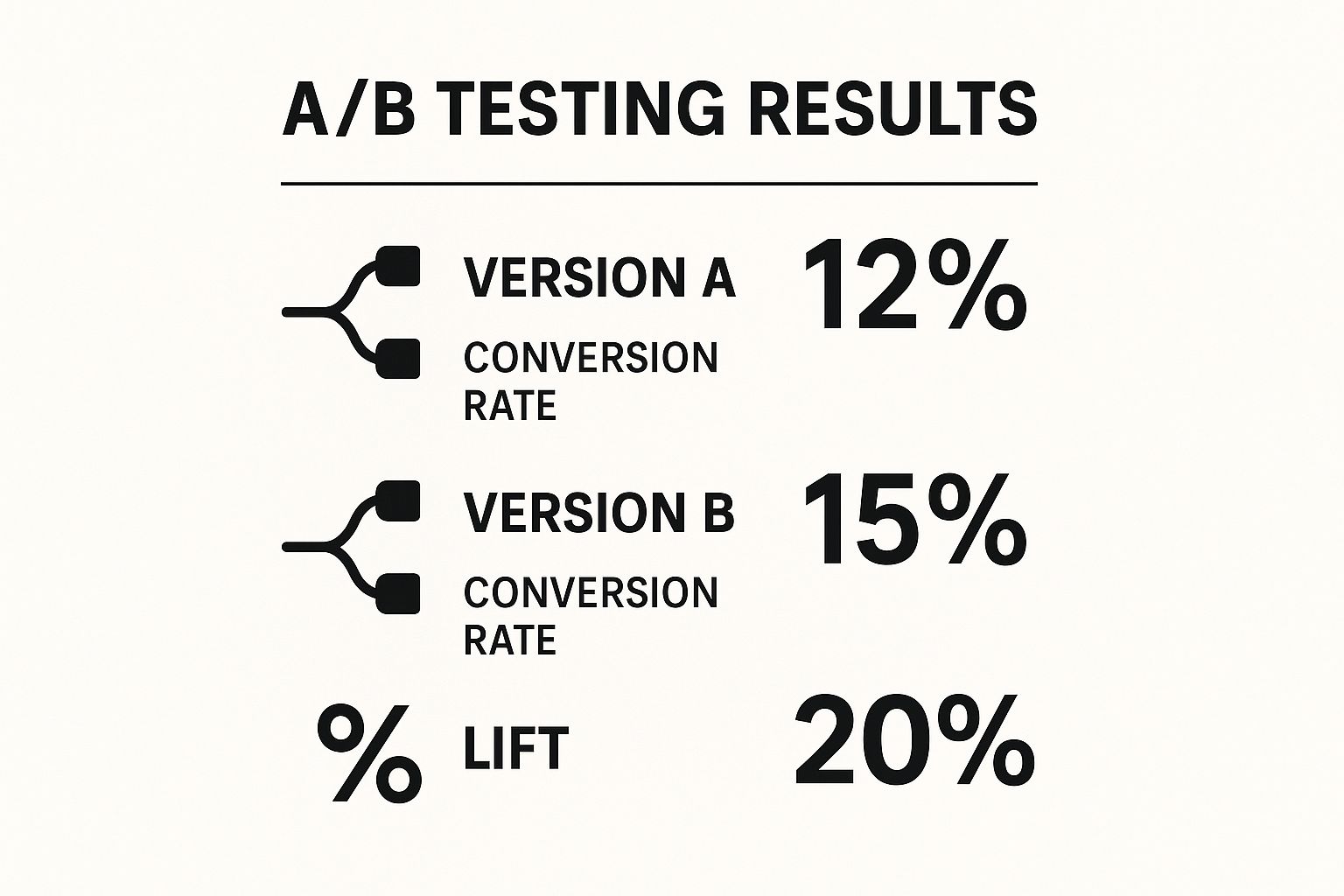
As shown, a seemingly small change can lead to a significant 20% lift in conversions, directly impacting your bottom line.
2. Lead Magnet Optimization
A powerful lead magnet is the gateway to your sales funnel, offering a high-value resource in exchange for a prospect's contact information. Lead magnet optimization involves strategically creating and refining these assets, such as ebooks, webinars, or templates, to attract your ideal customer. The goal is to maximize conversions at the top of the funnel by offering an irresistible solution to a specific problem.

This tactic is crucial for populating your pipeline with qualified prospects. For instance, HubSpot's extensive library of marketing templates generates tens of thousands of leads monthly by providing immediate, practical value. Similarly, Neil Patel’s SEO analyzer tool effectively captures high-intent leads by offering instant analysis. These examples prove that a well-optimized lead magnet is a cornerstone of effective sales funnel optimization strategies.
Implementing Lead Magnet Optimization
To ensure your lead magnet converts effectively, focus on both the offer and its presentation. It must be highly relevant and easy to access.
- Align with Buyer Personas: Your lead magnet must directly address a key pain point for your target audience.
- Use Compelling Headlines: Focus on the tangible benefits the user will receive, not just the features of the asset.
- Optimize Your Form: Keep your sign-up form brief, asking only for essential information to reduce friction. You can learn more about optimizing your lead capture form on distro.so.
- Create Urgency: Frame the offer with time-sensitive language or by highlighting its exclusivity to encourage immediate action.
3. Email Sequence Automation
A powerful engine for nurturing leads, email sequence automation is a systematic approach that delivers targeted messages to prospects over time. Instead of manual follow-ups, these campaigns are triggered by specific user actions, such as downloading an ebook or requesting a demo. This ensures prospects receive relevant, timely content that guides them through each stage of the buying journey, building trust and maintaining engagement without constant manual effort.
This strategy is one of the most effective sales funnel optimization strategies because it scales personalized communication. For instance, Airbnb's welcome sequence reportedly increased host engagement by 75% by guiding new users through the setup process. Similarly, Shopify’s abandoned cart sequences are famous for recovering an average of 15% of otherwise lost sales, directly converting interest into revenue by addressing a critical drop-off point in the funnel.
Implementing Email Automation Effectively
To deploy successful sequences, focus on delivering value and responding to user behavior. Your goal is to build a relationship, not just push a sale.
- Trigger Immediately: Start your sequence the moment a user opts in. This capitalizes on their peak interest and reinforces their decision.
- Provide Value First: Offer helpful content, tips, or resources in your initial emails before introducing a hard sales pitch.
- Use Behavioral Triggers: Personalize the journey by sending different content based on whether a user clicks a link, visits a pricing page, or watches a webinar.
- Test Sequence Cadence: Experiment with the length and frequency of your emails to find the optimal rhythm that keeps subscribers engaged without causing fatigue.
To dive deeper into setting up these campaigns, you can explore more about autopilot email marketing and its various applications.
4. Landing Page Conversion Optimization
A critical component of any effective sales funnel is the landing page, the dedicated page a visitor arrives at after clicking an ad or a link. Landing page conversion optimization is the systematic process of enhancing every element of this page, from headlines and images to forms and calls-to-action, to maximize the percentage of visitors who complete the desired action. It's about reducing friction and making it as easy as possible for a potential lead to convert.
This focused approach is one of the most impactful sales funnel optimization strategies because it directly targets the moment of conversion. For instance, Unbounce reports that its customers often achieve significant conversion rate improvements by fine-tuning their pages. Similarly, Basecamp’s famously simple, benefit-driven landing page design is a masterclass in reducing distraction to boost conversions. By applying a rigorous optimization framework, you can turn more visitors into qualified leads.

Implementing Landing Page Optimization Effectively
To transform your landing pages into high-performance assets, focus on creating a seamless and persuasive user experience. Start with the most crucial elements that influence a visitor's decision-making process.
- Keep Forms Short: Only ask for essential information. Each additional field you add increases friction and can cause a potential lead to abandon the form.
- Match Ad Copy to Headlines: Ensure a consistent message from the ad to the landing page headline. This reassures visitors they are in the right place, reducing bounce rates.
- Include Social Proof: Add testimonials, case studies, or logos of well-known clients to build trust and credibility with your audience.
- Prioritize Page Speed: A slow-loading page is a major conversion killer. Ensure your page loads quickly across all devices, especially mobile.
By following a structured approach, you can systematically improve your page performance. For a comprehensive guide, check out this conversion optimization checklist.
5. Retargeting and Remarketing Campaigns
One of the most powerful sales funnel optimization strategies is reaching users who have shown interest but haven't converted. Retargeting and remarketing campaigns are designed to do just that. They use tracking pixels and cookies to serve personalized ads to previous website visitors across different platforms, effectively re-engaging warm leads and guiding them back into your funnel. This method keeps your brand top-of-mind and provides a second chance to convert prospects who may have been distracted.
The impact of this strategy is significant. For instance, Amazon attributes a large portion of its advertising success to sophisticated product retargeting, while Facebook retargeting campaigns are known to generate click-through rates up to three times higher than standard display ads. These campaigns work because they target an audience that has already demonstrated intent, making them far more receptive to your messaging and offers.
Implementing Retargeting Effectively
To maximize your return on investment, your campaigns must be strategic and user-focused. Avoid generic ads and instead deliver personalized experiences.
- Segment Audiences: Group users based on their on-site behavior, such as pages visited or cart abandonment. This allows you to tailor ad creative and offers to their specific interests.
- Use Dynamic Ads: Automatically show prospects the exact products or services they previously viewed. This hyper-personalized approach is highly effective for e-commerce and B2B services.
- Set Frequency Caps: Prevent ad fatigue by limiting the number of times a single user sees your ad within a given period.
- Create Compelling Offers: Lure visitors back with exclusive discounts, free shipping, or a valuable content download to overcome their initial hesitation.
6. Social Proof Integration
A powerful psychological driver, social proof integration involves strategically placing evidence that others trust and value your product to build credibility. This includes customer testimonials, reviews, case studies, user counts, and expert endorsements. The core principle, popularized by Robert Cialdini, is that people conform to the actions of others in ambiguous situations, making it a critical component of modern sales funnel optimization strategies.
This method directly addresses a buyer’s hesitation by replacing uncertainty with confidence. For example, Booking.com uses real-time notifications like "other people are viewing this" to create urgency and increase bookings. Similarly, Basecamp found that their customer story page converted 40% higher than their product-focused pages, demonstrating that authentic user experiences are often more persuasive than feature lists. Strategically placing this validation at key decision points can significantly reduce friction and boost conversions.

Implementing Social Proof Effectively
To maximize impact, social proof must be relevant, specific, and placed where it can overcome objections.
- Be Specific and Quantifiable: Instead of a generic "great service," use testimonials with specific numbers like "increased our lead conversion by 30% in Q1."
- Match Proof to Audience Segments: Display case studies from a similar industry or role to the visitor to enhance relevance and relatability.
- Place Proof Near Conversion Points: Add a strong testimonial or user count directly beside a "Request a Demo" button or pricing plan to reinforce the decision.
- Use Visuals for Credibility: Include headshots, names, and company logos with testimonials to make them appear more authentic and trustworthy.
7. Progressive Profiling and Segmentation
A powerful sales funnel optimization strategy involves gradually gathering prospect information over multiple interactions instead of demanding it all at once. This method, known as progressive profiling, reduces initial form friction, encouraging more top-of-funnel sign-ups. As leads engage further, you can ask for more details, building a rich customer profile over time that enables hyper-targeted segmentation.
This approach respects the user's journey, asking for information only when it becomes relevant. For instance, HubSpot famously used its own progressive profiling tools to increase form submissions by 120% by breaking down information requests. Similarly, Marketo customers often report a 40% lift in engagement when using segmented campaigns powered by progressively collected data. This strategy transforms a generic funnel into a series of personalized, value-driven experiences.
Implementing Progressive Profiling Effectively
To leverage this strategy, integrate smart forms that adapt to what you already know about a contact. Focus on collecting data that directly informs your segmentation and nurturing efforts.
- Start with Minimal Information: Initially, ask only for the essentials, like a name and email address, to maximize initial conversions.
- Use Smart Forms: Implement forms that recognize returning visitors and hide fields they have already completed, asking for new information instead.
- Segment Based on Behavior: Group leads based on their engagement level, content downloads, and on-site behavior to deliver highly relevant follow-up content.
- Provide Value at Each Step: Ensure that every request for information is accompanied by a valuable offer, such as an ebook, webinar, or exclusive guide.
8. Conversion Rate Optimization (CRO) Through Analytics
A critical component of any sales funnel optimization strategy is Conversion Rate Optimization (CRO) powered by deep analytics. This data-driven approach involves analyzing user behavior to identify friction points and bottlenecks within your funnel. By using tools like heatmaps, session recordings, and funnel analytics, you can move beyond guesswork and understand precisely where and why potential customers are dropping off.
This methodology provides the quantitative and qualitative insights needed to make impactful changes. For instance, Hotjar's heatmap analysis helped VWO discover that users were confused by their pricing page layout, and a subsequent redesign led to a 55% increase in conversions. Similarly, Crazy Egg’s analysis was instrumental in optimizing Barack Obama's 2012 campaign donation page, resulting in a 49% uplift in conversions. This proves that understanding user interaction is key to unlocking significant growth.
Implementing Analytics-Driven CRO
To begin, prioritize your efforts on pages with the highest impact potential, such as those with high traffic but significant drop-off rates.
- Combine Quantitative and Qualitative Data: Use funnel analytics to see where users drop off, then watch session recordings of those pages to understand why.
- Establish Clear Goal Tracking: Ensure your analytics platform has properly configured goals and attribution models to accurately measure the impact of your changes.
- Maintain a Regular Cadence: Schedule regular analysis and reporting to continuously monitor performance and identify new optimization opportunities.
For more specific advice on boosting conversions, explore these actionable conversion rate optimization tips to further enhance your strategies.
9. Multi-Channel Funnel Integration
Modern customer journeys are rarely linear; they span multiple touchpoints across various channels. One of the most powerful sales funnel optimization strategies is to integrate these channels into a cohesive experience. Multi-channel funnel integration ensures that your messaging, branding, and user experience remain consistent whether a prospect interacts with an ad on social media, an email newsletter, or your website. This approach creates a seamless journey that guides users smoothly from one stage to the next.
This strategy moves beyond siloed channel performance to a holistic view of the customer journey. For example, Sephora's omnichannel approach, which integrates its mobile app, Beauty Insider program, and in-store experience, found that customers engaging across multiple channels spend significantly more. Similarly, Disney's MagicBand seamlessly connects the digital and physical park experience, from hotel room access to food purchases, creating a frictionless environment that encourages higher spending.
Implementing Multi-Channel Integration Effectively
To build a successful multi-channel funnel, focus on creating a unified customer view and consistent brand messaging. This ensures a seamless transition for leads as they move between platforms.
- Maintain Consistent Branding: Ensure your brand voice, messaging, and visual identity are uniform across all channels, from social media profiles to email campaigns.
- Use a Customer Data Platform (CDP): A CDP like Segment or Tealium can unify customer data from various sources, providing a single, comprehensive view of each prospect’s interactions.
- Create Channel-Specific Content: While maintaining overall strategic consistency, tailor content to the specific format and audience expectations of each platform.
- Analyze Cross-Channel Performance: Use analytics to understand how different channels work together to influence conversions, attributing value beyond the final click.
10. Exit-Intent and Abandonment Recovery
A critical sales funnel optimization strategy involves capturing leads who are about to leave your website or abandon a purchase. Exit-intent technology tracks user mouse movements, triggering a last-chance offer or message just as they navigate to close the tab. This intervention can be the difference between losing a prospect forever and capturing a valuable lead, making it a powerful tool for plugging leaks in your funnel.
These recovery tactics are highly effective because they engage a user at a pivotal moment of indecision. For instance, OptinMonster helped DigitalMarketer recover an additional 786 subscribers per month using exit-intent popups. Similarly, Klaviyo's automated cart abandonment email sequences are known to recover an average of 15% of lost e-commerce sales, directly converting would-be lost revenue into successful purchases. These examples prove the immense ROI of a well-timed recovery strategy.
Implementing Abandonment Recovery Effectively
To maximize the impact of these interventions, focus on providing immediate, compelling value that addresses the reason for leaving.
- Offer Genuine Value: Instead of a simple discount, consider a free resource, a consultation, or an exclusive guide that reinforces your value proposition.
- Time Your Triggers: Set your exit-intent popups to appear after a user shows clear signs of leaving, not so early that it disrupts their browsing experience.
- Test Your Offers: A/B test different headlines, visuals, and calls-to-action in your popups and abandonment emails to identify what resonates most with your audience.
- Use Progressive Sequences: For cart abandonment, create a multi-email sequence. The first can be a simple reminder, while subsequent emails can introduce a time-sensitive offer to create urgency.
Top 10 Sales Funnel Optimization Strategies Comparison
| Strategy | Implementation Complexity 🔄 | Resource Requirements ⚡ | Expected Outcomes 📊 | Ideal Use Cases 💡 | Key Advantages ⭐ |
|---|---|---|---|---|---|
| A/B Testing and Multivariate Testing | Moderate to High | High traffic, setup tools | Improved conversion rates through data-driven decisions | Optimizing landing pages, emails, funnel elements | Measurable ROI, continuous improvement |
| Lead Magnet Optimization | Moderate | Content creation time and effort | Increased qualified lead capture | Building authority and generating leads early in funnel | Cost-effective, builds trust and authority |
| Email Sequence Automation | Moderate to High | Marketing automation tools, planning | Scalable lead nurturing, higher conversions | Nurturing leads via behavior-triggered emails | Consistent follow-up, personalized targeting |
| Landing Page Conversion Optimization | Moderate | Design and development resources | Higher conversion rates, better user experience | Dedicated campaign landing pages | Lower cost per acquisition, enhanced UX |
| Retargeting and Remarketing Campaigns | High | Ad spend, tracking setup | Increased conversion from warm audiences | Re-engaging previous visitors with targeted ads | Cost-effective, higher conversion vs cold traffic |
| Social Proof Integration | Low to Moderate | Testimonial collection and management | Improved trust and conversions across funnel | Increasing credibility and reducing objections | Quick trust-building, cost-effective |
| Progressive Profiling and Segmentation | High | Sophisticated automation tools | Better data quality and personalized experiences | Collecting prospect data gradually to reduce friction | Higher initial conversions, enables advanced targeting |
| CRO Through Analytics | Moderate to High | Analytics tools, expertise | Identifies bottlenecks, measurable revenue impact | Data-driven funnel optimization | Specific problem identification, continuous improvement |
| Multi-Channel Funnel Integration | High | Significant resources and integration | Improved customer experience and lifetime value | Coordinating messaging across multiple channels | Comprehensive attribution, increased conversion touchpoints |
| Exit-Intent and Abandonment Recovery | Moderate | Automation tools, offer creation | Recovers lost sales and reduces abandonment | Capturing prospects about to leave funnel | High ROI, immediate feedback on funnel issues |
Turn Your Funnel Into a Perpetual Growth Engine
We have journeyed through a comprehensive suite of sales funnel optimization strategies, from the granular detail of A/B testing your landing pages to the broad scope of multi-channel integration. Each tactic, whether it's optimizing lead magnets, automating email sequences, or leveraging social proof, represents a critical lever you can pull to enhance performance. The common thread connecting all these methods is a commitment to a proactive, data-driven approach.
Optimizing your sales funnel is not a one-time fix. It’s an ongoing cycle of analysis, hypothesis, implementation, and measurement. The goal is to transform a simple, linear path into a dynamic and intelligent system that anticipates customer needs and systematically removes friction at every touchpoint. By embracing this mindset, you move beyond merely patching leaks; you begin to engineer a predictable and scalable revenue machine.
Key Takeaways for Immediate Action
The core principle to remember is that momentum is everything in sales. A delay of just five minutes in following up with a new lead can decrease the odds of qualifying them by a factor of ten. This is where the theoretical meets the practical. You can have the most persuasive landing page and a perfectly crafted email sequence, but if the handoff from marketing to sales is slow, you are actively sabotaging your own efforts.
Your most important takeaways should be:
- Data is Your Compass: Use analytics to identify the biggest drop-off points in your funnel. Focus your initial optimization efforts where they will have the most significant impact.
- Automation is Your Accelerator: Leverage technology to automate repetitive tasks like email nurturing and lead routing. This frees up your sales team to focus on high-value conversations.
- Speed is Your Differentiator: The transition from a prospect showing high intent (like filling out a demo request form) to speaking with a sales rep must be instantaneous. This single point of failure can undermine all other funnel optimizations.
From Optimization to Perpetual Growth
Ultimately, mastering these sales funnel optimization strategies is about building a powerful, self-sustaining growth engine. It’s about creating a customer journey so seamless and responsive that prospects feel understood and valued from their very first interaction. When you combine CRO tactics, retargeting, and intelligent segmentation with flawless execution at critical conversion points, you create a powerful competitive advantage. The result is not just more leads, but better-qualified opportunities that close faster and drive sustainable business growth.
Ready to eliminate the single biggest bottleneck in your entire sales funnel? Distro instantly routes high-intent leads from your web forms directly to the right salesperson's calendar, turning form-fills into booked meetings in seconds. Stop losing valuable leads to slow follow-up and see how real-time scheduling can transform your conversion rates by visiting Distro today.