Ever heard of "autopilot email marketing"? Let's get past the buzzwords and talk about what it actually is.
It's not about blasting out generic messages to your entire list and hoping something sticks. Think of it less like an email blaster and more like a personal concierge for every single one of your subscribers. It's a smart system designed to deliver the right content to the right person at precisely the right time.
What Is Autopilot Email Marketing, Really?
At its core, autopilot email marketing is a system that sends personalized emails automatically, triggered by specific actions your subscribers take. They sign up for your newsletter, download a guide, or even just visit your pricing page—each action kicks off a tailored response.
Instead of one generic "welcome" email for everyone, you create a thoughtful, automated journey that makes each person feel seen and understood. It’s all about scaling your communication without losing that crucial personal touch that builds real customer loyalty.
The Core Idea: Relevance and Efficiency
The whole point is to nurture relationships automatically and efficiently. You're essentially building pre-planned conversations that trigger based on user behavior.
Some of the most common triggers that can kick off an automated sequence include:
- A new user subscribing to your blog
- A potential customer downloading a whitepaper
- A shopper leaving items in their online cart
- A customer making their first purchase
Each of these moments signals a different level of interest and intent. This allows you to respond with targeted content that nudges them along their journey with your brand. If you want to dive deeper into the fundamentals, this guide on automated email marketing is a fantastic place to start.
The real power of autopilot email marketing is its ability to create consistent, relevant touchpoints that build trust over time. It’s the difference between shouting at a crowd and having a genuine one-on-one conversation.
Manual vs. Autopilot Email Marketing
To really see the difference, it helps to compare this automated approach to the old-school, manual way of sending emails. One is a reactive, labor-intensive chore; the other is a proactive, strategic system.
This table breaks it down:
| Aspect | Manual Email Campaigns | Autopilot Email Marketing |
|---|---|---|
| Trigger | Manual send by a marketer | User action or time-based |
| Targeting | Broad list segments | Hyper-specific, behavioral |
| Timing | Marketer's schedule | Instant and context-aware |
| Scalability | Limited by team resources | Highly scalable and efficient |
Once you grasp these differences, it’s clear why putting your email strategy on autopilot is such a game-changer. It shifts your focus from tedious, repetitive tasks to high-level strategy, letting technology handle the day-to-day engagement.
The True Business Impact of Automated Emails
Shifting to an autopilot email strategy is about so much more than just convenience. It fundamentally changes how your business operates by giving you back your team’s most precious asset—time.
When you automate all those routine communications, your team is finally freed from the hamster wheel of repetitive, manual tasks. That newfound freedom lets them pivot from tedious admin work to high-impact strategic projects. Instead of burning hours sending welcome emails or follow-ups, they can dive deep into campaign performance, dream up new creative angles, and build real relationships with customers.
This is a massive boost to your team's capacity for innovation and growth. To see how this same principle supercharges a sales team, check out our guide on how to improve sales productivity.
From Time Savings to Revenue Growth
All that saved time translates directly to your bottom line. Think about it: automated workflows like welcome series and abandoned cart reminders aren't just saving you hours; they are powerful, round-the-clock revenue generators.
Because they’re triggered by specific things a user does, these emails are incredibly relevant and timely. That’s why they see engagement rates that your standard, one-off campaigns can only dream of. A perfectly timed abandoned cart email can single-handedly recover a sale that was just seconds away from being lost forever. A great welcome series doesn't just say hello—it educates a new subscriber and smoothly guides them toward their first purchase.
Each automated touchpoint builds on the last, creating momentum and speeding up the entire customer journey.
The impact here is staggering. While automated emails make up only about 2% of all emails sent, they drive a massive 41% of all email orders. That stat alone screams efficiency and ROI.
Driving Real Engagement with Personalization
Beyond the direct cash injection, autopilot email marketing is a master at building stronger customer relationships. It does this by delivering personalization at a scale that would be impossible for a human to manage. These systems use behavioral data—what people click on, what they look at, what they buy—to send messages that feel like a one-on-one conversation. This completely changes how subscribers see your brand.
This tailored approach leads to some seriously impressive results. According to recent data, automated emails see open rates leap from 25.2% to 42.1% and click rates climb from 1.5% to 5.4% when compared to traditional bulk emails. The numbers don't lie. When you send the right message at the right moment, your audience doesn't just listen—they act.
This kind of sustained, relevant engagement is what turns passive subscribers into loyal customers and even brand advocates. It's how you build a stable foundation for long-term growth. The takeaway is clear: automation isn't just about sending emails; it's about building a smarter, more profitable business from the ground up.
Alright, let's move from the "why" to the "how." Knowing that autopilot email marketing works is one thing; putting it into action to actually drive revenue is another. This is where we stop talking theory and start building the specific, proven workflows that will become your new best friends—the ones that quietly nurture leads and close sales while you're focused on other things.
Don't think of these as just a bunch of one-off emails. A better way to see them is as automated conversations, guiding people through the most important moments of their journey with your brand. Each workflow has a clear job, a specific trigger that kicks it off, and a sequence designed to build a real relationship and boost customer lifetime value.
The Essential Welcome Series
First impressions are everything. Your welcome series is your one shot to nail it with a new subscriber, making it arguably the most important automation you'll build. This is where you set the tone for the entire relationship. It's your chance to deliver on whatever promise you made at signup and start earning their trust right away.
- Goal: Greet new subscribers, give them immediate value (like a discount or a free guide), and introduce them to your brand's personality and what you're all about.
- Trigger: Someone signs up for your newsletter, blog updates, or creates an account on your site.
- Sample Structure:
- Email 1 (Immediately): Welcome & Deliver the Goods. Send a warm "hello" and instantly give them the discount code or resource you promised. No delays.
- Email 2 (Day 2): Share Your Story & Some Social Proof. Tell them a bit about your brand's mission. Sprinkle in a few customer testimonials or highlight your most popular products to build credibility.
- Email 3 (Day 4): A Gentle Nudge. Encourage them to take the next logical step. Maybe that’s checking out a specific product category, reading your most popular blog post, or connecting on social media.
This simple, three-part sequence is the first crucial step in turning a curious subscriber into a paying customer. It's a foundational piece of the puzzle.
From picking the right features to monitoring the campaign after launch, every successful workflow follows a structured path. This infographic breaks down those core stages.
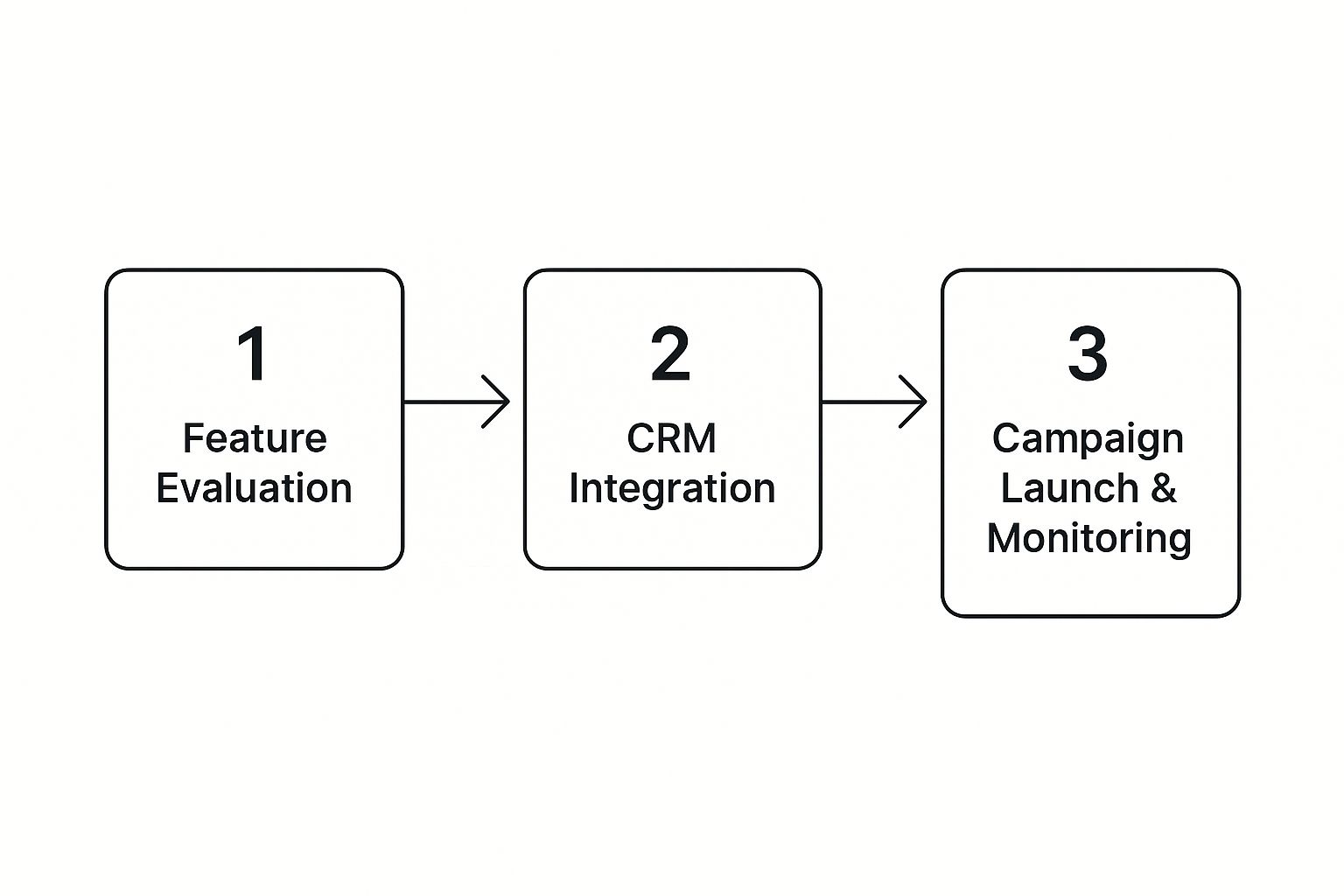
As the visual shows, a great campaign is more than just good copy. It’s a process that relies on solid technical setup and keeping an eye on the data.
The High-Impact Abandoned Cart Sequence
Think of the abandoned cart sequence as your money-making machine. When a shopper adds items to their cart, they're showing massive buying intent. If they leave, something stopped them. This workflow is your direct line to re-engage them at that exact moment of hesitation and gently bring them back to finish what they started.
These aren't just feel-good campaigns; they have a staggering impact on the bottom line.
Automated workflows like abandoned cart and post-purchase follow-ups can pull in up to 30 times more revenue per person than your typical marketing email. For e-commerce businesses, these abandoned cart sequences are the undisputed king, making up 54.2% of all automation workflows for a reason—they work.
The Relationship-Building Post-Purchase Follow-up
The sale is not the end of the conversation. In fact, it's just the beginning. The time right after a purchase is a golden opportunity to turn a one-time buyer into a raving fan. A smart post-purchase workflow solidifies the relationship, quiets any buyer's remorse, and lays the groundwork for repeat business.
Building this kind of thoughtful, automated follow-up is a key part of effective sales process automation. It shows you care about the customer, not just their wallet.
These three workflows—Welcome, Abandoned Cart, and Post-Purchase—are the bedrock of a smart and profitable autopilot email marketing strategy. Get these right, and you’ll create a seamless journey that turns brand-new leads into your most loyal customers.
How AI Is Making Email Automation Smarter
If standard automation is your smart personal concierge, think of AI as giving that concierge a direct line to the future. It’s what transforms autopilot email marketing from a system that just reacts to what customers do into one that actively anticipates what they’ll do next.
This isn't some far-off sci-fi concept. These are practical tools you can use today to make your existing automation sharper and more effective. AI works behind the scenes, sifting through patterns and data points at a scale no human team could ever dream of managing.
What you get is a more intelligent, responsive, and ultimately more profitable email strategy. Instead of just following a rigid, pre-set path, AI-powered automation learns and adapts on the fly. It helps you send the perfect message at the perfect moment, creating a customer experience that feels almost psychic.
Predictive Personalization and Send-Time Tuning
One of the coolest applications of AI is predictive personalization. Traditional automation personalizes based on past actions, like when someone downloads an ebook. AI, on the other hand, looks at a customer’s entire digital footprint to predict what they'll need in the future.
This means AI can suggest products a customer is likely to buy next or send them content that lines up with their budding interests—even before they've typed it into a search bar. It's the difference between sending a follow-up about a product page they already visited and sending an email about a complementary product they haven't even seen yet.
On top of that, AI is a master at send-time optimization. It analyzes individual open habits to make sure your email lands in their inbox at the exact time they are most likely to open it.
"AI doesn't just automate tasks; it elevates them. It takes the solid foundation of autopilot workflows and layers on a level of intelligence that can dynamically adjust to each subscriber, maximizing the impact of every single email sent."
AI-Powered Content and Performance
AI is also a game-changer for the content creation process itself. You can find AI tools that will generate compelling subject lines, draft persuasive email copy, and even A/B test different versions of a message automatically to find the winner.
The results speak for themselves. By 2025, an incredible seven out of ten marketers in the US will be using generative AI tools, and 34% are already using them specifically to write email copy. This shift has led to a 13% jump in click-through rates and a massive 41% increase in revenue compared to old-school methods. You can dive deeper into these numbers and discover additional insights into email marketing statistics on Omnisend.com.
With this kind of power, you can do much more than just send emails. You can:
- Generate Multiple Variants: Quickly whip up different subject lines and body copy to test what really clicks with your audience.
- Ensure Brand Voice Consistency: Train an AI on your brand’s tone to keep your voice consistent across all automated messages.
- Optimize for Conversion: Let AI automatically pinpoint the best-performing email in a sequence and send it to the rest of your list, boosting your overall results.
By bringing AI into the mix, your autopilot email marketing system evolves from a static set of rules into a dynamic, learning machine that’s constantly working to improve your outcomes.
Alright, let's get into the nitty-gritty. Moving from theory to action can feel like a big leap, but building your first automated workflow is a lot less intimidating than it sounds.
Think of it like putting together a piece of IKEA furniture. You get a box of parts and a clear set of instructions—you just need to follow the steps in the right order.
We'll walk through a classic, highly effective example: the Lead Magnet Nurture Sequence. This is the workflow that kicks in right after someone downloads a freebie from your site, like a guide or a checklist. The goal is to automatically engage them while their interest is at its peak. Let’s break down how it’s done.
Step 1: Define Your Goal and Trigger
Every great workflow starts with a clear "why." For our Lead Magnet Nurture Sequence, the goal is simple: build trust with a brand-new lead and gently guide them toward understanding what your business actually does.
The trigger is the specific action that sets everything in motion. In this case, it’s when a user successfully submits a form to download your lead magnet. The second they click that "download" button, they're officially in your workflow.
Step 2: Map the Email Journey
Before you even think about writing, you need a roadmap. Sketch out the path you want your new lead to take. This doesn't need to be some complex, color-coded flowchart. A simple outline is perfect. Just map out the timing and the point of each email.
Here’s a sample map for our sequence:
- Email 1 (Immediate): Deliver the goods! Send the lead magnet and a warm, genuine welcome.
- Email 2 (2 days later): Follow up with more value. Offer something extra that’s related to the lead magnet's topic.
- Email 3 (4 days later): Start connecting the dots. Introduce a common problem your product solves, linking it back to their original interest.
- Email 4 (7 days later): Make the introduction. Present your product or service as the solution, and sprinkle in some social proof to build confidence.
This structure creates a natural progression. It carefully moves the subscriber from casual interest to product awareness without coming on too strong.
Step 3: Write Compelling Email Content
Now it’s time to start writing. Just because it's automated doesn't mean it should sound like a robot wrote it. Each email needs to feel personal, offer real value, and have a single, clear call-to-action (CTA).
- Email 1 Content: Keep this one short and sweet. Welcome them, give them the download link, and maybe hint at what’s coming next.
- Email 2 Content: This is where you establish your expertise. Share a related blog post, a quick tip, or a video that expands on the topic they’re already interested in.
- Email 3 Content: Time to pivot toward their pain points. Use a bit of storytelling to describe a challenge your audience faces—a challenge your product just so happens to solve.
- Email 4 Content: Now you can make your offer. Clearly explain how your solution works and back it up with a customer testimonial or a short case study to show you’re legit.
Pro Tip: Your subject lines have to be engaging, and your CTAs need to be dead simple. Each email should guide the reader to do one specific thing, whether that’s "Read the article," "Watch the video," or "See how it works."
Step 4: Set Up the Automation
With your map and content ready, it’s time to actually build the workflow in your email marketing tool. Most platforms today use a visual, drag-and-drop editor that makes this part surprisingly easy. You'll just set your trigger, then add each email with the time delay you decided on earlier.
If you're getting your hands dirty with this for the first time, a detailed guide on how to automatically send email can be a lifesaver for navigating the technical side of things.
Step 5: Test Your Sequence
This is the step everyone wants to skip, but don't. Never, ever launch a workflow without testing it.
Sign up for your own lead magnet using a test email. Go through the entire sequence yourself. Look for typos, broken links, weird formatting, or awkward timing between emails. This final quality check is what ensures your new leads have a smooth, professional experience right from the very first touchpoint.
Best Practices for Long-Term Autopilot Success

It feels great to get your first few workflows live, but real success with autopilot email marketing isn't a "set it and forget it" game. You can’t just walk away. Think of it more like tending a garden; it needs consistent care to keep producing results.
To keep your automated messages from getting stale or, worse, totally ineffective, you have to commit to a few core principles. These practices are what turn a basic setup into a powerful engine for engagement and revenue that works for you over the long haul.
The best strategies are all about continuous improvement and adaptation. This just means you need to regularly check in on your automated systems to make sure they still line up with your current business goals and sales approach. If you need a refresher on solid frameworks, reviewing the best sales methodologies can give you some great context for your campaigns.
Smart Segmentation and Advanced Personalization
Your audience is not a monolith. You’ve got to move beyond basic list segmentation and start grouping subscribers based on specific behaviors, what they've bought in the past, and how much they interact with your emails. This is how you create hyper-relevant workflows that speak directly to what they actually care about.
Personalization also needs to be more than just plugging in a {{first_name}}. Use the data you have to tailor the content itself, the product recommendations you make, and the offers you send based on what you know about each segment.
Remember, the point of automation isn’t just to send emails—it’s to deliver a personalized experience at scale. Relevance is what keeps people engaged and stops them from smashing the unsubscribe button.
Continuous Testing and Optimization
You should always be testing. Seriously. Even tiny tweaks to your automated emails can lead to huge wins in performance.
- A/B Test Subject Lines: Are questions better? What about curiosity-driven phrases or benefit-focused headlines? Keep testing to see what actually gets people to open your emails.
- Refine Email Content: Play around with your calls-to-action (CTAs), your images, and the overall tone of your copy. The goal is to get more clicks.
- Monitor Analytics: Keep a close watch on your key metrics. If you see a big drop-off at a specific email in a workflow, that’s your cue to dig in and figure out how to fix it.
Finally, keeping your list clean is non-negotiable. If you want your automated emails to actually land in inboxes, it's vital to Master Email Hygiene Best Practices for Better Delivery. Regularly scrubbing your list protects your sender reputation and keeps your deliverability sky-high.
A Few Lingering Questions About Autopilot Email Marketing
As you start thinking about putting your email strategy on autopilot, a few common questions usually pop up. Let's clear the air on those so you can move forward with confidence.
What’s The Difference Between Automation and Autopilot?
It's easy to see why these two get mixed up, and honestly, a lot of people use them interchangeably. The way I like to think about it is that "automation" refers to the individual tasks you set up, like sending a single welcome email when someone signs up.
Autopilot email marketing, on the other hand, is the whole system. It's the grand strategy that connects all those separate automated workflows into one smooth, intelligent customer journey. Automation is the trees; autopilot is the entire forest.
Is This Only for Big Companies?
Not a chance. While it's true that huge enterprises have some seriously complex systems, the core ideas of autopilot marketing scale down beautifully. Modern email platforms have made it incredibly simple for small and mid-sized businesses to launch the most important workflows, like a welcome series or abandoned cart reminders.
You can absolutely start small. Pick one or two automations that will have the biggest impact and build out from there as your business grows.
Just remember, the goal isn't to build something complicated just for the sake of it. The real win is creating timely, relevant touchpoints that actually get results. That’s a strategy that works for any business, no matter the size.
Ready to stop leads from slipping through the cracks? See how Distro automatically routes high-intent prospects to the right sales rep’s calendar, converting demo requests into booked meetings instantly. Learn more at Distro.so.