In today's competitive market, attracting potential customers is only half the battle. The real challenge lies in turning that initial interest into tangible revenue. Many businesses unknowingly struggle with a 'leaky funnel,' where promising leads and high-value prospects drop off before ever making a purchase. This directly impacts your bottom line, stagnates growth, and wastes valuable marketing spend. The key to plugging these leaks and maximizing revenue is focusing on one critical metric: conversion rates sales.
Improving this single metric means you're not just getting more traffic; you're getting significantly more value from the traffic you already have. A higher conversion rate is the most efficient path to sustainable growth. For an in-depth look at preventing these issues, explore comprehensive proven sales funnel optimization strategies.
This article cuts straight to the point, breaking down eight powerful, data-backed strategies to help you optimize your sales process, engage prospects more effectively, and achieve a meaningful boost in your sales conversions. We'll explore everything from implementing A/B testing and leveraging social proof to advanced landing page and value proposition optimizations, providing actionable steps to turn more of your qualified leads into closed deals.
1. A/B Testing
A/B testing, often called split testing, is a methodical approach to compare two versions of a single marketing asset to see which one performs better. It is a cornerstone for optimizing conversion rates sales because it replaces guesswork with hard data. The process is straightforward: you divide your audience and show version A (the control) to one half and version B (the variation) to the other. By measuring which version drives more desired actions, like clicks or sign-ups, you can make data-backed decisions that incrementally improve performance.
This technique is essential when you want to optimize specific elements of your sales funnel. From the color of a "Request a Demo" button to the headline on a landing page, small changes can yield significant results. For example, HubSpot famously increased conversions by 24% simply by changing a call-to-action (CTA) button from green to red. Similarly, Basecamp saw a 30% jump in sign-ups after simplifying their headline to be more direct and benefit-driven.
How to Implement A/B Testing Effectively
To get reliable results, your testing process must be structured. Random changes without a clear hypothesis will lead to confusing data. Instead, follow a disciplined approach to ensure your findings are both accurate and actionable.
- Isolate Variables: Test only one element at a time. If you change the headline and the CTA button simultaneously, you won't know which change was responsible for the lift in conversions.
- Ensure Statistical Significance: Use a sample size large enough to produce meaningful results. A test with only 100 visitors is unlikely to be reliable. Tools like Optimizely have built-in calculators to help determine this.
- Run for a Full Business Cycle: Let your test run long enough to account for weekly fluctuations in traffic and user behavior. A one-week minimum is a good starting point.
- Document Everything: Keep a detailed log of every test you run, including your hypothesis, the variation, the results, and your conclusion. This creates a valuable knowledge base for future optimization efforts.
The following infographic highlights crucial metrics to keep in mind when planning your A/B testing strategy.
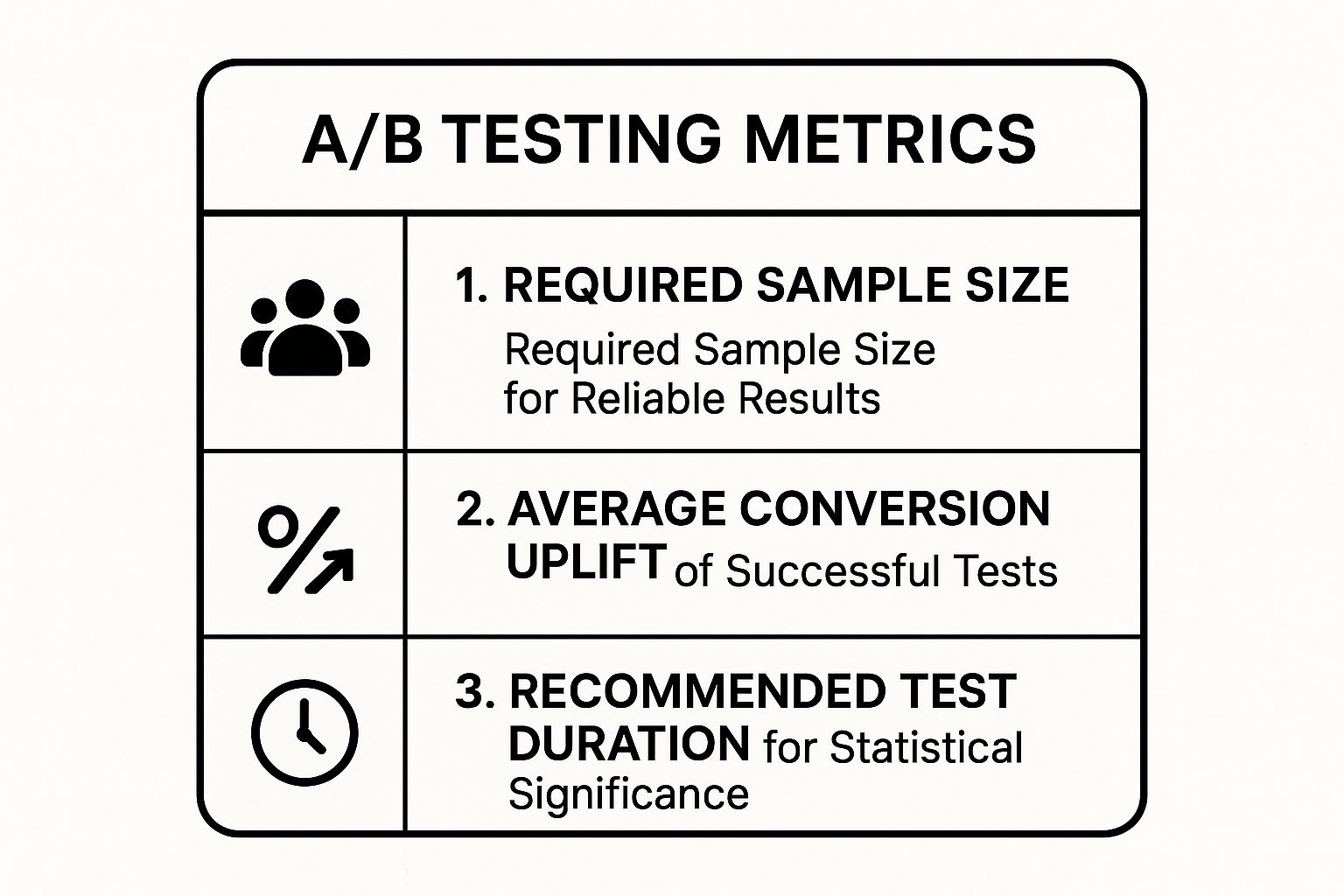
As the data shows, achieving a meaningful outcome requires a substantial sample size and patience, but the potential for significant conversion uplift makes it a worthwhile investment.
2. Social Proof Integration
Social proof is the psychological concept that people will conform to the actions of others because they assume those actions reflect the correct behavior. In marketing, it's a powerful tool for improving conversion rates sales by demonstrating that other people have purchased and found value in your product. It builds trust and credibility, easing the minds of potential customers who are on the fence about making a purchase decision.
This principle works by leveraging the "wisdom of the crowds" to validate a product or service. When prospects see evidence of happy customers, positive reviews, or notable clients, it reduces their perceived risk. For instance, Booking.com creates urgency and confidence by showing how many people are currently viewing a specific hotel. Similarly, Amazon's extensive customer review system has become a core part of its sales process, allowing buyers to make informed decisions based on the experiences of others.

How to Implement Social Proof Integration Effectively
To leverage social proof, you must strategically integrate it across your marketing touchpoints. Simply having testimonials isn't enough; they need to be visible, credible, and relevant to your target audience. A structured approach ensures you build maximum trust.
- Display Testimonials Prominently: Place customer quotes, case studies, and video testimonials on key conversion pages, such as your homepage, pricing pages, and landing pages.
- Showcase Client Logos: If you serve B2B clients, displaying the logos of well-known companies you've worked with acts as a powerful, instant endorsement of your credibility.
- Use Specific Numbers: Instead of vague claims like "our customers love us," use concrete data like "Trusted by over 10,000 teams worldwide." Specificity is more believable and impactful.
- Implement Real-Time Notifications: Use widgets that show recent purchases or sign-ups in real-time. This creates a sense of a busy, trusted store and can trigger a fear of missing out (FOMO).
3. Scarcity and Urgency Marketing
Scarcity and urgency marketing are powerful psychological tactics that motivate immediate action by creating a fear of missing out (FOMO). This strategy leverages the principle that people place a higher value on things they perceive as limited in availability or time. By introducing these elements, you can significantly boost conversion rates sales by compelling prospects to make a decision quickly instead of delaying or abandoning a potential purchase.

This approach is highly effective because it shortens the consideration phase of the buyer's journey. For instance, Booking.com masterfully uses scarcity by displaying messages like "Only 2 rooms left at this price," while Amazon’s Lightning Deals use countdown timers to create a powerful sense of urgency. Similarly, limited-time offers or exclusive access to a product for the first 100 sign-ups can turn hesitant leads into decisive customers by making the cost of inaction seem greater than the cost of acting now.
How to Implement Scarcity and Urgency Effectively
To leverage these tactics without alienating your audience, your claims must be genuine and your strategy well-planned. Misleading customers with false scarcity can permanently damage trust. Instead, integrate these principles ethically to enhance your value proposition.
- Be Authentic: Ensure scarcity claims are real. If you claim only five spots are left for a webinar, that must be the truth. Authenticity builds long-term customer loyalty.
- Use Visual Cues: Implement countdown timers for time-sensitive offers or display real-time inventory levels when stock is genuinely low. Visuals make the urgency more tangible.
- Combine with Value: Scarcity works best when paired with a strong offer. A limited-time discount on a high-demand product is more compelling than scarcity alone.
- Deploy Strategically: Avoid making every offer urgent. Overuse can lead to "urgency fatigue," where customers become desensitized to your messaging. For a deeper dive into these methods, explore our guide on how to create urgency in sales.
4. Conversion Rate Optimization (CRO) Auditing
A Conversion Rate Optimization (CRO) audit is a systematic and in-depth analysis of your website and sales funnel designed to uncover barriers preventing visitors from converting. Instead of making isolated changes, this process examines the entire user journey to identify friction points. It's a foundational step for anyone serious about improving conversion rates sales, as it provides a data-driven roadmap for optimization efforts.
The goal is to move from guessing what might work to knowing what to fix. For example, a CRO audit might reveal that a complex checkout process is causing high cart abandonment rates. By analyzing user session recordings from tools like HotJar, a company could see exactly where users get stuck and simplify the process. Similarly, using heatmaps from Crazy Egg might show that a critical call-to-action is being completely ignored because of its placement, leading to a simple but high-impact design change.
How to Conduct a CRO Audit
A successful audit combines quantitative data with qualitative insights to build a complete picture of user behavior. This holistic view ensures you are addressing the root causes of poor conversion, not just the symptoms. For an even deeper understanding, you can explore more about improving conversion rates in sales.
- Start with Analytics: Dive into your Google Analytics to identify the biggest drop-off points in your conversion funnel. Where are you losing the most potential customers?
- Analyze User Behavior: Use heatmaps and session recordings to visualize how users interact with your pages. Understand what they click, how far they scroll, and where their journey ends.
- Evaluate Key Pages: Scrutinize your high-traffic and high-exit pages. Check for unclear value propositions, weak trust signals (like testimonials or security badges), and confusing navigation.
- Assess Technical Performance: Poor page load speed is a known conversion killer. Test your site's performance, especially on mobile, and address any technical glitches or bugs that hinder the user experience.
5. Email Marketing Automation and Nurturing
Email marketing automation is a strategic method of sending systematic, trigger-based email sequences to nurture leads through the sales funnel. It moves beyond generic email blasts by using behavioral triggers and segmentation to deliver personalized content at the right moment. This approach is fundamental for improving conversion rates sales because it builds trust and maintains engagement over time, guiding prospects toward a purchase decision without constant manual intervention.
This technique is crucial for managing leads at scale and ensuring no potential customer falls through the cracks. It allows you to deliver relevant information based on a user's actions, such as downloading a whitepaper or visiting a pricing page. For instance, welcome series from companies like Airbnb introduce new users to key features, while abandoned cart emails from e-commerce sites like ASOS use reminders and incentives to recover lost sales. Similarly, educational drip campaigns from HubSpot provide ongoing value, positioning them as an industry authority and keeping their brand top-of-mind.
How to Implement Email Marketing Automation Effectively
To transform email from a simple communication tool into a powerful conversion engine, your automation strategy must be thoughtful and data-driven. Sending the wrong message at the wrong time can do more harm than good. A disciplined approach ensures your automated campaigns are relevant and impactful.
- Segment Your Audience: Group your contacts based on demographics, behavior, or their stage in the sales funnel. This allows you to send highly targeted and relevant messages.
- Provide Value, Don't Just Sell: Each email should offer something valuable, whether it's an educational resource, a helpful tip, or an exclusive insight. A sales pitch should feel like a natural next step, not an interruption.
- Use Behavioral Triggers: Set up automated workflows that are triggered by specific user actions, like visiting a certain product page or clicking a link in a previous email. This ensures your communication is timely and contextual.
- Create Compelling Subject Lines: Personalize subject lines and make them intriguing to boost open rates. A message that isn't opened has zero chance of converting a lead.
- Include a Clear Call-to-Action (CTA): Every email should have a clear, singular goal. Whether it's to "Book a Demo," "Download the Ebook," or "Shop Now," make the next step obvious and easy for the user to take.
By implementing these tactics, you can create a robust lead nurturing machine that works around the clock. If you want to delve deeper into this topic, you can learn more about automating your email marketing strategy.
6. Landing Page Optimization
Landing page optimization is the continuous process of improving every element on a dedicated webpage to increase the percentage of visitors who complete a desired action. This is a critical component for improving conversion rates sales, as the landing page is often the final step before a visitor becomes a lead or customer. It involves strategically refining headlines, copy, forms, calls-to-action (CTAs), and visuals to create a frictionless and persuasive user experience.
This focused approach is essential because landing pages serve a single purpose, whether it's downloading an ebook, signing up for a trial, or requesting a demo. By removing distractions and aligning every element with that one goal, you can significantly boost performance. For instance, Unbounce, a company built around this concept, regularly achieves conversion rates over 20% on its own pages by relentlessly testing and refining. Similarly, Shopify’s free trial landing pages succeed by presenting a crystal-clear value proposition and a simple, non-intimidating sign-up process.
How to Implement Landing Page Optimization Effectively
Successful optimization goes beyond just changing button colors; it requires a deep understanding of user psychology and a commitment to data-driven improvements. A methodical approach ensures that your changes are impactful and contribute directly to higher conversion rates.
- Align Message Match: Ensure the headline and content on your landing page directly match the ad or link the visitor clicked to get there. This consistency reassures users they are in the right place and reduces bounce rates.
- Simplify Forms: Only ask for the information you absolutely need. HubSpot famously discovered that reducing the number of form fields from four to three could increase submissions. Each additional field creates friction.
- Incorporate Trust Signals: Build credibility by including elements like customer testimonials, security badges (for e-commerce), partner logos, or case study statistics. These signals alleviate user anxiety and build confidence.
- Focus on a Single CTA: Avoid giving visitors too many choices. Your landing page should have one primary goal and one clear, compelling call-to-action that guides the user toward it. Use a contrasting color to make the CTA button stand out.
7. Retargeting and Remarketing Campaigns
Retargeting is a powerful strategy designed to re-engage prospects who have previously interacted with your brand but did not convert. It works by using cookies and pixel tracking to serve targeted advertisements to these individuals as they browse other websites, social media platforms, or search engines. This approach is fundamental to improving conversion rates sales because it keeps your brand top-of-mind and provides a second, third, or even fourth chance to win over a warm lead.
This technique is especially effective for nurturing leads who are still in the consideration phase. By reminding them of your value proposition, you can gently guide them back to your sales funnel. For instance, Amazon's dynamic ads showcasing products you recently viewed or left in your cart are a classic example of effective retargeting. Similarly, B2B companies can use LinkedIn retargeting to show case studies or whitepapers to users who visited their pricing page but didn't book a demo, addressing potential hesitations with relevant content.
How to Implement Retargeting Effectively
A successful retargeting campaign requires more than just showing the same ad to everyone. To avoid ad fatigue and maximize ROI, you need a segmented and thoughtful approach that aligns with the user's journey.
- Segment Your Audience: Group visitors based on their on-site behavior. Someone who bounced from your homepage needs a different message than someone who abandoned a demo request form. Create separate campaigns for each segment.
- Use Sequential Messaging: Guide your audience through a narrative. Your first retargeting ad could address a common pain point, the next could showcase a customer testimonial, and a final one could present a direct call-to-action with an offer.
- Set Frequency Caps: Bombarding a user with ads can be counterproductive and damage your brand's reputation. Limit the number of times an individual sees your ad per day or week to maintain a positive impression.
- Implement Burn Pixels: Stop showing ads to users who have already converted. A burn pixel placed on your post-conversion "thank you" page will remove them from your retargeting list, saving your budget for active prospects.
8. Value Proposition Optimization
Value proposition optimization is the process of crafting and refining the core message that explains why a customer should choose your product over competitors. This message must clearly articulate the unique, measurable value you provide. It’s a critical driver for improving conversion rates sales because it directly answers a prospect's fundamental question: "What's in it for me?" A weak or confusing value proposition leaves potential buyers unsure of your offering’s benefits, leading to high bounce rates and lost opportunities.
This technique is essential for capturing attention and building immediate interest in the first few seconds a visitor lands on your page. For example, Slack’s early message, "Be less busy," resonated by focusing on a universal pain point rather than just listing features like channels or integrations. Similarly, Zoom’s straightforward "Video conferencing that doesn't suck" directly addressed the frustrations users felt with competing platforms, promising a simple, reliable experience that drove massive adoption.
How to Implement Value Proposition Optimization Effectively
A powerful value proposition is not created in a vacuum; it requires a deep understanding of your customer and a structured approach to messaging. To develop a message that truly converts, you must move beyond internal jargon and focus on the customer’s perspective.
- Focus on Outcomes: Don't sell features; sell results. Instead of saying "Our software has AI-powered analytics," say "Make smarter decisions with predictive revenue insights."
- Use Customer Language: Speak in terms your audience understands. Analyze customer reviews, support tickets, and sales calls to identify the exact words they use to describe their problems and desired solutions.
- Be Specific and Quantifiable: Whenever possible, include hard numbers. "Reduce invoicing time by 50%" is far more compelling than "Save time on invoicing."
- Ensure Prominent Placement: Your value proposition should be the first thing visitors see on your homepage, landing pages, and other key entry points. It must be impossible to miss.
- Test and Iterate: Treat your value proposition like any other element of your conversion funnel. Use A/B testing or customer surveys to compare different versions and identify the one that resonates most powerfully with your target audience.
Conversion Rate Strategies Comparison
| Technique | Implementation Complexity 🔄 | Resource Requirements ⚡ | Expected Outcomes 📊 | Ideal Use Cases 💡 | Key Advantages ⭐ |
|---|---|---|---|---|---|
| A/B Testing | Medium - requires setup & traffic | Moderate - analytics & traffic | Reliable conversion uplift measurement | Optimizing specific webpage/email elements | Data-driven, low risk, clear ROI |
| Social Proof Integration | Low - easy content updates | Low - use existing customer inputs | Builds trust, boosts conversions | Increasing credibility and reducing buyer risk | Trust-building, cost-effective, psychology-driven |
| Scarcity and Urgency Marketing | Medium - timing and design needed | Low to Medium - tools for timers | Short-term sales spikes, reduced abandonment | Time-sensitive promotions, inventory clearing | Immediate motivation, boosts urgency |
| CRO Auditing | High - requires expertise & tools | High - analytics, UX, competitor analysis | Identifies barriers and opportunities | Comprehensive site-wide conversion strategy | In-depth insights, prioritizes fixes |
| Email Marketing Automation | High - complex setup & segmentation | Medium - software & content | Nurtures leads, recovers lost sales | Lead nurturing over long sales cycles | Scalable personal communication, high ROI |
| Landing Page Optimization | Medium - ongoing testing required | Medium - design, copywriting | Higher conversion on targeted pages | Focused campaign landing pages | Better UX, targeted messaging, easy to test |
| Retargeting and Remarketing | Medium - pixel setup and segmentation | Medium - ad spend and platforms | Higher conversion from warm audiences | Re-engaging previous visitors | Cost-effective, personalized ads |
| Value Proposition Optimization | Medium - requires research & testing | Low to Medium - messaging & testing | Improved clarity and conversion uplift | Brand messaging across channels | Clear differentiation and emotional connection |
From Strategy to Sales: Activating Your Conversion Plan
Boosting your conversion rates sales is not a one-time fix but a continuous process of strategic refinement and optimization. Throughout this guide, we've explored a collection of powerful, distinct strategies, each designed to systematically dismantle barriers in your sales funnel and create a smoother path from prospect to loyal customer. The journey from a simple lead to a closed deal is paved with crucial micro-conversions, and mastering each stage is essential for sustainable growth.
From the data-driven precision of A/B testing your call-to-action buttons to the psychological power of integrating compelling social proof, every element plays a vital role. You've learned how to create a sense of urgency without being disingenuous, how to conduct thorough CRO audits to find hidden friction points, and how to optimize your core value proposition to resonate instantly with your ideal customer profile. Each of these tactics contributes to a more persuasive, efficient, and user-centric sales process.
Synthesizing Your Strategy for Maximum Impact
The true power of these methods is unlocked when they work in concert. A highly optimized landing page means little if the leads it generates are left waiting. An effective email nurturing sequence loses its impact if it leads to a generic, unoptimized sales page. The overarching theme is clear: reduce friction and act on intent with speed and precision.
This is where the intersection of strategy and technology becomes paramount. The moment a high-intent lead fills out a demo request form is arguably the most critical juncture in the entire sales cycle. Delays at this stage, even for a few minutes, can drastically reduce your chances of a successful conversion. This is why intelligent automation is no longer a luxury but a fundamental component of a high-performing revenue engine.
Your Actionable Next Steps
To transform these insights into tangible results, start with a focused approach. Don't attempt to implement everything at once.
- Select Two Strategies: Choose one "quick win" (like refining your CTA copy) and one larger initiative (like a comprehensive landing page overhaul).
- Establish Baselines: Before you begin, document your current conversion rates. You cannot improve what you do not measure.
- Implement and Test: Roll out your chosen strategies and monitor the data closely. Use the insights to inform your next set of optimizations.
- Automate Critical Touchpoints: Pay special attention to the initial lead response. Automating lead routing and meeting scheduling ensures that no high-intent prospect ever slips through the cracks due to manual delays.
By systematically applying these principles, you move from a reactive sales model to a proactive, data-informed machine. Improving your conversion rates sales is about making a commitment to continuous, incremental improvement. Each test, each tweak, and each optimized process compounds over time, leading to significant and lasting revenue growth.
Ready to eliminate the biggest conversion killer in your funnel? Distro instantly routes leads from your forms to the right sales rep and books a meeting in seconds, ensuring you engage prospects at their peak moment of interest. See how you can increase your conversion rates sales by visiting Distro and turning more inbound leads into qualified meetings.