Understanding Live Lead Transfer Like a Sales Pro
Imagine a potential customer browsing your website, showing all the signs they're ready to buy. Instead of making them fill out a form and wait hours—or even days—for a callback, what if you could connect them to your best available salesperson in a live conversation, right then and there? That’s the power of live lead transfer. Think of it as a digital concierge that identifies peak interest and immediately builds a bridge between a prospect and a sales agent.
This process eliminates the dreaded follow-up delay—a black hole where countless deals go to die. It’s not just about speed; it's about seizing the moment. When a prospect is actively researching a solution, their motivation is at its absolute highest. A live lead transfer system capitalizes on this momentum, turning a warm website visitor into a qualified phone conversation within seconds. To make this work smoothly, it's vital to understand how chatbots can effectively qualify leads, ensuring only the most promising prospects are sent to your sales team. This pre-qualification step is key to keeping your sales reps efficient and focused.
Traditional Lead Handling vs. Live Lead Transfer
To see just how much of a difference this makes, let's compare the old way of handling leads with this modern, real-time approach. The contrast is sharp, highlighting how traditional methods can leave money on the table.
Here's a breakdown of how the two methods stack up and the direct impact on your ability to close deals.
Table: Traditional Lead Handling vs Live Lead Transfer
A comparison showing the key differences between conventional lead management and real-time transfer systems
| Aspect | Traditional Method | Live Transfer Method | Impact on Conversion |
|---|---|---|---|
| Response Time | Hours to days | Seconds to minutes | Drastically increases win rates by engaging leads at peak interest. |
| Lead Quality | Mixed bag (unqualified leads included) | High (pre-qualified and vetted) | Focuses sales time on revenue-generating conversations. |
| Prospect State | Interest has faded or gone cold | Peak buying intent | Captures deals before competitors have a chance to respond. |
| Agent Workflow | Manual lead assignment and chasing | Automated, intelligent real-time routing | Improves team efficiency and morale by eliminating busywork. |
The takeaway is clear: the traditional approach creates delays that kill deals, while the live transfer method is built for immediate action and higher conversions. It’s about working smarter, not just harder.
The High Cost of Inefficiency
Getting leads in the door is a top priority for most companies, but it's an expensive one. Marketers generate an average of 1,877 leads per month, and the average cost per lead is a staggering $198.44. Despite this heavy investment, a surprising 44% of sales representatives admit they are too busy to follow up with every prospect.
This reveals a massive gap where money and opportunity are being wasted. A live lead transfer system is designed specifically to close this gap. It ensures that your most valuable, high-intent leads—the ones you paid good money for—are passed directly to an agent who is ready to convert them on the spot. You can explore more data on the state of lead generation statistics from Exploding Topics to see just how critical this is.
The Technology That Makes Instant Connections Possible
Have you ever wondered how a website visitor becomes a qualified phone conversation in less than a minute? It might feel like magic, but it’s actually a carefully choreographed sequence powered by smart technology. A successful live lead transfer relies on a stack of connected systems working together to identify, qualify, and connect prospects with sales agents almost instantly.
This process turns a simple click into a quick and valuable conversation, showing the smooth path from a digital interaction to a human one.
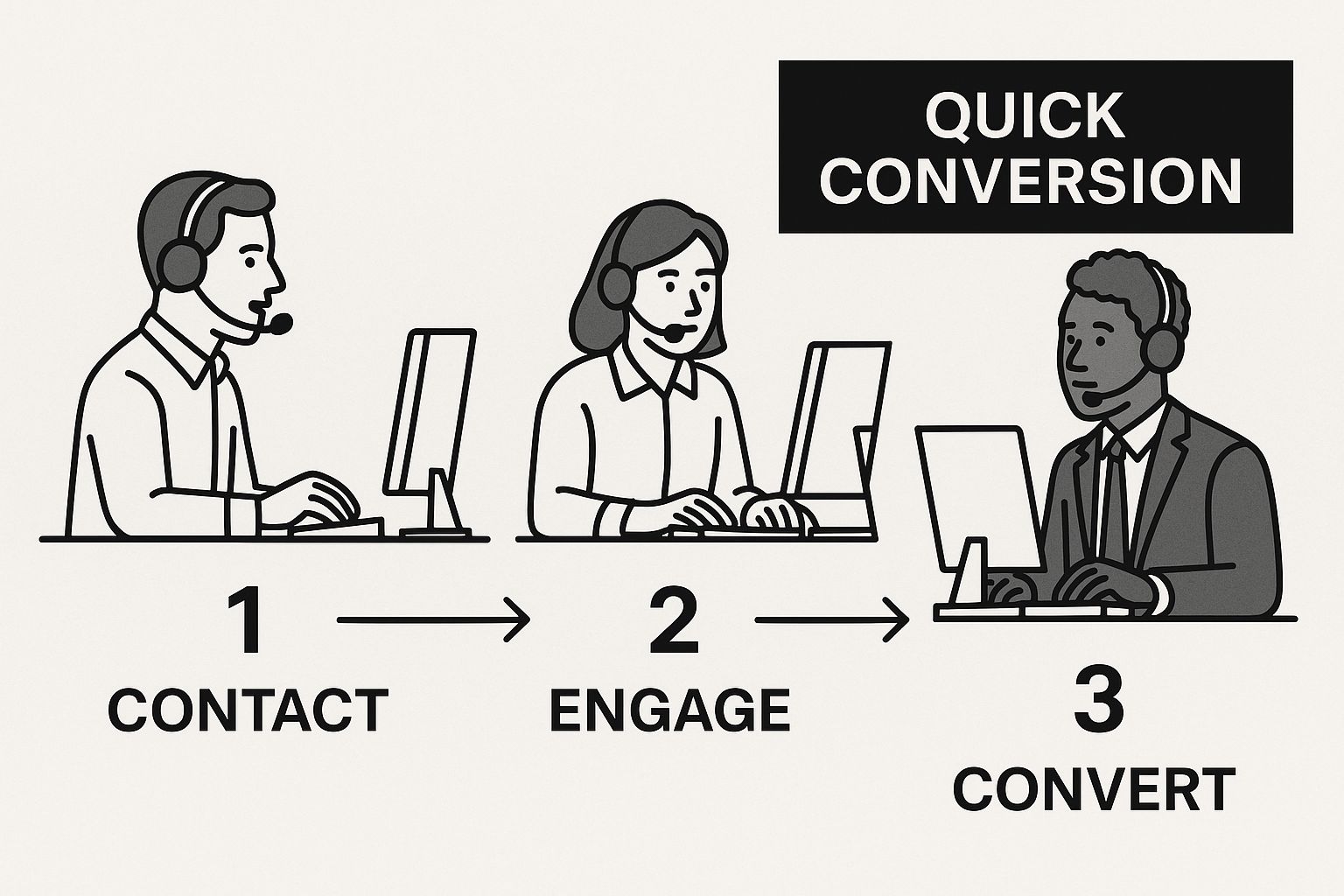
The main goal here is to remove as many friction points as possible. This ensures that a prospect's journey from showing interest to having a conversation is as short and simple as it can be.
Intelligent Routing and Pre-Qualification
The journey starts the moment a prospect lands on your website. Behind the scenes, behavioral tracking and intelligent scoring algorithms are busy gauging a user's intent. Did they look at your pricing page? Did they watch a product demo video? These actions add up, contributing to a lead score.
Once a prospect hits a certain score—or clicks a "Call Me Now" button—the system kicks the transfer process into gear. This is where AI-driven pre-qualification plays a vital role. Instead of just forwarding any call, modern systems use automated questions to confirm genuine interest and collect basic details. This step makes sure your sales reps are talking to motivated buyers, not just window shoppers. The effectiveness of live lead transfer is built on AI tools that can accurately determine when to pass a conversation to a human, ensuring hot prospects reach the right sales professional quickly.
The Connection: From System to Agent
After the pre-qualification step, the system’s routing logic takes charge. This isn't just a simple "first-come, first-served" assignment. Advanced routing rules match the lead with the ideal agent based on several factors:
- Availability: Is the agent free to talk right now?
- Expertise: Does the lead's interest, like enterprise software, match the agent’s specialty?
- Performance: Which agent has the best track record for closing this type of lead?
- Territory: Is the lead located in a specific agent's sales region?
This smart matching greatly increases the odds of a productive conversation. The smooth integration between your website, the routing engine, and your CRM is what determines the success of the entire experience. This efficiency is a major economic driver, with the U.S. digital lead generation market expected to reach $3.2 billion. Studies also show that 66% of marketers who spend about 6 hours a week on lead nurturing see higher-quality leads—a process that live transfers make much more effective. You can dive deeper into these trends on Salesmate's marketing blog.
Industries Where Live Lead Transfer Drives Massive Results
While the idea of instant connection sounds great on paper, live lead transfer isn't a magic bullet for every business. It truly shines and produces the most significant returns in high-stakes industries where a single delay can mean a lost deal. For companies in these competitive fields, it's more than a nice-to-have; it's a fundamental part of their growth engine.
Imagine sectors where potential customers are actively comparing complex options and need expert guidance right now. The first expert voice they hear is often the one that wins their business. This is especially true for financial services and insurance. A person looking for a business loan or an insurance quote needs to solve an immediate, important problem. Their motivation is sky-high, but their patience is razor-thin. A system that connects them directly to a qualified agent or loan officer at that exact moment of need creates a powerful advantage.
Why Speed Is Critical in High-Value Markets
Certain markets are a natural fit for the live lead transfer model because of a few shared traits. Recognizing these factors can help you see if your business is set up to gain from this approach.
- Urgency of Need: Prospects require immediate answers to make a decision, like when they're applying for a mortgage or seeking emergency business funding.
- Complexity of Solutions: The products or services are too detailed for a simple form or chatbot. They demand a conversation with a knowledgeable expert.
- High Transaction Values: The potential revenue from one deal is large enough to justify the investment in a top-tier lead generation and connection process.
- Intense Competition: In markets such as real estate and insurance, dozens of competitors are fighting for the same customer. Speed becomes the main differentiator.
To see how these factors come together, let's look at a few industries where live lead transfers make a measurable impact. The following table shows typical performance metrics, highlighting how immediate response times correlate with higher conversion rates and ROI.
Live Lead Transfer Performance by Industry
Performance metrics showing conversion rates, average deal size, and ROI across different industries using live transfer
| Industry | Conversion Rate | Average Deal Size | Response Time | ROI Improvement |
|---|---|---|---|---|
| Financial Services | 25% - 35% | $50,000+ | < 1 minute | 150% - 200% |
| Insurance | 20% - 30% | $2,500/year | < 2 minutes | 120% - 180% |
| Real Estate | 15% - 25% | $350,000 | < 5 minutes | 100% - 150% |
| Merchant Cash Advance | 30% - 40% | $25,000 | < 1 minute | 200% - 250% |
As the data shows, industries with high-value, urgent transactions see the greatest ROI from live transfers. The incredibly short response times directly contribute to higher conversion rates, proving that in these markets, speed literally translates to revenue.
The Merchant Cash Advance (MCA) sector is a perfect example of this dynamic in action. Live transfers are a premium lead generation method, and they are essential here. The MCA market is expected to grow to $19.73 billion in 2025, marking a 15% increase from the prior year. In this expanding market, connecting a pre-qualified business owner directly with a funder dramatically increases the chance of closing a deal. You can get a more detailed look at the 2025 MCA leads market on MasterMCA.com. This high-speed connection is often supported by solid sales process automation, which ensures no valuable lead is ever left waiting.
Building Your Live Transfer System From The Ground Up
Setting up a successful live lead transfer operation is like building a high-performance race car; every single part needs to work together perfectly. It’s not just about buying a new piece of software. You’re constructing an entire system built to handle your most valuable prospects with speed and accuracy, turning a spark of interest into a real conversation. A key part of this process is understanding how to deploy smart agents by creating new chatbots to handle the initial interaction.
The whole process starts with the tires—your lead capture points. These need to be robust enough to grip the road, separating casual window shoppers from serious buyers ready to talk.
Laying the Foundation: Capture and Qualification
The first step is to design lead capture points that invite high-intent actions. Think of a "Speak to an Expert Now" button on your pricing page or an interactive quiz that provides immediate value. The objective is to engage prospects right when their interest is at its highest.
Once a prospect interacts, the qualification process kicks in. This is where you set up clear rules to filter out leads that aren't a good fit, without accidentally turning away real opportunities.
Your qualification rules should confirm a few key things:
- Does this person fit your ideal customer profile?
- Have they shown enough interest, like viewing specific product pages?
- Are they located in a region you serve?
Picture this stage as a digital bouncer at an exclusive club. It only lets the most qualified, motivated buyers past the velvet rope to meet your sales team. This ensures your agents spend their time on conversations that have a genuine chance of converting.
Designing Your Routing and Failsafe Logic
Once a qualified lead is identified, the next piece of the puzzle is intelligent routing. This is the brain of your operation, directing the prospect to the best available agent. Modern systems go beyond a simple round-robin approach, using rules based on agent expertise, past performance, or assigned territories. For instance, a lead asking about enterprise-level features should be sent straight to a senior account executive, not a junior rep who handles small business accounts.
But what if no one is available to take the call? This is a critical point where many systems break down. A well-built system must have a backup plan, or failsafe logic. If a live connection can’t be made within a short window (like 30-60 seconds), the system should automatically execute a backup plan.
This could mean offering to schedule a call-back at the prospect's preferred time or creating a high-priority task in your CRM for immediate follow-up. This simple step ensures that no lead ever falls through the cracks. Building this kind of resilience into your process is what separates a decent live lead transfer system from a truly great one.
Maximizing Conversions Through Strategic Implementation

Simply turning on live lead transfer software is like buying a top-of-the-line camera; owning the equipment doesn't automatically make you a great photographer. The true value appears when you pair the technology with a strategy that considers every human touchpoint in your prospect's journey. Success depends on mastering the elements that software alone can't address. This means looking beyond the technical setup and focusing on the people and processes that convert a warm connection into a closed deal.
The real gains are found in the details. It begins with solid lead qualification that sends higher-quality calls to your sales team, making sure they aren't spending time on poorly matched prospects. From there, it involves dedicated training that prepares agents for the specific dynamics of a transferred lead. They need the skills to build on the prospect's existing interest, not start over as if it were a cold call.
Optimizing the Human Element
Technology can connect two people, but it can't build instant trust. This is where focused training and smart conversation guides become essential. High-performing companies don't leave these crucial interactions to chance. They create specific strategies that give their agents the tools to turn a simple transfer into a meaningful, revenue-generating conversation.
- Agent Training Programs: Give your team scripts and tactics specifically for warm transfers. Agents should be trained to quickly reference the prospect's initial interaction (e.g., "I see you were just looking at our enterprise plan") to create a smooth and continuous experience.
- Conversation Frameworks: Instead of strict scripts, offer flexible frameworks that guide the discussion. This approach lets agents have a natural dialogue that addresses the prospect’s needs while still covering key qualification and discovery questions.
- Continuous Feedback Loops: Set up a system where agents can give feedback on lead quality directly from their CRM. This information is critical for improving your pre-qualification rules and ensuring the marketing team is attracting the right audience.
From Data to Decisions
The most effective live transfer strategies are built on data. They use real-time analytics not just to celebrate wins, but to spot and resolve bottlenecks before they turn into costly issues. For example, if you see a high drop-off rate when leads are transferred to a particular team, you can investigate right away. Is it a problem with agent availability, or does that team need more training on a specific product?
This cycle of constant improvement turns every conversation into a source of business intelligence. By analyzing call outcomes, you can adjust every part of your process, from the first chatbot questions to the final sales pitch. The objective is to create a self-improving system that consistently boosts the performance of your entire sales team. To learn more about this, see our complete guide to improve your sales conversion rate with actionable tips.
Measuring Success And Avoiding Expensive Mistakes
What separates companies that profit from a live lead transfer system from those who see it as just an expensive tech toy? The answer is simple: measurement. Without the right data, you’re flying blind, unable to tell if you’re building a revenue machine or just wasting money. True success requires a commitment to analyzing the metrics that reveal the health of your system, moving beyond basic conversion rates to understand what actually drives results.
Imagine your lead transfer system is a high-performance engine. A simple conversion rate is like knowing your car is moving—it tells you nothing about fuel efficiency, engine temperature, or if you’re about to break down. You need to look under the hood. This means building reporting dashboards that give you actionable insights, not just vanity metrics that look good but don’t inform decisions.
Key Performance Indicators That Matter
To get a clear picture of performance, you must track metrics that connect directly to business outcomes. Focus on data that helps you optimize costs, improve the quality of your leads, and forecast long-term value. Start with these essential KPIs:
- Lead Quality Score: Did the transfer result in a qualified opportunity? Tracking this helps you fine-tune your upfront filtering and ensures your marketing efforts are aligned with what sales actually needs.
- Agent Utilization Rate: Are your agents busy with valuable calls, or are they just waiting around for the next transfer? This metric is critical for optimizing staffing and preventing burnout.
- Customer Lifetime Value (CLV): How valuable are customers acquired through live transfers compared to those from other channels? This reveals the true ROI of your investment over time.
- System Reliability & Speed: What is your average connection time? How often do transfers fail? Every second of delay and every dropped lead represents lost revenue.
Avoiding Common, Costly Pitfalls
Many businesses stumble during implementation, making expensive mistakes that can derail their efforts before they even begin. These errors often come from overlooking the small operational details that support the technology. The good news is that they are entirely avoidable with proper planning.
| Common Mistake | How to Avoid It |
|---|---|
| Inadequate Lead Qualification | Work with marketing and sales to develop clear, strict criteria for what defines a "qualified" lead. Continuously refine these rules based on real conversion data. |
| Poor Agent Training | Give your agents specific scripts and background information for transferred leads. Role-playing different scenarios is key to building their confidence and competence. |
| Technology Integration Failures | Before going live, test the entire workflow—from a website click to the final entry in your CRM. Ensure data passes between systems automatically without any manual steps. |
| Unrealistic Benchmarks | Set your goals based on your specific industry and lead source. A 25% conversion rate might be fantastic for insurance leads but low for a different sector. |
By tracking the right KPIs and proactively addressing these common issues, you can ensure your live lead transfer system becomes a predictable and profitable part of your growth strategy, not a costly experiment.
Your Complete Live Lead Transfer Success Roadmap
Ready to turn your lead conversion process into a revenue-generating machine? This action plan provides a practical, step-by-step roadmap for putting a live lead transfer system into place. It’s built for any business, no matter your current setup or level of experience.
Implementation Timelines and Budgets
Success begins with a realistic plan. A small business might get a basic system up and running in 2-4 weeks. A larger company with complex CRM integrations might need 8-12 weeks to get everything connected and running smoothly.
Your budget needs to cover more than just the software. You'll need to account for licensing, any one-time setup fees, and the ongoing cost of your agents' time. Don't forget about the hidden costs, like the initial training to get your team ready and creating new marketing materials to let customers know they can connect with you instantly.
Key Milestones for Success
To keep your project on track, it's helpful to set clear milestones. These markers help you measure progress, show value to stakeholders, and keep the momentum going.
- Month 1: Technology Selection & Setup. Your first goal is to choose your vendor and finish the technical integration. Success at this stage means your routing rules are fully configured and you've tested them to make sure calls go to the right people.
- Month 2: Agent Training & Internal Launch. The focus now shifts to your team. You need to give them the skills and confidence to handle these warm transfers effectively. A successful launch is when agents are managing live calls without a hitch and you're getting positive initial feedback.
- Month 3: Performance Analysis & Optimization. It's time to dive into the data. Start tracking key metrics like how fast you connect with leads and their quality scores. You'll know you're successful when you can make data-driven adjustments that boost conversion rates by at least 10-15%.
Often, the biggest challenge isn't the technology, but getting everyone on board internally. When you make your case, frame the investment around a clear return on investment (ROI). Show your team how responding faster directly leads to more closed deals. A great system is built on precision, so it’s important to apply solid lead routing best practices right from the start.
Ready to stop losing leads to delays? Book a demo with Distro and see how our intelligent routing can triple your meeting conversion rates.