At its core, the conversion rate formula is a beautifully simple calculation that tells you one crucial thing: how many people who visit your website actually do the thing you want them to do. It’s calculated as the number of conversions divided by the total number of visitors, then multiplied by 100 to get a percentage.
Think of it as the ultimate scorecard for your marketing efforts.
What Is The Conversion Rate Formula?
Let’s use a real-world analogy. Imagine you own a brick-and-mortar shop. Thousands of people might wander through your doors (your visitors), but the question that really matters is how many of them actually buy something or sign up for your loyalty program (your conversions). The conversion rate formula gives you that exact answer for your digital storefront.
This is the bedrock of data-driven growth. It forces you to look past flashy but often meaningless stats like page views and instead measure what truly impacts your bottom line. It tells you, in no uncertain terms, how persuasive your website is.
Breaking Down The Core Components
The beauty of the conversion rate formula is its simplicity. To get your number, you only need to track two key pieces of data.
To make it crystal clear, let's break down each part of the formula.
| Component | Definition | Example |
|---|---|---|
| Conversions | The total number of times a user completes your specific, desired action. This goal can be anything from a product purchase to a demo request or a newsletter signup. | 181 customers completed a purchase on your e-commerce site last month. |
| Total Visitors | The total number of unique people who visited your site or landing page during a specific period. This represents your total opportunity for conversions. | 12,355 unique individuals visited your website last month. |
With these two numbers, the math is straightforward and universally understood. For instance, an e-commerce site that had 12,355 visitors and 181 purchases would calculate its conversion rate like this: (181 ÷ 12,355) x 100 = 1.46%.
By focusing on this single metric, you stop guessing what works and start making decisions based on what your audience actually does. It shifts your focus from just attracting traffic to attracting the right traffic that turns into tangible business results.
This single percentage holds a wealth of insight into your user experience and marketing return on investment (ROI). Is the rate low? That could point to a confusing checkout process, a weak call-to-action, or a disconnect between your ad copy and landing page. Is it high? That’s a great sign that your messaging is hitting the mark and your user journey is smooth.
For a more foundational understanding conversion rate, diving into different examples and contexts can really help solidify the concept.
A Practical Guide to Calculating Your Conversion Rate
Knowing the conversion rate formula is one thing, but actually putting it to work is where you’ll see the real payoff. Let's get our hands dirty and walk through exactly how to calculate this must-know metric for your business. It’s surprisingly simple, but like anything, success starts with being crystal clear on your goals.
The first, and most important, step is to nail down what a "conversion" actually means for you. This isn't a one-size-fits-all term. Your conversion goal is the single most important action you want a visitor to take on a specific page or within a particular campaign.
Define Your Conversion Goal
Just think about your main business objective. Are you trying to move products off the digital shelf? Feed your sales team with qualified leads? Or maybe just grow your audience? Your answer will point you directly to your conversion event.
Here are a few common examples to get you started:
- E-commerce: A completed purchase is the most obvious—and most valuable—conversion.
- B2B/SaaS: A submitted demo request form or a free trial signup is a huge win.
- Content Marketing: A newsletter subscription or a resource download (like a whitepaper or an ebook) often serves as the primary conversion goal.
Once you have a specific, concrete goal, you can track down the two numbers you need for the formula: total conversions and total visitors. This data is readily available in tools like Google Analytics. Just pop into the "Conversions" and "Audience" reports to find what you need for any given time period.
This quick visual breaks down the simple flow for the calculation.
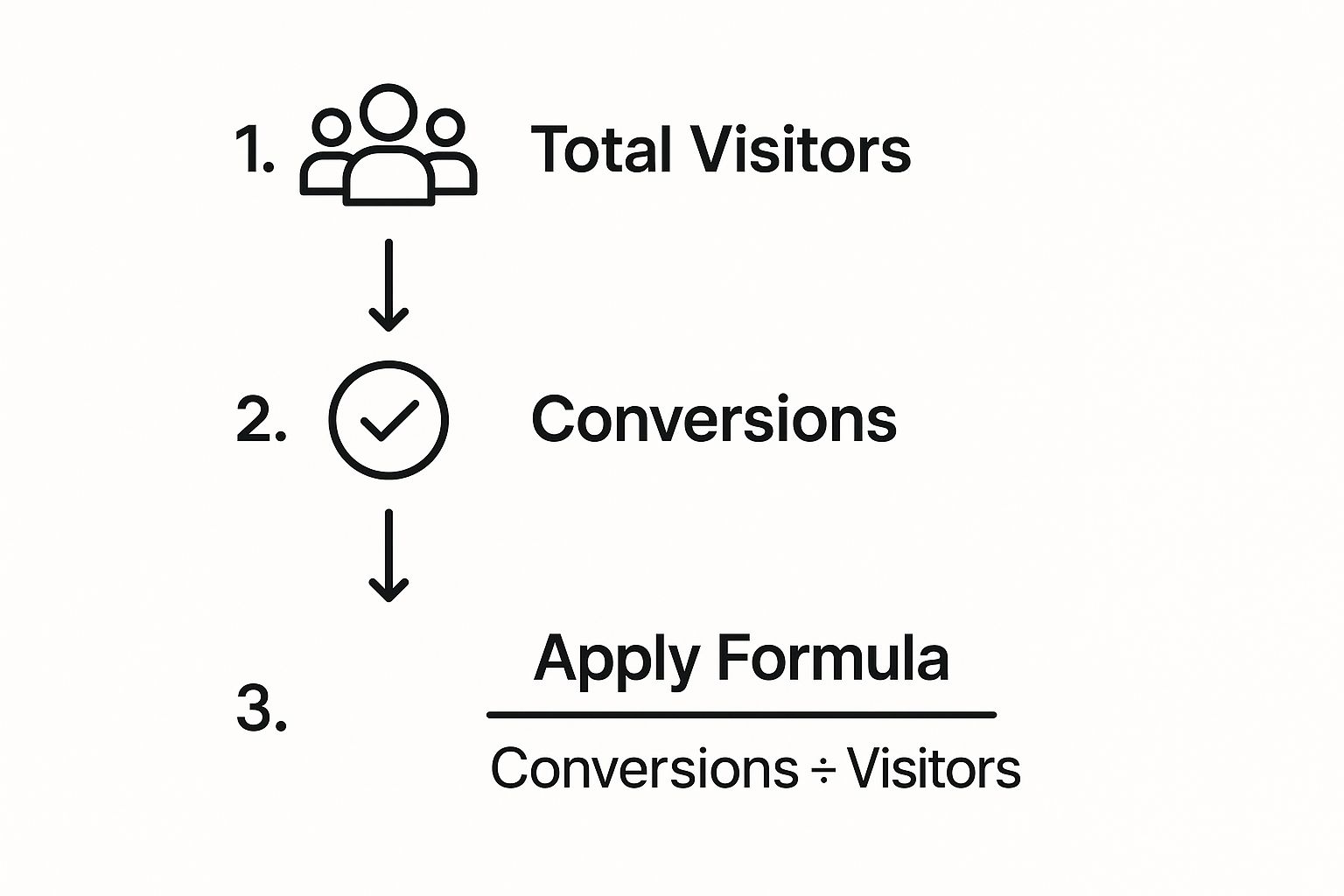
This process neatly boils down your performance into a single, powerful percentage.
Putting the Formula Into Action with Examples
Let's plug this into a couple of real-world scenarios to see just how flexible this formula is.
Example 1: The E-commerce Store Picture an online boutique that sells custom-printed t-shirts.
- Conversion Goal: A completed purchase.
- Total Visitors (Last Month): 10,000
- Total Purchases (Last Month): 150
Now, we just apply the formula: (150 Conversions / 10,000 Visitors) * 100 = 1.5% Conversion Rate
Simple. This tells us that for every 100 people who visited the site last month, 1.5 of them bought something.
Example 2: The B2B Software Company Now let's switch gears to a B2B company like Distro, whose main goal is to book more demos for its sales team.
- Conversion Goal: A submitted demo request form.
- Landing Page Visitors (Last Quarter): 4,000
- Completed Demo Requests (Last Quarter): 80
Let's run the numbers: (80 Conversions / 4,000 Visitors) * 100 = 2% Conversion Rate
This shows the sales team their landing page is turning 2% of its visitors into solid leads. While that's a crucial first step, it’s just as important to see how many of those leads actually become paying customers. For a deeper look into that part of the funnel, you can check out guides on the lead-to-sale conversion rate.
Key Takeaway: The real power of the conversion rate formula is its adaptability. Whether you're tracking million-dollar enterprise deals or free newsletter signups, the basic math is the same. It gives you a consistent benchmark for performance, no matter your business model.
Moving Beyond The Basic Conversion Rate Formula

The standard conversion rate formula is a solid starting point, but it's just that—a start. True insight, the kind that actually helps you make smarter decisions, comes from slicing your data in more specific ways.
Visits Versus Visitors: The Critical Difference
Imagine an excited customer lands on your online store three separate times this week. On that third visit, they finally pull the trigger and buy something.
If you only use the basic formula, you’re getting a distorted picture of what actually happened. This is where you need to understand the crucial difference between a "visit" and a "visitor."
- Visit Conversion Rate: This looks at conversions per session. For our customer, that's 1 purchase across 3 separate visits, giving you a 33% visit conversion rate for that user. It answers the question: "How good is an individual session at getting a conversion?"
- Visitor Conversion Rate: This calculates conversions per unique person. Since 1 unique visitor made a purchase, their visitor conversion rate is 100%. This answers: "How effective are we at converting people, no matter how many times they stop by?"
For most businesses, the Visitor Conversion Rate is where the real value lies. This is especially true for B2B companies like Distro, where sales cycles are longer and involve multiple touchpoints. It gives you a much clearer picture of how many individual prospects you're successfully guiding through your funnel.
Segmenting Your Conversion Rate For Deeper Insights
Relying on a single, site-wide conversion rate is like looking at a map of the entire United States. It’s useful for a high-level view, but it tells you nothing about the street-level details where the real action is. To find those hidden opportunities for improvement, you have to segment.
Segmentation just means applying the same core formula (Conversions / Visitors * 100) to smaller, more specific slices of your audience. Instead of a single number, you get a story.
This approach reveals which parts of your strategy are crushing it and which are falling flat.
By segmenting your data, you stop making broad assumptions and start diagnosing specific performance issues. It’s the difference between knowing you have a fever and knowing exactly where the infection is.
Putting Advanced Formulas Into Practice
Let's see how this plays out with a quick, real-world example.
Scenario: A SaaS Company A SaaS company sees its overall conversion rate for demo requests is 2.5%. Not terrible, but not great either. They decide it's time to dig deeper and segment the data.
- By Traffic Source: They discover visitors from organic search convert at a healthy 4%, but traffic from paid social media ads converts at a dismal 0.8%. This is a huge red flag, pointing to a disconnect between their ad targeting and the landing page experience.
- By Device: They find their desktop conversion rate is 3.5%, but it plummets to just 1% on mobile. The mobile form is probably a nightmare to use, causing people to give up in frustration.
- New vs. Returning Visitors: New visitors convert at 1.5%, but returning visitors convert at an impressive 7%. This tells them their content is doing a great job of nurturing leads, but their first impression needs some work.
Suddenly, they have a clear action plan. They know they need to fix the mobile form, rethink their social ad campaigns, and improve the experience for first-time visitors.
This level of detail is exactly what you need for smart, targeted improvements. Without segmenting, these critical problems would have stayed completely hidden. For a structured way to tackle these issues, check out our ultimate conversion optimization checklist.
Benchmarking Your Conversion Rate Against Your Industry
So you’ve run the numbers and calculated your conversion rate. Now you’re staring at a single, powerful percentage. But that number doesn’t mean much on its own.
The first question everyone asks is, "So... is that good?" The answer, as it often is in business, is: it depends.
A “good” conversion rate isn’t some universal number etched in stone. It’s a moving target that gets pushed and pulled by your industry, the price of your product, and even where your website traffic comes from. Comparing a high-ticket B2B software to a cheap, impulse-buy t-shirt shop is like comparing apples to oranges. Sure, they're both fruit, but that's where the similarities end.
What Is a Good Conversion Rate?
To figure out if your numbers are solid, you have to understand what is considered a good sales conversion rate for your specific market. A rate that would have one team popping champagne might be a five-alarm fire for another. Setting realistic goals starts with knowing where the goalposts are in your field.
Take a company like Distro, for instance. We offer a specialized B2B scheduling platform. We’d naturally see a lower conversion rate on our demo request form than an e-commerce site selling a trendy $20 gadget. The B2B sales cycle is longer, the decision requires more thought, and the pool of potential customers is much smaller.
The real key is to measure what actually matters for your business. Don't get discouraged if your numbers don't stack up against a flashy case study from a totally different industry. Focus on getting a baseline for your own performance and then work on improving it, bit by bit. That’s how you build real, sustainable growth.
Average Conversion Rates by Industry
To get your bearings, a great first step is looking at industry averages. These numbers aren’t the final word, but they provide a much-needed reference point to see how you stack up and what you should be aiming for.
Here’s a look at how different industries typically perform.
Average Conversion Rates by Industry
| Industry | Average Conversion Rate (%) |
|---|---|
| B2B Tech & SaaS | 1% - 3% |
| E-commerce (General) | 2% - 4% |
| Finance & Insurance | 5% - 10% |
| Health & Wellness | 2% - 4% |
| Travel & Hospitality | 1% - 5% |
As you can see, the differences can be huge. The finance sector often pulls in higher rates because they’re capturing people with very high intent—they need a loan or an insurance quote now.
Crucial Insight: Your industry defines the realm of what's possible. A 2.5% conversion rate is fantastic for a B2B SaaS company but might just be average for a sharp e-commerce store. Use these benchmarks as a guide, not gospel.
Factors That Influence Your Benchmark
Industry is the big one, but a few other factors can seriously sway your conversion rate. Keep these in mind when you're comparing your performance, whether against competitors or just your own past results.
- Traffic Source: A visitor who finds you after typing a super-specific, long-tail search query is usually much more primed to convert than someone who just scrolled past a generic ad on social media. Intent is everything.
- Price Point: It’s a no-brainer that a $10,000 enterprise software package will have a lower conversion rate than a free trial or a $15 e-book. The bigger the commitment, the more friction, and the lower the rate.
- Device Type: Conversions on mobile can often lag behind desktop. It's just harder to fill out complex forms or make big purchases on a small screen. People often feel more comfortable and secure entering details on a full-size keyboard.
- Market Scale: This one is a bit counterintuitive. As your overall traffic grows, especially in large markets, your conversion rate might actually dip. Why? Because you start reaching a broader, less-targeted audience.
Five Actionable Strategies To Boost Your Conversion Rate

Knowing your conversion rate is a great start, but the real work begins when you try to make that number climb. Improving your conversion rate is all about getting more value out of the traffic you already have. Honestly, it's a much smarter play than constantly chasing new visitors.
This section is your playbook for doing just that. We're going to walk through five powerful, battle-tested strategies that zero in on the highest-impact areas of the customer journey. These aren’t just theories; they're concrete steps you can take to turn more browsers into buyers.
1. Master Your Call-To-Action
Your Call-to-Action (CTA) is easily the most important element on any page with a conversion goal. It's the gatekeeper. Whether you want a purchase, a demo request, or a simple signup, a weak or confusing CTA will kill your chances.
Think of your CTA as the final, clear instruction you give a visitor. It needs to be compelling, obvious, and almost impossible to ignore.
To get your CTAs working harder, focus on these areas:
- Action-Oriented Language: Use strong, direct verbs. Instead of a passive "Submit," try something like "Get Your Free Demo" or "Download My Ebook Now." This tells people exactly what they're getting and what to do next.
- High-Contrast Design: Your CTA button needs to visually pop. Use a color that stands out against the page's background and surrounding elements. You want the user's eye drawn right to it.
- Prominent Placement: Don't make people hunt for it. Put your CTA "above the fold" and consider repeating it after longer chunks of content. For B2B platforms like Distro, placing a clear "Book a Demo" button in the main navigation keeps that primary goal front and center, no matter where someone is on the site.
2. Create a Frictionless Process
Every extra step, unnecessary form field, or moment of confusion adds friction to your conversion process. And friction is the absolute enemy of conversions. The more roadblocks a user hits, the more likely they are to just give up and leave.
Imagine trying to buy a coffee, but the barista hands you a three-page form to fill out first. You'd probably walk right out. The same thing happens online. Your job is to make the journey from visitor to customer as smooth and painless as possible.
Key Insight: Trimming down friction isn't just about a better user experience; it directly fattens your wallet. A Baymard Institute study found that 18% of users ditch their shopping cart simply because the checkout process is too long or complicated.
For a B2B company, this might mean radically simplifying your demo request form. Do you really need their phone number, company size, and job title right this second? Or could you just start with an email and qualify them on the back end? The less you ask for, the more people will actually finish the form.
3. Leverage A/B Testing for Data-Backed Decisions
Guesswork has no place in conversion optimization. The most successful companies don't guess; they test. And the best way to get reliable data is through A/B testing. Also known as split testing, it's where you create two versions of a page (Version A and Version B) and show them to different groups of visitors to see which one performs better.
This lets you test changes—from tiny tweaks to major overhauls—and see exactly how they impact your conversion rate. You can test anything: your headline, the color of your CTA button, or even the entire page layout.
Here’s a simple way to approach A/B testing:
- Form a Hypothesis: Start with an educated guess. For instance, "I believe changing the CTA from 'Learn More' to 'Get Started Free' will increase signups because it's more specific and value-driven."
- Create a Variation: Build the new version of your page (Version B) with that single change you want to test.
- Run the Test: Use a testing tool to split your traffic between the original page and your new variation.
- Analyze the Results: Once you have enough data to be statistically confident, see which version drove a higher conversion rate.
This cycle of testing, learning, and iterating is the engine of continuous improvement. If you want to dig deeper into optimizing your sales funnel, our guide on how to improve your sales conversion rate is a great next step.
4. Optimize the Mobile Experience
It’s no secret that more than half of all web traffic now comes from mobile devices. Yet so many websites still feel clunky and frustrating on a phone. A slow, hard-to-navigate mobile site is a guaranteed conversion killer.
People on their phones expect a seamless experience. If they have to pinch-and-zoom just to read your text, they’re gone.
Responsive design is the bare minimum. You really need to think "mobile-first." This means designing for the smallest screen and then scaling up. Think large, easy-to-tap buttons, dead-simple navigation, and forms that don't feel like a chore to complete on a touchscreen.
If you're looking for more practical ideas, there are tons of great strategies to improve your website conversion rate that can help you optimize your entire funnel, especially for mobile users.
5. Build Trust with Social Proof
People are naturally wired to be cautious. We look to others for clues about what’s safe, what’s valuable, and what’s trustworthy. This psychological shortcut is the power of social proof.
You can ease a visitor's anxiety by showing them that other people just like them have already had a great experience with your brand. Adding social proof is one of the fastest ways to build credibility and nudge people toward converting.
Here are a few powerful forms of social proof to try:
- Customer Testimonials: Real quotes from happy customers.
- Case Studies: In-depth stories showing how a customer found success with your product.
- Company Logos: The logos of well-known companies you work with can lend you instant credibility.
- Star Ratings & Reviews: A simple visual that communicates quality in a split second.
Place these trust signals strategically near your CTAs. Often, it's the final nudge a hesitant user needs to take action.
A Few Common Questions About the Conversion Rate Formula
Once you get the hang of the conversion rate formula, a few practical questions always seem to surface. It’s one thing to know the math, but it's another thing entirely to use it effectively out in the wild.
Let's dig into some of the most common questions we see. We'll give you clear, straightforward answers to help you navigate the tricky spots and use this metric with real confidence.
How Do I Define What Counts as a Conversion?
Simply put, a conversion is any action you want a user to take on your site that you consider valuable. The key here is that you are the one who defines what "valuable" actually means for your business.
For an e-commerce store, the big one is almost always a completed purchase. For a B2B company like Distro, it’s usually a demo request or signing up for a free trial. If you're running a blog, maybe your main conversion is getting someone to subscribe to your newsletter.
The best way to define your conversion is to start with your goal for a specific page or campaign and work backward. Ask yourself, "What's the number one thing I want a visitor to do right here, right now?" That's your conversion.
How Often Should I Check My Conversion Rate?
It’s incredibly tempting to obsessively check your numbers every single day. The problem is, daily checks can be really misleading because of normal, random ups and downs. One slow day doesn't mean your entire strategy is failing.
For most businesses, checking in weekly or monthly strikes a much healthier balance. This gives you enough time to smooth out the daily noise and spot the trends that actually matter.
The only real exception is when you’re running a specific, time-sensitive campaign or an A/B test. In those situations, you'll want to keep a closer eye on performance to make quick, smart adjustments. The goal is always to find statistically significant patterns, not to panic over every little dip or spike.
Don't get lost in the daily noise. Keep your eyes on the bigger picture. Real business growth comes from consistent, long-term improvement, and that story unfolds over weeks and months, not hours.
Is a Low Conversion Rate Always a Bad Thing?
Not at all. Context is everything. A low conversion rate isn't an automatic red flag—it often just reflects what you're asking people to do.
Think about these two completely different scenarios:
- A website selling luxury sports cars for $200,000 will have a tiny conversion rate. But a single conversion is a massive win.
- A blog offering a free checklist download might get a super high conversion rate, but each conversion brings in zero immediate revenue.
The percentage is just a number. What really matters is the business impact. Instead of getting fixated on the rate itself, focus on the total value you're creating, whether that's direct sales or a pipeline full of qualified leads. A 0.1% conversion rate can be fantastic if each conversion is valuable enough.
What Is the Difference Between Conversion Rate and Click-Through Rate?
This is a common mix-up, but the distinction is pretty simple and super important. Both are critical metrics, but they measure success at two totally different points in the customer's journey.
- Click-Through Rate (CTR) tells you how many people click on a link (like in an ad or an email) to even get to your website. It happens before they arrive. It answers the question: "Is my ad good enough to make people curious?"
- Conversion Rate tells you how many people take the action you want them to after they're already on your site. It answers the question: "Is my website good enough to convince visitors to act?"
Here's a simple way to think about it: CTR gets people to the front door of your shop. Conversion rate gets them to walk up to the register and buy something. You need both to work well, but they tell you completely different things about your performance.
Ready to turn more of your high-intent prospects into scheduled meetings? Distro automatically routes qualified leads from your demo forms directly to the right sales rep's calendar, eliminating friction and dramatically increasing your form-to-meeting conversion rate. See how much faster you can grow at https://distro.so.