At its core, the customer acquisition cost calculation is pretty simple: divide your total sales and marketing spend by the number of new customers you brought in over a specific time. But mastering this metric is what separates the businesses that scale from those that stall out. It tells you the real cost of winning every single customer.
Why Mastering Your CAC Calculation Matters
Before we get into the spreadsheets, let’s be clear on why a precise customer acquisition cost calculation is so critical. Think of CAC less as just another KPI and more as a direct signal of your company's long-term health. Getting this number right is the difference between sustainable growth and a frantic, cash-burning treadmill of unprofitable activity.
A solid grasp of your CAC helps you dodge unsustainable ad spend, zero in on your most profitable marketing channels, and pour your budget into what actually works. Without it, you’re basically flying blind—investing in campaigns that feel successful but are actually costing you more than the customers they generate are worth.
The Rising Cost of Acquiring Customers
This isn't just a theoretical exercise; the financial stakes are higher than ever. It's gotten dramatically more expensive to acquire customers over the last decade. In fact, some research shows that CAC has jumped by a staggering 222% since 2013, all thanks to fierce competition and skyrocketing ad prices.
This means businesses are now spending more than triple what they did just a few years ago to win a new customer. The average loss per acquisition has ballooned from $9 to $29. If that doesn't make you want to get your numbers straight, I don't know what will. You can discover more insights about rising customer acquisition costs if you want to dig deeper.
A precise customer acquisition cost calculation is your safeguard against unprofitable growth. It separates the channels that build your business from those that drain your bank account, ensuring every dollar spent is an investment in long-term success.
From Vague Metric to Strategic Tool
Too many businesses make the classic mistake of tracking a vague, blended CAC that doesn't offer any real, actionable insight. A truly effective customer acquisition cost calculation goes deeper. It helps you answer the tough questions that actually shape your strategy:
- Channel Profitability: Which channels, like Google Ads or content marketing, are actually delivering customers efficiently?
- Budget Allocation: Where should we be doubling down on our spend, and where do we need to pull back?
- Pricing Strategy: Is our product priced correctly to ensure a healthy margin over what it costs us to get a customer?
- Operational Efficiency: Are our sales and marketing teams operating as lean and mean as they possibly can be?
When you get this right, CAC transforms from a simple number on a dashboard into a powerful strategic lever for profitable growth.
Gathering the Right Data for an Accurate Calculation
Your CAC calculation is only as good as the data you feed it. That might sound obvious, but you’d be surprised how many teams get this wrong.
If you just divide your total ad spend by your new customers, you're going to end up with a dangerously misleading number. To get the real picture—the one you can actually make smart budget decisions with—you have to account for every single dollar that goes into winning a new client.
Think of it like this: if you’re baking a cake and leave out the eggs and flour, what you pull out of the oven won’t be a cake. The same principle applies here. A flawed CAC leads to bad budget decisions, totally unrealistic growth projections, and a skewed view of your company’s actual health.
The basic formula isn't complicated: Total Marketing & Sales Spend ÷ Number of New Customers Acquired = CAC.
But the devil is in the details of that "Total Spend." It’s way more than just your ad budget. We're talking salaries, software, content creation—the whole shebang. For instance, if you spend $50,000 on all of those things in one quarter and bring in 500 new customers, your CAC is $100. Simple enough, but getting to that $50,000 figure is where the real work begins.
Identifying Your Total Acquisition Spend
Let’s break down the two main buckets of expenses you need to track. Don't gloss over this part. Every cost you miss artificially lowers your CAC and gives you a false sense of security.
Here's a quick checklist of the costs you absolutely need to include. Don't just skim it—pull up your own expense reports and make sure you're accounting for everything here.
Essential Costs to Include in Your CAC Calculation
A checklist of all potential marketing and sales expenses to ensure a comprehensive and accurate Customer Acquisition Cost calculation.
| Cost Category | Examples | Why It's Included |
|---|---|---|
| Marketing Expenses | Google Ads, social media ads, sponsored content, agency retainers, freelance writers/designers, video production. | These are the direct costs of reaching potential customers and generating leads. They're usually the easiest to track but are only one piece of the puzzle. |
| Sales Expenses | Base salaries, commissions, and bonuses for sales reps and managers. | Your sales team's compensation is a major driver of acquisition. Ignoring it gives you an incomplete picture of what it truly costs to close a deal. |
| Team Salaries (Proportional) | Salaries and benefits for your marketing team (e.g., content managers, SEO specialists, campaign managers). | The people running the campaigns and creating the content are a core part of the acquisition engine. Their cost needs to be factored in. |
| Software & Tools | CRM (like Salesforce), marketing automation (like HubSpot), SEO tools (like Ahrefs), analytics platforms, email software, ad management tools. | These tools are the infrastructure of your go-to-market motion. They aren't free, and their costs are directly tied to acquiring customers. |
| Overhead & Other | Sales-related travel, conference sponsorships, costs for client dinners or events. | Any operational expense directly related to the sales or marketing process contributes to the overall cost of acquiring a customer. |
Remember, tracking every single one of these costs is what gets you a fully loaded CAC.
A common mistake is to only track direct ad spend. Including salaries and software provides a fully loaded CAC, which is the only number that truly reflects the total investment required to win a new customer. Anything less is just vanity.
Defining a New Customer Accurately
Once you've wrangled all your costs, you need an equally accurate count of your new customers from that same time period.
And that means you need a clear definition. Are you counting free trial sign-ups? What about freemium users? For a true CAC calculation that investors and your exec team will trust, you should only be counting customers who have started paying for your product or service. Anything else muddies the waters.
This all hinges on getting your attribution right. If you can't confidently say which channels and expenses brought in which customers, you're flying blind. It's worth taking the time to nail down your model by understanding cross-channel marketing attribution to ensure you're assigning costs correctly.
Similarly, keeping a close eye on your lead generation KPIs will give you the ground-level data you need to see which efforts are actually turning prospects into paying customers. This disciplined approach is the difference between a CAC that's just a number on a spreadsheet and one that's a powerful tool for growth.
Putting the CAC Formula to Work With Real-World Numbers
Okay, you've done the legwork and gathered the data. Now for the fun part: running the numbers. This isn't just some abstract accounting exercise—it's about drawing a straight line from your spending to your growth and seeing exactly what your budget is buying you.
Let's start with a simple, blended CAC to get a feel for the business's overall health. After that, we'll slice and dice the data to calculate CAC for specific marketing channels. This is where the magic happens and you find the insights that actually let you optimize your spend.
Calculating a Simple Blended CAC
Let's imagine you run an e-commerce store selling custom-printed apparel. To figure out your overall CAC for the last quarter (Q3), you first need to add up all your sales and marketing costs from that period.
- Total Marketing & Sales Spend (Q3):
- Google Ads Spend: $15,000
- Social Media Ads Spend: $10,000
- Marketing Team Salaries (pro-rated for the quarter): $20,000
- CRM & Analytics Software Costs (quarterly): $5,000
- Total Spend: $15,000 + $10,000 + $20,000 + $5,000 = $50,000
Next, you'll need the total number of new customers you brought in during that same time frame. Pulling up your analytics, you see you acquired 500 new paying customers in Q3.
Time to plug it into the formula:
Total Spend / New Customers = Blended CAC
$50,000 / 500 = $100
Your blended CAC for Q3 is $100. This single number is a vital health check. It tells you that, on average, it costs your business $100 to bring a new customer through the door.
Digging Deeper with Channel-Specific CAC
A blended CAC is a great starting point, but its real value is unlocked when you start comparing it to the cost of each individual channel. This is how you spot your most efficient growth engines and find the budget-wasters.
Let’s break down the numbers for your e-commerce store’s two main ad channels.
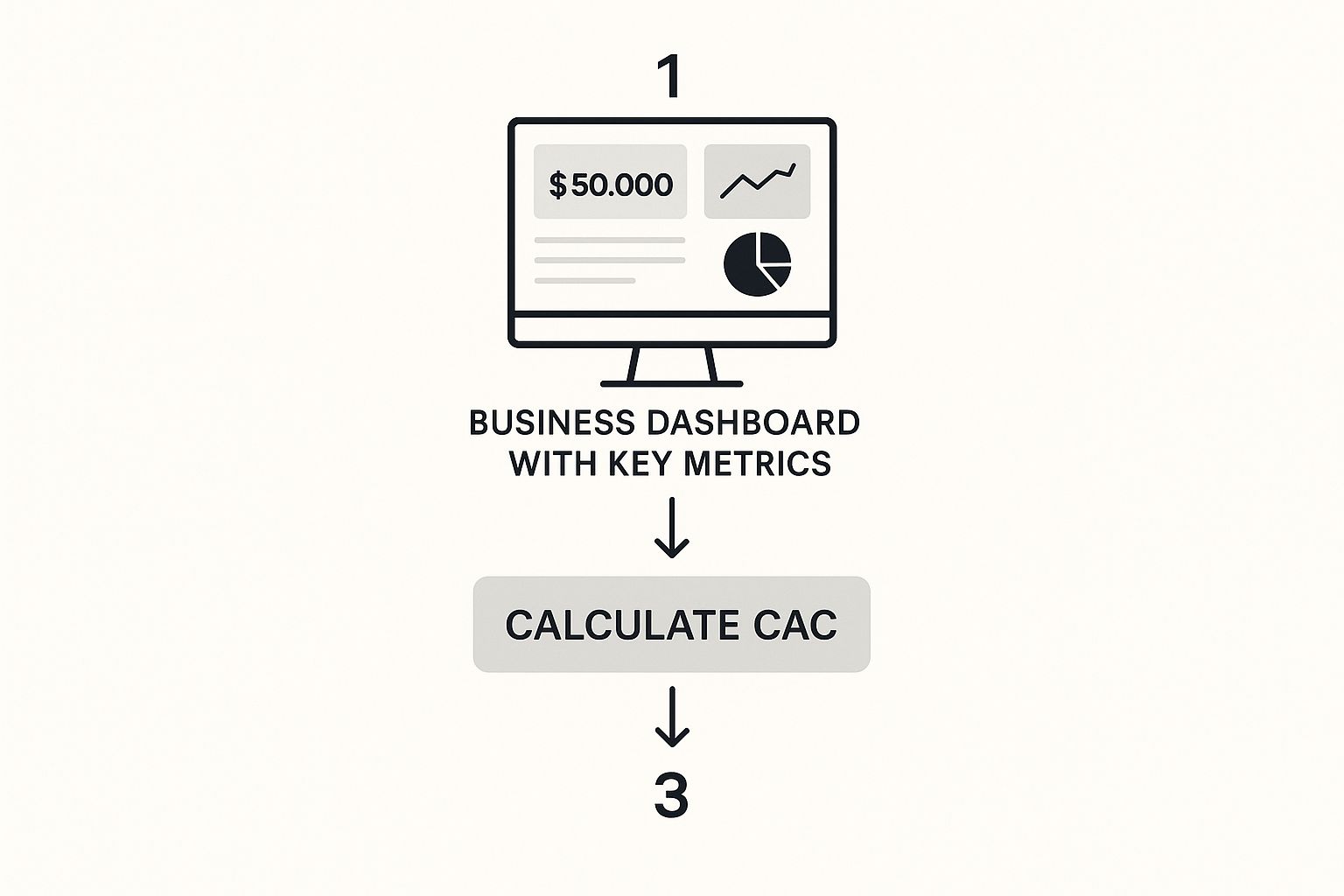
Isolating the data this way gives you a crystal-clear picture of what’s working and what isn’t, so you can start moving your budget around intelligently. To get this view, you need to attribute both costs and new customers to their specific channels.
Google Ads Performance (Q3):
- Direct Ad Spend: $15,000
- New Customers Attributed to Google Ads: 250
- Google Ads CAC: $15,000 / 250 = $60
Social Media Ads Performance (Q3):
- Direct Ad Spend: $10,000
- New Customers Attributed to Social Media: 150
- Social Media CAC: $10,000 / 150 = $66.67
Suddenly, the picture is much clearer. While your blended CAC is $100, your paid channels are actually performing much more efficiently. And between the two, Google Ads is the clear winner with a $60 CAC, acquiring customers for quite a bit less than your social media campaigns.
A blended CAC tells you what it costs to get a customer. A channel-specific CAC tells you where you should be putting your money. That granular view is the secret to scaling smart.
This is the kind of analysis that leads to real action. You might decide to shift more budget over to Google Ads or dig into why the social media CAC is higher. Is the targeting off? Is the creative not hitting the mark? This is how a simple calculation becomes a powerful strategic tool.
Alright, so you’ve crunched the numbers and have your Customer Acquisition Cost. That’s a massive first step, but the number itself is just a data point sitting in a spreadsheet. The real magic happens when you figure out what that number is actually telling you about the health and future of your business.
A CAC isn't "good" or "bad" on its own. Its real meaning comes to light when you put it in context.
The most critical piece of that context? Your Customer Lifetime Value (LTV). LTV is the total amount of money you can reasonably expect to make from a customer over their entire time with you. When you put LTV and CAC side-by-side, you get the ultimate health check for your business model.
The LTV to CAC Ratio Explained
The LTV to CAC ratio is your reality check. It tells you exactly how much return you're getting for every single dollar you pour into acquiring new customers. It's the number that answers the big question: is our growth actually profitable?
- LTV < CAC (less than 1:1): This is a red flag. You're spending more to get a customer than you'll ever make back from them. It’s a fast track to burning through cash unless you have a rock-solid, short-term plan to either boost LTV or slash your acquisition costs.
- LTV = CAC (a 1:1 ratio): You're essentially breaking even on every new customer. While you're not actively losing money on acquisition, you also aren't generating any profit to cover your other operational costs. It's treading water.
- LTV > CAC (greater than 1:1): This is where you want to be. Every new customer is profitable.
The gold standard for a healthy LTV to CAC ratio is generally considered 3:1 or higher. For every $1 you spend to bring a customer in the door, you're getting $3 back over their lifetime. A ratio like this signals a strong, scalable business.
This one ratio can drive your entire strategy. If it's too low, you know you need to focus on customer retention to increase LTV or find more efficient marketing channels. And believe it or not, a super high ratio (think 8:1) might mean you're underinvesting in growth and could be scaling much faster.
Understanding Your CAC Payback Period
Another metric I always look at is the CAC Payback Period. This is simply how many months it takes for you to earn back the money you spent to acquire a customer. For any subscription business, this is a non-negotiable metric for understanding cash flow.
Calculating it is straightforward: just divide your CAC by your average monthly recurring revenue (MRR) per customer.
Let's say your CAC is $300 and your average customer pays you $50/month. Your payback period is 6 months. That means it takes half a year before that new customer actually starts generating profit. Shorter is always better here—it means healthier cash flow and less risk.
Comparing Your CAC to Industry Benchmarks
Finally, you need to zoom out and see how your CAC stacks up against your industry. Acquisition costs are wildly different across sectors. Things like the length of your sales cycle, how crowded your market is, and the sheer complexity of your product can cause huge variations.
It’s just not an apples-to-apples comparison.
Average Customer Acquisition Cost (CAC) by Industry
The cost of acquiring a customer varies dramatically from one industry to another. This table gives you a rough idea of what others are spending, helping you see where your own numbers fall. Factors like competition, sales cycle complexity, and customer value all play a huge role.
| Industry | Average CAC | Key Influencing Factors |
|---|---|---|
| Fintech | $1,450 | High competition, long sales cycles, complex regulatory environment |
| Insurance | $1,280 | Intense market competition, high LTV, significant ad spend |
| Medical Devices | $921 | Specialized B2B sales, long approval processes, high-value contracts |
| SaaS (B2B) | $395 | Varies by sub-niche, reliance on content and outbound sales |
| eCommerce | $88 | High volume, low-margin, dependent on ad performance and SEO |
As you can see, B2B and highly regulated industries tend to have much higher costs than most B2C businesses. It makes sense—a fintech company selling a complex platform will naturally spend more than an eCommerce store selling t-shirts. You can discover more insights about average customer acquisition costs to get a better feel for your specific market.
Knowing these benchmarks helps you set realistic goals. It also pushes you to think about the source of your customers. For instance, the cost difference between inbound leads vs outbound leads can be massive, and understanding that is key to optimizing your spend.
Actionable Strategies to Reduce Your Customer Acquisition Cost

Once you’ve nailed down an accurate CAC calculation, you have the power to actually manage it. Lowering your CAC isn’t just about slashing budgets; it’s about investing smarter to get more from every single dollar you spend. The goal is efficient growth, not stalled growth.
This really comes down to a two-pronged attack. First, you need to optimize the top of your funnel by getting better at attracting and converting prospects. Second, you have to maximize the value of the customers you already have, turning them into your most cost-effective growth engine.
Enhance Your Conversion Funnel
The most direct way to drive down your CAC is to convert more of the prospects you’re already paying to reach. Even a small lift in your conversion rate can have a massive impact on your bottom line.
Start by getting serious about A/B testing elements on your landing pages. I'm talking headlines, calls-to-action, even page layouts. For example, a SaaS company might test "Start Your Free Trial" against "Request a Demo" to see what truly resonates with their ideal user. Improving your lead to sale conversion rate is a direct lever for reducing acquisition costs.
You should also be constantly refining your ad targeting. Stop casting a wide net. Use your data to zero in on high-intent audiences—the people who are far more likely to become paying customers. This makes your ad spend work much harder, bringing in more qualified leads for the same cost.
Invest in Sustainable, Long-Term Channels
Paid advertising is great for getting immediate results, but relying on it exclusively is like being on a hamster wheel of spending. To build a more sustainable acquisition model, you need to invest in organic channels that deliver compounding returns over time.
These are the long-game strategies:
- Content Marketing: Create genuinely valuable blog posts, guides, and webinars that actually answer your audience's burning questions. This builds authority and attracts qualified traffic without a per-click cost.
- Search Engine Optimization (SEO): Optimizing your website for the right keywords ensures a steady stream of organic traffic from people actively searching for solutions just like yours.
- Email Marketing: Nurturing leads with targeted email campaigns keeps your brand top-of-mind and nudges prospects toward a purchase, all at a minimal cost.
For instance, you can dramatically cut content creation costs by leveraging free AI video tools to produce compelling marketing materials without a huge budget. These organic efforts might take longer to bear fruit, but they build an asset that pays dividends for years.
Your most cost-effective acquisition channel is often hidden within your existing customer base. Retention is the new acquisition; every customer you keep is one you don’t have to pay to replace.
Finally, never, ever underestimate the power of your current customers. A happy customer is your best marketing tool, period. Implementing a simple referral program can turn your user base into a low-cost sales force that brings in warm, high-quality leads. Likewise, focusing on customer retention boosts LTV, which makes your initial acquisition spend far more profitable in the long run.
Common Questions About CAC Calculation
Even when you feel like you've got the CAC formula down, a few tricky details can throw your numbers off. And getting these details right is the difference between a vanity metric and one you can actually use to make smart decisions.
Let's clear up a couple of the most common hangups.
How Often Should I Calculate CAC?
This is one of the first questions people ask. My advice? A mix is usually best. Calculating CAC monthly and quarterly gives you the perfect blend of short-term agility and long-term perspective.
Monthly checks are your early warning system. They help you spot immediate trends and see how a specific campaign is performing right now. A quarterly analysis, on the other hand, smooths out the random noise—those weird monthly spikes or dips—giving you a much more stable, big-picture view of your acquisition engine's health.
What Is the Difference Between CAC and CPA?
It's incredibly easy to mix up Customer Acquisition Cost (CAC) and Cost Per Acquisition (CPA), but the distinction is critical for clean reporting.
Think of CPA as a catch-all term for any action you pay to generate. That could be a new lead, a free trial signup, or even just a newsletter subscription.
CAC, however, is laser-focused on one single outcome: acquiring a new paying customer.
The simplest way to remember it is that every CAC is a type of CPA, but not every CPA is a CAC. This keeps you honest about measuring the real cost of generating revenue, not just kicking up interest.
Should I Include Free Trial Users in My CAC Calculation?
This is a classic pitfall, especially for SaaS companies. The short answer is: it's a two-part process.
You should absolutely include all the marketing and sales costs associated with getting those free trial users in your total spend. But—and this is the important part—you should only count them as 'acquired customers' in your formula after they convert to a paid plan.
A common mistake is to divide your total marketing spend by the number of new free signups. That's not your CAC; that's your cost per lead. To do it right, you track the costs to get the free users, then attribute those costs to the smaller group who actually start paying you. That's the kind of discipline that separates a meaningful metric from a misleading one.
Ready to stop losing high-intent leads and convert more demo requests into meetings? Distro automatically routes inbound prospects to the right sales rep's calendar in real-time, eliminating manual follow-up and capturing buyers when their interest is highest. Learn how Distro can 3X your demo conversion rates.