At its core, a sales conversion rate is pretty simple. It's the percentage of potential customers who actually take the action you want them to, whether that's buying your product or just booking a demo.
Think of it as the ultimate scorecard for your sales and marketing efforts. It cuts through the noise and tells you how good you are at turning casual interest into real revenue.
What Are Sales Conversion Rates Really Telling You
Let's look past the basic formula for a second. Imagine your sales pipeline is a brick-and-mortar store. All your website visitors and leads are the people walking through the front door. Your conversion rate tells you how many of them actually pull out their wallets and buy something.
This single number is a vital health check for your entire sales journey. It shines a light on what's working and, more importantly, what isn't, giving you a clear window into your strategy from the first hello to the final handshake.
The Story Behind the Number
A conversion rate isn't just a static percentage you stick in a report. It’s a living, breathing indicator of your business's pulse. A low rate could mean your offer is falling flat or your pricing is off. A high rate? That suggests your message and value are hitting the bullseye with your audience.
Of course, to really get the full story, you need to have effective metrics and reporting in place. Raw numbers without context are just noise; good reporting turns them into actionable insights.
A sales conversion rate is more than a KPI—it's a reflection of your customer's journey. It measures the seamlessness of their experience and the persuasiveness of your value proposition at every single stage.
This metric is so powerful because it ties different parts of your business together. It shows you:
- Marketing Effectiveness: Are you bringing in qualified people who are actually a good fit for your solution?
- Offer Strength: Is your product or service compelling enough to get someone to act?
- Sales Team Efficiency: Can your reps actually communicate that value and get the deal across the finish line?
Defining What a "Conversion" Is
Here's where it gets interesting. The word "conversion" can mean a lot of different things depending on your business. A B2C e-commerce store and a B2B SaaS company will have very different definitions. That’s why you have to be crystal clear about what specific action you’re measuring.
For some, a conversion is a done deal—a signed contract and money in the bank. For others, it might be an important step earlier in the process.
Common conversion points in a sales funnel could be:
- A prospect filling out a "Request a Demo" form.
- A lead having their first real conversation with a sales rep.
- A qualified opportunity moving into the proposal stage.
- A prospect signing on the dotted line and becoming a paying customer.
When you start tracking conversion rates at each of these micro-stages, you can see exactly where people are falling out of your funnel. This turns a simple metric into a diagnostic tool, showing you precisely where to focus your efforts for real, sustainable growth.
Benchmarking Your Sales Conversion Success
Ever ask, "what's a good sales conversion rate?" That's a bit like asking how fast a car should go. The answer completely depends on where you are—cruising through a school zone or flying down a racetrack?
It’s the same with sales. What looks like a fantastic conversion rate in one industry could be a huge red flag in another. Chasing some generic, global average is almost always a misleading way to measure your own business.
So many things factor into your unique performance standard: your product's price, how long your sales cycle is, and even where your leads are coming from. Think about it: a company selling six-figure B2B software with a six-month sales cycle will have a totally different conversion rate than an e-commerce store slinging t-shirts. They aren't even running the same race.
This is exactly why you need to get familiar with industry benchmarks. It gives you the context you need to see how you really stack up and set goals that actually make sense.
What Is a Good Conversion Rate?
Globally, the average e-commerce conversion rate tends to hover between 2% and 4%. But that number hides a massive amount of variation.
For instance, fast-moving consumer goods, like personal care products, can hit conversion rates as high as 6.8%. On the other hand, industries like home decor and automotive often sit closer to 1.4% and 2.1%. The difference usually boils down to how much thought a customer has to put in before buying.
It's crystal clear that a one-size-fits-all number is useless. You've got to look at the averages within your specific niche to get a real feel for what success looks like.
Average E-commerce Conversion Rates By Industry
This table offers a comparative look at average conversion rates across different e-commerce sectors, highlighting the significant performance variations.
| Industry | Average Conversion Rate (%) |
|---|---|
| Fashion & Apparel | 2.5% |
| Health & Beauty | 3.3% |
| Electronics | 1.8% |
| Food & Beverage | 4.6% |
| Home & Garden | 1.9% |
As you can see, what’s considered "average" is all over the map, proving that your industry is the first and most important piece of context.
Below, this chart shows how conversion rates and the time spent on a site can vary wildly between different groups of customers.
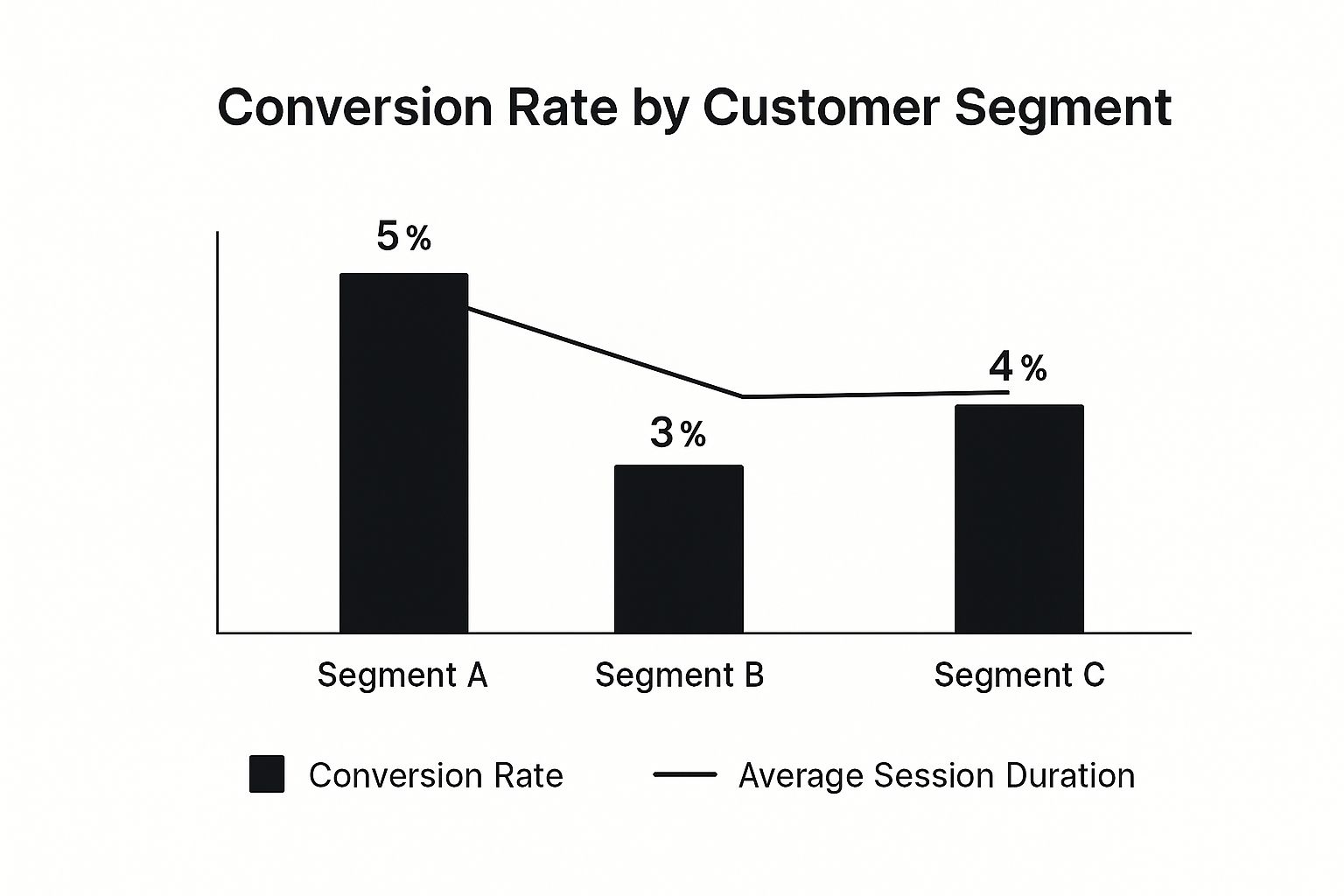
It’s no surprise that the group with the highest conversion rate also sticks around the longest. This points to a powerful truth: the more engaged someone is, the more likely they are to buy.
Context Is Everything in Performance Analysis
Beyond your industry, a handful of other factors create the unique benchmark for your business. To truly understand what's happening with your conversion rates in sales, you have to slice and dice your data.
You absolutely need to be looking at these variables:
- Traffic Source: A lead from a highly-targeted webinar is almost guaranteed to convert better than someone who stumbled onto your site from a broad organic search.
- Device Type: It's still true—desktop users tend to convert at higher rates than mobile users. It’s just easier to fill out complex forms or complete a checkout on a bigger screen.
- Lead Intent: A prospect who hits the "Request a Demo" button is screaming intent. They should convert at a much higher clip than someone who just downloaded a top-of-funnel ebook.
By breaking down your conversion data by source, device, and lead type, you move from a blurry, averaged-out number to a high-definition view of your sales funnel's health.
This is where the real insights are hiding. It helps you figure out not just if you have a problem, but where that problem is. For example, if your mobile conversion rate is miles behind your desktop rate, that's your cue to dig in and fix the mobile experience, stat. You can find more practical advice in our guide to sales funnel optimization strategies.
At the end of the day, benchmarking isn’t about chasing one magic number. It’s about understanding the specific context of your business, setting realistic targets based on relevant data, and using that info to find your biggest growth opportunities. It turns your conversion rate from a simple metric into a powerful diagnostic tool for your entire sales process.
What Really Moves the Needle on Conversion Rates?
Knowing your industry benchmarks is one thing, but actually improving your numbers is a whole different ballgame. High conversion rates in sales are never an accident. They’re the direct result of a thoughtfully designed customer journey where every single touchpoint nudges a prospect closer to saying "yes."
Think of your sales process like a chain—a conversion only happens if every link is strong. A confusing website, a lukewarm offer, or a simple lack of trust can be the weak link that breaks the whole thing. The sale is lost. To turn genuine interest into real revenue, you have to master a few core pillars of the sales experience.
The Power of a Seamless User Experience
First up, and arguably most important, is the User Experience (UX). How easy is it for someone to do business with you? Nothing kills a potential sale faster than a clunky, slow, or confusing process. In fact, a staggering 88% of online consumers say they’re less likely to return to a site after a bad experience.
Imagine a customer is fired up and ready to buy, but to book a simple demo, they have to click through five different pages and fill out a dozen form fields. Each step adds friction, giving them another chance to second-guess their decision and bounce.
A great user experience, on the other hand, feels invisible. It’s effortless. It anticipates what the customer needs and removes obstacles before they even notice them. This boils down to:
- Fast Load Times: Every second counts. A slow site is a frustrating site, and that frustration costs you sales.
- Intuitive Navigation: Can a first-time visitor find exactly what they’re looking for without a map?
- Simplified Forms: Only ask for what you absolutely need. The fewer fields, the higher the conversion rate.
A frictionless UX isn’t just about convenience; it communicates professionalism and shows you respect your customer's time. That sets a positive tone for the entire relationship.
Building Unshakeable Trust Signals
No one is going to buy from you if they don't trust you. This is non-negotiable, especially for high-ticket B2B software or big e-commerce purchases. Trust signals are the visual cues and social proof that quietly tell a prospect, "You're in safe hands here."
These signals work on a subconscious level, reassuring visitors that they’re making a smart, safe choice. Without them, even the most amazing offer can feel too risky to act on.
Trust is the currency of sales. Every testimonial, security badge, and case study is a deposit into your trust bank, giving customers the confidence to invest in your solution.
Here are a few key trust signals you should have on full display:
- Customer Testimonials and Reviews: Nothing is more persuasive than authentic praise from real, happy customers.
- Security Badges: SSL certificates and trusted payment logos signal that their data is secure.
- Case Studies and Success Stories: Show, don't just tell. Detailed stories of how you’ve helped others prove your value.
- Clear Contact Information: A real phone number and address show you're an accountable, legitimate business.
Crafting an Irresistible Offer
At the core of every conversion is a killer offer. Your offer is your value proposition made tangible—the specific solution you provide and the clear-cut benefit a customer gets. If your offer is weak, confusing, or just a carbon copy of your competitors, no amount of optimization can save it.
A powerful offer instantly answers the prospect's most important question: "What's in it for me?" It needs to be so compelling that taking the next step feels like a no-brainer. This isn’t just about the price tag; it’s about the perceived value. For a deeper look at this, check out these sales operations best practices to make sure your team nails this every time.
The Final Touch: Personalization
Finally, personalization is what turns a generic sales pitch into a genuine conversation. Today's buyers don't just want you to sell to them; they expect you to understand their specific challenges, their industry, and their needs. The one-size-fits-all approach is officially dead.
This can be as simple as using a prospect's name in an email or as advanced as tailoring your website's content based on their past behavior. The goal is to make the customer feel seen. By customizing your messaging and recommendations, you prove you've done your homework and are truly invested in helping them succeed. That human connection makes all the difference.
Actionable Strategies to Improve Your Sales Conversion Rate
Knowing your conversion rate is one thing. Actually making it go up? That's where the real growth happens. Improving your conversion rates in sales isn’t about some huge, overnight overhaul. It's more of a steady process: test, learn, and tweak your approach until you’ve built a customer journey that's both compelling and incredibly easy to navigate.
Think of this as your playbook for getting it done. These are practical, road-tested strategies you can put into action to clear out bottlenecks, build genuine trust, and ultimately give more prospects a reason to say "yes."
Embrace A/B Testing to Find What Works
You can't fix what you can't measure. In the world of optimization, A/B testing is the gold standard for a reason—it’s driven purely by data. The concept is refreshingly simple: you create two versions of one thing, like a landing page headline or a call-to-action (CTA) button, and show each version to a different slice of your audience.
Whichever version gets more conversions wins. Simple as that. This process pulls all the guesswork out of your strategy and lets your audience tell you exactly what moves them to act.
Don't boil the ocean. Start by testing the elements with the biggest impact first:
- Headlines: Does a headline focused on benefits outperform one that asks a question?
- CTA Button Copy: Pit "Get Started Free" against "Request a Demo" and see who comes out on top.
- Form Length: Will asking for fewer fields get you more submissions? (Almost always, yes.)
- Page Layout: Try shuffling the arrangement of your text, images, and forms.
By constantly testing and rolling out the winners, you'll make small, incremental gains that stack up over time, leading to a serious lift in your overall sales conversion rate.
Leverage the Unmistakable Power of Social Proof
Here’s a simple truth: people trust other people way more than they trust brands. That’s the entire idea behind social proof, and it’s easily one of the most powerful conversion tools you have. When a prospect sees that other people have used your product and had a great experience, it dials down their skepticism and builds a mountain of credibility for you.
User-generated content (UGC) isn't just a nice-to-have; it's a conversion engine. Active engagement with UGC can double the likelihood of a purchase, effectively boosting conversion rates by over 100%.
The data shows that while desktop devices tend to convert better at 5.06%, the sheer volume of traffic comes from mobile. Sprinkling in UGC helps close that gap, establishing a baseline conversion rate of 3.2% that can climb even higher when visitors actually engage with it. For a closer look at the data, you can explore the complete findings on conversion statistics.
To put social proof to work for you, make sure you're prominently featuring:
- Customer Testimonials: Short, punchy quotes from happy clients are gold.
- Case Studies: Tell a deeper story. Detail the problem you solved and the results you delivered.
- Reviews and Ratings: Star ratings are a fast, visual form of validation that everyone understands instantly.
- "As Seen On" Logos: Featuring logos of well-known partners or publications lends you immediate authority.
Create Genuine Urgency and Scarcity
Why should someone buy from you right now instead of next week? If you don't give them a good reason, many potential customers will put it off... and then forget about you completely. Creating a sense of urgency or scarcity gives them that little nudge they need to act.
This isn't about shady tactics like fake countdown timers. It's about highlighting real reasons to act quickly. For instance, you could offer a limited-time discount on a new feature, mention that a special onboarding package is only for the first 10 new customers, or show low stock levels for a product. This encourages people to make a decision by framing it as a can't-miss opportunity. If you're looking for more ideas, our article offers a deep dive on how to improve your sales conversion rate.
Streamline Your Checkout and Sign-Up Process
Friction is the number one enemy of conversions. Every single unnecessary step, confusing form field, or extra click in your sign-up or checkout process is another chance for a prospect to bail. The goal is to make converting feel completely effortless.
Go through your entire process from your prospect’s perspective. Is every piece of information you're asking for truly essential? Can you offer a guest checkout option for e-commerce, or use social sign-ins to save people from typing? A simple, transparent, and fast process shows you respect your customer's time and can slash your abandonment rates. For more direct methods to boost your sales outcomes, explore these proven tactics to improve conversion rates.
A Global Perspective on Sales Conversion
Your business doesn’t operate in a vacuum. To really get a handle on your performance, you have to zoom out and see where your conversion rates in sales fit into the bigger global picture. What might look like a disappointing number in one market could actually be best-in-class in another.
These differences are driven by a fascinating mix of culture, technology, and local economics. Thinking globally is mission-critical, especially if you have international ambitions. The sales strategy that crushes it in North America could be a complete dud in Europe or Asia. A one-size-fits-all approach is just a recipe for wasted time and missed revenue.
Getting a feel for these regional quirks is the first step. It lets you tweak your messaging, fine-tune your offers, and adapt your sales process to match how people actually buy in different parts of the world. This unlocks new growth and makes for a much better customer experience.
Why Conversion Rates Vary Around the World
The data tells a pretty clear story: conversion rates can swing wildly from one region to the next. For instance, a recent deep dive into billions of e-commerce sessions showed some major differences between key markets.
The United Kingdom often leads the pack with an average conversion rate of around 4.1%, while the United States is a bit behind at 2.5%. The wider EMEA region (Europe, Middle East, and Africa) hovers around 1.8%, and other global territories trail at just 1.3%. If you want to see the full breakdown, you can explore more of these conversion rate statistics.
Global conversion rates aren't a single number. Think of them as a mosaic of distinct regional behaviors, each shaped by its own cultural norms, economic realities, and digital maturity.
These figures aren't just stats on a spreadsheet; they reveal how consumers behave. A higher rate in the UK might point to a more mature e-commerce market where people have greater trust in online payments. Lower rates elsewhere could signal a preference for in-person shopping or different cultural attitudes toward buying things online.
The Key Drivers Behind the Differences
So what's actually causing these regional gaps in sales conversion rates? A few key factors are at play, and understanding them is crucial for adapting your strategy.
Here are three of the biggest drivers:
- Cultural Buying Habits: In some cultures, buying is a slow, consensus-driven process with a ton of research involved. In others, people are quick to trust online reviews and pull the trigger on a purchase much faster.
- Economic Factors: The health of the local economy, average disposable income, and even preferred payment methods make a huge difference. For example, the popularity of "buy now, pay later" services or mobile wallets can dramatically reduce friction at checkout.
- Technological Infrastructure: You can't have e-commerce without the basics. The speed and reliability of internet access, plus how many people use smartphones, set the stage. A region with blazing-fast internet and a mobile-first mindset will naturally have a different conversion landscape than one that doesn’t.
How to Tailor Your Strategy for Global Success
Knowing these differences exist is one thing. Doing something about it is what separates the winners from the rest. Instead of painting with a broad brush, the most successful global companies localize their entire approach.
This goes way beyond just translating your website copy. It means adapting your messaging to click with local values, adjusting pricing to meet market expectations, and making sure your site works flawlessly on the devices people in that region use most.
When you treat each market as its own unique entity, you meet customers on their own terms. That's how you build the trust you need to boost conversion rates in sales no matter where you do business.
Putting It All Together: Your Path to Higher Conversions
Improving your conversion rates in sales isn't a one-off project with a neat little finish line. Think of it more as a continuous cycle of testing, learning, and tweaking your approach. It’s all about building a system that consistently turns curiosity into commitment, one small win at a time.
We've covered a lot of ground, building a full framework from the bottom up. We started by figuring out what this metric really says about your business's health, then benchmarked your performance against industry standards, and dug into what’s either helping or hurting your success. To wrap it up, we laid out some actionable strategies you can put into play immediately.
This whole process gives you a clear road map, so you can make meaningful changes that actually move the needle.
Your First Steps Toward Improvement
Here’s the key: don't get overwhelmed. You don’t need to tear down and rebuild your entire sales funnel overnight. Real, lasting growth comes from small, deliberate, and data-backed changes that build on each other.
Focus on a simple, repeatable process:
- Spot a Bottleneck: Use your data to find one specific place where potential customers are dropping off.
- Form a Hypothesis: Make an educated guess about why it's happening. A good example might be, "Our demo request form is way too long and asks for too much."
- Test One Change: Run an A/B test on a single element, like cutting a few non-essential fields from that form.
- Analyze the Results: Did the change make a difference? Whether it worked or not, you just learned something valuable.
- Repeat: Take that insight and apply it to the next bottleneck you find.
The goal isn’t just to pump up a number on a dashboard. It’s about building a more effective, customer-focused, and profitable sales engine for the long haul. The real win is consistently delivering value at every single stage of the buyer's journey.
When you adopt this mindset, conversion rate optimization stops being a massive, intimidating task and becomes a manageable—and even rewarding—habit. You now have the blueprint not just to chase a metric, but to build a fundamentally stronger business.
Got Questions? We've Got Answers.
When you start digging into sales conversion rates, a few common questions always seem to pop up. Let's tackle some of the big ones so you can move forward with a clearer picture.
How Often Should I Be Looking at My Sales Conversions?
Honestly, it depends entirely on your business rhythm. If you're running a high-volume e-commerce store, checking your conversion data daily or weekly is just good practice. It's the only way to see the immediate impact of a flash sale or a tweak to your checkout page.
But for a B2B company with a six-month sales cycle? Looking at daily numbers would be maddening. Monthly or quarterly check-ins will give you a much more meaningful view of what's actually happening. The key isn't the interval itself, but the consistency. Pick a schedule and stick to it so you can spot real trends, not just react to random noise.
What's the Difference Between a Lead Conversion and a Sales Conversion?
Great question. It's easy to mix these up, but they measure success at two very different points in the journey.
Lead Conversion Rate: This is all about the top of your funnel. It's the percentage of anonymous visitors who take that first step and become a known lead—think signing up for a webinar or downloading an ebook.
Sales Conversion Rate: This one lives further down the funnel. It tracks how many of those qualified leads actually pull out their credit card and become paying customers.
Think of it like fishing. Your lead conversion rate is how many fish bite the hook. Your sales conversion rate is how many you actually reel into the boat. You need to be good at both to have a successful day on the water.
A healthy pipeline means mastering both lead gen and sales execution. Being great at one without the other is a recipe for frustration—you either have a ton of leads that go nowhere, or a killer closing team with nobody to talk to.
Can Too Much Traffic Actually Hurt My Conversion Rate?
You bet it can—if it's the wrong traffic. It's a classic mistake to think that more website visitors automatically equals more sales. Driving a flood of unqualified traffic to your site is like inviting a busload of vegans to your steakhouse. The place will be packed, but nobody's ordering the ribeye.
This influx of uninterested visitors will tank your overall conversion percentage and give you a misleading picture of your sales team's performance. That's why focusing on attracting the right audience is so much more powerful than just chasing bigger traffic numbers. When it comes to sales conversions, quality beats quantity every single time.
Ready to turn more of your high-intent prospects into scheduled meetings? Distro automatically routes inbound leads to the right sales rep's calendar in real-time, eliminating friction and tripling demo request form conversion rates. See how it works at Distro.