
In the competitive world of B2B sales, relying on intuition and charisma alone is a high-risk strategy. Today’s buyers are more informed, face more complex internal decisions, and have access to more alternatives than ever before. To consistently close deals and build a predictable revenue engine, your team needs a structured approach, a replicable blueprint for navigating intricate buying cycles. This is precisely the role of a sales methodology.
While a sales process outlines the sequence of stages a deal moves through (the what and when), a sales methodology provides the framework for how your reps should execute within those stages. It’s the guiding philosophy that shapes conversations, uncovers critical customer needs, and demonstrates value in a compelling way. Choosing one of the best sales methodologies isn’t just an academic exercise; it’s a strategic decision that directly impacts performance.
Adopting the right framework standardizes best practices across your team, sharpens forecast accuracy, and can significantly shorten sales cycles, leading to accelerated revenue growth. For those committed to continuous improvement, staying updated on tactical applications is key. For continuous learning and deeper dives into evolving sales strategies and their practical application, resources like the Connectflux Blog for sales insights can be invaluable.
In this comprehensive guide, we will dissect ten of the most effective sales methodologies. We’ll explore their core principles, ideal use cases, and the pros and cons of each, providing the actionable insights you need to select, implement, and master the perfect framework for your sales organization.
1. SPIN Selling
SPIN Selling is a cornerstone among the best sales methodologies, built on the principle that in complex sales, asking the right questions is more effective than delivering a hard pitch. Developed by Neil Rackham after extensive research into successful sales calls, it shifts the representative’s role from a seller to a trusted advisor. The acronym SPIN provides a powerful framework for this consultative dialogue.
The methodology guides salespeople through a sequence of questions designed to uncover pain and build value naturally.
How SPIN Selling Works
The SPIN framework is a four-stage questioning process:
- Situation Questions: These gather context about the prospect's current state (e.g., "What system are you currently using for lead routing?"). While necessary, they should be used sparingly to avoid tiring the buyer.
- Problem Questions: These help the prospect identify and articulate specific challenges or dissatisfactions (e.g., "Are you concerned about the speed at which inbound leads are assigned to reps?").
- Implication Questions: This is where top performers excel. These questions explore the consequences and effects of the identified problems, making the pain more tangible (e.g., "What is the revenue impact of high-value leads going unassigned for hours?").
- Need-Payoff Questions: Finally, these questions encourage the prospect to envision the value and benefits of a solution, essentially stating the benefits in their own words (e.g., "If you could automatically route every demo request to the right rep's calendar in seconds, how would that impact your team's quota attainment?").
Key Insight: The power of SPIN lies in making the buyer the hero of their own story. By asking Implication and Need-Payoff questions, you guide them to articulate the value of your solution themselves, which is far more persuasive than you simply stating it.
Best Use Cases for SPIN
SPIN is most effective in large, complex B2B sales cycles where understanding the customer’s nuanced business challenges is critical for success. It excels in environments where building long-term, trust-based relationships is more important than a quick, transactional sale. If your product or service solves a significant, multi-faceted business problem, SPIN provides the ideal framework to explore that problem's depth and connect your solution directly to the prospect's acknowledged needs.
2. Challenger Sale
The Challenger Sale is one of the best sales methodologies for modern B2B selling, arguing that the most successful reps aren't relationship builders but "Challengers." Popularized by Matthew Dixon and Brent Adamson of CEB (now Gartner), this approach is built on a simple yet powerful premise: teach your prospects, tailor your messaging, and take control of the conversation. Instead of discovering the customer's known needs, a Challenger pushes them to think differently about their business.

This methodology reframes the sales conversation from a simple needs analysis to a consultative, insight-led dialogue. The goal is to reframe the customer's perspective on their challenges and introduce unconsidered needs they didn't know they had.
How The Challenger Sale Works
The Challenger model is executed through a three-part framework: Teach, Tailor, and Take Control.
- Teach for Differentiation: Challengers provide unique, commercial insights that teach prospects something new and valuable about their own business. This isn't about teaching them about your product; it's about teaching them how to save money, make money, or mitigate risk in ways they haven't considered.
- Tailor for Resonance: The insights must be tailored to the specific needs, challenges, and context of the customer's organization and the individual stakeholder's role. A generic pitch won't work; the message has to resonate deeply with the buyer's world.
- Take Control of the Sale: This involves being assertive and comfortably guiding the conversation, including discussions around price and money. A Challenger takes control not by being aggressive, but by being confident in the value of their insights and steering the customer toward their solution. By focusing on business outcomes, they can improve sales productivity and shorten the sales cycle.
Key Insight: The Challenger's power comes from disruption. By challenging a customer's core assumptions with a compelling, data-backed insight, you move the conversation away from a price-based comparison and toward a value-based partnership, making your solution the only logical choice.
Best Use Cases for Challenger
The Challenger Sale is exceptionally effective in complex, enterprise-level sales where the status quo is a major competitor. It thrives in industries undergoing disruption or change, where customers are open to new ideas but may not yet recognize the full scope of their problems. It is ideal for companies selling innovative solutions that require a shift in the customer's thinking. If your goal is new logo acquisition in a crowded market, the Challenger methodology provides a clear path to differentiate your offering and establish credibility.
3. Solution Selling
Solution Selling is a problem-led approach that positions the salesperson as a strategic problem-solver rather than a product pusher. This methodology, one of the foundational best sales methodologies, was popularized by Mike Bosworth and focuses on diagnosing a prospect’s needs before prescribing a solution. The core principle is that customers buy outcomes and solutions to their problems, not just products or features.
By deeply understanding a prospect's "pain," a salesperson can build and present a tailored vision of a solution that directly addresses those specific challenges. This shifts the entire dynamic from a commodity sale to a high-value, consultative partnership.

How Solution Selling Works
Solution Selling is less about a rigid script and more about a disciplined process of discovery and diagnosis. It typically follows these phases:
- Preparation: Research the prospect's company, industry, and potential business challenges before the first conversation.
- Diagnosis: Use open-ended, pain-focused questions to help the prospect identify and quantify their critical business problems. The goal is to uncover the root cause of their pain.
- Vision Creation: Help the prospect envision a future state where their problems are solved. The salesperson co-creates this vision, aligning it with the capabilities of their offering.
- Solution Matching: Once the vision is established, present your product or service not by its features, but by how it directly enables that vision and solves the diagnosed pain.
Key Insight: Solution Selling succeeds when you stop selling your product and start selling the resolution to the customer's problem. By quantifying the cost of their pain and the value of your solution, you create a powerful business case that transcends a simple feature comparison.
Best Use Cases for Solution Selling
Solution Selling is highly effective in industries where products are complex or customizable, such as technology, consulting, and enterprise software. Microsoft famously adopted this approach to sell its integrated solutions to large enterprise accounts. It is ideal for sales environments where the value proposition is not immediately obvious and requires a deep understanding of the customer’s operational reality. If you need to differentiate your offering based on value and business outcomes rather than price, Solution Selling provides the perfect framework. It is a critical component for anyone looking to streamline their sales process for complex deals and build lasting customer relationships.
4. MEDDIC
MEDDIC is a highly-regarded qualification framework that belongs in any discussion of the best sales methodologies. It provides a rigorous checklist for B2B sales teams to qualify opportunities and forecast with precision. Developed at PTC by Dick Dunkel and Jack Napoli, MEDDIC is an acronym that forces reps to look beyond surface-level interest and systematically validate if a deal is truly winnable.
This methodology shifts the focus from pitching to qualifying, ensuring that sales efforts are concentrated on deals that have a genuine chance of closing. It acts as a GPS for complex sales cycles, highlighting the exact information needed to move forward.
How MEDDIC Works
The MEDDIC framework is a six-part qualification checklist. Each letter represents a critical element of the deal that must be understood and validated:
- Metrics: What is the quantifiable economic impact of the solution? These are the measurable gains the prospect expects, such as a 20% increase in revenue or a 15% reduction in operational costs.
- Economic Buyer: Who is the individual with the ultimate authority to approve the funds for this purchase? This person can create a budget where none existed or veto a decision made by others.
- Decision Criteria: What are the specific, formal criteria the organization will use to evaluate potential vendors? This could include technical requirements, security standards, or specific functionalities.
- Decision Process: What is the exact step-by-step process the organization follows to make a purchasing decision? This includes the paper process, technical validation, and key stakeholders involved at each stage.
- Identify Pain: What is the compelling business pain driving the need for a solution? It's the primary motivator that will push the organization to act now rather than later.
- Champion: Who is the influential person within the prospect's organization who is selling on your behalf when you are not there? A true champion has power, influence, and a vested interest in your success.
The following infographic highlights the proven impact of implementing this structured qualification approach.
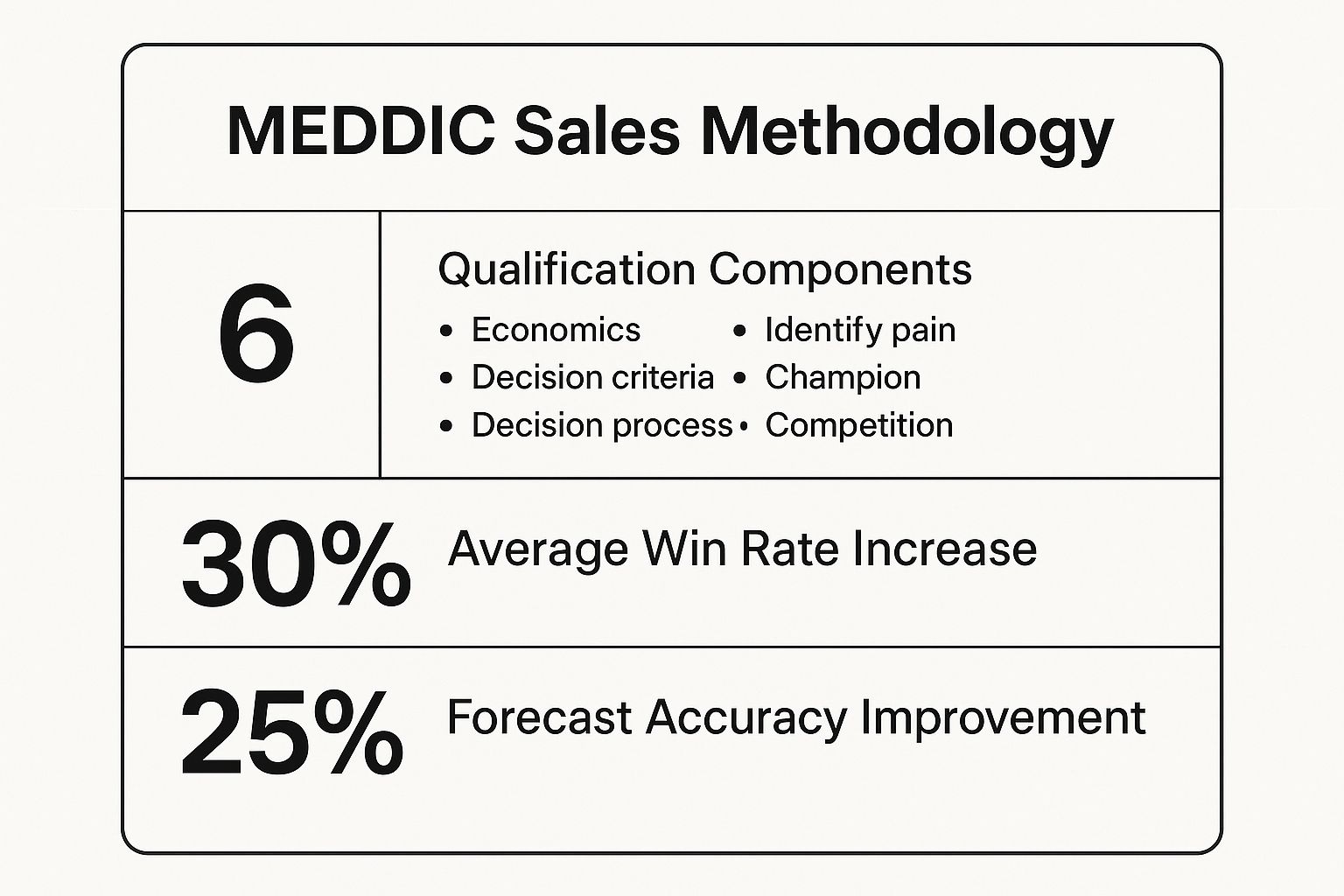
These figures show that by systematically gathering MEDDIC intelligence, sales teams not only win more but also gain a much clearer view of their pipeline.
Key Insight: MEDDIC transforms sales from an art into a science. If you can't confidently check off each letter in the acronym for a given deal, your forecast is based on hope, not data. The framework forces an honest assessment, preventing reps from wasting time on opportunities they can't win.
Best Use Cases for MEDDIC
MEDDIC is exceptionally powerful in enterprise B2B sales environments with long, complex sales cycles and multiple stakeholders. It is the go-to methodology for organizations selling high-value, complex solutions where a deep understanding of the buyer's internal politics and processes is non-negotiable. Companies like Salesforce and other top enterprise software firms have adopted variations of MEDDIC because it provides an unparalleled system for qualifying deals, improving forecast accuracy, and ultimately, driving predictable revenue growth.
5. Sandler Selling System
The Sandler Selling System is one of the best sales methodologies for flipping the traditional sales dynamic on its head. Developed by David Sandler, this approach positions the salesperson as a consultant who qualifies the prospect just as rigorously as the prospect qualifies them. It emphasizes establishing an equal business stature, avoiding the typical cat-and-mouse game of sales by focusing on honest, direct communication.
At its core, Sandler is about systematic qualification and mutual respect. The goal is to identify and disarm sales pressure by creating a transparent process where both parties agree on the next steps.
How the Sandler Selling System Works
The Sandler system is often visualized as a submarine with seven distinct compartments. A salesperson must successfully close the door on one compartment before moving to the next, ensuring no critical step is missed.
- Building Rapport: This goes beyond small talk. It’s about establishing a human connection and creating an environment of trust from the very first interaction.
- Upfront Contracts: Before any substantive discussion, the rep and prospect agree on the agenda, timing, desired outcomes, and what will happen if those outcomes aren't met. This sets clear expectations for every interaction.
- Pain Funnel: Similar to SPIN, this is a structured questioning process. The rep uncovers a prospect's surface-level problems, then digs deeper to understand the business and personal impacts of that pain, making the need for a solution urgent.
- Budget & Decision-Making: Uniquely, Sandler addresses budget and the decision-making process early on, before a solution is ever presented. This prevents reps from wasting time on prospects who cannot or will not buy. If the prospect can't afford the solution, the process stops there.
Key Insight: Sandler’s power comes from its "go for no" mindset. Instead of chasing every lead, reps are encouraged to disqualify poor fits quickly. This frees up their time to focus on high-probability opportunities where they can genuinely solve a significant business pain.
Best Use Cases for Sandler
The Sandler Selling System is highly effective in environments where complex solutions require significant investment and a clear business case. It is commonly adopted by financial services, insurance companies, and professional services firms. The methodology is ideal for sales teams that want to shorten sales cycles by eliminating unqualified leads early. It empowers reps to take control of the sales process, ensuring that every stage of their sales pipeline is managed with intention and clarity. If your team struggles with "think-it-overs" or gets stuck in endless follow-up, Sandler provides a framework for decisive action.
6. Conceptual Selling
Conceptual Selling is one of the most respected best sales methodologies, centered on the idea that customers don't buy a product or service; they buy their concept of a solution to their problem. Developed by Robert Miller and Stephen Heiman, this approach prioritizes understanding the customer's perspective and decision-making process before ever presenting a product. The core principle is "get information before you give information."
This methodology frames the sale as a joint venture where the salesperson acts as a consultant, helping the customer define their ideal outcome. By aligning the solution with the customer’s pre-existing concept, the sales process becomes collaborative rather than confrontational.
How Conceptual Selling Works
Conceptual Selling revolves around uncovering the customer's "Concept" through strategic questioning and aligning every sales activity to a "Single Sales Objective."
- Discover the Concept: Sales reps ask three types of questions to understand the prospect's world:
- Information Questions: Gather facts about the current situation.
- Attitude Questions: Uncover personal feelings, goals, and motivations of stakeholders.
- Commitment Questions: Test the prospect's willingness to move forward.
- Map the Buying Influences: It identifies key roles in the decision: the Economic Buyer (final approval), the User Buyer (will use the solution), the Technical Buyer (evaluates feasibility), and the Coach (provides internal guidance).
- Define the Single Sales Objective (SSO): For every customer interaction, the salesperson defines a clear, specific, and measurable action they want the customer to take. This ensures every meeting has a purpose and moves the deal forward.
Key Insight: The sale is won or lost based on your ability to understand and align with the customer’s vision. Instead of pushing your solution, you help the customer build a mental model of their ideal result, and then demonstrate how your offering is the perfect fit for that model.
Best Use Cases for Conceptual Selling
Conceptual Selling is highly effective in complex, multi-stakeholder enterprise environments where solutions are not one-size-fits-all. It is a go-to methodology for professional services, consulting, and high-value technology sales where understanding nuanced business needs and navigating internal politics is crucial. If your sales cycle involves multiple decision-makers with different priorities, Conceptual Selling provides the framework needed to build consensus and guide the collective group toward a purchase decision.
7. SNAP Selling
SNAP Selling is one of the best sales methodologies designed specifically for the modern, overwhelmed buyer. Developed by Jill Konrath, it acknowledges that today's prospects are frazzled, have limited time, and are wary of complex solutions. The core principle is to make the buying process as simple and seamless as possible for the customer. The acronym SNAP guides salespeople to be more effective by adapting their approach to the buyer's reality.
The methodology provides a framework to cut through the noise and earn the attention of busy decision-makers, positioning the salesperson as a valuable resource rather than just another vendor.
How SNAP Selling Works
SNAP Selling is built on four core principles, guiding every interaction with the prospect:
- Simple: Keep your communication incredibly simple and easy to understand. This means using concise language, avoiding jargon, and presenting information in digestible formats. The goal is to reduce the mental effort required for the buyer to engage with you.
- iNvaluable: In every touchpoint, from an email to a demo, you must provide value. This means sharing relevant insights, offering useful resources, and demonstrating a deep understanding of the prospect's business. You become an indispensable source of information.
- Align: Ensure your solution is directly aligned with the prospect's key business objectives, goals, and priorities. Salespeople must clearly connect their product's benefits to what the buyer genuinely cares about achieving.
- Priorities: Modern buyers are juggling multiple initiatives. A key part of SNAP is to help them understand why your solution should be a top priority. This involves creating a sense of urgency by highlighting the cost of inaction or the immediate gains of moving forward.
Key Insight: SNAP Selling’s power comes from its buyer-centric empathy. It assumes the customer is overwhelmed and makes it the seller’s job to simplify the decision, provide clear value, and align with existing priorities, thereby making it easy for the buyer to say "yes."
Best Use Cases for SNAP
SNAP Selling is highly effective in fast-paced sales environments where decision-makers are time-poor and information-saturated. It is ideal for technology companies selling to busy IT executives, sales teams targeting C-level decision-makers, or anyone selling to overwhelmed small business owners. If your buyers often delay decisions due to complexity or a lack of clear ROI, SNAP provides a framework to streamline the process, create urgency, and secure commitment more efficiently.
8. Value Selling
Value Selling is one of the best sales methodologies for shifting conversations from price and features to measurable business outcomes. Popularized by firms like Value Selling Associates, this approach positions the sales representative as a strategic business consultant. The core principle is that customers buy outcomes, not products, so every interaction should focus on quantifying and communicating the financial impact and return on investment (ROI) your solution provides.
This methodology forces a deep understanding of the customer's business, enabling salespeople to build a compelling business case that resonates with executive decision-makers who care about the bottom line.
How Value Selling Works
Value Selling is built on a framework that connects your solution’s capabilities directly to the prospect's most critical business issues. It requires sellers to become fluent in the language of business value.
- Discover Business Issues: First, identify the high-level business problems the prospect is facing (e.g., declining market share, rising operational costs, or poor customer retention).
- Connect to Problems: Drill down to understand the specific problems contributing to these issues (e.g., "Our manual lead routing process causes a 24-hour delay, which is hurting our speed-to-lead and conversion rates.").
- Quantify the Impact: Work with the prospect to assign a monetary value to the problem. This involves calculating the cost of inaction (e.g., "That delay costs us an estimated $250,000 in lost revenue per quarter.").
- Present a Valued Solution: Frame your solution in terms of the value it creates. Instead of listing features, present a business case showing how your product solves their quantified problem and delivers a clear ROI.
Key Insight: Value Selling fundamentally changes the negotiation dynamic. When you have collaboratively built a business case that proves your solution delivers a 10x ROI, objections about a price that is 10% higher than a competitor’s become irrelevant.
Best Use Cases for Value Selling
Value Selling is indispensable in competitive markets where products are highly commoditized or when selling high-ticket enterprise solutions. It excels when the decision-maker is a CFO, CEO, or another executive leader who is primarily motivated by financial metrics like profitability, cost savings, and revenue growth. If your solution delivers a clear, quantifiable financial benefit, especially in complex B2B sales cycles, this methodology provides a powerful framework to justify the investment and close larger deals.
9. Insight Selling
Insight Selling is an advanced sales methodology where the representative leads with valuable perspectives that challenge a customer's assumptions and illuminate unrecognized needs or opportunities. Popularized by experts like Mike Schultz and John Doerr of RAIN Group, this approach positions the salesperson not just as a problem-solver but as a source of market intelligence and strategic guidance. It's among the best sales methodologies for building credibility in a crowded market.
Instead of reacting to a buyer’s stated needs, an insight-led seller proactively introduces new ideas that reframe the customer’s thinking about their own business, creating a powerful link between the insight and the seller's unique solution.
How Insight Selling Works
The core of Insight Selling is a three-part process of diagnosing, differentiating, and resonating with the customer on a deeper level.
- Educate with New Ideas: The process begins with sharing a compelling, data-backed insight that reveals a previously unknown problem or a missed opportunity. For example, a technology consultant might share data showing how a company’s competitors are gaining market share through a new digital transformation trend.
- Reframe the Conversation: This insight challenges the customer's current worldview, causing them to reconsider their priorities and strategies. The goal is to shift the conversation from "what we need" to "what we should be doing differently."
- Connect to Your Solution: After establishing the new problem or opportunity, the salesperson connects their solution as the ideal way to act on this newfound insight. This makes the offering feel less like a product and more like an essential strategic tool.
Key Insight: In Insight Selling, the value isn't just in your product; it's in the sales conversation itself. When you teach a prospect something valuable about their own business, you create a powerful sense of obligation and differentiate yourself from every competitor who is simply asking about their budget and timeline.
Best Use Cases for Insight Selling
This methodology is highly effective in complex, competitive B2B markets where buyers are sophisticated and already well-informed. It thrives in industries undergoing rapid change, such as technology, financial services, and professional consulting, where bringing new perspectives is a significant differentiator. If your sales team has deep industry expertise and your solution enables a new or better way of doing business, Insight Selling provides the framework to elevate your conversations from transactional to truly strategic partnerships.
10. BANT Qualification
BANT stands as a classic, time-tested framework among the best sales methodologies, designed for rapid lead qualification. Developed by IBM, it gives salespeople a simple yet effective checklist to determine if a prospect has the potential to become a customer. The goal is to quickly filter opportunities, ensuring that sales reps invest their valuable time on leads with the highest probability of closing.
This methodology helps prevent reps from wasting cycles on prospects who lack the fundamental ability or intent to buy. The acronym BANT provides a clear, memorable structure for this initial assessment.
How BANT Qualification Works
The BANT framework prompts salespeople to gather information across four critical pillars to qualify a prospect:
- Budget: Does the prospect have the financial resources allocated to purchase your solution? This involves questions like, "What budget has been set aside for this type of initiative?" or "How do you typically fund new projects like this?"
- Authority: Is your contact the person with the power to make the final purchasing decision? If not, who is? This is uncovered with questions such as, "Who else, besides yourself, is involved in the decision-making process?"
- Need: Does the prospect have a specific, compelling business pain that your product or service can solve? This is the core of qualification, explored through questions like, "What challenge prompted you to look for a solution now?"
- Timeline: Is there an established, urgent timeframe for implementing a solution? Questions like, "What is your target date for having a solution in place?" help gauge the prospect's sense of urgency.
Key Insight: BANT is most powerful when used as a conversational guide, not a rigid interrogation. The goal isn't just to check boxes but to understand the prospect's situation. A "no" on one criterion, like Budget, doesn't always mean a dead end; it could mean an opportunity to help them build a business case.
Best Use Cases for BANT
BANT is highly effective for inside sales teams and organizations dealing with a high volume of inbound leads. It provides a standardized, efficient way to triage opportunities and ensure marketing and sales efforts are aligned. While modern sales often involve more complex buying committees, BANT remains an excellent starting point for initial qualification. Beyond understanding the BANT framework, mastering the broader process of how to qualify leads is essential for boosting conversions and ensuring your sales team focuses on the right opportunities. It's particularly useful when sales resources are limited and prioritizing leads is critical for hitting targets.
Top 10 Sales Methodologies Comparison
| Methodology | 🔄 Implementation Complexity | ⚡ Resource Requirements | 📊 Expected Outcomes | 💡 Ideal Use Cases | ⭐ Key Advantages |
|---|---|---|---|---|---|
| SPIN Selling | Moderate to high; requires mastering questioning skills | Skilled salespeople with strong listening | High-quality needs discovery and trust building | Complex B2B sales, longer sales cycles | Proven effectiveness, consultative, customer-centric |
| Challenger Sale | High; needs deep industry knowledge and confidence | Trained reps with business insights | Higher win rates, larger deals, customer challenge | Complex B2B, new customer acquisition, competitive | Differentiates via insights, controls conversation |
| Solution Selling | Moderate to high; diagnostic and solution development | Sales + technical experts collaboration | Increased deal size, stronger relationships | Complex solutions, consultative sales roles | Customized solutions, reduces price sensitivity |
| MEDDIC | High; disciplined qualification enforcement | Trained reps focused on metrics and process | Improved forecast accuracy, better opportunity prioritization | Complex B2B, multiple stakeholders, long cycles | Systematic qualification, reduces guesswork |
| Sandler Selling System | Moderate to high; mindset shift required | Training intensive, cultural adaptation | Fewer unqualified prospects, more honest conversations | Transactional to mid-complexity sales | Early budget focus, systematic objection handling |
| Conceptual Selling | Moderate; patience and strong info gathering | Skilled questioning and decision mapping | Better solution fit, reduced misunderstandings | Complex B2B with multiple decision-makers | Focuses on customer's concept, builds relationships |
| SNAP Selling | Moderate; needs discipline to stay simple | Focused on making sales process easy | Faster decision-making, better buyer alignment | Busy executives and time-pressed decision makers | Addresses overwhelmed buyers, practical framework |
| Value Selling | High; requires financial acumen and analysis | Business and finance expertise | Larger margins, reduced price sensitivity | High-value B2B sales requiring ROI justification | Quantifies business value, aligns with executives |
| Insight Selling | High; ongoing market research and insight generation | Investment in industry expertise | Creates new demand, builds advisor trust | Consultative roles, complex B2B environments | Thought leadership, perspective shifting |
| BANT Qualification | Low to moderate; simple framework | Minimal resources, easy lead screening | Faster lead triage, prioritization | Lead qualification, inside sales, transactional sales | Quick qualification, easy to understand and apply |
From Methodology to Mastery: Activating Your Sales Blueprint
Navigating the landscape of the best sales methodologies can feel like learning a new language. From the diagnostic questioning of SPIN Selling to the authoritative insight delivery of the Challenger Sale, and the rigorous qualification of MEDDIC, each framework offers a distinct path to revenue. We've journeyed through ten powerful blueprints, each with its own philosophy, tactical approach, and ideal customer scenario. Yet, the most critical takeaway is not which one you choose, but how you commit to activating it within your organization.
Selecting a methodology is merely the starting point. True mastery and transformation are born from deliberate, consistent, and organization-wide implementation. A methodology cannot live in a forgotten training manual or a one-off seminar. It must become the living, breathing DNA of your sales culture, influencing every discovery call, every product demo, and every negotiation.
The Myth of the "Perfect" Methodology
One of the most common pitfalls for sales leaders is the endless search for a single, perfect, one-size-fits-all framework. The reality is that it doesn't exist. The best sales methodologies are not rigid doctrines to be followed without question; they are adaptable structures. The most effective sales teams don't just adopt a methodology, they adapt it.
Consider a team selling a highly complex, enterprise-level SaaS product. They might build a hybrid model that starts with the Challenger Sale to disrupt the status quo and earn a seat at the table. From there, they could pivot to Solution Selling to diagnose deep-seated business pains, and then use MEDDIC as a final qualification checklist to ensure the deal is solid and forecastable. This intelligent blending, tailored to your specific product, market, and sales cycle, is where sustainable success is found.
From Theory to Practice: Your Actionable Next Steps
Transitioning from theoretical knowledge to practical execution is the most challenging, yet most rewarding, part of this process. It requires more than just announcing a new initiative. It requires a dedicated, multi-faceted strategy. Here is your roadmap to activate your chosen sales blueprint:
Conduct a Sales Process Audit: Before implementing anything new, you must understand your current state. Where are deals stalling? What are your top performers doing differently? Analyzing your existing process will reveal the specific gaps a new methodology can fill. This foundational step is crucial for optimizing your sales process and ensuring your efforts are targeted effectively.
Secure Universal Buy-In: A methodology pushed from the top down without genuine buy-in is doomed to fail. Involve your sales reps in the selection process. Host workshops to discuss the pros and cons of different frameworks and gather their feedback. When your team feels a sense of ownership, their commitment to adoption will skyrocket.
Integrate and Automate: Your chosen framework must be embedded directly into your daily workflow, primarily within your CRM. Create custom fields for MEDDIC criteria, build templates for SPIN questions, and develop talk tracks for Challenger insights. Crucially, support this structure with automation that removes administrative friction. The goal is to make following the methodology the path of least resistance for your reps.
Key Insight: A sales methodology without technological reinforcement is just a suggestion. A methodology supported by smart automation becomes a high-performance engine.
By combining the strategic structure of a framework like MEDDIC or the Challenger Sale with operational excellence, you create a system that is both repeatable and scalable. You empower your reps to stop wasting time on manual tasks and start dedicating their full attention to what they do best: building relationships, providing value, and closing deals. The synergy between a powerful methodology and intelligent tools is what transforms a good sales team into an unstoppable revenue-generating force, fully prepared to meet the demands of tomorrow's market.
Ready to eliminate friction and empower your sales team to master their chosen methodology? Distro automates lead routing and meeting scheduling, instantly connecting your reps with high-intent prospects so they can apply their skills when it matters most. See how Distro can activate your sales blueprint and turn speed-to-lead into your ultimate competitive advantage.