Think of the sales cycle as your team's playbook for turning a stranger into a happy customer. It’s the repeatable sequence of steps your reps follow to move a potential buyer from initial interest all the way to a signed deal. This isn't some rigid, one-size-fits-all script; it’s a flexible framework you shape around your industry, your product, and most importantly, your buyer.
Your Map to Closing More Deals
Without a defined sales cycle, your team is flying blind. Sales efforts become chaotic and unpredictable. Deals stall for no clear reason, follow-ups get missed, and forecasting turns into a wild guessing game.
A well-defined cycle changes all that. It gives your team a shared language and a clear path forward, transforming uncertainty into a predictable, measurable process. This framework is essential for a few key reasons:
- Forecast with Confidence: When you know the typical path a deal takes, you can track its progress and project future revenue with far greater accuracy.
- Pinpoint Bottlenecks: A clear process immediately shows you where deals are getting stuck. Is it at the demo stage? Negotiation? Now you know exactly where to focus your coaching.
- Build a Scalable Process: It provides a blueprint for new hires. They can get up to speed faster and start contributing sooner, making it much easier to grow your sales team effectively.
A defined sales process isn't just an internal tool; it provides a consistent and professional experience for the buyer, guiding them through their decision-making journey without pressure.
At its core, the sales cycle is a series of stages that reflect the buyer's journey. While the specifics can vary, most follow a similar pattern from initial awareness to the final purchase.
Here's a quick look at the standard stages you'll find in most sales cycles. Think of this as the basic template you can customize for your own process.
The 7 Core Stages of a Typical Sales Cycle
| Stage Number | Stage Name | Primary Goal |
|---|---|---|
| 1 | Prospecting | Identify potential customers (leads) who fit your ideal customer profile. |
| 2 | Connecting | Make initial contact with the lead to gauge interest and gather information. |
| 3 | Qualifying | Determine if the lead is a good fit and has a genuine need for your solution. |
| 4 | Nurturing | Build a relationship and provide value to the prospect, keeping them engaged. |
| 5 | Presenting | Demonstrate your product or service, highlighting its value and benefits. |
| 6 | Handling Objections | Address any concerns or questions the prospect has about your solution. |
| 7 | Closing the Deal | Finalize the agreement and get the contract signed. |
Each stage represents a milestone for both the seller and the buyer. By understanding where a prospect is in their journey, your reps can deliver the right message at the right time.
The Value of a Repeatable Process
Ultimately, mastering your sales cycle is about building a system for consistent growth. It moves your organization away from relying on a few star performers and toward a model where every team member has a clear map to success.
This structured approach is so effective that companies are increasingly looking for outside help to perfect it.
The global outsourced sales services market, valued at $2.71 billion, is projected to rocket to $4.21 billion by 2034. This explosion shows just how focused businesses are on dialing in their sales process. By mastering this journey, you’re not just closing more deals—you’re building a more resilient and predictable revenue engine.
Breaking Down the 7 Sales Cycle Stages
While every business puts its own spin on things, the journey from a curious prospect to a happy customer usually follows a pretty predictable path. Getting a handle on these distinct stages is the first step to truly understanding—and managing—your sales cycle.
Let's walk through the seven core stages, looking at what your team is doing and what the buyer is experiencing every step of the way.
Stage 1: Prospecting
This is ground zero. It’s where your sales team hunts for potential customers, or leads. Think of it like panning for gold; you're sifting through the market to find businesses that perfectly match your Ideal Customer Profile (ICP). This isn't just about finding anyone—it's about finding the right one.
Good prospecting isn’t a blind outreach campaign. It involves solid research to make sure the leads you find actually have a problem your product can solve. To get your sales cycle started on the right foot, it's critical to use proven lead generation strategies. The effort here really does set the tone for everything that follows.
You can see how a huge pool of initial leads gets whittled down as they move through the first few stages.
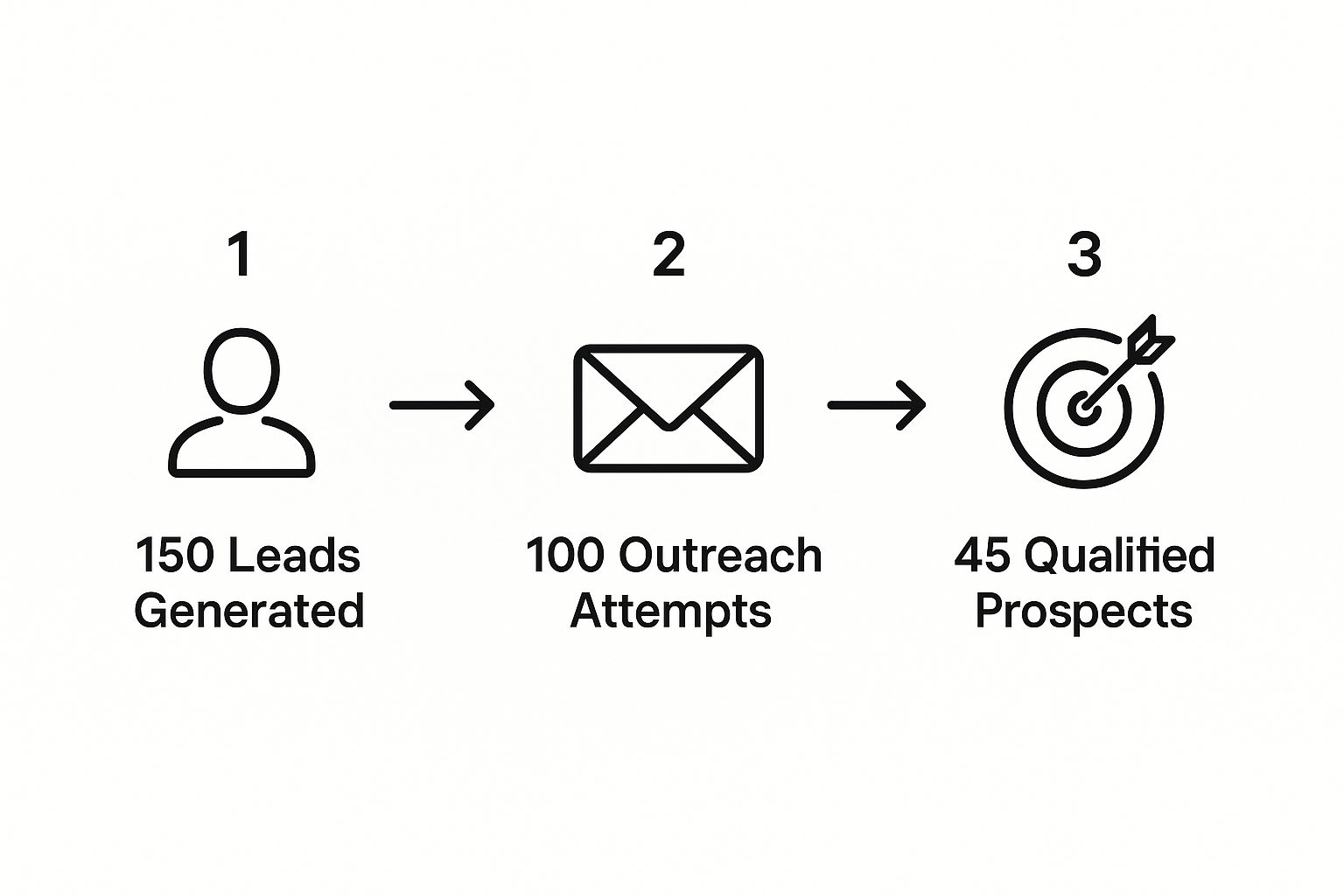
This visual drives home the natural funnel effect in sales. It’s exactly why you need a high volume of quality leads at the top to hit your numbers at the bottom.
Stage 2: Contacting
Once you’ve spotted a promising lead, it’s time to make first contact. This is all about opening up a dialogue, whether that's through a cold call, a personalized email, or even a message on social media. The goal isn't a hard sell. Not even close. It's just to start a conversation.
Your rep’s job is to simply introduce the company and start learning about the prospect's world. For the buyer, this is their first real interaction with your brand, making it a make-or-break moment for building that initial spark of trust.
Stage 3: Qualifying
Look, not every prospect is going to be a perfect fit. This is the stage where you figure out who’s a serious contender and who’s just window shopping. Qualifying means confirming that a lead has a real need, the budget to buy, and the authority to sign on the dotted line. It’s how you stop wasting precious time on deals that were never going anywhere.
A classic framework for this is BANT:
- Budget: Can they actually afford your solution?
- Authority: Are you talking to the decision-maker, or at least someone who has their ear?
- Need: Do they have a clear pain point that you can actually fix?
- Timeline: Is there a specific timeframe they're working with to find a solution?
By asking these tough questions early, your team can zero in on the opportunities that have a real shot.
Stage 4: Nurturing
Here’s the thing: most qualified leads aren't ready to buy the second you talk to them. Nurturing is all about building a relationship and staying on their radar until the timing is right. It’s about giving them value without asking for anything in return.
This could be as simple as sharing a helpful blog post, inviting them to a webinar, or sending over a case study you know they'll find interesting. You want to position your company as a trusted advisor, not just another vendor trying to make a sale. For the buyer, this is where they’re learning more about their own problems, with your brand as their helpful guide.
Nurturing is the art of building trust over time. It’s about proving you understand the buyer’s challenges and are genuinely invested in their success, long before they ever see a contract.
Stage 5: Presenting
Okay, you've built trust and rapport. Now it's time to officially present your solution. This is your moment for the product demo, the sales presentation, or the detailed proposal. The absolute key here is to tailor the pitch directly to the specific needs and pain points you dug up during the qualifying stage.
Don't just rattle off a list of features. Show them the real, tangible value your solution will bring to their business. This is the "aha!" moment for the buyer, where they can finally see exactly how your product is going to make their problem disappear.
Stage 6: Handling Objections
It's pretty rare for a prospect to just say "yes" without any questions. Objections are a normal—and honestly, a good—part of the sales process. It means the prospect is engaged and thinking seriously about what you're offering. The usual suspects are concerns about price, timing, features, or the competition.
A great sales rep doesn't get defensive. They listen, validate the concern, and then provide a thoughtful response that reframes the conversation around value. This is a massive step in building their confidence and clearing any final hurdles.
Stage 7: Closing
This is it—the final step where you ask for the business. You've presented your case and handled all the objections. Now it’s time to negotiate the terms, get the contract finalized, and collect that signature. This is where all the hard work from the previous six stages pays off.
This entire journey, from that first prospect to the final close, makes up your sales pipeline. And knowing how to manage it is the secret to predictable revenue. To dig deeper, check out our complete guide on sales pipeline management best practices. A successful close might be the end of the sales cycle, but it’s really just the beginning of a long and profitable customer relationship.
How Long Should Your Sales Cycle Really Be?

Asking "how long should my sales cycle be?" is a bit like asking "how long is a piece of string?" The only real answer is: it depends. There’s no magic number that works for every company. The goal isn’t to hit some arbitrary timeline, but to build the most efficient and predictable process for your specific market.
Think of your ideal cycle length as a unique fingerprint. It's shaped by a mix of external market forces you can't control and internal processes you absolutely can.
The External Forces That Dictate Your Timeline
A few powerful factors outside your direct control will naturally stretch or shrink the time it takes to close a deal. Understanding these is key to setting realistic benchmarks and managing expectations across your organization.
- Industry & Market: Some sectors just move slower than others. A straightforward retail purchase closes in a snap compared to a complex enterprise software deal bogged down by regulations and legacy buying habits.
- Product Complexity: Selling a simple, plug-and-play tool is a world away from selling a highly customized platform that needs serious technical validation. The more complex the solution, the more due diligence the buyer needs, tacking on extra time.
- Price Point: A bigger price tag always invites more scrutiny. A $50,000 deal will face a far more rigorous approval gauntlet involving multiple layers of management and finance than a $500 one.
- Number of Decision-Makers: The more people who need to sign off, the longer it’s going to take. Just trying to navigate the calendars and priorities of multiple stakeholders is often one of the biggest slowdowns in B2B sales.
The key isn’t to fight these external factors, but to understand them. When you acknowledge the realities of your market, you can build a sales process that anticipates delays and proactively addresses the complexities of your buyer's world.
What Do Industry Benchmarks Say?
While your company is unique, industry data provides a valuable gut check. It helps you see if your sales cycle is in the right ballpark or if there’s a massive opportunity for improvement just waiting to be seized.
Sales cycle lengths vary wildly by sector. The software industry, for instance, averages around 90 days to close a deal. Compare that to sectors like energy and pharmaceuticals, which have much longer cycles at 155 days and 153 days, respectively. On the quicker side, you’ll find retail clocking in at about 70 days. You can find more sales cycle benchmarks for your industry to see how you stack up.
Internal Factors You Can Actually Control
This is where you can really make a difference. You can't change your industry, but you can absolutely sharpen your internal processes to be as swift and effective as possible. Optimizing these areas will have a direct, measurable impact on your sales cycle length.
Your internal efficiency is the true driver of velocity.
- Lead Quality: Are you chasing down every single lead, or are you zeroing in on high-intent prospects who actually match your ideal customer profile? A tight qualification process ensures your team invests their precious time where it counts, preventing wasted cycles on deals that were never going to close anyway.
- Sales Process Efficiency: How smooth is your process, really? Delays between stages, manual handoffs, and administrative bottlenecks all add unnecessary time. Automating tasks like scheduling and lead routing can eliminate friction and keep the momentum going.
- Sales Team Skillset: An experienced team that nails discovery, handles objections with ease, and knows how to build urgency will naturally close deals faster than a team that's still learning the ropes. This is why continuous training and coaching are non-negotiable for compressing timelines.
To really see how different variables pull your sales cycle in opposite directions, it helps to lay them out side-by-side.
Factors Influencing Sales Cycle Length
| Factor | Impact on Shortening Cycle | Impact on Lengthening Cycle |
|---|---|---|
| Price Point | Lower price points with minimal budget approval needed. | High-ticket items requiring multiple sign-offs and financial scrutiny. |
| Product Complexity | Simple, out-of-the-box solutions that are easy to understand. | Highly customized platforms needing technical validation and integration planning. |
| Decision-Makers | A single, empowered decision-maker can approve the purchase quickly. | A large buying committee with competing priorities and packed schedules. |
| Lead Quality | High-intent, pre-qualified leads who have a clear and urgent need. | Unqualified, low-intent leads who are "just browsing" or are a poor fit. |
| Process Efficiency | Automated handoffs, clear next steps, and minimal admin work for reps. | Manual processes, internal bottlenecks, and reps bogged down in CRM updates. |
| Sales Team Skill | Experienced reps who are experts at discovery, objection handling, and creating urgency. | Inexperienced reps who are still developing their core sales competencies. |
Ultimately, your sales cycle is a direct reflection of both the market you serve and the efficiency of the machine you've built to serve it. The best companies don't just accept their timeline; they measure it, understand it, and relentlessly optimize every single part of it they can control.
The Sales Playbook Has Changed. Radically.
Let's be honest, the old-school sales playbook is gathering dust for a reason. It used to be simple: sellers had all the information, and they guided buyers down a straight, predictable path.
Not anymore. The tables have completely turned. Today, the B2B buyer is firmly in the driver's seat, and they're not asking for directions.
This isn't just some passing trend; it's a fundamental rewiring of how people make buying decisions. Modern buyers are more informed, more self-sufficient, and way more skeptical of the classic sales pitch. They don't wait for a sales rep to tell them what they need—they've already done their homework.
This new reality means we have to completely rethink the sales cycle. The old, seller-centric "push" model is officially dead. It’s time for a buyer-centric "pull" approach that meets them where they are, instead of interrupting their journey.
The Buyer Is in Control Now
Here’s the biggest shift: buyers get a huge amount of their research done on their own, long before a salesperson ever gets involved. They’re digging into blog posts, reading G2 reviews, and asking their peers for recommendations to build a shortlist.
In fact, buyers are so independent that they complete nearly 70% of their journey before ever engaging with a sales rep. And to make things even more complex, the average B2B purchase now involves about 7.4 different decision-makers. You can see more stats on today's B2B sales world to really grasp this shift.
What does that mean for you? By the time your team finally lands a meeting, the prospect has already formed strong opinions and likely narrowed their options down to just a few contenders.
The modern sales cycle isn't about controlling the flow of information anymore. It's about earning a seat at a conversation that already started without you.
Your role has evolved from being a gatekeeper to a trusted advisor. The goal is to add real value at every single touchpoint, helping prospects make sense of the complex information they’ve already gathered.
How to Align Your Sales Cycle With Today's Buyer
To win in this new environment, your sales process has to mirror how people actually buy things. That means ditching the aggressive pitch and focusing on being genuinely helpful. Here's what a modern, buyer-centric sales cycle is built on.
- Build Trust by Adding Value: Your first job is to be a resource, not a vendor. Share valuable content—insightful blog posts, original research, practical case studies—that solves your buyers' problems without asking for anything in return.
- Engage on Their Terms: Buyers want to connect on the channels they already use, at times that work for them. Your process needs to be flexible enough to handle conversations across email, social media, live chat, and video calls.
- Personalize Every Single Interaction: Generic, one-size-fits-all messages are an instant deal-killer. Use the data you have to show you understand a prospect's specific industry, role, and challenges. Make it clear you've done your homework, too.
- Act Like a Consultant: Your reps need to be more than just product experts; they need to be problem-solvers. This requires a deep understanding of the customer's business and the ability to diagnose issues and recommend the right solutions.
This isn't a small tweak. It's a complete mindset shift for the entire sales organization.
From Interruption to Guidance
The key takeaway is simple but profound: you can no longer force a buyer through your predefined sales stages. You have to understand their journey and align your process to support them every step of the way. It’s about being present and helpful wherever they're already looking for answers.
A successful modern sales cycle makes the buying process easier, clearer, and more valuable for the customer. It's less of a rigid checklist for your reps and more of a flexible framework designed to empower an already-empowered buyer.
When you focus on building trust and providing genuine guidance, you position your team not as salespeople, but as indispensable partners. And that’s the real path to closing deals and building relationships that last.
The Metrics You Need to Manage Your Sales Cycle

You can't improve what you don't measure. Having a well-defined sales cycle is a great start, but to really dial it in, you need to be tracking the right key performance indicators (KPIs). These are the numbers that turn your sales process from a list of activities into a predictable engine for growth.
Think of these KPIs as the dashboard for your sales machine. They tell you how fast you're going, how efficiently you're using fuel, and where you might need a tune-up. By keeping an eye on them, you can ditch the guesswork and start making data-driven decisions that actually move the needle.
Key Sales Cycle Metrics to Track
To get a clear picture of your process's health, you don’t need to drown in dozens of complicated reports. Start by focusing on a few essential metrics that give you the most actionable insights.
Sales Cycle Length: This is the average time it takes to close a deal, from that very first contact to the final signature. Tracking this helps you set realistic forecasts and immediately spot when deals are dragging on longer than they should. A lengthening cycle might point to new friction in your process or even a shift in the market.
Conversion Rate by Stage: This metric shows you the percentage of deals that successfully move from one stage of your cycle to the next. It’s one of the most powerful diagnostic tools you have. A low conversion rate between "Presentation" and "Handling Objections," for example, tells you exactly where your team needs more coaching.
Win Rate: The big one. This is the overall percentage of opportunities that become closed-won deals and it’s the ultimate measure of your sales effectiveness. Improving this number is a direct path to higher revenue without needing a single extra lead.
When you put these data points together, you get a complete picture of your sales performance. You can see not only how many deals you’re winning but also how efficiently you’re getting them across the finish line. It helps you focus your efforts where they'll make the biggest difference. Learning how to improve sales productivity almost always starts with a deep dive into these numbers.
Understanding Your Financial Efficiency
Beyond just tracking deal flow, you have to understand the financial health of your sales efforts. This is where cost-related metrics come into play, helping you ensure your growth is both profitable and sustainable.
A critical metric for evaluating the efficiency and effectiveness of your sales cycle is understanding your customer acquisition cost (CAC) calculation. This number tells you exactly how much you're spending on sales and marketing to acquire a single new customer.
A rising CAC could mean you're spending too much on low-quality leads or that your sales process has become bloated. Paired with Customer Lifetime Value (LTV), it helps you determine if your whole acquisition strategy is profitable in the long run. The simple goal is to keep your LTV significantly higher than your CAC.
By consistently monitoring these KPIs, you can uncover hidden bottlenecks, make smarter coaching decisions, and continuously fine-tune your approach. This is how you transform your sales cycle from a simple process into a powerful strategic advantage.
Actionable Strategies to Shorten Your Sales Cycle
Knowing your sales cycle is one thing. Actually shrinking it? That’s where you start to pull away from the competition.
A shorter cycle means revenue hits the books faster, customer acquisition costs go down, and your sales team operates like a well-oiled machine. The point isn’t to strong-arm buyers into a quick decision. It’s about removing all the friction and unnecessary delays that get in their way.
You can do this by focusing on a few high-impact areas: refining your internal processes, giving your team the right tools, and using smart tech to kill the administrative busywork.
Sharpen Your Lead Qualification Process
Let's be honest: not all leads are created equal. Treating them like they are is one of the biggest time-sucks in any sales org. Chasing after unqualified prospects means burning countless hours on deals that were never, ever going to close.
The fix? Get laser-focused on spotting the high-intent buyers right from the start.
Put a clear lead scoring model in place that looks at firmographics (like company size and industry) and behavioral cues (what pages did they visit on your site? Did they download that big case study?). This gives your team a simple system to prioritize outreach, making sure they spend their precious time with prospects who actually have a problem you can solve.
When your qualification process is tight, your pipeline naturally fills up with higher-quality opportunities. And guess what? Higher-quality deals just move faster.
Build a Proactive Content Library
Today’s buyers do a ton of research on their own before they ever talk to a salesperson. You can speed this whole process up by giving them the exact info they need, right when they need it. Don't wait for them to ask—get ahead of their questions with a solid content library.
Your library should be stocked with:
- Case Studies: Real-world proof that shows prospects what success looks like.
- Pricing Guides: Clear, easy-to-digest pricing info that tackles the budget question head-on.
- Comparison Sheets: Honest breakdowns of how you stack up against the competition, highlighting your unique advantages.
- Technical Docs: The nitty-gritty details for the technical folks who need to make sure your solution plays nice with their stack.
When your reps can fire off these resources in a second, they eliminate days—sometimes weeks—of back-and-forth. They're not just selling; they're becoming a genuinely helpful resource, which builds a ton of trust.
Leverage Technology to Eliminate Friction
Manual tasks are the silent killers of sales velocity. All that time spent updating the CRM, logging calls, and scheduling meetings doesn't actually move a deal forward. It just bogs your team down. This is where automation is a total game-changer.
By automating the repetitive stuff, you free up your sales team to do what they do best: build relationships and sell. The right tech doesn't just make things faster; it makes the whole process smarter.
Take Distro, for example. It's built to solve one of the biggest early bottlenecks: getting a hot lead to the right rep, right now. Instead of a new lead sitting in a queue for hours waiting for someone to assign them, Distro instantly routes them to the correct rep's calendar based on rules you set up. That immediate connection captures a buyer’s interest when it’s at its peak and can literally shave days off the front end of your sales cycle.
To find other areas for improvement, you can also check out a strategic guide to operational efficiency improvement and use data to guide your decisions. The secret sauce is combining smart processes with powerful automation to create a lean, mean, sales machine.
Putting these strategies into practice creates a smoother sales experience for everyone involved—your team and your customers. For a deeper dive into more tactics, check out our detailed guide on how to shorten your sales cycle.
Still Have Questions About the Sales Cycle?
Even with a solid plan, a few questions always seem to pop up when you're deep in the trenches of defining and managing a sales cycle. Let's tackle some of the most common ones.
What Is the Difference Between a Sales Cycle and a Sales Funnel?
It’s easy to get these two mixed up, but they represent two very different perspectives.
Think of the sales cycle as the seller's roadmap. It’s the sequence of steps your team takes to move a deal from A to Z—prospecting, qualifying, presenting, closing. It’s an active, process-driven view from your side of the table.
The sales funnel, on the other hand, is the buyer's journey. It’s a visual that shows how the total number of potential customers shrinks as they move from initial awareness all the way down to making a purchase. The cycle is your team's "how," while the funnel is the customer's "what."
How Often Should We Adjust Our Sales Cycle Stages?
There’s no single right answer, but a good rhythm is to review your sales cycle quarterly and do a much deeper analysis once a year. This cadence keeps you in sync with market changes and your team's actual performance.
But don't wait for the calendar. You need to do an immediate review any time there's a major shift in the business—like launching a new product, breaking into a new market, or if you spot a consistent drop-off in your conversion rates between stages.
The goal is to make sure your process reflects how your customers want to buy today, not how they bought last year.
Can CRM Software Help Manage the Sales Cycle?
Absolutely. In fact, it’s practically essential. Your CRM is the command center for your entire sales cycle. It’s where you centralize every prospect interaction, automate critical follow-ups, and get the hard data on things like cycle length and conversion rates.
A well-used CRM gives you a clear, data-backed picture of your pipeline and shines a spotlight on bottlenecks. It transforms your sales cycle from a theoretical map into a living, breathing system you can actually manage and improve.
Ready to eliminate the biggest bottleneck in your sales cycle? Distro instantly routes high-intent leads from your demo forms to the right sales rep's calendar, capturing buyer interest when it's at its peak. See how you can 3X your demo request conversions at https://distro.so.