So, what is pipeline management? It's the hands-on process of guiding every single sales opportunity through a defined set of stages, all the way from that first handshake to a signed contract.
Think of it as the active discipline of turning potential leads into predictable revenue. It’s how you make sure no deal falls through the cracks, bringing order, visibility, and—most importantly—control to your sales efforts.
Unlocking Predictable Revenue With Pipeline Management

If your sales pipeline is the roadmap for your deals, then pipeline management is how you actively navigate that map. It’s not just a passive list of prospects gathering dust; it's a living, breathing system for converting interest into income.
I like to use a manufacturing assembly line analogy. Raw materials (your leads) go in one end, and a finished product (a closed deal) comes out the other. Each stage—qualification, discovery, proposal, negotiation—is a station on this line. At every step, you're adding value and moving the opportunity closer to the finish line. Good pipeline management makes sure this process runs without a hitch, helping you spot bottlenecks, prioritize the best deals, and forecast your output with real accuracy.
To give you a clearer picture, here’s a quick breakdown of the core components that make up a pipeline.
Core Components Of Pipeline Management
This table breaks down the essential elements of a sales pipeline to provide a quick, scannable overview for readers.
| Component | Description | Example |
|---|---|---|
| Stages | Distinct steps in the sales process that a lead moves through. | Qualification > Discovery Call > Demo > Proposal Sent > Negotiation > Closed-Won |
| Deals | The individual opportunities or potential sales being tracked. | "Acme Corp - Q4 Enterprise Software Upgrade" |
| Deal Value | The potential revenue associated with each deal. | $50,000 Annual Recurring Revenue (ARR) |
| Win Probability | The likelihood of closing a deal, often based on its current stage. | A deal in the "Negotiation" stage might have an 80% probability. |
| Sales Velocity | The speed at which deals move through your pipeline. | The average deal takes 45 days to close from the initial contact. |
Understanding these pieces is the first step to seeing your sales process not as a series of random events, but as a system you can actively manage and improve.
From Guesswork to Growth
Without this kind of strategic oversight, sales teams are essentially flying blind. They're operating on guesswork. Reps don't know which deals are at risk, managers don't know where to focus the team's energy, and leaders have no idea how much revenue they can realistically expect next quarter. This is why mastering what is pipeline management is so crucial for any company that wants predictable growth.
This intense focus on structured sales processes is driving huge market expansion. As more businesses look for better forecasting and lead management, the sales pipeline software market is projected to grow at a CAGR of 15% through 2033 from its current valuation of roughly USD 15 billion. You can get more details about this trend from a recent sales pipeline market research report.
This growth points to a universal business truth:
A well-managed pipeline transforms sales from an unpredictable art into a repeatable science. It's the core discipline that separates high-performing teams from those who are constantly surprised by their own results.
Ultimately, taking a proactive approach to your pipeline gives you some serious advantages:
- Improved Forecasting: Get a clear, real-time view of future revenue based on actual deal progress, not wishful thinking.
- Increased Efficiency: Focus your team's valuable time and energy on the opportunities that are most likely to close.
- Enhanced Accountability: Define clear next steps and ownership for every single deal, so nothing gets dropped.
- Faster Sales Cycles: Pinpoint and eliminate the friction points where deals always seem to get stuck.
Navigating The Key Stages Of A Sales Pipeline
Think of your sales pipeline less like a simple list and more like a structured journey that every single opportunity travels through. Each stage is a critical milestone, moving a potential customer from "just curious" all the way to a signed deal. Getting a handle on these stages is the absolute bedrock of managing your pipeline effectively.
While every business has its own unique flavor, most successful sales processes are built on a similar, proven framework. These stages aren't just labels; they're crucial checkpoints that tell you if a deal is actually ready to move forward. The proof is in the numbers: companies that formally map out their sales process see 18% more revenue growth than those that just wing it. Structure works.
This infographic breaks down the core flow of a typical sales pipeline.
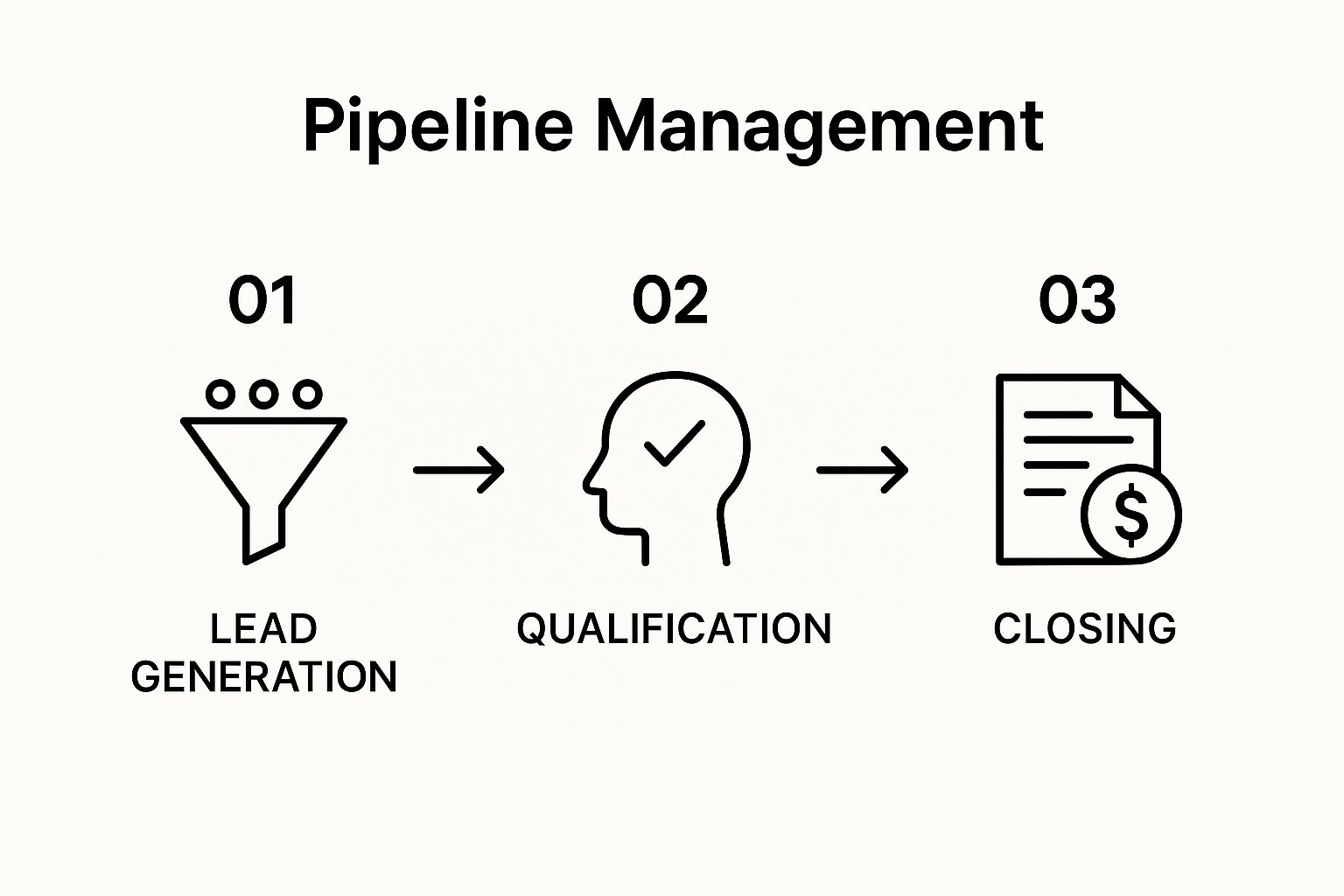
This visual gives you a great at-a-glance look at the progression from finding new leads to figuring out if they're a good fit, and finally, getting that contract signed. This is the backbone of any sales operation.
From Lead Generation To Closing The Deal
Let’s dig into the most common stages and what actually needs to happen in each one. When your pipeline is clearly defined, your team knows exactly where to focus their energy for the biggest impact.
Lead Generation
This is the very top of your funnel where potential customers first appear. Leads can pop up from anywhere—marketing campaigns, website contact forms, referrals, or good old-fashioned outbound prospecting. The name of the game here is simply to gather a list of contacts who've shown at least a flicker of interest.Qualification
Here’s a hard truth: not all leads are created equal. This stage is absolutely critical. It’s where you figure out if a lead is actually a good fit for what you sell. Reps often use frameworks like BANT (Budget, Authority, Need, Timeline) to ask the right questions and make sure they’re not wasting time on opportunities that are doomed from the start.Discovery Call or Meeting
Once a lead is qualified, it's time for a real conversation. The goal here isn't to launch into a pitch; it's to understand the prospect’s world—their specific pain points, their biggest challenges, and their ultimate goals. It's about listening and diagnosing their needs to see if you can genuinely help.Solution Proposal or Demo
Armed with all the insights from your discovery call, you can now present a solution that actually makes sense for them. This might be a formal proposal document, a product demo tailored to their problems, or a detailed quote. The key is to connect the dots and show exactly how your offering solves the specific issues they told you about.Closing
This is it—the final hurdle. Here's where you handle negotiations, hash out the contract terms, and get that final signature. A smooth closing almost always comes down to the trust and value you've meticulously built in all the previous stages.
Defining these steps with this level of clarity is a massive lever for team performance. You can find even more ways to sharpen your team's process in our guide on how to improve sales productivity.
Unlock Growth With Effective Pipeline Management

This is where the rubber meets the road. Moving from theory to practice, disciplined pipeline management is how sales teams truly unlock serious growth. It’s so much more than just keeping deals organized; it's a strategic lever that has a direct, measurable impact on your bottom line.
When you get it right, the benefits start to stack up, creating a powerful cycle of continuous improvement.
One of the first things you'll notice is just how accurate your sales forecasting becomes. When you have a crystal-clear view of every deal's stage, its value, and the probability of it closing, you can predict future revenue with a confidence that’s frankly impossible otherwise. This clarity empowers you to make smarter hiring decisions, allocate resources effectively, and have much more credible conversations with the C-suite.
Accelerate Your Sales Cycle
A well-tended pipeline shines a spotlight on all the bottlenecks that slow your deals down. By tracking how long opportunities are sitting in each stage, you can pinpoint exactly where the friction is. Maybe your proposal process is a slog, or perhaps follow-ups are falling through the cracks.
Addressing these snags is the key to shortening your entire sales cycle. It's a huge deal, especially when you consider that nearly 27% of sales reps say a long sales cycle is the biggest hurdle they face in hitting quota. Good pipeline management gives you the hard data needed to fix those delays and get deals from "hello" to "closed-won" much, much faster.
A healthy pipeline isn’t just about the number of deals it holds; it's about the velocity at which valuable deals move through it.
This focus on velocity and efficiency makes sure your team is always working on the most promising opportunities. By regularly cleaning out deals that have stalled or leads that were never really qualified, reps can pour their energy into opportunities that have a real shot at closing. That’s a win for morale and your win rates.
Ultimately, this data-driven approach builds a high-performing sales culture grounded in accountability. Of course, to measure your pipeline's health, you have to track the right metrics. You can learn more by exploring the essential sales pipeline KPIs that truly matter. These benefits all work together to create a predictable, scalable revenue engine:
- Higher Win Rates: Your team focuses its energy on high-probability deals.
- Greater Efficiency: Reps spend less time on admin and more time actually selling.
- Increased Revenue: This is the natural outcome of faster sales cycles and better win rates.
Proven Best Practices For Managing Your Pipeline
Knowing what a sales pipeline is and actually managing one effectively are two very different things. The best sales teams don’t just have a pipeline; they have a set of disciplined habits that keep it healthy, accurate, and consistently moving forward.
It’s about turning a reactive, often chaotic sales process into a predictable revenue engine. Let's dig into how they do it.
First things first: you have to standardize your sales stages. This is non-negotiable. Everyone on your team needs the exact same definition for what "Qualification" means or when a deal officially moves to "Proposal Sent." Without that shared language, your forecasting is just guesswork.
Maintain Impeccable Pipeline Hygiene
Think of your pipeline like a garden. If you don't pull the weeds, they'll eventually choke out the healthy plants. That's exactly what pipeline hygiene is—the regular, routine process of cleaning out deals that are going nowhere.
Stalled opportunities and leads that have ghosted you do more than just clutter up your CRM. They create a false sense of security and completely wreck your sales forecast. It's a bigger problem than you might think; a shocking 63% of sales managers admit their organization does a poor job here, usually because basic hygiene falls by the wayside.
To fix this, get a weekly or bi-weekly review on the calendar and make it sacred. In that meeting, you’ll:
- Purge Dead Deals: Be ruthless. Get rid of opportunities that have gone cold or were never a good fit to begin with.
- Update Deal Values: Did the scope change? Adjust the potential revenue up or down based on what you know now.
- Re-evaluate Timelines: Push out those close dates. Be realistic about where the deal actually stands.
This isn't just busywork. It’s a strategic move that forces your team to pour their energy into real, winnable deals.
A clean pipeline is an actionable pipeline. Removing the clutter allows your team to focus its energy on deals that have a genuine chance of closing, which directly impacts win rates and morale.
Finally, you have to track the metrics that matter. It’s easy to get lost in a sea of data. Instead, pick a handful of key performance indicators that give you a true pulse on your pipeline's health. You'll want to watch things like conversion rates between stages, your average deal size, and sales velocity. For a deeper look at what to track, check out these essential sales pipeline management best practices. This data-first approach lets you spot problems and fix them long before they can derail your quarter.
Choosing The Right Tools For Pipeline Management

In modern sales, your Customer Relationship Management (CRM) platform is mission control. You can’t effectively manage a sales pipeline without the right tech to bring clarity, automate the grunt work, and serve up actionable insights right when your team needs them.
But with what feels like a million options out there, picking the right software can feel like a job in itself. The trick is to tune out the noise and focus on the core features that actually help you build a healthy pipeline and let your reps do what they do best: sell.
Must-Have Features For Your Sales Toolkit
When you're evaluating tools, always prioritize function over fluff. The best system is one that your reps will genuinely want to use because it makes their lives easier, not more complicated.
Here are the non-negotiables to look for:
- Intuitive Visual Pipelines: Your team needs to see every single deal, at every stage, with a quick glance. A drag-and-drop interface isn't just a nice-to-have; it's essential for moving opportunities along and keeping your data clean and current.
- Powerful Automation Rules: Sales teams that use automation see a 14% bump in productivity. Your tool has to be able to handle the routine stuff—sending follow-up reminders, assigning new leads, or flagging a manager when a deal goes quiet.
- Insightful Analytics Dashboards: Raw data is useless. A good platform will turn your pipeline activity into easy-to-read reports on the metrics that matter, like win rates, average sales cycle length, and where deals tend to fall out of the process.
The Rise Of AI In Pipeline Management
Beyond these basics, artificial intelligence is bringing a whole new level of smarts to sales tools. AI-powered features are quickly shifting from a luxury to a necessity, helping teams see around corners and get ahead of problems before they start. It's part of a bigger trend where advanced tech is becoming critical for staying proactive. You can find more on pipeline technology advancements on coherentmarketinsights.com.
An intelligent CRM doesn't just hold your data; it helps you make sense of it. It can predict which deals are most likely to close, flag at-risk opportunities that need attention, and even suggest the next best action for a rep to take.
This predictive power changes the game entirely. Pipeline management stops being a reactive exercise in tracking what already happened and becomes a proactive strategy for designing future wins. Investing in a tool with these capabilities gives your team the best possible shot at closing more deals, faster.
Common Pipeline Management Questions Answered
Even with a killer strategy, questions are going to pop up when you’re in the trenches. It just comes with the territory.
Getting straight answers to these common hang-ups can be the difference between a pipeline that feels like a constant scramble and one that runs like a well-oiled machine. Let’s tackle a few of the questions we hear all the time.
How Often Should I Review My Sales Pipeline?
For the team, a weekly pipeline review is the gold standard. This rhythm is frequent enough to spot deals that are starting to stall out and make smart adjustments, but not so often that it feels like micromanaging. It keeps everyone accountable and focused on the big picture: hitting those revenue targets.
But for individual reps? You should be living in your pipeline daily. This is non-negotiable. That daily check-in is what helps you prioritize your day, plan follow-ups, and make sure every single deal is actually moving forward. Think of it this way: the weekly meeting is for coaching and strategy; the daily habit is all about execution.
What Is The Difference Between A Sales Pipeline And A Sales Funnel?
Ah, the classic question. It's easy to get these two mixed up because they're really just two sides of the same coin, looking at the sales process from different angles.
- A sales funnel is all about the customer's journey. It visualizes the process of a huge pool of potential leads getting smaller and smaller as they move from just being aware of you to actually making a purchase. It's a marketing-centric view.
- A sales pipeline, on the other hand, is from the salesperson's perspective. It lays out the concrete, actionable stages a rep takes to actively work an opportunity from initial contact to a closed deal.
Here's an easy way to think about it: The funnel is a diagnostic tool for marketing to measure conversion rates. The pipeline is an active management tool for reps to organize and advance their deals.
How Many Stages Should A Sales Pipeline Have?
There's no magic number here, but a good rule of thumb is to aim for 5 to 7 distinct stages. The sweet spot is having enough stages to accurately reflect your sales process without making it a huge pain for your team to keep updated.
Each stage should mark a real milestone in the deal's progression—a point where the customer has made a commitment and the rep has a clear action to take to move it forward. It’s always better to start simple. You can always add more stages later if you find they genuinely help clarify the process and make your forecasting more accurate.
What Are The Most Important Metrics To Track?
You can track dozens of data points, but you don't need to. A handful of key metrics will give you a solid pulse on your pipeline’s health. If you're just starting out, focus on these four:
- Total Pipeline Value: The total dollar amount of all open opportunities. Simple, but powerful.
- Average Deal Size: Helps you understand what a typical "win" looks like for your team.
- Sales Cycle Length: How long, on average, does it take to close a deal from start to finish?
- Stage-by-Stage Conversion Rate: This is huge. It shows the percentage of deals that move from one stage to the next, instantly highlighting where deals are getting stuck.
At Distro, we help you turn more of those initial demo requests into qualified meetings that fill your pipeline. By automatically routing leads to the right rep’s calendar the moment they show interest, we ensure you never miss an opportunity to start a valuable conversation. See how our intelligent scheduling can accelerate your sales cycle at https://distro.so.