So, what exactly is lead qualification?
Think of it as a strategic filter that separates the serious buyers from the casual window-shoppers. It’s the essential process of figuring out which prospects are a genuinely good fit for your product or service, making sure your sales team invests its energy where it’ll actually make a difference.
The Bridge Between Marketing and Sales
Imagine you're a talent scout looking for the next basketball star. You wouldn't waste your time evaluating every person who can dribble a ball, right? Of course not. You'd have a specific set of criteria—things like speed, court vision, and teamwork—to spot the athletes with real potential.
Lead qualification is the exact same concept for your business. It's the methodical process of stacking up your prospects against a checklist of predefined criteria to see how likely they are to become a customer.
This isn't just about making a tidy contact list. It's the critical bridge that connects marketing's hard work in generating interest with the sales team's ability to close deals. Without it, your sales reps are flying blind, chasing every single form fill and website click with the same amount of effort. That's a fast track to burnout and a lot of missed opportunities.
Why This Process Is Non-Negotiable
A solid qualification process is the engine of an efficient sales machine. It gives your team permission to focus its limited time and resources on the deals with the highest chance of converting. This sharpens focus, boosts morale, and stops your pipeline from getting clogged with dead-end leads who were never going to buy anyway.
And the numbers don't lie. Qualified leads are reported to be a staggering 5 to 21 times more likely to convert than their unqualified counterparts. On top of that, companies that implement lead scoring often see a 38% jump in their lead-to-opportunity conversion rates. Yet, despite this, a surprising 44% of companies don't use lead scoring at all, leaving a massive opportunity on the table for teams willing to get strategic.
By systematically identifying who is actually ready to have a conversation, you transform your sales process from a game of chance into a predictable, revenue-generating machine. It’s about working smarter, not just harder.
The table below breaks down the tangible benefits companies see when they stop guessing and start qualifying their leads strategically.
The Real-World Impact of Lead Qualification
| Metric | Improvement/Statistic | Impact on Business |
|---|---|---|
| Sales Productivity | 10-15% increase in sales output | Reps waste less time on poor-fit leads and focus on high-potential deals, closing more with less effort. |
| Conversion Rate | Up to 300% higher for qualified leads | Focusing on motivated, well-aligned prospects naturally leads to more "yeses" and closed-won deals. |
| Marketing ROI | 47% larger purchases made by nurtured leads | Marketing gets clear feedback on what works, allowing them to attract better leads and justify their spend. |
| Sales Cycle Length | 23% shorter sales cycles | Engaging with pre-vetted, educated buyers eliminates early-stage friction and accelerates the journey to a signed contract. |
This data paints a clear picture: a dedicated qualification process isn't just a "nice-to-have"—it's a core driver of growth and efficiency.
From Generation to Qualification
Ultimately, a well-defined qualification strategy does more than just sort your contacts. It creates an invaluable feedback loop for your marketing team, helping them fine-tune their campaigns to attract better-fit prospects right from the start. To qualify leads effectively, you first have to understand where they're coming from. Exploring the best ways to generate leads shows how different acquisition channels can influence your qualification criteria.
When you nail this critical function, you unlock several key outcomes:
- Shorter Sales Cycles: Reps connect with prospects who are already vetted and have a confirmed need.
- Higher Conversion Rates: Focusing on high-potential leads naturally boosts the percentage of deals you win.
- Improved Sales and Marketing Alignment: Both teams finally agree on what a "good lead" looks like, ending the friction and blame games.
This structured approach is the foundation for turning mildly interested prospects into loyal, long-term customers.
Defining Your Ideal Customer Profile
Before you can even think about qualifying a lead, you have to know exactly who you’re looking for. This is where creating an Ideal Customer Profile (ICP) isn't just a good idea—it's the most critical first step. An ICP isn’t some flimsy list of demographics; it's a detailed, living portrait of the perfect company for your product or service.
Think of your ICP as the blueprint for your entire go-to-market strategy. Without it, you’re basically building in the dark, just hoping your efforts stumble upon the right people. With a clear ICP, every marketing campaign, sales call, and product feature becomes more focused and effective.
The whole foundation of good lead qualification is built on this ICP and the clear criteria it sets. It helps you pinpoint the traits of your absolute best customers, so you can stop wasting time and start focusing your energy on prospects who are a perfect fit.
Key Components of a Strong ICP
A really solid ICP goes way beyond the surface-level stuff. It pulls together two distinct types of data to give you a complete, 360-degree view of your target accounts.
1. Firmographics: The Company-Level Data
These are the hard, quantifiable facts about a company. Think of them as the first big filter that takes the entire market of millions of businesses and narrows it down to a manageable list of real targets.
- Industry: Which specific sectors get the most bang for their buck from your solution? (e.g., B2B SaaS, Healthcare Technology)
- Company Size: How many employees does your ideal customer have? Is it a startup or an enterprise? (e.g., 50-250 employees)
- Annual Revenue: What's the revenue range that signals they can afford you and actually have the problems you solve?
- Geographic Location: Are there specific countries, states, or even cities you focus on?
2. Psychographics: The Human Element
This is where you get into the good stuff—the motivations, challenges, and mindset of the people inside those companies. It’s all about understanding their "why."
- Pain Points: What are their biggest professional headaches? What keeps them up at night?
- Goals: What are they trying to accomplish? Are they aiming to boost efficiency, slash costs, or get their team to collaborate better?
- Buying Habits: How do they research and buy new tools? Who really calls the shots in a buying decision?
When you combine the "what" of firmographics with the "why" of psychographics, you stop talking about a vague "customer" and start focusing on a highly specific, actionable profile. This is the kind of clarity your whole organization can get behind, ensuring your inbound lead generation efforts bring in the right kind of attention from day one.
This detailed profile becomes the gold standard you measure every single new lead against. It makes your qualification process faster, smarter, and way more accurate.
Choosing Your Lead Qualification Framework
Frameworks are what bring order to the chaos of lead qualification. Instead of just relying on gut feelings, these established systems give your team a structured, repeatable way to figure out if a prospect is a good fit.
Think of them as recipes for finding your perfect customer. Each one uses slightly different ingredients and steps, but they all aim for the same delicious outcome: a genuinely qualified lead.
The right framework for you really depends on your business. You have to consider your sales cycle, how complex your product is, and who you're selling to. A simple, quick sale might only need a lightweight framework, but a massive enterprise deal is going to demand something much more rigorous.
The goal is to pick a system that your sales reps will actually use and that lines up perfectly with your Ideal Customer Profile (ICP). Let's dig into a few of the most popular and effective ones out there.
BANT: The Classic Starting Point
You've probably heard of BANT. It's one of the oldest and most recognized frameworks, first developed by IBM decades ago. Its staying power is a real testament to its simplicity and effectiveness, especially for businesses with a pretty straightforward sales process.
It’s an acronym that stands for:
- Budget: Can the prospect actually afford your solution? This is the most basic go/no-go question.
- Authority: Are you talking to the person who can sign the check, or are they an influencer who needs to get approval from someone else?
- Need: Do they have a clear pain point or challenge that your product directly solves?
- Timeline: How soon are they looking to make a decision and get a solution in place?
BANT is a great fit for many SaaS companies or any business with a shorter sales cycle. For instance, a marketing manager looking for a social media scheduling tool probably knows their budget, has the authority to buy, feels the pain of inefficiency, and wants a tool within the quarter. BANT lets a rep confirm all that quickly.
MEDDIC: For Complex Enterprise Sales
When you're dealing with high-ticket items and long, complex B2B sales cycles, BANT can feel a little too basic. This is where a more heavy-duty framework like MEDDIC really shines. It pushes reps to dig much deeper into a customer’s organization to understand the full political and financial picture.
MEDDIC is an acronym for:
- Metrics: What are the measurable business outcomes the prospect is hoping to achieve? (e.g., "increase revenue by 15%," "reduce support tickets by 30%")
- Economic Buyer: Who is the person with the ultimate profit and loss responsibility for this purchase?
- Decision Criteria: What specific technical, financial, and vendor requirements will they use to judge their options?
- Decision Process: How does the organization actually make a decision? Who’s involved, and what are the formal steps?
- Identify Pain: What's the core business challenge making them look for a solution right now?
- Champion: Who is the person on the inside who has influence and is actively selling on your behalf when you're not in the room?
Imagine a consulting firm selling a multi-year digital transformation project. They would absolutely use MEDDIC to navigate the complex corporate structure and ensure the deal is solid from every single angle. It turns qualification from a simple checklist into a truly strategic exercise.
Comparing Popular Lead Qualification Frameworks
Choosing between frameworks like BANT, MEDDIC, or even others like CHAMP can be tough. They all aim to qualify leads, but they focus on different aspects of the sale. This table offers a side-by-side look to help you decide which system might be the right fit for your team.
| Framework | Primary Focus | Best For | Key Question Example |
|---|---|---|---|
| BANT | Budget & Authority | Simple, transactional sales with shorter cycles. | "What budget has been allocated for this project?" |
| MEDDIC | Metrics & Champion | Complex, high-value enterprise sales with multiple stakeholders. | "Who is your internal champion that will benefit most from this?" |
| CHAMP | Challenges & Prioritization | Businesses where understanding the prospect's pain is paramount. | "How does this challenge rank among your current priorities?" |
Ultimately, the "best" framework is the one that aligns with your sales motion and gives your reps the clarity they need to close deals. Don't be afraid to test one out and adapt it to your specific needs.
A common point of confusion is the distinction between Marketing Qualified Leads (MQLs) and Sales Qualified Leads (SQLs). Frameworks help formalize the transition from one to the other.
This visual helps clarify the roles MQLs and SQLs play in the sales funnel.
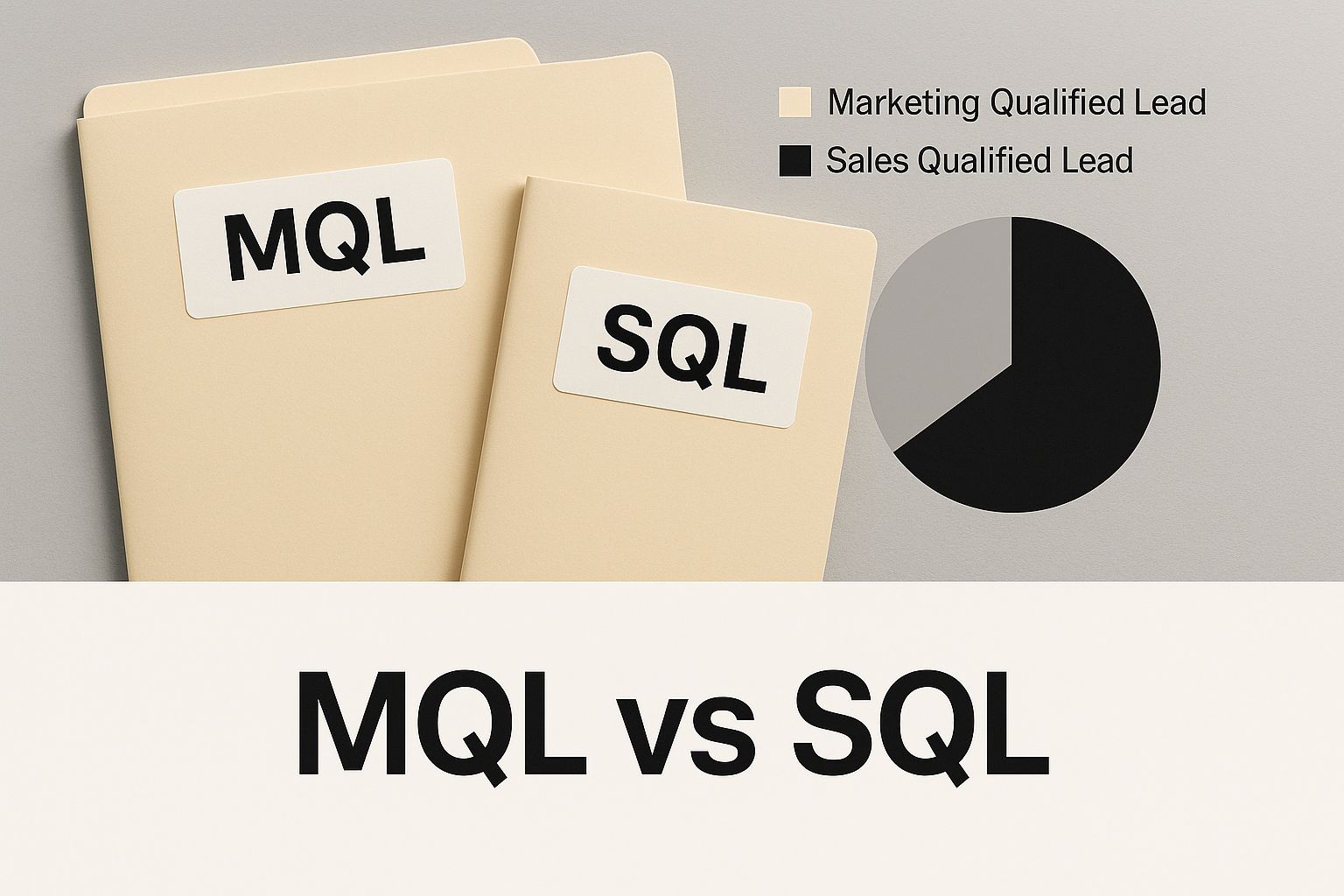
Essentially, an MQL shows interest based on marketing engagement, while an SQL has been vetted by sales (often using a framework like BANT or MEDDIC) and confirmed as a viable opportunity. You can learn more about this in our guide on MQL vs SQL frameworks.
How Lead Scoring Prioritizes Your Best Leads

If your qualification framework is the overall strategy, then lead scoring is the powerful engine that makes it all run. Think of it as a point-based system humming in the background, constantly ranking every single lead from “ice cold” to “red hot and ready for a sales call.”
This process is all about getting rid of the guesswork. Instead of your team treating every new inbound lead the same way, lead scoring assigns a numerical value to each one. This score is based on a mix of who they are and how they’ve been interacting with your brand.
It's a simple but game-changing system. It ensures your sales reps always know exactly which leads to reach out to first, focusing their energy where it will have the biggest impact.
The Art and Science of Assigning Points
Good lead scoring isn't just a technical exercise; it's a blend of art and science. It’s about balancing two very different kinds of data to build a complete picture of each prospect. Essentially, you're assigning points for specific traits and actions that signal a great potential customer.
1. Explicit Data (Demographics & Firmographics)
This is the straightforward stuff—the clear, concrete information a lead hands over to you directly, usually through a form. It’s the "who they are" part of the puzzle. The more a lead matches your ideal customer profile, the more points they get.
- Job Title: A "Director of Marketing" might get +15 points, while a "Student" gets 0.
- Company Size: If your ideal customer has 100-500 employees, a lead in that sweet spot gets +10 points.
- Industry: A lead from a key industry like "B2B SaaS" could earn +10 points.
2. Implicit Data (Behavioral Signals)
This is where things get interesting. This is the data you gather by observing what a lead actually does. These actions are huge indicators of their interest and intent, painting a vivid picture of how engaged they really are.
- Key Page Visits: Someone looking at your pricing page is a massive buying signal. Give them +20 points.
- Content Downloads: Downloading a detailed whitepaper shows they're doing their research. That’s worth +10 points.
- Demo Requests: A direct request for a demo? That's a top-tier action, often earning +50 points or even more.
When you combine these scores, a crystal-clear picture emerges. A lead with the perfect job title who also visits your pricing page is instantly flagged as a top priority. This allows your sales team to connect with them while their interest is at its absolute peak.
This isn't just about making your internal process more efficient; it has a massive impact on the bottom line. In fact, organizations using lead scoring see a 77% increase in their lead generation ROI. It’s proof that focusing on the right prospects directly improves both marketing spend and sales outcomes. To get started on your own model, you can dive into these lead scoring best practices.
What's more, 68% of the most successful marketers point to lead scoring as their number one driver of revenue, confirming its direct link to business growth. By setting up a simple but thoughtful scoring model, you're creating a system that automatically brings your best opportunities to the surface for immediate action.
Using AI to Supercharge Your Qualification
While traditional frameworks like BANT and MEDDIC give you a solid playbook for understanding what is lead qualification, the next leap forward is all about artificial intelligence and automation. This isn't just about making things faster; it's about moving past simple, rule-based systems and into the world of predictive insights.
Think of it this way: AI doesn't just add up a score. It sifts through mountains of data to find the subtle buying signals a human team could easily miss. It spots patterns in behavior, language, and market shifts to predict which leads are truly ready to talk—often with startling accuracy. You're no longer just sorting leads; you're working with a much deeper level of intelligence.
The Power of Automation in Qualification
One of the most immediate wins with this technology is its knack for handling the repetitive, time-sucking tasks that bog down your sales team. This is where you start getting precious hours back in your day.
- Intelligent Lead Routing: Forget managers manually doling out leads. Automation can instantly send a hot prospect to the perfect rep based on their territory, product expertise, or even their current workload.
- Automated Follow-Ups: AI can trigger the first email or enroll a lead into a nurture sequence the moment they qualify. No more leads going cold because someone was too busy to reach out.
- Instant Engagement: A powerful way to ramp up your qualification is with a dedicated lead generation chatbot. These bots work 24/7, asking those first crucial questions and even booking meetings right onto a sales rep's calendar.
This shift frees your sales team from the administrative grind, letting them pour all their energy into what they do best: having meaningful conversations and closing deals.
The core idea is simple: let machines handle the mechanics of sorting and routing so humans can focus on the nuance of conversation and persuasion. It creates a seamless, intelligent workflow that dramatically accelerates the entire sales pipeline.
The Future is AI-Driven
This move toward AI-powered qualification is picking up steam, fast. Projections show that by 2025, a staggering 88% of marketers will be using AI tools in their day-to-day work to sharpen their lead scoring and efficiency. In fact, the adoption of AI-driven scoring has already ballooned nearly 14 times since 2011 among B2B companies, which tells you just how quickly this is becoming standard practice. You can discover more insights about these AI adoption trends and see how they're reshaping sales processes.
But there’s a catch. An AI system is only as good as the data it’s fed. Clean, accurate, and integrated data is the fuel that makes any AI qualification engine run. Get the right technology and commit to data quality, and you can build a hyper-efficient system that surfaces your best leads at incredible speed.
Actionable Best Practices for Qualification Success
Knowing the theory is one thing, but getting real results is another game entirely. A solid lead qualification process isn't a "set it and forget it" project. It's a living, breathing system that needs constant attention—alignment, tweaks, and a serious need for speed—to keep your pipeline packed with deals waiting to happen.
Here are the core practices that really separate the high-growth teams from everyone else.
Forge a Sales and Marketing Alliance
The most common reason any qualification process falls apart? The chasm between sales and marketing. It’s a classic story.
Both teams absolutely must agree on the definition of your Ideal Customer Profile (ICP), what makes a lead a Marketing Qualified Lead (MQL), and the precise moment that lead graduates to a Sales Qualified Lead (SQL). Getting this shared understanding ironed out stops the friction and makes sure marketing is handing over prospects that sales is actually excited to talk to.
A formal Service Level Agreement (SLA) is the bedrock of this alliance. Think of it as a treaty. It puts the agreed-upon definitions, handoff rules, and follow-up time expectations in writing. This creates mutual accountability and a truly unified front.
When everyone’s working from the same playbook, the entire revenue engine just runs better. To get this alignment right from the start, it's crucial to understand how to qualify sales leads from both a marketing and sales point of view.
Regularly Review and Refine
Your market doesn't stand still, and neither do your customers. You can't treat your qualification criteria like they're set in stone.
Make it a habit to review your ICP and lead scoring rules every quarter. Dig into the data. Which lead sources brought in the most closed-won deals? Which criteria consistently flagged your absolute best customers?
This ongoing refinement cycle lets you:
- Adapt to Market Changes: Adjust your strategy when new trends pop up or competitors make a move.
- Optimize Your Scoring Model: Double down on what’s working and get rid of points for actions that don't signal real buying intent.
- Improve Predictive Accuracy: Make your qualification process smarter and more effective over time.
Act with Urgency
In sales, speed is everything. It's a massive competitive advantage. The second a lead shows strong intent—like asking for a demo—a clock starts ticking. Fast.
Responding quickly has a ridiculous impact on your chances of success. A staggering 78% of customers buy from the first company to respond. It gets crazier: just contacting a lead within one minute can boost conversions by a massive 391%.
The drop-off is brutal. The odds of qualifying a lead are 21 times higher if you reach out within five minutes compared to waiting 30. Speed isn't just a nice-to-have; it's a make-or-break factor in modern sales.
Frequently Asked Questions
Even with a solid game plan, you're bound to run into some practical questions when you start putting a lead qualification process into action. Here are some of the most common ones we hear from sales and marketing teams.
How Is Lead Qualification Different from Lead Generation?
It's helpful to think of them as two sides of the same coin, or maybe a two-step dance.
Lead generation is step one: casting a wide net to attract interest and gather contact info. It’s all about filling the top of your funnel with as many potential leads as possible. Lead qualification is the crucial second step. This is where you sift through that crowd to figure out who's a serious prospect and who's just window shopping.
Simply put, generation finds the crowd; qualification finds the actual buyers hiding within it. You can't have a healthy pipeline without both.
When Is a Lead Officially Considered Qualified?
A lead crosses the "qualified" finish line the moment they meet a specific set of criteria that both sales and marketing have agreed on beforehand. This usually happens when a lead's score—a number that reflects both their demographic fit and their recent actions (like checking out your pricing page)—hits a certain threshold.
A lead becomes "qualified" at the exact moment they check enough boxes to signal a high probability of becoming a customer. This is the green light for a sales rep to engage directly.
That handoff, when a lead graduates from a Marketing Qualified Lead (MQL) to a Sales Qualified Lead (SQL), is a make-or-break moment in the sales process.
Can a Lead Be Qualified but Not Ready to Buy?
Absolutely. This happens all the time, and it's a critical distinction to make.
A lead might be a perfect match for your Ideal Customer Profile (ICP). They could have the right job title, work in the right industry, and be at a company of the perfect size. On paper, they're golden. But in reality, they might not have the budget approved yet, or maybe their purchase timeline is six months out.
These leads are still incredibly valuable. Don't push them for a sale they aren't ready for. The smart move is to place them in a long-term nurturing sequence. This keeps your brand top-of-mind, so when they are ready to pull the trigger, you're the first person they call.
Ready to stop letting hot leads go cold? Distro automatically routes your most qualified prospects to the right sales rep’s calendar the instant they show intent. See how you can 3X your demo request conversions at https://distro.so.