
The fastest way to grow your revenue is surprisingly simple: stop wasting your sales team's time on leads who will never buy.
That’s where lead qualification comes in. It’s a systematic process for figuring out which prospects have the highest potential to become fantastic customers. This isn't about robotic scripts; it's about using proven frameworks to have smarter conversations and point your team's energy toward deals that are actually likely to close.
Why You Need a Lead Qualification Strategy
Chasing down every single lead that trickles into your pipeline is a surefire recipe for burnout and missed quotas. A real qualification process changes the game. It turns your sales motion from a wide, inefficient net into a sharp, accurate spear, filtering out the casual window-shoppers from the genuinely interested buyers.
The idea is to focus your sales efforts on the right people, which naturally speeds up the sales cycle and stops you from pouring resources down the drain on prospects who are a poor fit from the start. To get a bird's-eye view of the core principles, this comprehensive guide on how to qualify leads is a great place to start.
The Real Cost of Unqualified Leads
Letting unqualified leads clog up your funnel doesn't just waste time—it actively hurts your business. When reps are swamped with low-quality leads, their morale tanks, and their focus shatters. This disconnect between marketing's lead generation and sales' expectations creates friction that grinds the entire revenue engine to a halt.
The numbers are pretty stark. A staggering 25% of marketing-generated leads are considered high-quality enough to even send to sales. Worse, only 5% of salespeople actually rate those leads as very high quality.
This gap screams opportunity. Despite the obvious benefits, many companies are still behind. In 2024, only 44% of businesses had lead scoring in place. This contributes to a massive problem where 55% of leads are neglected simply because there’s no consistent follow-up process.
The Pillars of an Effective Qualification Process
So, how do you build a system that consistently bubbles up the best opportunities? From my experience, it really comes down to three core pillars that, when combined, give you a complete picture of a lead's potential.
Before we dive into the details, here’s a quick overview of the essential components that make up a strong lead qualification process. Think of this as your cheat sheet.
Core Pillars of Lead Qualification
| Pillar | Description | Why It Matters |
|---|---|---|
| Profile Fit | Firmographics and demographics. This is all about who the lead is—their industry, company size, and job title. | This tells you if the lead matches your Ideal Customer Profile (ICP). If they don't look like your best customers, they're likely a poor fit. |
| Engagement & Intent | Behavioral signals. This covers what the lead does, like visiting your pricing page, downloading a case study, or requesting a demo. | Actions speak louder than words. High engagement is a strong indicator of genuine interest and buying intent. |
| Buying Readiness | BANT (Budget, Authority, Need, Timeline). This confirms the lead's readiness to make a purchase. | This is the final gut check. A lead can be a perfect fit and highly engaged, but if they have no budget or authority, the deal is dead on arrival. |
Getting these three pillars right is the foundation of any successful qualification strategy. Let's break down what each one looks like in practice.
A truly robust qualification process is built on:
- Firmographics and Demographics: This is about understanding who you're talking to. What's the company's size, industry, and location? What is the lead's job title or role within that company? The fundamental question here is: does this person and their organization fit your Ideal Customer Profile (ICP)?
- Behavioral Signals and Intent: Here, you're analyzing what the lead is doing. You need to track their engagement with your brand—what pages they visited on your website, what content they downloaded, which emails they opened, and if they requested a demo. These actions are digital breadcrumbs that signal their level of interest.
- Budget, Authority, Need, and Timeline (BANT): This is the classic framework for confirming a lead's readiness to buy. It's a gut check to see if they have the necessary budget, the authority to make the final decision, a genuine business pain you can solve, and a clear timeline for when they need a solution.
Define Your Ideal Customer Profile

Before you can even think about qualifying leads, you need a rock-solid, crystal-clear picture of who you're actually looking for. This is where your Ideal Customer Profile (ICP) comes in. Think of it as a detailed blueprint of the perfect company for your product—the ones who get the most value, stick around the longest, and sing your praises.
An ICP isn't some vague idea you keep in your head. It's a data-driven definition that gets your entire company on the same page. When marketing and sales both know exactly who they're targeting, the quality of leads goes through the roof. Everyone can spot a home-run prospect the second they see one, which makes the whole qualification game faster and way more accurate.
Look Beyond Surface-Level Details
A classic mistake is stopping at the basics, like industry and company size. Sure, those are important starting points, but a truly powerful ICP goes much, much deeper. You need to get into the nitty-gritty characteristics and behaviors that separate your absolute best customers from everyone else.
The best place to start is with your own data. Dive into your most successful accounts and hunt for patterns.
- Company Size: Is there a sweet spot for employee count or annual revenue? Maybe you thrive with startups between 20-50 employees, or perhaps enterprise clients with $50M+ in revenue are your bread and butter.
- Industry or Niche: Do certain verticals just get it? You might find that SaaS companies have a much shorter sales cycle than manufacturing firms, for example.
- Geography: Are there specific regions where you're crushing it? This can inform everything from ad targeting to sales territory planning.
- Technology Stack: What other tools are your best customers using? This is a huge clue. If they all use Salesforce and Marketo, that signals a certain level of technical maturity and opens up integration possibilities.
These firmographic data points create the basic skeleton of your ICP. They're the objective, easy-to-spot traits you can use for that first quick filter.
Uncover the “Why” Behind the Buy
Now for the fun part. It’s time to add the psychographic and behavioral layers that bring your ICP to life. This is all about understanding the human element—the real-world motivations, challenges, and triggers that push a company to look for a solution like yours in the first place.
To get this information, there’s no substitute for actually talking to people. Go interview your top salespeople and account managers. They’re on the front lines every day and have priceless insights into what makes a deal sail through or get stuck in the mud.
Ask your team questions that dig beneath the surface and reveal the underlying patterns:
- What were the specific pain points or frustrations these customers had right before they found us? Get specific.
- Was there a common triggering event? Maybe they just closed a new funding round, hired a new VP of Sales, or a competitor launched a new product.
- What business outcomes were they trying to drive? Were they laser-focused on boosting revenue, slashing costs, or making their team more efficient?
- Who was the internal champion that pushed the deal across the finish line? What was their job title and how much pull did they have?
When you combine this hard data with these qualitative, real-world insights, you create a rich, three-dimensional profile. This ICP becomes your North Star. It guides every decision you make when qualifying sales leads and makes sure you’re only pouring your energy into prospects who have a real shot at becoming fantastic customers.
Put a Practical Lead Scoring Model in Place
With a crystal-clear Ideal Customer Profile in hand, it's time to turn that blueprint into an automated, actionable priority list for your sales team. This is where a practical lead scoring model becomes your secret weapon. It’s essentially a system for assigning points to leads based on who they are and what they do, instantly showing you which ones are ready for a conversation.
Think of it this way: a "Director of Operations"—a key job title from your ICP—from a target industry might automatically get 15 points. If that same person then downloads a detailed case study (a huge buying signal), they get another 10 points. Suddenly, you’re not just staring at a list of names; you have a ranked list of hot prospects.
Blend Demographics with Behavior
The most effective lead scoring models don’t just look at one type of data. The real magic happens when you mix the explicit information people give you with the implicit signals from their online activity. This combo gives you a complete picture of both a lead's fit and their intent.
Here's how to think about the two core components:
- Demographic/Firmographic Scoring: This is all about the hard data a lead provides. It answers the question, "How much does this person look like my ideal customer?" You'll assign points for things like their job title, company size, industry, and maybe even the tech stack they use.
- Behavioral Scoring: This score is based on a lead's actions—their "digital body language." It answers, "How interested is this lead in us right now?" Obvious high-value actions like visiting your pricing page or requesting a demo should rack up way more points than something passive like opening a newsletter.
This visual shows exactly how these two scoring types work together to qualify sales leads.
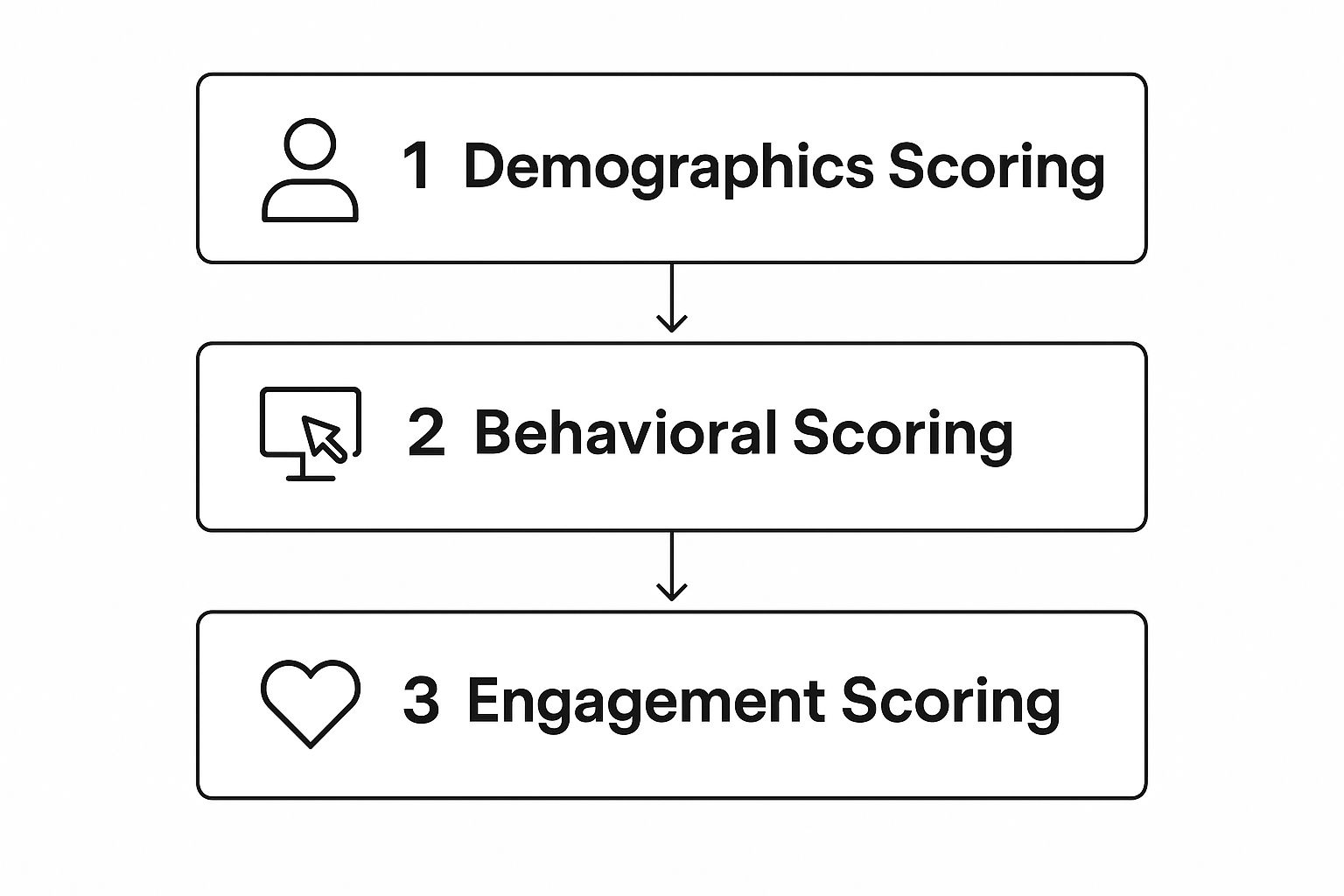
The flow makes it clear: a lead's true value emerges when you layer their demographic fit on top of their specific behaviors and overall engagement.
Building Your Scoring System
The goal here is to create a simple, effective model you can actually use and tweak over time. I've seen too many teams build overly complex systems that get abandoned after a month.
Start by defining point values for your most important attributes and actions, usually right inside your CRM or marketing automation platform. For a deeper dive, check out our guide on lead scoring best practices.
Remember, the point isn't just to collect leads; it's to find the ones who will actually buy. Recent sales data shows that only about 1-2% of all B2B leads ever convert into a sale. This makes a solid qualification process absolutely essential for efficiency.
By setting simple thresholds (e.g., any lead scoring over 50 points becomes a "hot lead"), you can trigger automated workflows. These workflows can instantly route the best opportunities straight to your sales team, making sure a high-value prospect never slips through the cracks.
Master the Art of the Qualification Call

Alright, your lead scoring model has done its job and flagged a high-potential prospect. Now it's time for the human touch.
The qualification call is where you move past the data and start a real conversation. This isn't an interrogation to just check off boxes on a list. It’s a consultative discovery session where your goal is to genuinely help the prospect while also gathering the intel you need.
You want to build rapport and get a real sense of their world. When they hang up, they should feel like they just had a valuable chat with an expert, not like they were shoved through a rigid sales script. This approach changes the entire dynamic and paves the way for a real partnership.
Use Frameworks as Your Guide, Not Your Script
Frameworks like BANT (Budget, Authority, Need, Timeline) or MEDDIC are fantastic for structuring your thoughts, but they should never, ever be used as a robotic checklist.
A call that sounds like, "Okay, great. Now, what's your budget?" is a surefire way to kill any rapport you've built. Instead, you need to weave these concepts into a natural, flowing conversation. Think of them as guardrails for your discovery process, just making sure you touch on all the critical points without sounding like you're reading from a teleprompter.
The real key is asking open-ended questions that get the prospect talking.
Instead of: "Do you have the budget for this?"
Try: "What does a typical investment in new software look like for your team? Have you allocated resources for solving this particular challenge this year?"
Instead of: "Are you the decision-maker?"
Try: "Who else on your team would be involved in evaluating a new solution like this?"
It’s a subtle shift in language, but it makes a world of difference. You’re turning a direct, almost confrontational question into a collaborative exploration. It makes the prospect feel heard.
The most powerful qualification calls boil down to one thing: active listening. When you truly listen to a prospect’s challenges and goals, you can tailor your value proposition on the fly and show exactly how you can solve their specific problems. That's how you build immense trust.
Asking Questions That Uncover True Pain
Your number one mission on a qualification call is to uncover the core business pain that’s driving their search in the first place. Surface-level problems are just the start; you have to dig deeper to find the real, quantifiable impact this issue is having on their organization. This is what creates urgency and ultimately justifies the investment.
To get better at steering these conversations, looking at resources like powerful cold calling scripts can give you some great ideas on how to frame your questions for maximum impact.
Here are a few questions I've found that get to the heart of the matter:
- "Could you walk me through how your team is currently handling [the specific challenge]?"
- "What happens if you don't find a solution to this problem in the next six months?"
- "How is this issue impacting your team's productivity or your company's bottom line?"
Focusing on these deeper questions moves you from a simple feature-and-benefit pitch to a strategic business conversation. This is the essence of qualifying sales leads effectively. It positions you as a problem-solver and is a critical step to improve sales productivity because it ensures your team only spends time on deals where there's a genuine, pressing need.
Automate Your Qualification Workflow
Having a solid scoring model and a sharp call strategy is a great start, but in sales, speed is your ultimate competitive advantage. This is where you bring in technology to build an efficient, scalable machine that lets your reps focus on what they do best: talking to qualified buyers.
Automating your qualification workflow is all about getting rid of the manual, repetitive tasks that bog down your team. Those are the things that cause high-potential leads to slip through the cracks. It's about creating a system that works for you 24/7, making sure no opportunity is ever left waiting.
Setting Up Smart Workflows
The real magic of automation happens inside your CRM. This is where you can set up workflows to trigger specific actions based on the lead scores you’ve already defined. Doing this turns your static scoring model into a dynamic, action-oriented process that actually does something.
For instance, you could build a workflow that automatically assigns any lead scoring above a certain threshold—let's say 75 points—directly to a sales rep. This one simple rule completely eliminates the manual review process and slashes your response times.
Timeliness is a massive challenge in qualifying sales leads. The average organization generates around 1,877 leads every month, yet a staggering 41% of companies admit they struggle to respond quickly. That delay is a deal-killer. Responding within five minutes can boost your qualification chances tenfold, but waiting just ten minutes can cause success rates to tank by 400%.
Practical Automation Examples
Automation isn't just about being fast; it's about being precise. Your workflows can handle surprisingly complex routing logic to make sure every single lead lands with the perfect person to handle it.
Here are a few powerful examples I’ve seen work wonders:
- Territory-Based Routing: Got reps covering different regions? Set up a workflow to automatically assign leads based on their geographic location, whether it's by state, country, or even down to the zip code.
- Round Robin Distribution: Want to keep things fair? A round robin workflow automatically distributes hot new leads evenly among a team of Account Executives. This ensures everyone gets an equal shot at the best opportunities.
- Personalized Nurture Sequences: For those warm leads who aren't quite ready for a sales call, you can automatically enroll them in a tailored email sequence. This keeps your brand top-of-mind by delivering valuable content until they signal they're ready.
Key Takeaway: The whole point of automation is to eliminate administrative drag. Every minute a sales rep spends manually assigning leads or logging data is a minute they aren’t spending on a qualification call.
This frees up your team to have more high-quality conversations, which is where the real value is. To take it a step further, think about how automated lead generation strategies can feed your newly automated system with a steady stream of prospects. By connecting these systems, you create a powerful, end-to-end engine for revenue growth.
Common Lead Qualification Questions

Even with a perfect framework on paper, the real world of sales qualification is messy. When you start putting theory into practice, you'll inevitably run into some tricky situations and nuanced questions.
Let's walk through some of the most common hurdles I've seen teams face. These aren't just textbook answers; they're practical insights for those gray areas that pop up all the time.
Getting these details right is more than just an academic exercise. A staggering 67% of lost sales happen simply because reps didn't qualify their leads properly from the get-go.
What Is the Difference Between an MQL and an SQL?
This is a classic, but the distinction is absolutely crucial for a smooth handoff between marketing and sales.
A Marketing Qualified Lead (MQL) is someone who's poked around your marketing content—maybe they downloaded an ebook or attended a webinar. They’re curious, for sure. But we don't yet know if they're a serious buyer.
A Sales Qualified Lead (SQL), on the other hand, is a lead that a sales rep has personally vetted. They've had a conversation and confirmed there’s a real business need, the company fits your target profile, and they're a legitimate potential customer. The handoff from MQL to SQL is where the rubber meets the road.
This transition point is a huge lever for your company’s performance. To see how well you're managing it, you should be tracking your lead to sale conversion rate.
The simplest way to think about it: An MQL is qualified based on behavior (what they did), while an SQL is qualified based on a conversation (what they said).
How Often Should I Update My Lead Scoring Model?
Your lead scoring model is not a slow cooker—you can't just set it and forget it. Think of it as a living system that needs regular check-ups to stay effective.
I recommend reviewing its performance at least quarterly. You should also take a look anytime you see a major change in your sales results or launch a new product.
Here’s a simple audit process:
- Pull your list of most recent closed-won deals. Do these customers consistently have high scores?
- Now, look at your closed-lost deals. Are you losing deals that also had high scores? That’s a red flag your logic is flawed somewhere.
This quick analysis will show you exactly which point values need tweaking. A little bit of tuning can make your model a much sharper predictor of which leads are actually worth a sales rep's time.
What If a Lead Has a Need but No Budget?
Ah, the "great fit, no money" problem. This happens all the time in B2B sales, and it’s tempting to just toss these leads in the trash.
Don't. This is a massive mistake.
Instead of disqualifying them, reclassify them. These are prime candidates for a long-term nurture sequence. The need is real; the timing is just off. Keep the relationship warm by sending them valuable content and checking in periodically—not to sell, but to share insights.
When you build rapport without the pressure of a sale, you become their go-to advisor. And when the budget finally materializes (which it often does at the start of a new fiscal year), you’ll be the first person they call. You're not losing a deal; you're playing the long game and turning a "not now" into a future "yes."
Ready to stop letting hot leads go cold? Distro automatically routes high-intent prospects from your forms to the right sales rep’s calendar in seconds. See how teams are 3Xing their conversion rates at https://distro.so.