
Think of lead nurturing like gardening. You wouldn't just scatter seeds on the ground and hope for the best, right? Of course not. You’d water them, make sure they get sunlight, and protect them until they grow into healthy, strong plants.
Lead nurturing applies that exact same idea to your potential customers.
Understanding the Art of Nurturing

It’s the art of building a real relationship with people who’ve shown some interest but aren’t quite ready to pull out their credit card. Let’s be real: just because someone downloaded your latest ebook doesn't mean they’re waiting by the phone for a sales call.
That's where truly understanding what is lead nurturing makes all the difference. It's a strategic process that’s all about listening to what your prospects need, giving them genuinely helpful content, and guiding them through their decision-making process—on their timeline, not yours.
The Shift From Selling to Guiding
The heart of lead nurturing is a move away from the aggressive, "buy now!" sales pitch. Instead of pushing for a quick close, the goal is to become a trusted advisor they can count on. This whole approach gets that the modern buyer is smart, does their own homework, and prefers to research things independently.
When you consistently offer real value without asking for anything in return, you build incredible credibility and rapport. This is how your brand becomes the first one they think of when they are finally ready to make a move.
"Lead nurturing is about earning trust and becoming a go-to advisor, not about aggressive selling. It transforms the sales process from a transaction into a relationship."
This change in mindset has a huge impact on how people see your business. It flips the script from a one-sided sales pitch to a collaborative, supportive partnership, which is way more effective in today's market.
Nurturing vs Hard Selling: A Quick Comparison
To really see the difference, let’s look at how each approach handles a brand-new lead. The traditional "hard sell" tactic might involve hammering them with immediate calls and emails that are all about closing the deal. A nurturing strategy, on the other hand, leads with value first.
Here's a simple table to break it down:
| Aspect | Lead Nurturing Approach | Traditional Sales Approach |
|---|---|---|
| Primary Goal | Build trust and educate the lead | Close the sale as fast as possible |
| Communication | Personalized, helpful, and timed to the lead's actions | Generic, frequent, and focused on the product |
| Pacing | Follows the prospect's timeline | Pushes the company's timeline |
| Outcome | Creates loyal, well-informed customers | Often results in alienated or lost prospects |
As you can see, the difference is night and day. One builds lasting relationships that turn into loyal customers, while the other often just pushes potential buyers away. The choice is pretty clear.
Why Lead Nurturing Is a Growth Engine

It’s easy to dismiss lead nurturing as just another marketing task on a long to-do list. That's a costly mistake.
Think of it less like a task and more like the engine that actually powers your growth. It’s the essential, ongoing process that turns a flicker of curiosity into a real, profitable customer relationship. When you get it right, the impact on your bottom line is huge.
Ignoring nurturing is like leaving cash on the table. Without a consistent way to build trust and show value over time, leads go cold. They forget about you and drift toward competitors who are doing a better job of staying in touch. All that money you spent getting their attention? Wasted.
Boosting Revenue and ROI
If you're looking for a direct path to better marketing ROI, look no further. Effective lead nurturing isn't just about converting more leads; it's about converting better leads, more efficiently.
By systematically guiding prospects, you dramatically shorten the sales cycle. Why? Because by the time they talk to a salesperson, they're already educated, engaged, and confident that you can solve their problem.
The numbers don't lie. Companies that get lead nurturing right generate 50% more sales-ready leads at a 33% lower cost. What’s more, these nurtured leads make purchases that are 47% larger than non-nurtured prospects. That's because you've spent weeks or even months building trust and familiarity before ever asking for the sale. You can dig into more of the data on this from Martal.ca.
A strong nurturing process doesn't just find customers; it creates higher-value customers who are more likely to become loyal brand advocates.
Aligning Sales and Marketing Teams
One of the biggest unsung benefits of a solid nurturing program is the powerful alignment it forces between your sales and marketing teams. The age-old friction just melts away.
When marketing consistently delivers a stream of warm, educated, and qualified leads, the sales team can stop cold calling and start doing what they do best: closing deals with people who are actually ready to talk.
This strategic handoff turns a historically adversarial relationship into a true partnership.
- Marketing’s Role: Attract prospects, educate them with valuable content, and qualify them based on their behavior and engagement.
- Sales’ Role: Jump in to engage highly qualified leads who already understand their problem and are actively looking for your solution.
This synergy ensures no lead ever falls through the cracks and every marketing dollar is squeezed for maximum value. You get a more predictable pipeline, happier teams, and a scalable way to grow revenue. Lead nurturing isn't just a "nice-to-have"—it's a non-negotiable for any business that’s serious about winning.
The Building Blocks of a Nurturing Campaign
Okay, so we've covered the what and the why of lead nurturing. Now let's get into the fun part: the "how." A solid nurturing campaign isn't just about sending a few emails and hoping for the best. It’s a well-oiled machine, built from a few key parts that all work together to create a smooth, helpful journey for your future customers.
The real magic happens when you stop thinking just about the inbox. It's about being present and helpful wherever your prospects are.
This means building a multi-channel communication strategy that coordinates every touchpoint. Think about it: you might use a targeted email to send over an in-depth guide, follow up with a retargeting ad on LinkedIn to stay top of mind, and share valuable social posts to build a sense of community. The goal is to create a consistent presence that feels natural, not pushy.
The Power of Segmentation and Personalization
If there’s one thing to take away from this section, it’s this: treat your leads like people, not a faceless crowd. Blasting the same generic message to everyone is a surefire way to get ignored or, worse, get a flood of unsubscribes. This is where segmentation and personalization become your secret weapons.
Segmentation is simply the act of grouping your leads based on things they have in common. This lets you tailor your message so it actually resonates. Some common ways to slice up your list include:
- Demographics: Grouping by job title, industry, or company size.
- Behavior: Segmenting based on which pages they've visited, content they've downloaded, or emails they've opened.
- Needs: Categorizing leads by the specific problems they're trying to solve.
Once you’ve got your groups, personalization lets you send hyper-relevant messages that speak directly to what they care about. And this goes way beyond just dropping their first name in the subject line. We're talking about sending a case study from their specific industry or an article that tackles a pain point you know they have.
The Role of Marketing Automation
Trying to run these complex, personalized campaigns by hand? It's pretty much impossible. This is where marketing automation platforms step in. These systems are the engines that power your entire nurturing strategy, making sure the right message gets to the right person at the perfect time, all without you lifting a finger.
Automated emails are a cornerstone here, giving you consistent communication at scale. You can Explore examples of automated email responses to see how this works in the real world.
Think of an automation platform as your campaign’s central nervous system. It triggers actions based on what a lead does. If someone visits your pricing page, the system can automatically send them a follow-up email with customer testimonials.
The image below breaks down the core workflow of a typical nurturing process humming along with automation.
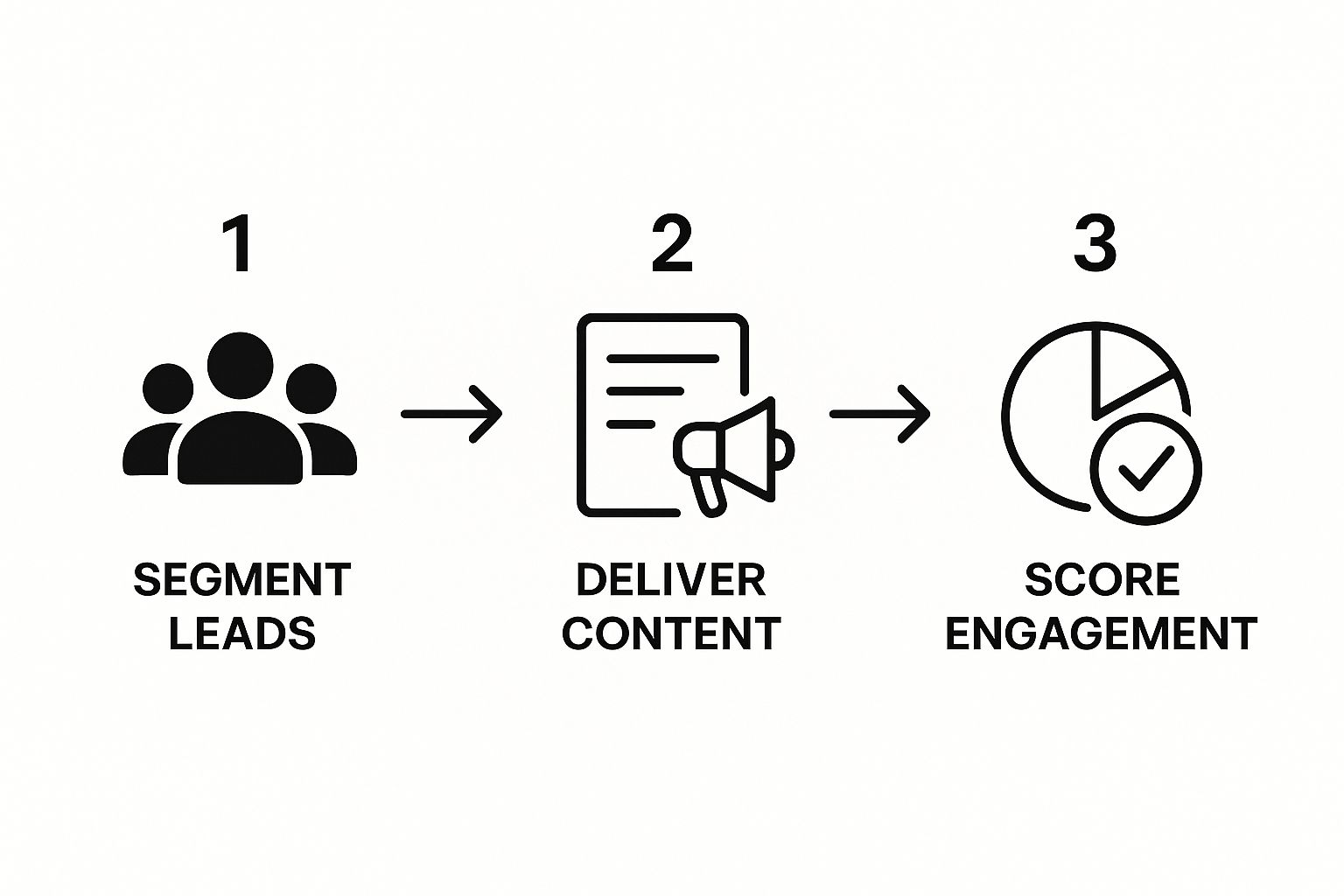
This simple loop—segment, deliver, score—is the fundamental engine that turns cool leads into qualified opportunities. By combining smart segmentation with valuable content and powerful automation, you can build a nurturing machine that drives predictable growth.
And if you're wondering how this all fits with your existing tools, you might find our guide to effective lead management in Salesforce useful for connecting these processes together.
Actionable Lead Nurturing Strategies to Start Today

Theory is great, but results come from action. Let’s move past the "what" and "why" and get into the "how." It's time to translate all that knowledge into a practical playbook of proven lead nurturing strategies you can start using right away.
These aren't just random email blasts. They're carefully designed campaigns meant to meet leads exactly where they are in their journey, guiding them to the next logical step. When you get this right, it feels less like marketing and more like a genuinely helpful conversation.
The Essential Welcome Series
First impressions are everything, right? Your welcome series is your one shot to greet new subscribers, set expectations, and prove your value from day one. This isn't just a single "thanks for subscribing" email. Think of it as a multi-step introduction to your brand.
- Goal: Onboard new leads, build that initial spark of trust, and get them to engage immediately.
- Target Audience: Anyone who just signed up for your newsletter, downloaded a guide, or opted into your world for the first time.
- Content to Use: Kick things off with a warm welcome that introduces your brand’s mission. Then, give them a "quick win"—a link to your most popular blog post, a useful checklist, or a free tool.
This initial sequence is absolutely critical. It sets the tone for the entire relationship and confirms to the lead that handing over their email address was a smart move.
The Educational Drip Campaign
Okay, you've made a great first impression. Now it's time to establish your authority. An educational drip campaign is your way of becoming the go-to expert in your space by consistently solving your audience's problems with high-value content.
The goal here isn't to sell your product directly. It's to sell your expertise. When you consistently provide answers and insights, your solution becomes the only logical choice when they're finally ready to buy.
This approach is perfect for leads floating around the middle of your funnel who are actively looking for solutions. You can learn more about pulling these folks into your orbit with effective inbound lead generation tactics.
The content needs to be substantial and hit on specific pain points. Think about sharing detailed guides, webinar recordings, or insightful case studies that show off real-world results. Each piece should build on the last, taking the lead on a journey from "I have a problem" to "I know how to solve it."
The Re-Engagement Campaign
What about those leads who've gone quiet? A re-engagement campaign is your targeted effort to win back their attention. Instead of just letting those dormant contacts gather digital dust, you can reignite their interest with a few strategic moves.
Key tactics for a re-engagement sequence include:
- Acknowledge the Silence: Start with a friendly, low-pressure email that acknowledges it's been a while. Something like, "Is the spark gone?" can work wonders.
- Offer New Value: Tempt them back with your best and most recent content, a new tool, or an exclusive offer to show them what they've been missing.
- Ask for Feedback: Sometimes, the simplest approach is best. Just ask what they'd like to see from you or why they disengaged. You might get some invaluable insights.
To keep all your nurturing efforts sharp, it's a good idea to constantly collect customer insights. Learning and applying effective customer feedback strategies will give you the data you need to make sure your campaigns always hit the mark.
Any strategy is only as good as the results it produces. Without a clear way to measure what’s working, your lead nurturing efforts are just a shot in the dark. To really prove its value, you have to look past vanity metrics like open rates and zero in on the key performance indicators (KPIs) that actually move the needle on business growth.
Tracking success isn't just about patting yourself on the back for wins; it's about finding the gaps and getting better. When you watch the right data, you can see exactly where your nurturing process is clicking and where it’s falling flat. That lets you make smart, data-driven tweaks instead of just guessing.
Core Metrics That Truly Matter
To get a real feel for your campaign's health, you only need to focus on a handful of high-impact metrics. These are the numbers that show how well you're guiding prospects through their buying journey and turning marketing spend into actual revenue.
Here’s what you should be watching:
- Engagement Rates: Don't just stop at opens. Look at click-through rates (CTR) on your calls-to-action. Are people actually inspired enough by your content to take the next step?
- Funnel Conversion Rates: Keep an eye on how many leads are graduating from one stage to the next—for instance, moving from a simple subscriber to a Marketing Qualified Lead (MQL).
- MQL-to-SQL Conversion Rate: This one is a huge health indicator. It tells you what percentage of leads your marketing team qualifies are actually accepted by sales as real opportunities.
- Sales Cycle Length: A solid nurturing campaign should shorten the time it takes for a lead to become a customer. You're educating them proactively, so the sales process should speed up.
A low MQL-to-SQL rate is often a classic sign of sales and marketing being out of sync. You can tighten up this process by using data-driven lead scoring best practices to make sure marketing is handing over leads that sales actually wants.
Continuous Optimization Through Testing
The best nurturing strategies are never set in stone; they’re constantly adapting and evolving. The key to making them better over time is A/B testing. It's simple: you create two versions of one element—like an email—to see which one performs better.
Start by testing the big stuff: email subject lines, call-to-action (CTA) button copy, or even the main offer itself. You'd be surprised how small changes can create significant lifts in engagement and conversion, turning a decent campaign into a great one.
But measurement can also tell you when things aren’t working. While some marketers see a 30% or more jump in sales opportunities, about 32% report no measurable difference between nurtured and non-nurtured leads. This usually points to a problem with the strategy or how it's being measured, not a flaw in the idea of lead nurturing itself. You can discover more insights about lead nurturing statistics on Bloggingwizard.com.
Got Questions About Lead Nurturing? We Have Answers.
As you start putting lead nurturing into practice, you're bound to run into a few questions. That's completely normal. Getting clear, straightforward answers is the best way to build confidence and make sure your strategy actually works.
Let's tackle some of the most common questions we hear from teams just like yours.
How Long Should a Lead Nurturing Campaign Be?
There’s no magic number here. The best rule of thumb is to let your campaign's length mirror your typical sales cycle. A one-size-fits-all approach is a recipe for disaster. If you're selling a simple B2C product, a campaign might only need to run for a few days.
But for a complex B2B software sale with a whole committee of decision-makers, you could be looking at a nurturing sequence that spans several months. The goal is to match your campaign's timeline to the average time it takes a customer to go from "just looking" to signing on the dotted line.
Dig into your customer data to figure out that average timeframe and use it as your starting point. And remember, always prioritize delivering value over sticking to a rigid schedule. If a lead is still engaged and clicking through, keep the conversation going.
What Is the Difference Between Lead Nurturing and Email Marketing?
This is a fantastic and super common question. The easiest way to think about it is this: email marketing is a tool, while lead nurturing is the strategy. They're connected, but they aren't the same thing.
You can use email marketing for all sorts of things, like blasting out a one-off promotional email about a flash sale to your entire list. It’s a broad channel you can use for tons of different goals.
Lead nurturing, on the other hand, is a much more focused and deliberate strategy. It uses email (plus other channels like social media or retargeting ads) to send a carefully planned series of personalized messages to a specific group of leads over time.
- Email Marketing: A broad communication channel. Think of it as a megaphone.
- Lead Nurturing: A focused strategy to build relationships. Think of it as a series of one-on-one conversations.
So, while almost all lead nurturing involves email marketing, not all email marketing is lead nurturing. The real difference is the strategic, long-term goal of guiding a prospect down the path to purchase.
When Should a Lead Be Passed to the Sales Team?
You should hand a lead over to sales the moment they show clear, undeniable signs of buying intent. No sooner, no later. The most effective way to nail this timing is by using a lead scoring system.
This is a data-driven process where you assign points to leads for taking specific actions. For example, opening an email might be worth a couple of points, but visiting your pricing page or requesting a demo? That's worth a lot more.
When a lead’s score hits a certain number you've decided on beforehand, they officially become a Marketing Qualified Lead (MQL). That’s the trigger. This MQL status should automatically send them over to a sales rep for immediate follow-up. This data-backed handoff is absolutely critical for getting marketing and sales on the same page and ensuring your reps spend their precious time on the hottest leads who are actually ready to talk.
Ready to turn more of your high-intent leads into scheduled meetings? Distro automatically routes prospects from your demo request forms directly to the right sales rep’s calendar, eliminating delays and boosting conversion rates. See how it works.