Let's be honest, the old way of selling is getting tired. Cold calls, interruptive ads... it feels like shouting into a void. What if, instead of chasing customers down, they came looking for you?
That’s the core idea behind an inbound lead.
Simply put, an inbound lead is a potential customer who actively seeks you out and initiates contact. They found your blog, watched your webinar, or downloaded your guide. They raised their hand. Think of it like a customer walking into your store because your window display was just that good—they chose to engage with you.
Understanding Inbound Leads and Attraction Marketing

This isn't just luck; it's the result of a deliberate strategy called attraction marketing. Instead of pushing your message out to a massive, often uninterested, audience, you focus on pulling the right people in. How? By creating content and experiences that are genuinely helpful.
This isn't about a flashy sales pitch. It's about earning attention and building trust long before a sales conversation ever happens. When someone finds your business because you helped them solve a problem, they arrive with a completely different mindset—they're already warmed up to your brand.
To get a clearer picture, let's break down the core characteristics of a true inbound lead.
Core Characteristics of an Inbound Lead
This table outlines the key attributes that define an inbound lead, offering a quick reference for what sets them apart.
| Attribute | Description |
|---|---|
| Initiated by the Prospect | The individual makes the first move—be it filling out a form, signing up for a newsletter, or starting a chat. |
| High Intent | They are actively researching a problem or looking for a solution, which means their interest is genuine and timely. |
| Permission-Based | They have given you explicit consent to contact them, creating a more receptive and positive interaction from the start. |
| Self-Qualified | By engaging with specific content, they often signal their needs and interests, providing valuable context for your sales team. |
These traits make inbound leads some of the most valuable assets for any sales pipeline. They're not just names on a list; they're people actively looking for answers you can provide.
The Engine Behind Inbound Marketing
So, how do you actually get these high-intent prospects to your digital doorstep? It’s not magic. It’s a well-oiled machine built on a few key pillars working in tandem.
Here are the primary channels that drive inbound leads:
- Content Marketing: This is your foundation. Think insightful blog posts, deep-dive guides, or how-to videos that directly address the pain points of your ideal customer. You're giving away value, no strings attached.
- Search Engine Optimization (SEO): SEO is what makes sure your amazing content actually gets found. It’s the art and science of optimizing your website to show up when people search for the problems you solve.
- Social Media Engagement: It's about being part of the conversation where your audience lives. Sharing helpful content, answering questions, and building a community around your brand—not just broadcasting ads.
The real power of inbound marketing is that it’s built on permission. Prospects choose to interact with you. That simple fact means they show up with a higher level of interest and are almost always more qualified from the get-go.
This entire approach flips the traditional sales model on its head. Your company stops being just a seller and becomes a trusted expert. By consistently providing value, you build a sustainable, predictable flow of potential customers who actually want to hear from you.
For a deeper look at putting these ideas into practice, check out our complete guide to inbound lead generation strategies.
The Strategic Advantage of Inbound vs. Outbound
Picking between inbound and outbound lead generation isn't just a tactical choice—it's a foundational decision that shapes your entire go-to-market strategy. The real difference comes down to the customer's mindset when they first talk to your sales team.
Think about someone actively searching for a solution to a problem that's been keeping them up at night. They stumble upon your blog, get some real value from it, and decide to download your guide. That's an inbound lead. They came to you because you were helpful.
Now, picture that same person getting a cold call from a number they don't recognize right in the middle of a packed workday. That's an outbound approach. Both are trying to get to a sale, but the starting points couldn't be more different. One builds rapport through value; the other interrupts to create demand.
Why Intent Is The Real Game-Changer
The single biggest advantage of an inbound strategy boils down to one powerful word: intent.
An inbound lead shows up already warm. They've raised their hand, signaling they have a problem and are actively looking for a fix. This inherent interest makes the entire sales conversation smoother, more relevant, and way more effective from the first "hello."
Outbound leads, on the other hand, are often ice-cold. Your reps have to do all the heavy lifting—educating them from square one, building trust from scratch, and just trying to figure out if there's even a problem to be solved. The contrast is obvious when you look at the numbers.
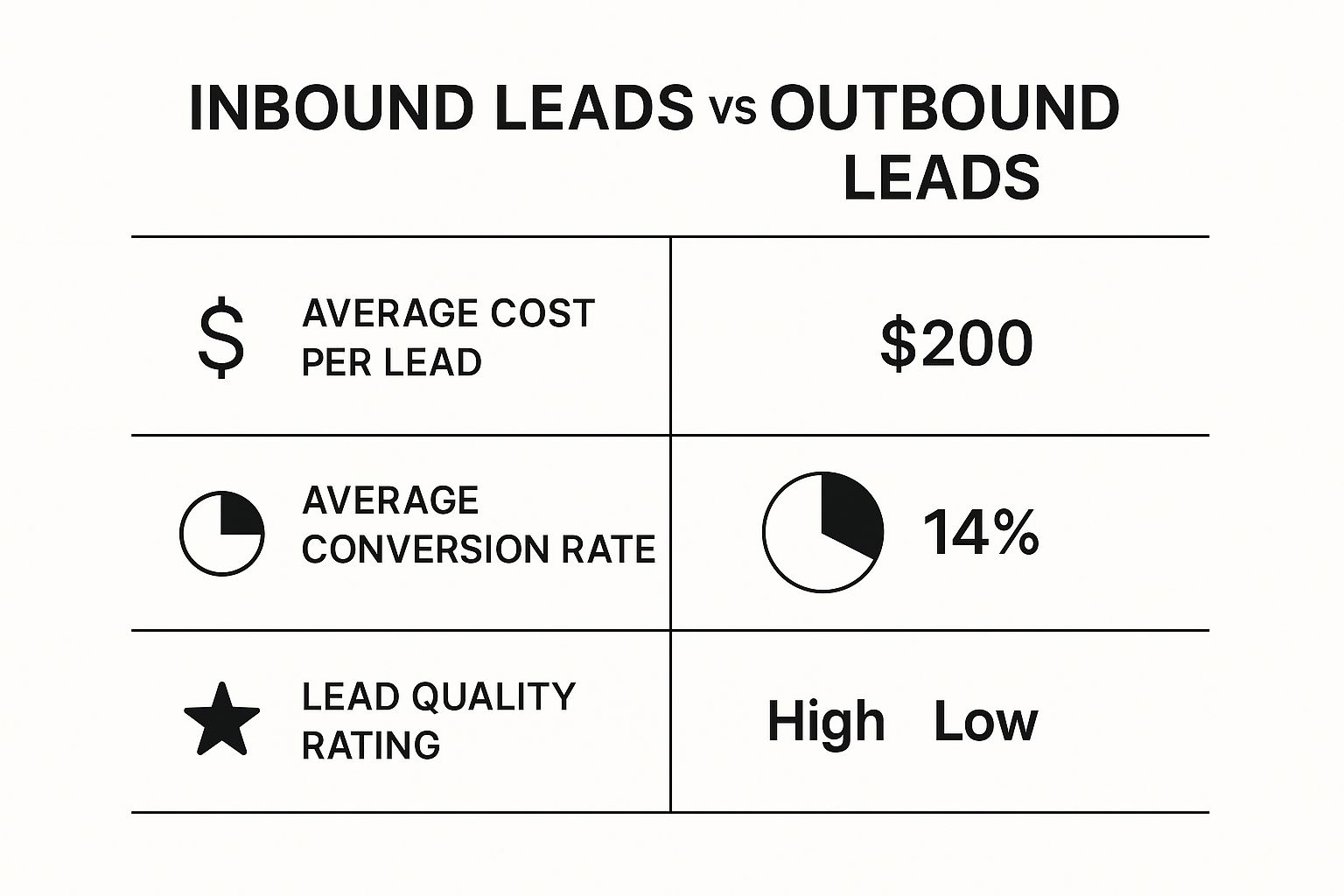
As you can see, inbound doesn't just feel better—it performs better, delivering higher-quality leads and better conversion rates, all while costing you less.
Inbound vs. Outbound: A Head-to-Head Comparison
To really spell it out, let's put these two strategies side-by-side. The differences in approach, cost, and overall effectiveness are pretty stark.
| Aspect | Inbound Leads | Outbound Leads |
|---|---|---|
| Approach | Attracts customers with valuable content (blogs, SEO, social media) | Pushes messages to a broad audience (cold calls, emails, ads) |
| Lead Quality | High-intent, self-qualified leads who are actively seeking solutions | Low-intent leads who may not be aware of their problem or your brand |
| Cost Per Lead | Lower, as content assets provide long-term, compounding value | Higher, requiring continuous investment to maintain lead flow |
| Sales Cycle | Typically shorter, since leads are already educated and interested | Often longer, as reps must educate and build trust from scratch |
| Conversion Rate | Higher, due to the pre-existing interest and trust | Lower, as it's an interruption-based model |
Ultimately, while both methods have their place, the data consistently shows that building a strategy around attracting interested buyers is a far more efficient path to growth.
The Financial Case for Inbound
Looking beyond lead quality, the economic argument for inbound is impossible to ignore. Because you're creating assets—blog posts, webinars, guides—that have a long shelf life, your efforts generate compounding returns. A single great article can bring in leads for years.
Outbound is more of a rental model. The moment you stop paying for ads or your sales team stops dialing, the leads dry up. This makes inbound a much more sustainable and scalable engine for long-term growth.
In fact, inbound marketing costs 62% less per lead than traditional outbound methods. This isn't just about saving a few bucks; it's about generating up to three times more leads for the same spend. That's how you build a sustainable revenue machine.
This efficiency frees up budget that you can reinvest into creating even more amazing content, which in turn strengthens your brand and attracts even more high-quality prospects. To really get into the weeds on this, check out our deep dive into inbound vs. outbound leads.
How to Build an Inbound Lead Generation Engine
 Okay, so you get what inbound leads are. Now for the fun part: building a system that brings them to your digital doorstep, day in and day out.
Constructing an inbound lead generation "engine" isn't about finding some secret growth hack. It’s about building a solid foundation of value and trust that naturally pulls your ideal customers toward you. This isn’t about pushy sales tactics; it’s about being so helpful they can’t ignore you.
This engine is powered by three core pillars that work together to create a predictable, scalable flow of high-intent prospects who are genuinely interested in what you have to offer. Let’s break down what you need to build.
The Power of Value-Driven Content
Content is the fuel for your entire inbound machine. And I don't mean just churning out blog posts for the sake of it. I'm talking about creating genuinely helpful resources that actually solve your audience's problems.
Good content positions your brand as a trusted authority, not just another vendor trying to sell something.
Your goal is to answer your customer's questions before they even think to ask you directly. That's how you build that first layer of trust and become the go-to resource in your space.
Here are the key content formats that really pull in inbound leads:
- Actionable Blog Posts: Ditch the generic fluff. Write content that answers a very specific customer question. For example, a software company might write "How to Choose the Right CRM for a Small Sales Team," tackling a real-world pain point head-on.
- In-Depth Guides and Ebooks: These are your "lead magnets." You offer a ton of value in exchange for an email address. A financial advisor could offer a comprehensive "Retirement Planning Checklist" to attract people who are actively looking for that kind of guidance.
- Engaging Webinars: Live or on-demand events let you connect with your audience on a more personal level. A marketing agency could host a webinar on "The Top 5 SEO Mistakes Businesses Make" to show off their expertise and capture leads who are ready to learn.
As you build out your content strategy, keep an eye on how new tools are changing the game. For instance, exploring how leveraging AI for content solutions to drive engagement can give you a serious edge.
Strategic SEO to Ensure Discovery
Creating amazing content is a total waste of time if no one can find it. Simple as that. Search Engine Optimization (SEO) is what makes your content visible to people actively searching for solutions on platforms like Google.
Think of SEO as the signposts that direct traffic to your digital storefront.
But effective SEO is about more than just stuffing keywords into a page. It’s about understanding user intent—what is someone really looking for when they type something into the search bar? When you align your content with that intent, you attract visitors who are a perfect match for your business.
The core of great SEO is empathy. You're not optimizing for a search engine; you're optimizing for a person who has a problem. When you solve their problem with your content, search engines reward you with visibility.
A well-executed SEO strategy brings in a steady stream of organic traffic from prospects who are already in a problem-solving mindset. They're the best kind of inbound leads you can ask for.
Authentic Social Media Engagement
Finally, social media gives you a platform to share your content and actually talk to your community. The key word here is engagement, not just broadcasting. It's about joining conversations, sharing useful insights, and building real relationships.
Instead of just dropping links to your latest blog post, use platforms like LinkedIn or Twitter to share key takeaways, ask thought-provoking questions, and interact with other people in your industry.
This approach builds a loyal following and reinforces your brand’s reputation as a helpful expert. When you combine these three pillars—valuable content, smart SEO, and authentic social engagement—you create a powerful, self-sustaining engine that consistently delivers high-quality inbound leads to your business.
Turning Website Visitors into Qualified Leads
Getting tons of traffic to your site is great, but it’s a bit like filling a store with window shoppers. The real magic happens when you turn that casual curiosity into a genuine sales opportunity. This is where the mechanics of lead capture and qualification come into play—it's the bridge between a passing glance and a real conversation.
To build that bridge, you need the right tools. A sharp landing page, a simple form, and a can't-miss call-to-action (CTA) all have to work in harmony. The goal is to make it incredibly easy for someone interested to raise their hand and say, "Hey, I want to know more."
The Anatomy of a Strong Lead Capture Process
Your website isn't just a digital brochure; it’s your best tool for generating inbound leads around the clock. You want to create an experience so smooth that visitors don't even think twice about sharing their info in exchange for something valuable.
Here are the key pieces of that puzzle:
- Compelling Calls-to-Action (CTAs): These are your action triggers—the "Download the Guide" or "Request a Demo" buttons. They need to be crystal clear, straight to the point, and pop off the page visually.
- Optimized Landing Pages: A landing page has one job and one job only: conversion. That means no distractions, a laser focus on a single offer, and a clear message about the value the visitor is about to receive.
- Frictionless Forms: Nothing kills a conversion faster than a long, complicated form. Stick to the essentials. Only ask for what you absolutely need to get a conversation started. To really nail this, check out our guide on building the ideal lead capture form.
Distinguishing MQLs from SQLs
Okay, so you've captured a lead. What's next? Qualification. Let’s be real: not everyone who downloads an ebook is ready to buy your product today. This is where we separate the curious from the serious by sorting them into two main buckets.
A Marketing Qualified Lead (MQL) is someone who's shown interest in your content but isn't quite ready for a sales call. They grabbed a guide or signed up for your newsletter. They look like your ideal customer, but they need a bit more nurturing before they’re ready to talk business.
A Sales Qualified Lead (SQL), on the other hand, is flashing clear buying signals. They’ve taken a high-intent action, like requesting a demo or asking for a price quote. These are the hot leads your sales team needs to jump on immediately.
Think of it like this: An MQL is someone browsing the menu, while an SQL is someone who has asked the waiter for their recommendation. The first is still considering their options; the second is ready to order.
Implementing Lead Scoring for Smarter Sales
So, how do you know when an MQL has warmed up enough to become an SQL? The answer is lead scoring. It’s a system where you assign points to leads based on who they are and what they do.
For example, a lead’s job title, company size, and industry can get certain point values. Then, their actions—like visiting your pricing page or opening a bunch of your emails—add more points to their score.
- VP of Sales from a target industry: +20 points
- Downloaded a case study: +10 points
- Visited the pricing page: +15 points
Once a lead hits a certain point threshold (say, 100 points), they’re automatically flagged as an SQL and routed over to a sales rep. This data-driven approach ensures your sales team spends their time and energy on the prospects who are actually most likely to close. It makes the whole inbound process smarter, not harder.
Using Automation to Supercharge Lead Management
Getting a steady stream of inbound leads is a huge win, but it’s really just the first play in a much bigger game. The real challenge—and where the money is made—is in how you manage those leads with speed and precision. This is the point where automation shifts from a nice-to-have to an absolute necessity.
Without it, even your hottest leads will fall through the cracks. Manual processes are just too slow and full of human error. They simply can’t keep up with what buyers expect today. When someone with high intent fills out a demo request, they're looking for a response in minutes, not hours.
Eliminate Delays with Instant Lead Routing
Think of automation tools as an intelligent traffic controller for your leads. The second a prospect hits "submit" on a form, the system gets to work. It instantly scans their info—things like company size, industry, or territory—and zips them over to the perfect sales rep.
This completely cuts out the manual triage process that causes so many costly delays. No more leads languishing in a shared inbox, waiting for someone to get around to assigning them. Instead, the right salesperson gets an immediate notification, already armed with the context they need to kick off a relevant conversation.
This is exactly how a tool like Distro lets you build intelligent routing rules to automate the whole thing.

The interface makes it surprisingly easy to create sophisticated workflows that guarantee every single lead lands in the right hands, instantly.
From Interest to Meeting in Seconds
But the most powerful automation systems don't just stop at routing the lead. They take it one giant leap further by immediately showing the assigned rep’s calendar, letting the prospect book a meeting right then and there. This one step is an absolute game-changer for conversion rates.
By plugging scheduling directly into your inbound forms, you can accelerate your speed-to-lead by a staggering 240x. It collapses the sales cycle and engages prospects at the absolute peak of their interest.
Automation also knocks out other common problems that quietly kill your deals:
- Keeps Distribution Fair: Round-robin rules automatically and evenly distribute leads across the team. This prevents burnout and keeps everyone’s morale up.
- Stops Leads From Going Cold: With automated follow-up sequences, no prospect gets left behind. If someone doesn't book a meeting right away, the system can gently nudge them with reminders to keep the conversation going.
By automating your lead management, you build a scalable, efficient, and bulletproof process. It’s the only way to make sure every valuable inbound lead gets the immediate attention it deserves.
Common Questions About Inbound Leads
Jumping into an inbound strategy always brings up a few questions. Getting these sorted out early is the key to building a program that actually works and setting the right expectations from day one.
Let’s clear up some of the most common questions we hear about inbound leads.
What Is the Main Difference Between a Lead and an Inbound Lead?
The term “lead” is pretty broad. It’s a catch-all for any potential customer, regardless of how you got their name. It could be someone from a list you bought or someone you cold-called.
An “inbound lead” is a whole different ballgame—and a much better one at that. The defining action is simple: they came to you. They found your blog, saw a social media post, or Googled a problem, and they decided to reach out. That single act of self-initiated interest makes them fundamentally warmer and way more qualified than leads you have to chase down.
How Long Does It Take to Get Results from Inbound Marketing?
Inbound marketing isn’t a quick fix; it’s a long-term play. Think of it like planting a tree, not flipping a light switch. You might see some encouraging signs within 3-6 months, but building a strong, predictable flow of inbound leads usually takes a solid 6-12 months of focused effort.
The real payoff is building a sustainable asset. Unlike paid ads that disappear the second you stop paying, your content keeps working for you, pulling in and converting leads for years. The returns actually compound over time.
This is how you build a reliable revenue engine that just gets stronger the longer you stick with it.
What Are the Most Important Metrics for Tracking Inbound Success?
If you want to know if your inbound strategy is actually working, you have to track the right numbers—the ones that tell the whole story from first click to closed deal. Just looking at one metric, like website traffic, can give you a completely wrong picture.
Instead, keep an eye on a handful of key performance indicators (KPIs) together:
- Website Traffic: This tells you how many people you're attracting. It’s your top-of-funnel reach.
- Lead Conversion Rate: Are people actually taking the next step? This measures how effective your content, forms, and CTAs really are.
- Cost Per Lead (CPL): This one’s all about efficiency. It tells you exactly how much you're spending to get each new lead in the door.
- Lead-to-Customer Rate: This is the money metric. It reveals the true quality of your leads by showing how many of them actually become paying customers.
Tracking these metrics as a group gives you a clear, honest look at your inbound marketing ROI.
Ready to convert your inbound leads the moment their interest is highest? Distro helps you automatically route and schedule meetings with high-intent prospects instantly. See how you can 3X your demo form conversions by visiting https://distro.so.