
Think of dealing a deck of cards on game night. Each player gets one card at a time, in order, ensuring everyone gets a fair hand. That’s the core idea behind round robin scheduling. It’s a way to automatically pass out tasks—like sales leads or support tickets—in a continuous, equitable loop so every team member gets an equal share.
What Is Round Robin Scheduling?

At its heart, round robin scheduling is a simple but powerful system built for fairness and speed. It gets rid of the chaotic "fastest finger first" free-for-all where reps scramble to claim the best leads. Instead, this model assigns them one by one. The first lead goes to Rep A, the second to Rep B, the third to Rep C, and so on, cycling back to the start once everyone in the queue has received a lead.
This simple, automated process immediately solves two massive headaches common in sales and support teams:
- It stops lead hoarding. A few aggressive reps can no longer snatch up all the best inbound leads, leaving everyone else with scraps.
- It removes unconscious bias. When a manager assigns leads by hand, they might favor who they think is the "best" rep, which can kill team morale. Round robin takes that human guesswork out of the equation entirely.
The Foundation of a Balanced System
When every team member knows they have a fair shot, you build a more transparent and motivated team culture. It's one of the most popular and effective methods for distributing work for a reason. Research into more advanced, dynamic round robin algorithms has even shown they can cut average wait times by around 15.77% and reduce system overhead by about 20.68% compared to older methods. You can dive deeper into the data behind this enhanced round robin approach.
A fair system isn't just about distributing leads; it's about distributing opportunity. When everyone knows they have an equal chance to succeed, their focus shifts from internal competition to closing deals.
Ultimately, this simple concept of "taking turns" creates a ripple effect. It improves everything from team morale and response times to your overall pipeline velocity and revenue. It's a foundational strategy for building a sales operation that can scale efficiently.
Round Robin vs. Manual Lead Assignment
To see why so many teams are moving away from manual distribution, it helps to put the two methods side-by-side. The differences are stark.
| Feature | Round Robin Scheduling | Manual Assignment |
|---|---|---|
| Speed | Instantaneous, automated assignment | Slow, dependent on manager availability |
| Fairness | Completely impartial, equal distribution | Prone to favoritism and human bias |
| Efficiency | Highly efficient, no wasted time | Inefficient, creates bottlenecks |
| Morale | Boosts morale through transparency | Can create resentment and competition |
| Scalability | Easily scales with team growth | Becomes unmanageable as team grows |
As you can see, what might work for a tiny team of two or three reps quickly falls apart. Round robin scheduling isn’t just a convenience; it’s a necessity for any team that wants to grow without the growing pains of a biased and inefficient lead process.
Why Your Sales Team Needs Round Robin Lead Distribution

Putting an automated system like round robin in place isn't just a small operational change—it's a strategic move that can seriously boost your revenue. When a hot prospect fills out a demo request, the clock starts ticking. Immediately.
Manual lead assignment is slow, clunky, and creates bottlenecks that can kill a deal before it even gets off the ground.
Think about it this way: a high-intent lead sitting in an inbox, waiting for a manager to assign it, is like leaving a winning lottery ticket on the kitchen counter. The longer it sits, the colder it gets. An automated scheduling round robin system jumps on that lead instantly, assigning it to the next available rep in seconds.
The High Cost of Slow Response Times
In sales, speed is everything. It's the whole game. Yet, so many companies fumble the handoff with their inbound leads. It’s almost shocking, but a massive 55% of companies take more than five days to follow up on an inbound inquiry.
Contrast that with the high-performers. Companies that respond within five minutes are 100 times more likely to actually make contact with a lead. That’s not a typo. One hundred times.
Round robin automation gets rid of the human delay responsible for these painful stats. It guarantees every single lead gets routed and actioned while their interest is still red-hot, which dramatically improves your odds of closing the deal.
This isn’t just about being fast; it’s about being systematically fast. Automation kills the "I'll get to it later" mindset and replaces it with a machine-driven process that never gets sidetracked or needs a coffee break.
Creating a Culture of Fairness and Motivation
Beyond pure speed, round robin distribution fosters a much healthier and more competitive sales floor. When leads are doled out manually, it’s only a matter of time before reps start to feel like the game is rigged.
Whether it’s conscious or not, managers might favor certain reps, leaving others to feel like they’re stuck with the leftovers. This feeling of unfairness is a huge drag on morale. It breeds resentment, causes infighting, and gives your best people a reason to start looking elsewhere.
A round robin system demolishes these problems by making the process completely transparent.
Here’s how it changes the team dynamic for the better:
- Equal Opportunity: Every rep knows they're getting a fair shake. They can stop worrying about office politics and focus on competing with the market, not their teammates.
- Reduced Conflict: When an impartial system is assigning leads, there’s no one to blame for a "bad" lead. The process is objective and crystal clear to everyone.
- Increased Motivation: Reps who believe they have an equal shot at hitting their quota are naturally more motivated to bring their A-game to every single lead they get.
To see how fair lead distribution can directly impact sales outcomes, you might want to explore setting up your process for efficient demo scheduling. A fair process doesn't just feel better—it drives better results by getting everyone aligned on the same goal: closing more deals.
How to Set Up a Fair Scheduling System That Actually Works
Putting a round robin system into practice isn't as simple as flipping a switch. If you want your team to trust the process, you need to build it thoughtfully, taking into account things like individual rep capacity, working hours, and clear rules for what happens when. A well-built scheduling round robin feels fair and efficient right from the start.
The first move is to figure out each team member’s real capacity. Not every rep can—or should—juggle the same number of leads. Your senior reps can probably handle a higher volume, while a new hire who's still learning the ropes needs a smaller, more manageable queue. Modern tools let you set these individual limits, so leads are only sent to people who can actually work them.
This simple step keeps new reps from getting buried and makes sure your seasoned pros have enough at-bats to hit their numbers.
Defining Availability and Rules of Engagement
Once you have capacity sorted, the next step is to lock in everyone's availability. This is non-negotiable, especially for teams spread across different time zones. A truly fair system will only assign leads to reps during their set working hours, preventing hot leads from going cold in an offline rep’s inbox.
Your setup should also be smart enough to handle time off. A good round robin will automatically skip anyone on vacation or out sick, passing their share of leads to the next available person in line. No manual re-routing needed.
To keep things transparent and consistent, you also need to set clear rules for lead acceptance and re-assignment. We cover this in-depth in our guide to lead routing best practices. Getting these expectations down on paper upfront eliminates confusion and keeps the whole process running smoothly.
This visual gives you a simple look at how to optimize system performance.
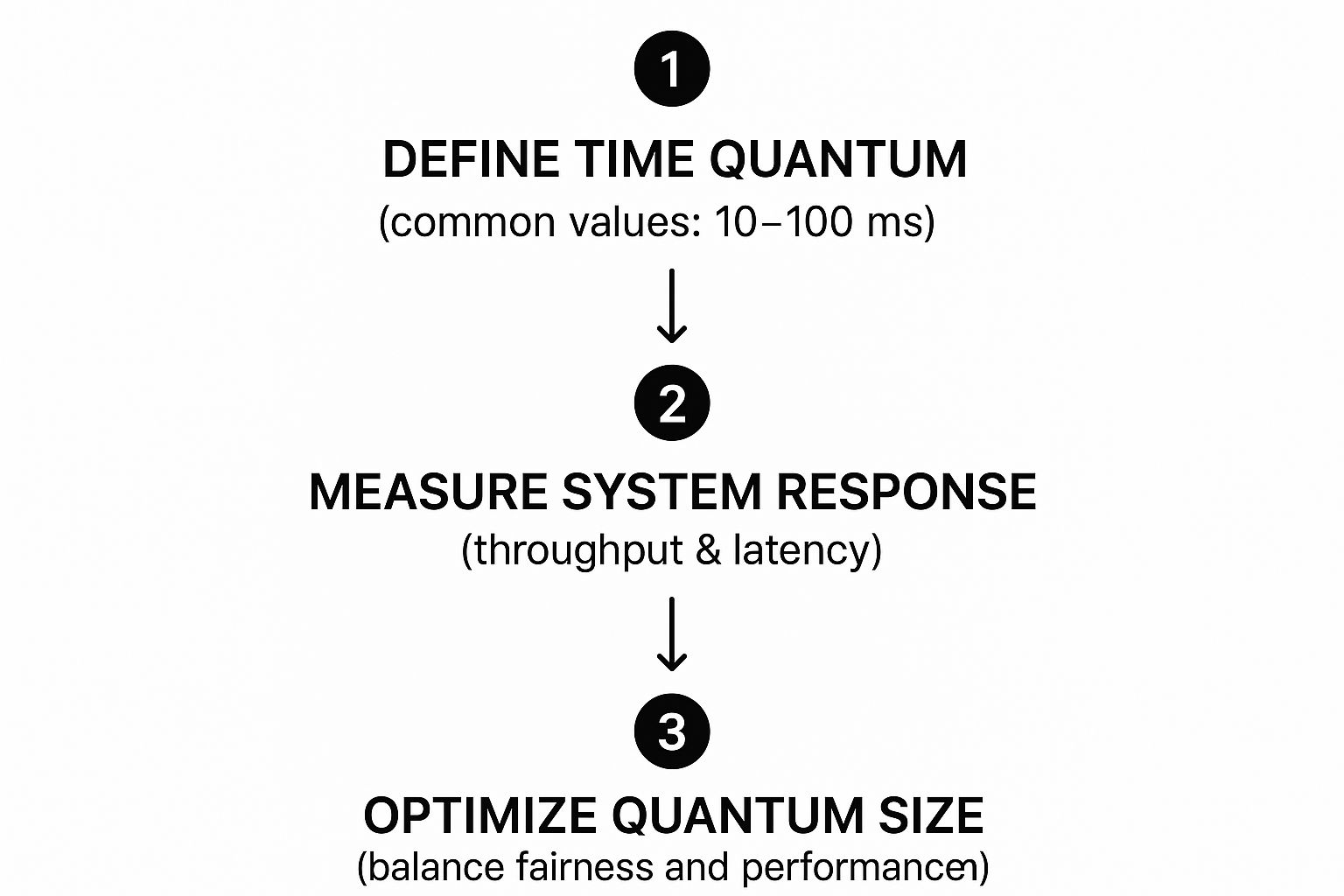
It all comes down to a core loop: define the rules, measure how they're working, and then tweak them for better results. This is the heart of effective lead routing.
Creating Failsafes and Catch-Alls
But what happens when nobody is available? Every solid scheduling system needs a backup plan. This is where a "catch-all" queue becomes your best friend. If every single rep in the rotation is offline or has already hit their capacity, the lead automatically goes to this unassigned queue instead of getting lost.
A catch-all queue is your system's safety net. It ensures that no matter what, a valuable lead is never ignored because of a gap in your routing logic.
From there, a sales manager can get a notification to step in and manually assign the lead, making sure it gets a fast response. This simple failsafe is a critical piece of the puzzle, protecting your pipeline and guaranteeing every inbound prospect gets the attention it deserves.
Advanced Round Robin Strategies for Peak Performance

So, you've got the basics of round robin down. That’s a great first step. But once your team gets comfortable with the simple rotation, it's time to add some layers of intelligence to really make it hum.
Standard round robin is great, but it has one major flaw: it treats every rep exactly the same. But let's be honest, your team isn't built that way. You’ve got seasoned closers, reps who are still learning the ropes, and specialists who own a particular niche. Advanced strategies allow your scheduling round robin system to see and account for these differences, turning a simple rotation into a serious performance optimization tool.
Weighted Distribution: Prioritizing Your Top Talent
The first leap beyond a standard 1-1-1 rotation is weighted distribution. This method lets you deliberately tip the scales, sending a larger portion of incoming leads to your most effective reps. It’s all about putting your best players on the field more often.
For example, you could give your top-performing senior rep a weight of "3," a solid mid-level rep a weight of "2," and a new hire a weight of "1." In this scenario, for every one lead the new rep gets, the senior rep gets three.
This keeps your closers fed with opportunities while giving newer team members a manageable workload, so they can learn without getting swamped.
Skill-Based Routing: The Ultimate Matchmaker
Weighted distribution is a game-changer, but you can dial in your process even further by adding skill-based rules. This is where your round robin system evolves from a simple distributor into an intelligent matchmaker, layering rules on top of the rotation to get the right lead to the right rep, every single time.
This approach is a must-have for any team with diverse skills. Think about the different kinds of expertise on your team:
- Product Gurus: Reps who are the go-to experts on Product A versus those who know Product B inside and out.
- Industry Specialists: You might have reps focused exclusively on healthcare, while others handle finance or manufacturing.
- Language Skills: If you do business globally, matching leads with reps who speak their language is non-negotiable.
- Company Size: The skills needed to close an enterprise deal are often completely different from those needed for an SMB.
With skill-based routing, a lead from a Spanish-speaking prospect in the finance industry would automatically be sent only to the pool of reps who speak Spanish and handle finance accounts. From there, the standard round robin logic would kick in to assign it to the next available specialist in that group.
This one-two punch of skills and rotation guarantees two things: your customer gets an amazing experience talking to a true expert, and your rep has a much higher chance of closing the deal.
This intelligent assignment process can drastically improve conversion rates because you’re always leading with your strongest hand. It’s a move beyond just being "fair" and into being truly strategic.
To give you a better sense of how you might structure these assignments, here are a few common round robin variations and where they shine.
Round Robin Scheduling Variations
This table breaks down different round robin models and shows you when to use each one for the best possible team performance.
| Scheduling Model | How It Works | Best For |
|---|---|---|
| Strict Round Robin | Assigns leads to reps in a fixed, repeating order (1, 2, 3, 1, 2, 3). No one is skipped. | Small, uniform teams where every rep has similar skills and capacity. Great for ensuring pure fairness. |
| Weighted Round Robin | Assigns a higher volume of leads to specific reps based on a predefined weight (e.g., Senior gets 3, Junior gets 1). | Teams with varying levels of experience or performance. Perfect for ramping new hires or rewarding top performers. |
| Skill-Based Round Robin | Routes leads to a specific subgroup of reps based on criteria like language, industry, or product knowledge, then uses round robin within that group. | Specialized sales teams where matching expertise to the lead is critical for winning the deal. |
| Time-Based Round Robin | Considers a rep's working hours or time zones, only routing them leads when they are online and available. | Geographically distributed teams or teams that need to provide 24/7 coverage to ensure fast response times. |
Each of these models serves a different purpose. The key is to look at your team's structure and your business goals to figure out which combination of rules will get you the best results.
Creating Complex Rules with And/Or Logic
To actually build these sophisticated routing flows, modern distribution platforms like Distro use "and/or" logic. This is what lets you create highly specific, flexible rules that perfectly mirror how you want your business to run.
For example, you could create a highly specific rule using "and": "Assign this lead to a rep who is on the Enterprise team AND speaks German." This rule significantly narrows the pool of eligible reps, ensuring a perfect match.
On the other hand, you could use "or" to create more flexibility: "Assign this lead to a rep who handles the East Coast territory OR is part of the SMB team." This broadens the pool, giving the system more assignment options.
By combining these logical operators, you can build a custom routing engine that’s perfectly tuned to your team’s unique structure and goals. You’ll maximize efficiency and give your team the best possible shot at success with every single lead.
Why Automated Scheduling Is No Longer Optional
The shift to automation isn't just another passing trend. It's a foundational change in how the most successful businesses operate. In this new world, features like scheduling round robin have gone from a "nice-to-have" perk to a baseline requirement for any team that wants to stay competitive. Let's be honest, manual processes are just too slow and full of holes to keep up anymore.
You can see this change reflected in the numbers. The scheduling tools market, currently valued around USD 193.1 million, is expected to balloon to USD 330.61 million by 2033. This isn't just random growth. It's driven by businesses finally realizing that automating how meetings get assigned with round robin logic maximizes the team's availability and slashes the friction that makes booking a pain for prospects.
The New Standard for Distributed Teams
With the explosion of remote and hybrid work, these tools have become absolutely essential. When your team is scattered across different cities—or even continents—manually coordinating schedules for sales calls becomes a logistical nightmare. That chaos creates delays that modern customers simply won't put up with.
Automated scheduling creates a smart, central hub that acts as the connective tissue for your entire distributed team. It ensures things keep running smoothly, allowing reps in different time zones to get leads fairly and instantly during their specific work hours. This isn't just about being more efficient; it's about keeping your operation cohesive and responsive, no matter where everyone is logging in from.
Integrating fair, automated scheduling into your tech stack isn't just a productivity hack anymore. It’s a strategic imperative for maintaining a competitive edge and delivering a seamless customer experience from the very first hello.
A Competitive Edge in a Crowded Market
At the end of the day, every business is fighting for the same thing: the customer's attention. The team that responds fastest, with the right person for the job, wins. Automating your scheduling with a fair round robin system is one of the most direct ways to build that competitive advantage right into your daily workflow. The whole evolution of sales tools, including new approaches for booking warm meetings on autopilot, highlights just how critical this speed is.
This kind of automation is the engine powering modern lead distribution software, which is all about turning a prospect's flicker of interest into a real conversation. For any team in sales, customer success, or support, this isn't optional—it’s the price of admission for staying relevant. By cutting out human bottlenecks and making sure every opportunity is jumped on immediately, you build a more resilient and high-performing revenue engine. You can dive deeper into how this all works in our complete guide on lead distribution software.
Frequently Asked Questions About Round Robin Scheduling
As you start to put round robin logic into practice, you'll inevitably run into some real-world questions. Moving from a neat concept on paper to the messy reality of a sales floor always brings up a few "what if" scenarios. Let's walk through some of the most common ones we hear.
What Happens When a Team Member Is on Vacation?
This is probably the first question everyone asks, and for good reason. A well-built system should handle this without anyone lifting a finger.
Modern scheduling tools are smart enough to see when a rep has blocked off time on their work calendar (like Google Calendar or Outlook). When a new lead arrives, the system sees the rep is OOO, simply skips them, and moves on to the next person in line. The vacationing rep isn't kicked out of the rotation—they're just temporarily bypassed. This means no leads get stuck in a dead-end inbox.
Once they're back, the system automatically slots them right back into the rotation. No manual updates from a manager needed.
A smart system respects time off. It keeps leads flowing to the active team and lets the person on vacation actually be on vacation, all without manager intervention.
Can I Assign More Leads to My Top Performers?
Absolutely. While a classic round robin is all about strict equality, any decent routing platform will let you use weighted distribution. This is where you can intentionally tip the scales to give more at-bats to certain reps.
For instance, you could set up your distribution so a senior rep gets leads at a 2:1 or 3:1 ratio compared to a new hire. It's a powerful strategy for a few reasons:
- Reward top performance: Give your best closers more opportunities to do what they do best.
- Ramp new hires: Let newer reps learn the ropes with a manageable flow of leads instead of drinking from the firehose.
- Maximize revenue: Funnel a bigger slice of your most valuable leads to the reps who have the highest chance of converting them.
How Is Round Robin Different from Simple Load Balancing?
This is a great question that gets to the core of what these systems are designed to do. While they both spread work around, they operate on totally different philosophies.
Load balancing is all about capacity. Its one and only job is to prevent anyone from getting overloaded. It looks at the team, finds the person with the lightest current workload, and sends the next task their way. It’s reactive.
Round robin scheduling, on the other hand, is built on fairness and sequence. It follows a fixed, predictable order, like dealing cards. Everyone gets their turn before the cycle starts over. While this does balance the workload over time, its main goal is sequential fairness, not managing immediate capacity.
Ultimately, sales teams tend to prefer round robin because it's transparent. Everyone knows the system is fair and that their turn is always coming up.
Ready to stop leads from slipping through the cracks and start converting more demo requests? See how Distro can implement a fair and powerful round robin system for your team. Learn more and get started today.