
What The Round Robin Algo Really Does (And Why You Should Care)
Imagine you're at a dinner party where every guest gets exactly three minutes to tell their story before the spotlight moves to the next person. No one gets to monopolize the conversation; everyone gets an equal chance to speak. This simple, fair-minded concept is the heart of the round robin algorithm. It was first developed to bring order to how computers handled competing tasks, which used to battle for attention much like siblings fighting over the last cookie. This elegant solution fixed one of computing's early challenges: keeping everything running smoothly without letting any single task wait indefinitely.
This approach was a major step forward for process management, creating a methodical, turn-based system. At its core, the round robin algorithm gives each process a small, fixed unit of time called a time quantum. It cycles through a queue of tasks, granting each one its designated time slice before moving to the next in line. You can learn more about its technical roots as a CPU scheduling method, where it first proved its worth.
The Cyclic Approach in Action
The real power of the round robin algorithm is its predictable, circular flow. Picture three processes—let's call them P1, P2, and P3—all waiting for their turn. The system doesn't pick favorites; it just follows the list in order.
- P1 runs for its assigned time quantum.
- The system then pauses P1 and switches to P2, which runs for its quantum.
- Next up, P3 gets its turn.
- Once P3's time is up, the cycle repeats, starting again with P1.
This visual shows how the scheduler moves from one process to the next in a continuous loop.

The diagram makes the core idea clear: a fair, continuous loop that gives every task its moment. This prevents any single, lengthy process from hogging all the system's resources, which helps maintain a responsive experience for all active tasks.
From Theory to Practical Necessity
This principle isn't just for operating systems anymore; it has found a home in many business applications. For today's sales and support teams, making sure opportunity is distributed fairly is vital for morale and peak performance. That's why many companies now rely on tools built around this exact concept. If you're looking to bring this kind of fairness to your own team's workflow, you might find our overview of round robin scheduling software helpful. The same logic that keeps a computer from freezing up can also keep a sales team motivated and productive by distributing leads equitably.
Inside the Round Robin Algorithm: A Step-by-Step Breakdown
To really understand its mechanics, let's look under the hood of the round robin algorithm. Picture your computer’s scheduler as a very organized traffic conductor managing three active tasks: a video call (P1), a file download (P2), and a game running in the background (P3). Instead of letting them all compete for resources at once, the algorithm makes sure each gets a fair, predictable slice of time.
This process is built on a few key actions: giving each task a fixed amount of time, cycling through the line of waiting tasks, and quickly switching between them when their time is up. This infographic shows the basic three-step flow of the round robin algorithm.
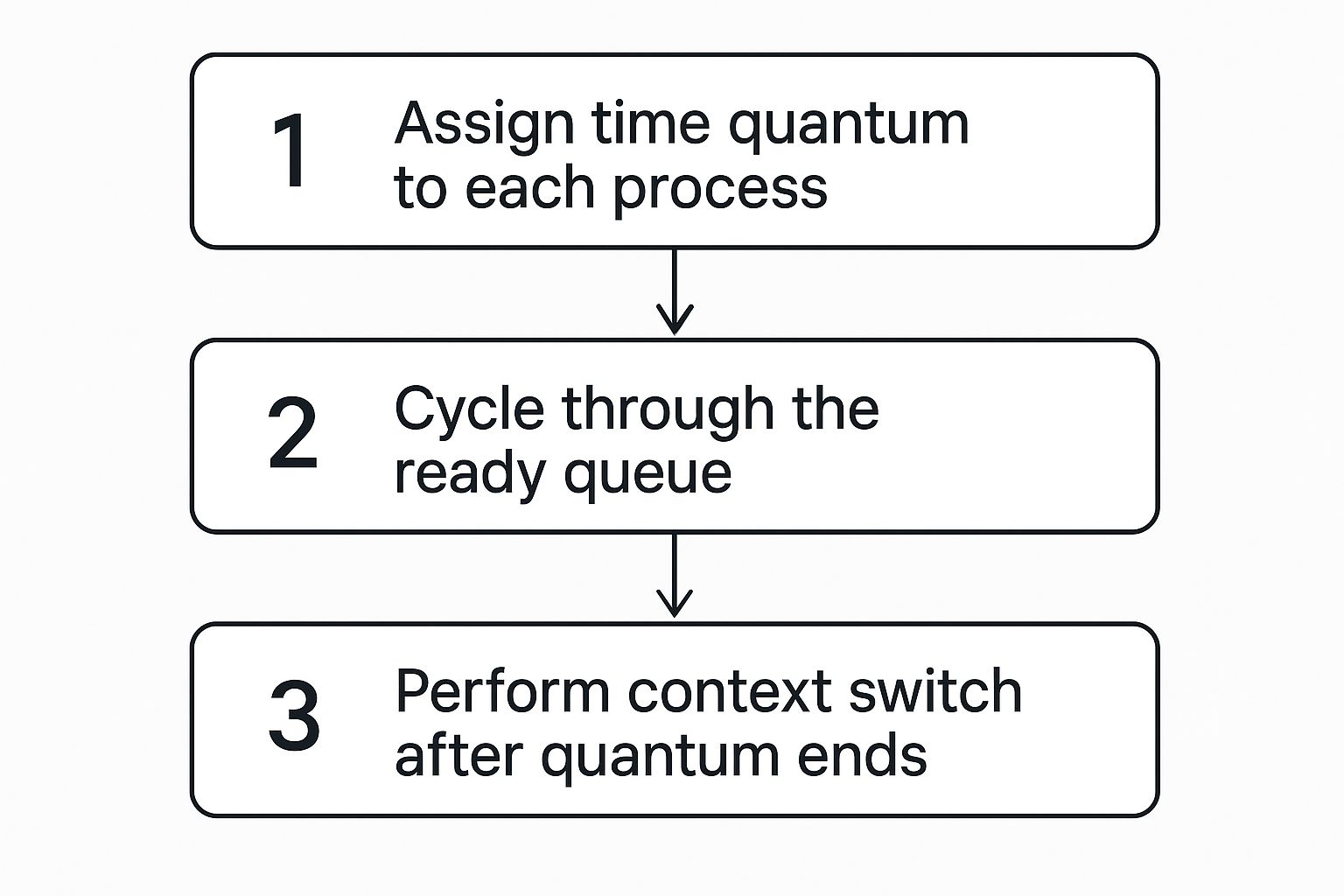
As you can see, the system moves from assigning a time slot to cycling through the queue and then performing a quick swap, creating a continuous loop that ensures every task gets its turn.
The Ready Queue and Time Quantum
At the center of this system is the ready queue, which is just the line where processes wait for their turn. When P1, P2, and P3 arrive, they form a queue, much like customers at a checkout counter. The scheduler then gives each process a time quantum—a small, fixed burst of CPU time. Let’s say this quantum is set to 20 milliseconds (ms).
The scheduler picks the first process, P1, from the front of the queue and lets it run. The timer begins. As soon as 20 ms have passed, the scheduler performs a context switch. This is a crucial step where it saves the current state of P1 (what it was doing and where it stopped) and moves it to the back of the queue. Now, it's P2's turn to get its 20 ms of attention.
A Walkthrough Example
Let's see how this plays out with our three processes, each needing a different amount of total time to finish. We'll use a time quantum of 20 ms.
| Process | Total Time Needed |
|---|---|
| P1 (Video Call) | 50 ms |
| P2 (File Download) | 30 ms |
| P3 (Game) | 60 ms |
The following table breaks down the execution moment by moment, showing how the scheduler manages the processes.
| Time | Process | Status | Remaining Time | Queue |
|---|---|---|---|---|
| 0-20 ms | P1 | Runs | 30 ms | [P2, P3, P1] |
| 20-40 ms | P2 | Runs | 10 ms | [P3, P1, P2] |
| 40-60 ms | P3 | Runs | 40 ms | [P1, P2, P3] |
| 60-80 ms | P1 | Runs | 10 ms | [P2, P3, P1] |
| 80-90 ms | P2 | Runs and Completes | 0 ms | [P3, P1] |
| 90-110 ms | P3 | Runs | 20 ms | [P1, P3] |
| 110-120 ms | P1 | Runs and Completes | 0 ms | [P3] |
| 120-140 ms | P3 | Runs and Completes | 0 ms | [] |
Notice how P2 finished in just 10 ms during its second turn. The scheduler didn't waste time; it immediately moved to the next process in the queue. This cycle continues until every process is complete.
This method guarantees that even long tasks like the game (P3) don't block shorter tasks like the file download (P2), creating a responsive and fair system. The appeal of the round robin algorithm is its simplicity and predictability.
Cracking The Time Quantum Code: Why Size Matters
The success of a round robin algorithm depends on one crucial, often underestimated factor: the time quantum. Think of it like a key ingredient in a recipe—add too little or too much, and the whole dish is ruined. This is the fine line where implementations either hit peak performance or fail completely. The size of the time quantum is a balancing act between system responsiveness and overall efficiency, and getting it right is both an art and a science.

The Downside of a Poorly Sized Quantum
A time quantum that's too short forces the system to behave like a frantic multitasker, constantly jumping between tasks. Each of these jumps, known as a context switch, eats up valuable CPU time without doing any real work for the processes themselves. Imagine a chef who spends more time switching between chopping vegetables and stirring a pot than actually cooking. The result is a lot of wasted effort and low productivity.
On the flip side, a time quantum that's too large defeats the whole purpose of the round robin algorithm: fairness. It allows long-running processes to hog the CPU, making shorter, interactive tasks wait in line. This leads to frustrating delays and a poor user experience. In effect, it turns the round robin scheduler into a much less effective First-Come, First-Served model.
Finding the Sweet Spot in Different Scenarios
The perfect quantum size isn't a one-size-fits-all number; it’s determined by what the system needs to accomplish. System architects make these critical choices by analyzing performance requirements.
- Interactive Systems: Picture a modern desktop operating system or a video game console. Here, responsiveness is everything. Users expect instant feedback when they click a mouse or press a controller button. For these systems, a short time quantum, usually between 10 to 100 milliseconds, is perfect. This setup ensures no single application can freeze the system, creating a smooth and seamless user experience.
- Batch Processing Systems: Now, think about a server crunching huge amounts of data overnight. In this scenario, user interaction is minimal or nonexistent. The main goal is throughput—getting as much work done as possible in a set amount of time. A longer time quantum, sometimes lasting several seconds, is more efficient. It reduces the overhead from context switching, letting each task make real progress before passing the baton.
The challenge is to pick a quantum that’s long enough to cut down on context switch overhead but short enough to keep things fair and responsive. A common rule of thumb for most general-purpose systems is to set a quantum that allows 80% of CPU tasks to finish within a single time slice. Spotting the warning signs of a poorly chosen quantum—like high system load with little actual work getting done or sluggish interactive performance—is the first step to optimizing any system that relies on a round robin algorithm.
Beyond CPUs: Where Round Robin Rules The Digital World
The core idea of the round robin algorithm—basically, just taking turns—is the quiet engine behind many of the digital services you rely on every day. It's not just a concept for computer scientists; its principles of fairness and order are essential for systems that need to handle a huge number of requests without crashing. From the websites you browse to the emails you send, this simple algorithm is working behind the scenes.
One of its most common and powerful uses is in load balancing. Think about a hugely popular website like Netflix or Google. A single server would crumble under the weight of millions of simultaneous user requests. Instead, these companies use large groups of servers. A round robin algorithm acts like a traffic cop, directing incoming requests one by one to each server in the cycle. The first request goes to Server 1, the second to Server 2, and so on, making sure no single server gets overwhelmed.
Real-World Examples in Action
The beauty of this method is its adaptability. The simple concept of fair, sequential distribution solves a surprising number of operational headaches across different fields.
Here are a few places you'll find it:
- Content Delivery Networks (CDNs): When you stream a movie, a CDN often uses a form of round robin for its DNS. It gives your device a list of server addresses, and your device cycles through them to pull down the video data. This spreads the demand and helps ensure your movie plays smoothly without constant buffering.
- Email Servers: Your email provider uses round robin to handle the constant flow of incoming and outgoing mail. By distributing this traffic across multiple mail servers, they prevent any one server from being swamped. This is a key strategy for fighting spam and keeping the email service online and available.
- Online Gaming: Ever wonder how multiplayer games create balanced matches? Matchmaking systems frequently use round robin logic to rotate players into lobbies. This gives everyone a fair shot at playing without sitting in a queue forever, no matter when they joined.
Scaling Fairness from Small to Large Systems
The round robin algorithm scales incredibly well, from a small office network sharing a single printer to massive, planet-spanning infrastructures managing global search queries. A business might use it to assign support tickets to its customer service team, guaranteeing an even workload and quicker replies. This is the very same principle that lets huge cloud providers manage resources for thousands of different customers.
The algorithm's lasting power comes from its simplicity and predictable nature. It establishes a baseline of fairness that's easy to implement and even easier to understand. This makes it a go-to solution for any system needing to balance demand. It's this powerful simplicity that keeps a decades-old concept so vital to our modern, connected world.
Supercharging Round Robin: Modern Performance Breakthroughs
While the traditional round robin algorithm is a reliable workhorse known for its simple fairness, the needs of modern applications have sparked the creation of more intelligent and flexible versions. These newer approaches build on the core principle of equitable turns but add layers of optimization. The result is a system that is not only fair but also remarkably efficient, moving beyond a "one-size-fits-all" time slot to meet the specific needs of each task.

Adaptive and Hybrid Models
One of the most effective enhancements is the creation of algorithms that adjust the time quantum on the fly. Instead of giving every process the same fixed time slice, these methods analyze a task's behavior and assign time accordingly. This simple change prevents short, quick tasks from getting stuck waiting behind a long, intensive process that received the same amount of time.
This line of thinking produced the Variable Optimized Round Robin (VORR) algorithm. A 2021 study showed that by dynamically changing the time quantum based on the needs of waiting processes, VORR could dramatically reduce average waiting times. The research reported a waiting time as low as 14.5 milliseconds, a significant improvement over the 26.6 ms found in standard round robin setups. The full findings offer a closer look at how these adjustments boost system responsiveness.
To put these performance differences into perspective, let's compare how traditional round robin stacks up against its more modern counterparts.
Round Robin Algorithm Performance Comparison
Comparison of traditional round robin vs. optimized variants showing waiting times, response times, and system throughput
| Algorithm Type | Average Waiting Time | Response Time | Context Switches | CPU Utilization |
|---|---|---|---|---|
| Traditional Round Robin | High | Moderate | High | Moderate |
| Variable Optimized (VORR) | Low | Fast | Moderate | High |
| Priority-Based Hybrid | Variable (Low for high priority) | Fast for high priority | Low to Moderate | High |
This table shows that while traditional round robin provides a baseline, optimized versions like VORR and priority hybrids offer substantial gains. They reduce wait times and improve CPU use by being smarter about how they allocate resources.
Combining Fairness with Priority
Another powerful strategy involves creating hybrid models that mix the round robin algo with other scheduling techniques, such as priority-based scheduling. This results in a multi-level system that gets the best of both worlds:
- High-priority tasks are addressed first, but within that top-tier group, a round robin cycle ensures no single critical task hogs all the resources.
- Low-priority tasks are handled in their own round robin queue, guaranteeing they still get processed without interfering with more urgent operations.
These advanced methods aren't just academic exercises. Major technology companies use these optimized versions in systems that support millions of users, demonstrating that these approaches can cut response times by over 40%. In business, this same logic can be applied to create more effective distribution systems, a topic we cover in our guide to round robin meetings. By blending fairness with intelligence, these modern algorithms bridge the gap between classic simplicity and today's performance demands.
Round Robin in Business: How Distro Drives Fair Lead Distribution
While the round robin algorithm is a workhorse for managing computer processes, its core idea of "taking turns" is incredibly effective for managing people and opportunities. This is where a computer science concept directly translates into revenue. For any sales team, fair lead assignment isn't just a matter of keeping everyone happy; it directly influences team morale, how fast deals close, and the company's bottom line.
Distro uses this exact logic to solve a classic sales headache: the messy, often biased scramble for new leads. Without a system, some reps get buried in opportunities while others are left waiting. A smart round robin setup replaces this chaos with a predictable and fair cycle. It ensures every team member gets a shot at high-intent prospects, turning algorithmic fairness into real business growth. This is why the round robin algorithm is a key feature in the best lead routing software.
Putting Algorithmic Fairness into Practice
Implementing a round robin algorithm for a sales team isn't as simple as just creating a list and going down it one by one. The real world of sales is messy and full of variables that demand a more intelligent approach. A truly effective system has to account for the human element to maintain fairness and speed.
Here’s how a tool like Distro makes this work:
- Managing Team Availability: The system is smart enough to know when a sales rep is on vacation, in a meeting, or otherwise unavailable. It automatically skips them in the queue, making sure leads go only to reps who can follow up right away.
- Handling Peak Hours: Imagine a flood of new leads after a popular webinar. The algorithm distributes them evenly across the available team, preventing any single rep from being overwhelmed and ensuring no lead gets cold.
- Balancing Lead Quality: Let's face it, not all leads are created equal. An advanced system can be set up to balance how high-value and lower-value leads are assigned. This prevents reps from feeling like they’re getting an unfair share of less-qualified prospects.
Overcoming Implementation Challenges
Rolling out a round robin system means thinking through real-world complexities. What happens when you have reps with different skill levels, high-priority leads that need special attention, or new people joining the team?
For example, a new hire might be placed in a separate, smaller queue or receive fewer leads as they ramp up. Meanwhile, high-priority leads from key accounts could be sent to a specific group of senior reps, who then receive those leads in a round robin fashion among themselves.
By understanding how to configure these kinds of smart workflows, companies can build a sales process that is not only fair but also highly effective at turning interest into revenue. Thoughtfully applying the principles of the round robin algorithm is a foundational step in creating a more productive and balanced sales floor.
Round Robin Algo Troubleshooting: Avoiding Common Disasters
While the round robin algo is praised for its elegant simplicity, a poor setup can lead to spectacular system failures. Getting it right means moving beyond theory to anticipate real-world problems. By learning to spot common errors, you can ensure your scheduling systems remain robust and fair under pressure.
The Time Quantum Guessing Game
The most classic blunder is picking a time quantum based on a gut feeling instead of careful analysis. This single mistake can cripple performance. A quantum that’s too short creates excessive context switching, where the system spends more time switching between tasks than actually working on them. Think of it like a chef who spends more time swapping knives than actually chopping vegetables.
On the other hand, a quantum that’s too long turns your fair scheduler into a sluggish first-come, first-served system. This leaves short, interactive tasks stuck waiting in line, frustrating users. To avoid this, you must measure your actual workloads. A good starting point is to aim for a quantum that allows 80% of your processes to complete in a single time slice, balancing responsiveness with efficiency.
Common Queue Management Errors
Poor queue management can quickly turn orderly scheduling into resource-wasting chaos. Here are a few critical issues to watch for:
- Resource Starvation: This happens when a high-priority queue is constantly fed new tasks, preventing lower-priority tasks from ever getting a chance to run. The fix is often to implement an "aging" mechanism, where a task's priority increases the longer it waits in the queue.
- The Convoy Effect: This is like a traffic jam on the highway. It occurs when several processes queue up behind a single, slow process that is holding a resource they all need. Even with a fair time slice, every process in the convoy ends up waiting. The solution involves better resource management, ensuring no single process can block critical resources for an extended period.
- Priority Inversion: This is a tricky issue where a low-priority task holding a needed resource gets pushed aside by a medium-priority task. This, in turn, prevents a high-priority task from running because it's still waiting for the resource held by the low-priority task. Implementing priority inheritance protocols, which temporarily boost the low-priority task's status, can resolve this deadlock.
By setting up robust monitoring and understanding these potential pitfalls, you can diagnose bottlenecks before they become major problems. This transforms the round robin algo from a potential point of failure into a reliable foundation for your systems.
Ready to implement fair, automated scheduling without the headaches? Distro uses intelligent round robin logic to route leads to the right reps instantly, ensuring fairness and maximizing your conversion rates.