Sales territory planning is much more than just carving up a map and handing out assignments. Think of it as the strategic foundation for how your entire sales force operates. It's the process of thoughtfully dividing your market into manageable chunks and giving them to the right reps.
When you get this right, you're directly aligning your team’s day-to-day efforts with the company's biggest growth goals. It's about optimizing how your team is deployed, squeezing every drop of potential revenue from the market, and making sure workloads are fair and balanced.
Why Sales Territory Planning Is Your Secret Weapon
Let's stop thinking about territory planning as a boring administrative chore. The highest-performing sales organizations I've worked with treat it as a core driver of sustainable growth. This isn't just about keeping things neat; it's about boosting team morale, penetrating deeper into your market, and forging stronger, more profitable customer relationships.
A well-designed plan is the bedrock of a motivated, high-achieving sales team.
I’ve seen firsthand what happens when territories are slapped together without much thought. It’s a fast track to rep burnout. Your top performers get buried under unworkable account lists, while others are left with bone-dry pipelines. This kind of imbalance is a recipe for disaster, creating missed opportunities all over the place. Reps either don't have the time to nurture their best accounts or simply don't have enough prospects to even have a shot at hitting their quota.
The Impact of Strategic Alignment
When territories are designed with care, the positive effects ripple across the entire sales org. The numbers don't lie: companies that are strategic about territory planning pull in 15% higher revenue compared to those that just wing it.
They also see a 20% bump in sales productivity and slash planning time by a staggering 75%. This frees up sales leaders to do what they do best—coach their teams and think strategically, instead of getting bogged down in administrative muck. You can dig into more of the data behind these gains in research from Abacum.ai.
A strategic approach means every rep gets a fair shake at success. It gets rid of those "golden territories" that cause resentment and the "dead zones" that just crush motivation. What you get instead is a culture where performance is a true measure of skill and hustle, not a lottery based on a lucky assignment.
A well-crafted sales territory plan is more than a map—it's a promise to your sales team that their success is tied to a fair, data-driven system designed to help them win.
Connecting Planning to Broader Sales Strategy
Great territory planning doesn't happen in a silo; it has to be woven into your entire go-to-market strategy.
For instance, you can't implement effective B2B sales automation strategies without knowing how your territories are structured. A solid plan is what makes automated lead routing, targeted email sequences, and other sales plays actually work. It ensures the right lead goes to the right rep—one who has the bandwidth and the specific expertise to follow up effectively.
Without that foundational alignment, even the most sophisticated automation tools will fall flat. Leads get routed to an overloaded rep, or to someone who doesn't know the first thing about that prospect's industry.
By building balanced, logical territories first, you create the essential structure for every other sales initiative to thrive. It makes your entire sales engine more efficient and a whole lot more powerful.
Before diving into the "how," it's crucial to understand the building blocks. A truly effective territory plan isn't just one thing; it's a combination of several key elements working together.
Core Components of a Winning Territory Plan
| Component | Key Objective | Primary Benefit |
|---|---|---|
| Data-Driven Analysis | To understand market potential, customer distribution, and historical performance. | Ensures decisions are based on facts, not guesswork, leading to more accurate forecasting. |
| Clear Account Segmentation | To group accounts by meaningful criteria like size, industry, or potential value. | Allows reps to tailor their approach and focus on the highest-potential opportunities. |
| Balanced Workload Distribution | To ensure each rep has an equitable and achievable set of accounts and goals. | Increases motivation, reduces burnout, and promotes a fair performance culture. |
| Defined Rep Assignment | To match the right salesperson to the right territory based on skills and experience. | Maximizes the chances of success by aligning rep strengths with account needs. |
| Performance Metrics (KPIs) | To establish clear goals and track the effectiveness of the plan over time. | Provides a clear way to measure success and identify areas for optimization. |
These components are the pillars of your plan. Nail these, and you're not just creating a map—you're building a strategic weapon for your sales team.
Building Your Foundation with Data and Clear Goals
 Before you even think about drawing lines on a map, know this: your entire sales territory plan lives or dies by the quality of your prep work. I've seen too many plans built on assumptions and old data, and they are always doomed from the start.
The best, most effective territories aren’t just drawn; they're engineered. They’re built on a rock-solid foundation of good data and a crystal-clear understanding of what the business is trying to accomplish. This is where you turn raw information into real strategy.
Align Your Plan with Core Business Objectives
First things first, step back from the map and look at the big picture. What are the company's high-level goals for the year? If your territory plan doesn't directly support those goals, it’s just a time-consuming administrative task. It has to be a strategic tool.
Think about how different company goals completely change your approach:
- Aggressive Market Expansion: If growth is the name of the game, you'll likely create smaller, highly focused territories in new or underserved markets. The goal is pure penetration and grabbing new logos, so you want reps to be laser-focused.
- Deepening Existing Relationships: Is the priority retention and upselling? Then you’ll probably build territories around your existing customer base, giving reps a manageable number of accounts to really nurture and grow.
- Launching a New Product: A big product launch might require specialized territories. You may need to assign reps with specific technical skills to regions where you know potential adoption will be highest.
The acid test is simple. Ask yourself, "How does this territory structure help us hit our main business goals?" If you don't have a crisp, clear answer, pump the brakes and revisit your objectives.
Gather the Essential Data Points
With your goals locked in, it's time to fuel the engine with data. A robust sales analytics framework isn't a nice-to-have; it's essential for pulling together the insights you need. Don't make the rookie mistake of only looking at one or two data sources. You need a 360-degree view to build territories that are truly balanced and equitable.
Your data-gathering checklist should have a few non-negotiables. These points give you a multi-dimensional picture of your market and customer base, which is exactly what you need.
A common pitfall is getting fixated on geography alone. Smart territory planning isn't just about carving up a map. It's about layering in account size, industry, and even product lines. Historical data on what customers buy and how profitable they are is gold when it comes to deciding where to allocate your resources.
Analyze and Interpret Your Findings
Data on its own is just noise. The magic happens during interpretation—this is where you connect the dots and start seeing the patterns that will literally shape your territories. You're not just looking at what happened, but digging into why it happened.
Here’s a practical way to break down your analysis:
| Data Type | What to Look For | Actionable Insight |
|---|---|---|
| Historical Sales Data | Top-performing regions, products, and customer segments. | This shows you where your proven "wins" are. Anchor your new territories around these strongholds. |
| Customer Density | Geographic clusters of high-value accounts vs. scattered, one-off prospects. | Helps you decide if a geographic model makes sense or if you should be thinking in account-based pods. |
| Market Potential (TAM) | Untapped markets or industries that perfectly match your ideal customer profile. | Directs your resources toward the highest-growth opportunities instead of just what's familiar. |
| Competitor Activity | Map out where competitors are entrenched and where they have a weak footprint. | Identifies "battleground" zones that might need your most experienced reps or a different strategy. |
When you analyze these elements together, the real picture emerges. You might find a territory that looks tiny on a map is actually a goldmine because it’s packed with ideal customers. On the flip side, a huge geographic area might be low-hanging fruit if the prospects are few and far between.
Doing this foundational analysis work ensures every territory you create is built for success from day one.
Choosing the Right Territory Mapping Model
Once you've got your data sorted, your next big move is picking the right way to map out your territories. This is a critical decision, and I can't stress this enough: there’s no one-size-fits-all answer here. The best model is the one that lines up perfectly with your business, how your team is built, and what you’re trying to accomplish.
Get this wrong, and you're just setting your team up for failure. I’ve seen it happen. Enterprise reps burn precious time and fuel chasing small-fry accounts, or a field rep gets a list of accounts that spans three different states. It’s a recipe for burnout and missed quotas. The whole point of this exercise is to focus your team’s energy where it will actually move the needle.
The three main flavors you'll encounter are geographic, account-based, and a hybrid of the two. Let's break down how each one works in the real world so you can figure out which makes the most sense for you.
This visual helps frame the process—it's all about plotting a clear route to success for your reps.
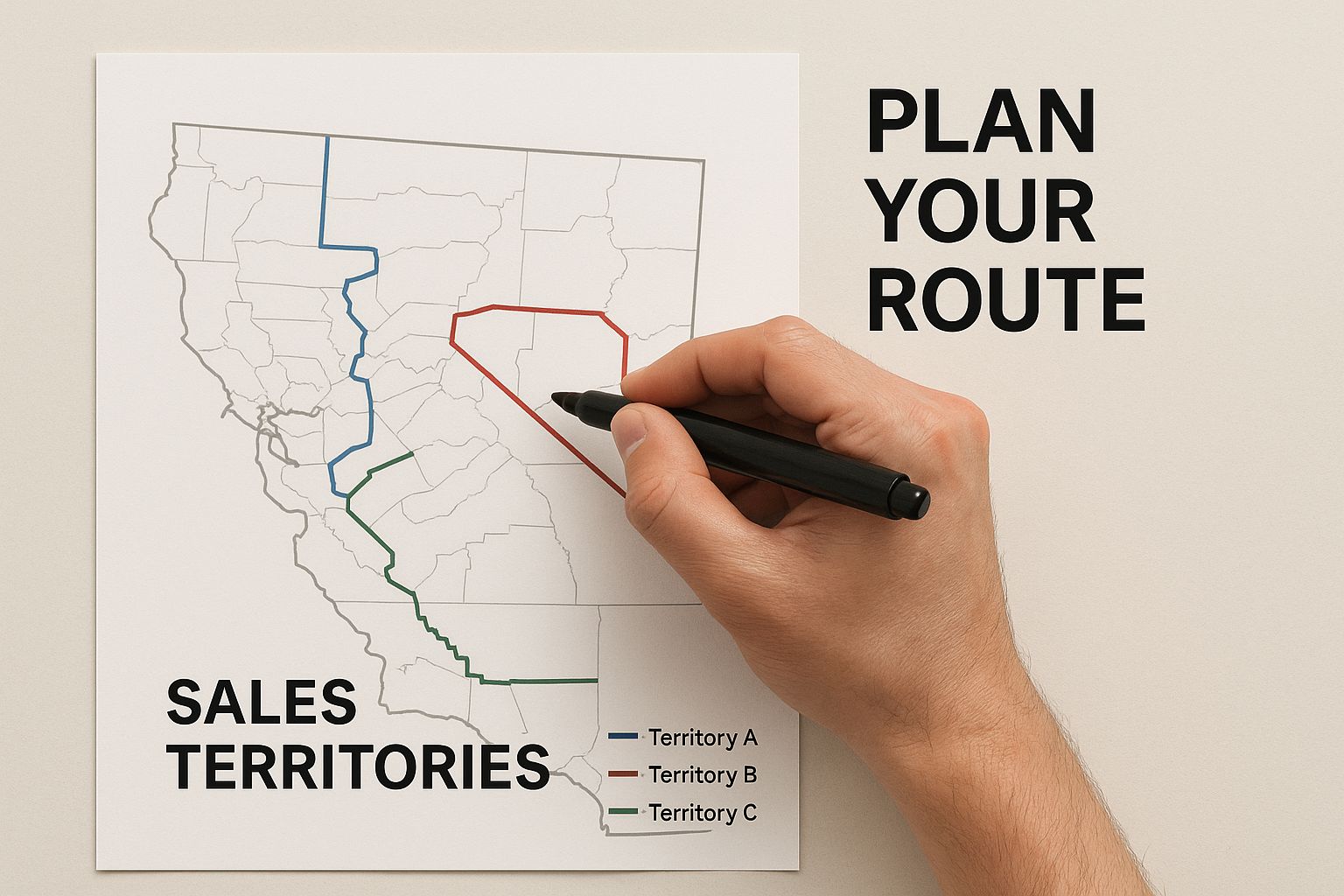
The image drives home a key point I always make to sales leaders: good planning isn't about making things complicated. It's about clarity. It’s about giving your reps a direct path to follow so they can spend their time selling, not scratching their heads.
Choosing the right territory model is a strategic decision that shapes how your sales team engages with the market. Each model offers distinct advantages and is suited for different business contexts. Below is a comparison to help you weigh the options and find the best fit for your team's structure and goals.
Comparing Sales Territory Mapping Models
| Model Type | Best For | Primary Advantage | Potential Drawback |
|---|---|---|---|
| Geographic | Teams with heavy field sales activity and high-volume, transactional sales. | Minimizes travel time and costs, maximizing face-to-face selling opportunities. | Reps may lack deep industry-specific expertise, treating all accounts similarly. |
| Account-Based | B2B companies with complex products, long sales cycles, and high-value accounts. | Fosters deep specialization and stronger client relationships, leading to higher conversion rates. | Can create geographic inefficiencies with reps traveling long distances for specific accounts. |
| Hybrid | Organizations with diverse customer segments or a mix of field and inside sales teams. | Highly flexible; combines the efficiency of geography with the specialization of account-based models. | Can be more complex to manage and requires careful balancing to avoid confusion. |
By understanding these trade-offs, you can select a model that not only makes logical sense but also empowers your team to perform at its peak.
The Classic Geographic Model
This is the old-school, tried-and-true method. You carve up the map by physical borders like states, ZIP codes, or even city blocks. It’s often the go-to for companies with a big field sales force where travel time is a huge line item on the budget.
This model shines when:
- You're in a high-volume, transactional sales game. If your reps need to be in front of a lot of people, cutting down on drive time is everything.
- Your product is straightforward. If it doesn't require a Ph.D. to explain, a generalist rep can handle all the accounts in their patch.
- Your customers are clustered together. If all your best prospects are in a few major cities, this model is a no-brainer.
Think about a medical device company selling to hospitals. A rep covering the Dallas-Fort Worth area can schedule a full day of meetings and demos without spending half of it on the highway. That's more time selling and less time listening to podcasts in traffic.
The Strategic Account-Based Model
With an account-based model, you throw the map out the window. Instead, you build territories around specific customers or types of prospects. We’re not talking about location; we’re talking about things like industry, company size, or which product they need.
This approach is perfect for B2B companies with complex, high-ticket sales. It’s about letting your reps become true experts.
For example, a cybersecurity software firm could create territories for "Financial Services" and "Healthcare." The rep focused on finance learns the ins and outs of industry compliance and can talk shop with CFOs. That level of expertise builds trust and, ultimately, closes more deals.
A well-designed account-based model is like a surgical strike. It puts your most skilled reps in front of the exact right customers, transforming them from salespeople into indispensable partners.
The Flexible Hybrid Model
The reality for many sales teams today is that a pure geographic or account-based model just doesn't quite fit. That’s where the hybrid model comes in, letting you mix and match to create something that’s just right for your team.
This is all about flexibility. You might run a geographic model for your mid-market team but give your top enterprise reps a list of "named accounts"—the big fish they can go after no matter where they're located.
Another common setup is to layer account types within geographic zones. A rep might cover the entire state of Florida but have a specific focus on hospitality clients within that area. This gives you geographic efficiency but still allows for that crucial specialization. The goal is to build a structure that mirrors your go-to-market strategy.
Whichever path you take, the objective is to help your team work smarter. A great territory plan is a force multiplier. If you're looking for more ways to get the most out of your team, our guide on how to improve sales productivity is packed with tips that work hand-in-hand with what we've discussed here.
Creating Fair and Motivating Territories
Nothing kills sales team morale faster than the hint of unfairness. Seriously. When some reps get "golden territories" stuffed with slam-dunk deals while others are staring down a barren landscape, you’re breeding resentment, not performance.
The real art of sales territory planning is to get rid of that feeling entirely. It's about building a system that every single rep looks at and thinks, "Okay, this is fair. I can hit my number here."
This goes way deeper than just splitting up accounts evenly. A list of 50 accounts in a dense city is a completely different world from 50 accounts scattered across three rural states. Real fairness means looking at the true potential of a territory, not just the raw account count.
Balancing Workload Beyond Account Count
First things first, we need to change how we think about "workload." It's not just the number of names on a rep's list. To build truly balanced patches, you have to weigh the factors that actually impact a rep's day-to-day grind and their shot at success.
I've seen this mistake play out countless times. A company redraws territories based only on geography. Rep A gets a tight urban territory. Rep B gets a huge, sprawling rural one. On paper, they both have 100 prospects.
But in reality? Rep A can knock out five client visits before lunch. Rep B is lucky to see two in an entire day because of all the windshield time. That’s not a balanced workload. It's a one-way ticket to burnout for Rep B.
To avoid this trap, your balancing act has to include:
- Sales Potential: All accounts are not created equal. Use your data to score accounts on potential revenue, how likely they are to close, and their strategic importance. A territory with a handful of high-potential accounts can be just as valuable as one with dozens of smaller fish.
- Travel Demands: Time is money, and travel eats up both. Use mapping tools to figure out the actual drive times between key accounts. A territory needs to be geographically logical so reps spend their time selling, not driving.
- Existing Workload: What's the current state of the accounts? A territory full of established, high-maintenance customers requires a totally different kind of effort than one focused purely on prospecting for new business.
- Lead Flow: Dig into the historical data. How many inbound leads does each territory get, and what’s their quality? A patch that gets a steady drip of warm leads might not need as many named accounts to be fair.
Scoring and Adjusting for True Equity
To make this balance happen, you need a system. One of the best ways I’ve found is to develop a territory "score." This is how you turn gut feelings and complaints into objective, hard data. It makes your decisions defensible and helps get the team on board.
Start by assigning points. For example, a high-potential "Tier 1" account could be worth 10 points, a "Tier 2" gets 5 points, and a "Tier 3" gets 2 points. Then, you can add or subtract points for other things, like travel complexity or the demands of existing customers.
The goal is for every territory to have a similar total score, even if the mix of accounts looks completely different. One territory might hit a score of 500 with ten huge, complex accounts. Another might get to that same 500 score with 50 smaller, faster deals.
This data-driven approach shifts the conversation from "My territory is smaller than hers" to "We all have an equitable shot at hitting our number." It replaces emotion with logic, which is fundamental to building a motivated sales culture.
This focus on fairness is a cornerstone of solid sales operations. For a deeper dive into keeping this balance over the long term, our guide on sales territory management best practices covers more advanced strategies for continuous improvement.
Designing for Motivation and Growth
At the end of the day, you're trying to build a system that fuels healthy competition and drives growth. When reps trust that the game isn't rigged, they stop looking over their shoulder and start focusing on their own performance.
A huge piece of this is matching the territory to the rep's experience. You wouldn't throw your most complex, high-stakes accounts at a rookie, right? By the same token, your top veteran will get bored and disengaged if their territory doesn't offer a real challenge.
Think about aligning skills with territory needs:
- Veteran Reps: Give them the territories with the high-value strategic accounts, the tangled sales cycles, or where you're facing down tough competition.
- Developing Reps: Hand them a mix. They need some existing accounts for stability and a pipeline of new prospects to help them sharpen their skills.
- New Hires: Start them off in more straightforward territories. Look for places with a clear playbook, good lead flow, and the chance for some quick wins to build their confidence.
When you design territories that are not just balanced but also matched to individual strengths, you create a powerful engine for motivation. Every single rep, from the greenest hire to the most seasoned pro, has a clear and fair path to crushing their goals.
Rolling Out and Refining Your Sales Plan

A brilliant sales territory plan on paper is just a starting point. Its real value only gets unlocked through a flawless rollout and a commitment to continuous refinement. I've seen it happen too many times: leaders spend weeks poring over data and maps, only to stumble during implementation, creating confusion that kills team morale.
The transition to new territories is a delicate process. How you communicate the changes is every bit as important as the changes themselves. But the work doesn’t stop once the new plan is live. Great sales territory planning is a living process, not a one-off project. It requires a mindset of ongoing monitoring and agile adjustments.
Communicating Your New Territory Plan
The moment you introduce a new territory structure is critical. Your team’s initial reaction will set the tone for the coming months. The key is managing this transition with total transparency and a clear, data-driven rationale.
Don't just drop a new map in their laps. Seasoned sales leaders know the "why" is everything. You have to walk your team through the entire process, showing them the data that informed every single decision. Explain how the new territories were balanced for potential, workload, and even travel time.
When reps see the logic and fairness baked into the plan, they're much more likely to buy in. The goal is to get them to see the new structure not as something being done to them, but as a system designed for their success.
To make sure the rollout goes smoothly, you have to nail these communication essentials:
- Present the Rationale First: Before you even hint at the new assignments, explain the business objectives driving this change. Are you pushing into a new market? Responding to a competitive threat? Show them the big picture.
- Use Data to Demonstrate Fairness: Put the numbers on the screen. Display the territory scores and metrics you used for balancing so reps can see that while territories might look different, the opportunity within each is equitable.
- Establish a Clear Transition Protocol: This is non-negotiable. Outline a precise plan for handing off accounts. This needs to include timelines, communication templates for clients, and rules of engagement to prevent any "land grabs" or confusion.
A transparent, well-managed rollout can prevent the dip in productivity that so often comes with major changes.
Making Your Plan a Living Document
Your sales territory plan shouldn’t be filed away and forgotten. Markets are constantly shifting, competitors make moves, and your own business goals will evolve. Your plan has to be dynamic enough to keep up. This is where continuous optimization comes into play.
Adopting this mindset means you’re always looking for ways to improve efficiency and jump on new opportunities. It transforms your plan from a static map into a strategic, responsive tool. This iterative process is a hallmark of high-performing teams, and you can explore more strategies in our guide to sales operations best practices.
To keep your plan relevant and effective, you need a framework for regular review and adjustment.
Tracking Performance and Making Adjustments
You can't refine what you don't measure. The success of your sales territory planning hinges on tracking the right Key Performance Indicators (KPIs) and establishing a regular cadence for reviews.
Your review process should be a core part of your sales management rhythm. A common pitfall is waiting until the annual planning cycle to look at what’s working. By then, you’ve likely missed months of valuable optimization opportunities.
Here’s a practical framework for ongoing refinement:
| Review Cadence | Key Focus Areas & KPIs | Purpose |
|---|---|---|
| Monthly Check-ins | Lead velocity, activity metrics, pipeline creation. | To spot early warning signs of imbalance or rep struggles before they become major problems. |
| Quarterly Reviews | Quota attainment, conversion rates, sales cycle length by territory. | For making tactical adjustments, like reallocating a few accounts or shifting marketing support. |
| Annual Overhaul | Market potential (TAM), customer satisfaction scores, rep feedback, overall revenue contribution. | For a deep-dive strategic reassessment of the entire territory structure. |
During these reviews, be on the lookout for persistent patterns. Is one territory consistently underperforming despite having a strong rep? The issue might be the territory itself. Is another rep blowing out their number with ease? Maybe their patch has more potential than you initially thought.
By making agile, data-backed adjustments, you ensure your sales territory planning remains a powerful driver of revenue and team motivation. It’s this commitment to continuous improvement that separates the good plans from the great ones.
Common Questions About Sales Territory Planning
Even with the best framework, you're going to hit some snags. It happens every time. Let's walk through some of the most common questions and sticking points that come up when you’re in the thick of territory planning.
Think of this as your quick-reference guide for those "what if" moments that every sales leader eventually runs into.
How Often Should We Review and Adjust Our Territories?
There's no magic number here, but here’s what I’ve seen work best: plan for one major, deep-dive review of your entire territory map annually. This is your chance to square everything up with your big-picture business goals for the year ahead.
But don’t set it and forget it. The market moves too fast for that. You need to be ready to make smaller, tactical adjustments more often. Quarterly or semi-annual check-ins are perfect for this. It's like tuning a guitar—you might change the strings once in a while, but you make small tweaks before every show.
Be on the lookout for specific triggers that demand an immediate review:
- Big market shifts: A new competitor just popped up, or a key industry in one of your territories is suddenly struggling.
- New product launches: Your shiny new product might need reps with specific skills or a different regional focus.
- Persistent performance gaps: If one rep is consistently blowing past their quota while another can't get close, the problem might be the territory design, not the rep.
The real goal is to be proactive, not reactive. If you wait a whole year to fix an obvious imbalance, you're just leaving money on the table for months. Regular, smaller tweaks keep your plan grounded in reality.
What Are the Best Tools for Sales Territory Mapping?
The right tool really boils down to your team's size and how complex your sales process is. You don't always need the most expensive, feature-packed platform out there.
Honestly, for really simple needs, you can get by with basic tools. I've seen small teams do a surprisingly good job with just a spreadsheet like Excel or Google Sheets, combined with Google Maps for a rough geographic picture.
But let's be real—the moment you start layering in multiple data points, that manual approach becomes a nightmare. It’s incredibly time-consuming and practically begs for errors. For truly strategic planning, you need dedicated sales territory mapping software. These tools are built for this exact job.
Popular choices like Salesforce Maps, Badger Maps, and Zoho CRM are game-changers. Their real power is integrating directly with your CRM data, allowing you to run complex analyses based on:
- Account value and historical spend
- Untapped potential in a market
- Travel time and efficient route planning
- Workload balancing scores
Using a dedicated tool takes you from guesswork to data-driven science. It’s how you end up with territories that are actually balanced and strategic.
How Do I Handle Sales Rep Pushback When Changing Territories?
This is easily the trickiest part of the whole process. Getting this right is a careful mix of transparency, empathy, and cold, hard data.
First, communicate changes way ahead of time. Absolutely do not spring a new territory map on your team in a Monday morning meeting. That's a recipe for disaster. Give them time to process what's happening.
Be totally transparent about why the plan is changing. Walk them through the data you used to balance the territories for potential and workload. When reps see the logic and fairness behind it, they're much more likely to get on board.
I also recommend involving your senior reps or team leads in the planning. When you give them a sense of ownership, they often become your biggest advocates for the new structure when talking to their peers.
Finally, have a crystal-clear transition plan for handing off accounts. The goal is to minimize disruption for your reps and, most importantly, for your customers. Acknowledge their concerns, listen to them, but stand firm on the data-driven reasons for the change.
Are your inbound demo requests falling through the cracks? Distro automatically routes high-intent prospects to the right rep’s calendar based on your territory rules, ensuring rapid follow-up and higher conversion. Eliminate manual lead assignment and see how intelligent scheduling can triple your meeting booking rates. Learn more about Distro.