Before you can even think about improving your sales process, you need a clear picture of where you stand right now.This starts with one critical number: your sales conversion rate.
This isn't just another piece of jargon. It’s the percentage of people who take the specific action you want them to, whether that's buying a product, booking a demo, or starting a free trial. Think of it as the pulse of your sales health—it tells you exactly how effective your efforts are.
What Are Good Sales Conversion Rates?
Here's the tricky part: there's no magic number for a "good" conversion rate. What's fantastic for one company could be a total disaster for another. It really depends on what you're selling, who you're selling to, and how you're selling it.
Your industry, price point, sales cycle length, and even where your traffic comes from all play a huge role.
For example, a B2B company selling high-ticket enterprise software might have a six-month sales cycle. For them, a 0.5% conversion rate from a website visitor to a closed deal could be cause for celebration. On the flip side, an e-commerce shop selling trendy, affordable t-shirts would go out of business with a rate that low.
The Simple Formula for Your Rate
Figuring out your own conversion rate is surprisingly simple. You don't need any fancy software, just two basic data points.
(Number of Conversions / Total Number of Visitors or Leads) x 100 = Conversion Rate %
Let's say your demo request landing page got 2,000 visitors last month, and 40 of them actually requested a demo. Your math would look like this: (40 / 2,000) x 100. That gives you a 2% conversion rate.
This simple calculation is your baseline. It's the starting point from which all your future improvements will be measured.
How Do You Stack Up? Industry Benchmarks
To give your number some much-needed context, it helps to see what's "normal" out there. A deep dive by Kibo Commerce found that the global average e-commerce sales conversion rate hovered around 2.7% between 2021 and 2022.
But even that figure varies wildly. Great Britain, for instance, pulled a strong 4.1% average, while the US was closer to the global average at 2.5%.
What you sell also makes a massive difference. Some sectors just naturally convert better than others. Take a look at these averages:
| Industry Sector | Average Conversion Rate |
|---|---|
| Food & Beverage | 6.2% |
| Home & Furniture | 5.0% |
| Consumer Goods | 4.8% |
| Beauty & Personal Care | 4.0% |
This data clearly shows why comparing yourself to direct competitors and industry-specific benchmarks is far more useful than chasing some generic, universal "good" number.
Understanding these details is the crucial first step before you can effectively learn how to improve your sales conversion rate with strategies that actually work. Your goal isn't just to find your current rate but to set a realistic target for growth based on your specific business. This baseline is the foundation you'll build everything on.
Finding Where Your Customers Are Dropping Off
A low sales conversion rate is almost never a single, massive problem. Instead, it’s usually a symptom of several smaller "leaks" in your sales funnel where interested prospects lose steam and just give up. Your job is to play detective, tracing the customer journey to find out exactly where those leaks are happening.
Think of your website as a physical path. A visitor shows up with a clear goal, but along the way, they run into confusing signs, blocked roads, or unclear directions. Every single point of friction makes it more likely they’ll just turn around and leave. The trick is to spot these friction points before you hemorrhage any more potential sales.
The flow from a website visit to a successful conversion is the foundation of our investigation.
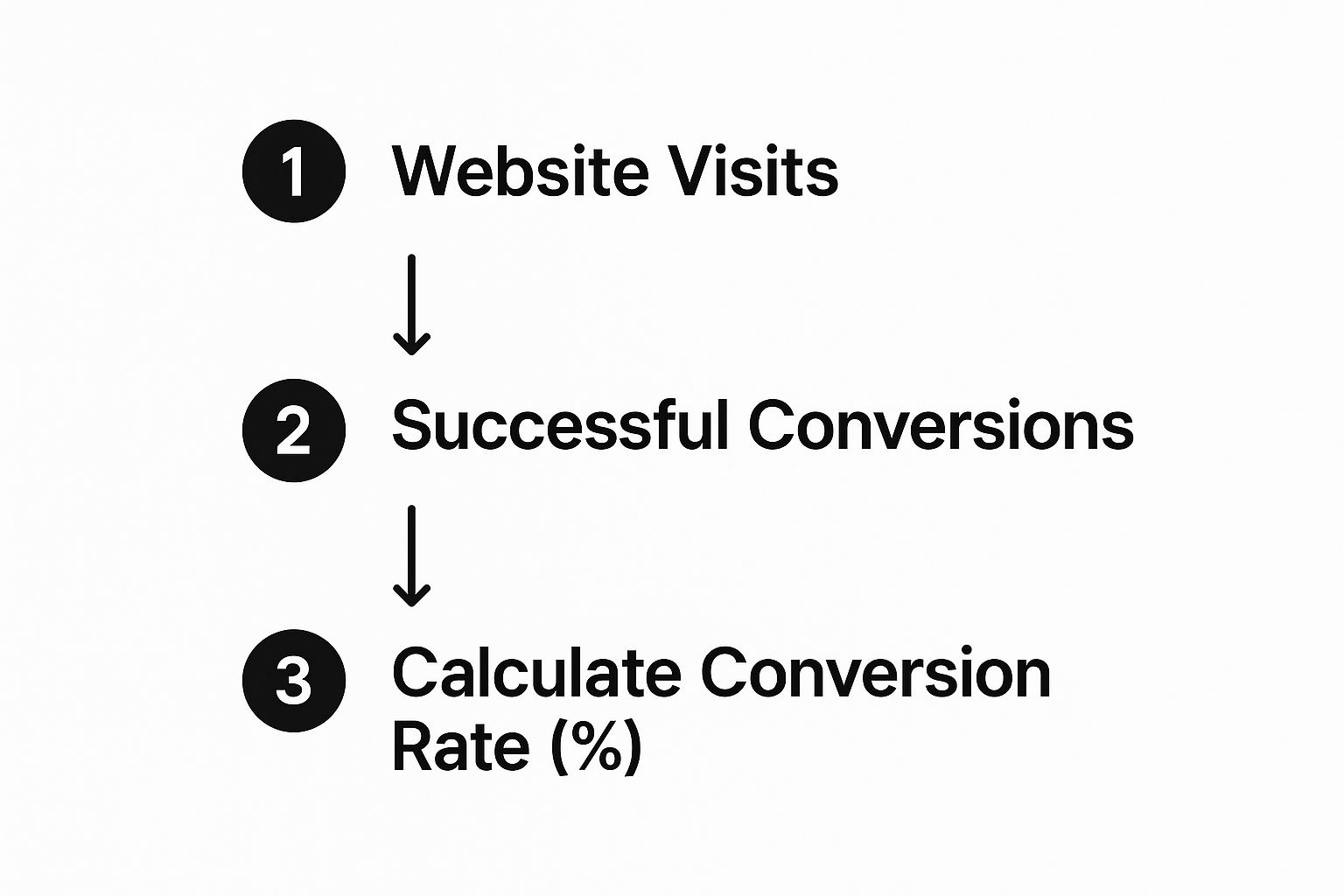
Every visitor represents a real opportunity. Understanding the drop-off between someone landing on your site and actually converting is fundamental to improving your sales conversion rates.
Uncovering the "Where" with Analytics
Your first stop should always be your website analytics platform, like Google Analytics. This is where you get the cold, hard data on user flow and behavior. Don't just glance at overall traffic; you need to dig much deeper into the specific paths people take.
The "Behavior Flow" or "Funnel Exploration" reports are your best friends here. They literally draw you a map of the most common routes users follow, from the second they land to the moment they leave. What you're looking for are the big drop-offs. For example, if 80% of users who add an item to their cart never even see the checkout page, you’ve just found a massive leak.
Visualizing the "Why" with Heatmaps
While analytics tells you what users are doing, it doesn't always explain why. That's where more qualitative tools like heatmaps come into play. Heatmaps give you a visual overlay of where people click, move their mouse, and how far they bother to scroll on a page.
- Click Maps: Show what users are actually clicking on. Are they hammering away at non-clickable elements, thinking they're links? That's a huge sign of a confusing UI.
- Scroll Maps: Reveal how far down a page people get. If your main call-to-action (CTA) is sitting below the point where 75% of users stop scrolling, it’s basically invisible.
- Move Maps: Track mouse movement, which is often a great stand-in for eye movement. This can tell you which headlines, images, or value props are grabbing the most attention.
By layering these views, you start to see your site through your customers' eyes. A heatmap might show that visitors are completely ignoring a critical "Features" tab because it’s poorly placed—a detail that raw numbers would never tell you.
Experiencing the Friction with Session Recordings
For the most granular, "aha!" level of insight, nothing beats session recordings. These tools create anonymized video replays of real people navigating your site. It’s like looking over their shoulder as they try to buy something.
You’ll see their mouse movements, where they hesitate, where they get stuck, and where they get frustrated in real-time. Watching someone rage-click a broken button or struggle to find shipping info provides an undeniable, gut-punch understanding of user frustration.
If you really want to get under the hood of customer behavior and find specific improvement areas, it’s worth exploring strategies for optimizing your funnel with analytics and testing.
Common Drop-Off Culprits to Investigate
As you sift through all this data, you'll start noticing patterns. Certain pages and process steps are notorious for causing user friction and tanking sales conversion rates. Keep a sharp eye out for these common trouble spots:
- The Pricing Page: Is your pricing clear and easy to understand? Hidden fees or ridiculously complex tiers can scare off potential buyers in an instant. They have to see the value before they see the cost.
- The Checkout Form: This is it—the final hurdle. A long, complicated form is one of the top reasons for cart abandonment. Are you asking for information you don't really need? Is the layout a nightmare on mobile?
- Surprise Shipping Costs: A study found that unexpected extra costs are the number one reason for cart abandonment. Be upfront about shipping fees as early as you possibly can.
- Forced Account Creation: Making people create an account before they can buy adds a ton of friction. Simply offering a "guest checkout" option can slash abandonment at this critical stage.
By systematically using these tools, you stop guessing what's wrong and start knowing precisely where the problems are. This data-driven diagnosis is the essential first step before you can roll out targeted fixes that will genuinely boost your sales conversion rates.
Tactical Website Changes That Drive Conversions
Once your diagnostic tools have shown you where the leaks are, it's time to roll up your sleeves and start patching them. Improving your sales conversion rates isn't about throwing spaghetti at the wall to see what sticks; it's about making specific, data-backed changes that directly fix the friction points messing with your user experience.
These tweaks can be anything from technical performance fixes to subtle psychological nudges. The whole point is to systematically knock down barriers, build trust, and make the path to purchase as smooth and intuitive as possible.
Start with the Need for Speed
In our on-demand world, nobody has time to wait. Page load speed isn't just a geeky metric anymore—it's a core part of the customer experience. If your site takes forever to load, potential customers will bounce before they even see what you're selling.
- Image Optimization: Huge, uncompressed images are the usual suspects. Use modern formats like WebP and compression tools to shrink those file sizes without making your site look pixelated.
- Code Minification: Clean up your site's CSS, JavaScript, and HTML. Getting rid of unnecessary characters, spaces, and comments makes the files smaller and way faster for browsers to handle.
- Leverage Caching: Browser caching is a lifesaver. It stores parts of your site on a visitor's device, so it doesn't have to reload everything from scratch on their next visit. This makes a massive difference for returning visitors.
Just a one-second delay in page response can slash your conversions by 7%. That's a huge loss for something that's completely in your control.
Enhance the Mobile User Experience
Mobile isn't just some secondary channel anymore. For many businesses, it's the primary way customers find and interact with them. A clunky mobile experience is a straight shot to lost revenue. Your site needs to be more than just functional on a small screen—it has to be truly optimized.
This goes beyond a simple responsive design that just shrinks everything down. It means thinking mobile-first. We're talking thumb-friendly navigation, simple forms, and buttons that are actually easy to tap. The checkout process, especially, has to be flawless on a phone.
Global ecommerce data backs this up. While mobile shopping is booming, conversion rates often lag behind desktops (4.8% on desktop vs. 2.9% on mobile, according to some analyses). This gap shows that many mobile sites are still full of friction. It's a huge reason why the overall cart abandonment rate has shot past 70%. Unexpected costs at checkout are still a top killer, which makes transparency critical on every device. You can dig into more of these global conversion trends on Statista.com.
Write Calls-to-Action That Compel
Your Call-to-Action (CTA) is probably the most important bit of text on any page. It's the signpost telling the user exactly what to do next. Weak, boring CTAs like "Submit" or "Click Here" don't inspire anyone to do anything.
A great CTA bridges the gap between the user's problem and your solution. It should be action-oriented, communicate clear value, and create a sense of urgency or benefit.
Instead of "Download," try "Get My Free Ebook." Instead of "Buy," how about "Start My 30-Day Free Trial"? The language you use has to reinforce the value the user gets by clicking. Don't be afraid to test different colors, placements, and—most importantly—wording to see what clicks with your audience.
Simplify Your Site Navigation
If users can't find what they're looking for, they can't buy it. It’s that simple. Confusing navigation is a top source of frustration and a one-way ticket to a high bounce rate. The goal? Make your site so intuitive that a first-time visitor can find any key page in three clicks or less.
- Logical Menus: Group related pages under clear, descriptive headings. Ditch the industry jargon that your customers won't get.
- Visible Search Bar: A prominent search bar is a must-have, especially for e-commerce or content-heavy sites. Make sure it actually returns relevant, accurate results.
- Clear Information Hierarchy: Use headings, subheadings, and plenty of white space to guide the user's eye and make your content easy to scan.
For a structured way to find and fix these kinds of issues, our complete conversion optimization checklist can be an incredibly valuable guide. It breaks the whole process down into manageable steps. By systematically tackling these core areas—speed, mobile usability, CTAs, and navigation—you can make a real, immediate impact on your sales conversion rates.
Using Automation to Improve Your Sales Process
Fixing your website's friction points is a solid start, but if you stop there, you're leaving money on the table. The sharpest sales teams I've worked with know that smart automation isn't just a nice-to-have; it's a massive force multiplier. It helps build a sales process that's not just efficient but also way more profitable.
Let's be clear: this isn't about replacing your people with robots. It's about amplifying their skills. Automation takes on the repetitive, time-sensitive grunt work that reps hate and often drop, freeing them up to do what they're paid for—building relationships and closing deals.
The Power of Instant Lead Routing
When a hot prospect fills out a demo request form, the clock starts ticking. Loudly. A lead's interest is at its absolute peak in that very moment. If you're manually assigning that lead, it could take hours. By then, their attention has drifted, or worse, a competitor has already swooped in.
This is where automated lead routing completely changes the game for your sales conversion rates. A tool like Distro plugs right into your web forms and instantly routes the new lead to the right sales rep’s calendar. No delays, no manual hand-offs.
You can set up intelligent routing rules based on pretty much anything:
- Territory: Leads from the West Coast go to your rep in California. Simple.
- Company Size: Enterprise-level inquiries get sent straight to your senior account executives.
- Round Robin: Keep lead distribution fair and even across the whole team.
- Product Interest: Route leads based on the specific service they asked about on the form.
By getting rid of that initial delay, you're catching prospects when they're most excited to talk. I've seen this one change dramatically increase the number of demos booked, giving your top-of-funnel metrics a serious boost.
For a much deeper dive on this, our guide on sales process automation walks you through how to build these kinds of efficient workflows from scratch.
Nurturing Leads with Personalized Sequences
Look, not every lead is ready to pull out their credit card right away. Many need a little more time and information to move through their decision-making process. This is the perfect job for automated email sequences, which keep your brand top-of-mind without any manual nagging from your reps.
But don't just blast everyone with the same generic emails. You can set up smart, personalized workflows that trigger based on what a user actually does. For instance, if someone downloads an ebook about a specific feature, you can automatically enroll them in a sequence that sends a relevant case study a few days later, followed by an invite to a webinar on that exact topic.
This kind of targeted follow-up feels helpful, not spammy. It educates your prospects and warms them up until they're genuinely ready for a sales conversation.
Building Trust and Urgency at Scale
Beyond managing leads, automation can also help you build the social proof and urgency needed to get hesitant buyers over the finish line.
- AI-Powered Chatbots: These can handle initial questions 24/7, qualify leads on the spot, and get them to a human agent without making anyone wait. No more missed opportunities after hours.
- Social Proof Plugins: You've seen these. They display real-time notifications like, "Jane from New York just purchased!" This creates a feeling of a busy, trusted store and taps into a bit of FOMO (fear of missing out).
The world of online sales is always in flux, driven by new tech and major world events. Data shows just how much things can change; during the pandemic, ecommerce conversion rates shot up to 5.0% before settling back down to a new normal between 3.0% and 4.2%. Your industry also sets your baseline—arts and crafts might see 3.8% to 4.1%, while food and drink is closer to 1.0% to 2.0%. With mobile shopping and live video commerce on the rise, staying agile is key.
When you integrate these automated systems, you're building a more robust and resilient sales machine. You're not just plugging leaks anymore; you're creating a high-pressure system that actively pushes leads forward and improves your sales conversion rates at every single stage.
Building a Culture of Continuous Improvement
Boosting your sales conversion rates isn't a project with a neat finish line. The smartest organizations know that optimization isn’t a one-and-done fix. It's a core business function—a daily commitment to getting just a little bit better, every single day. This means shifting your entire mindset, moving away from frantic, reactive repairs toward a culture of continuous improvement.
It all starts by swapping out the chaos for a repeatable, disciplined process. The loop is simple, but its value compounds over time: analyze your data, form a clear hypothesis, run a controlled test, and learn from every outcome. This cycle forces you to make decisions based on real evidence, not just gut feelings.
The goal is to stop treating a dip in conversions like a fire to put out. Instead, see it as a chance to learn something new about your customers.
The Analyze-Hypothesize-Test-Learn Cycle
This framework is the engine that powers any successful optimization program. It brings structure to the process and takes the guesswork out of improving your sales conversion rates. It’s all about being methodical.
- Analyze: You start by digging into your data—both the quantitative stuff (like your analytics) and the qualitative (like session recordings or customer feedback). You’re hunting for patterns, friction points, and opportunities.
- Hypothesize: Based on that analysis, you make an educated guess. A solid hypothesis is specific and measurable. For example: "We believe changing the checkout button CTA from 'Submit' to 'Complete My Secure Order' will increase final purchase conversions by 5% because it adds a sense of security."
- Test: Now it's time to run an A/B test to see if you're right. You show the original version (A) to one group of users and the new version (B) to another. The trick is to change only one thing at a time so you know exactly what caused any change in performance.
- Learn: Once the test wraps up, you analyze the results. Was your hypothesis correct? It doesn't matter if it was a huge win, a small loss, or made no difference at all—you’ve learned something valuable about what your audience responds to. That new insight feeds directly back into the analysis phase for your next test.
This loop should be constantly running in the background of your sales and marketing operations.
Breaking Down Silos for Better Insights
Real continuous improvement can't happen when teams are stuck in their own bubbles. A customer’s journey touches multiple departments, and if those teams aren't talking, you're missing huge pieces of the puzzle.
Think about it: Marketing runs the ads that set expectations. The product team designs the user experience on your site. And your sales team hears direct objections and questions from prospects every single day. Each team holds a critical piece of the conversion story.
Fostering collaboration is absolutely essential. Set up regular cross-functional meetings specifically to talk about conversion performance. When a salesperson shares that prospects are consistently confused about a feature, the product team can use that insight to rethink the features page. This collaborative feedback loop is where the most powerful improvements are born.
Championing the Mindset from the Top Down
A culture of improvement can't just be a grassroots effort; it needs support and reinforcement from leadership. When leaders champion this mindset, it sends a clear signal to the entire organization that testing and learning—even from failures—is a top priority.
One of the best ways to do this? Celebrate the small wins. When a team’s A/B test delivers a 2% lift in demo sign-ups, that success needs to be shared and celebrated publicly. This accomplishes two things: it validates the team's hard work and it inspires other teams to start running their own experiments.
This is how you build momentum. Over time, the entire organization starts thinking like an optimization expert, always asking, "How can we make this just a little bit better?" That perpetual curiosity is what will transform your approach from simply "fixing" conversion rates to constantly enhancing the entire customer experience for sustainable, long-term growth.
Frequently Asked Questions About Sales Conversion

Even after you've dug into the data and started testing new strategies, some questions about sales conversion rates always seem to linger. That's perfectly normal. This isn't a one-size-fits-all topic; what works for a B2C brand won't fly for a B2B SaaS company.
Let's tackle some of the most common questions we hear. My goal is to give you clear, straight-up answers to help you lock in your understanding and move forward with confidence.
So, What Is a Truly Good Sales Conversion Rate?
This is the million-dollar question, and the only honest answer is: it depends entirely on your context.
You'll see general benchmarks thrown around, like 2.5% to 3% for e-commerce, but that number is almost meaningless without more information. A "good" rate is always relative to your specific industry, how much your product costs, and how long your sales cycle is.
For example, if you're selling high-ticket items like enterprise software or luxury goods, your conversion rates will naturally be much lower. For products that cost thousands of dollars, a rate between 0.5% and 1.5% might be absolutely crushing it. The decision-making process is just that much more complex.
A 1% conversion rate on a $5,000 product is far more profitable than a 5% conversion rate on a $20 product. This is why focusing on your own benchmarks and gradual improvement is so much more productive than chasing a universal "good" number that doesn't apply to you.
How Often Should I Check My Conversion Metrics?
The right cadence for checking your metrics really comes down to your traffic volume.
If you're running a high-traffic e-commerce site with thousands of daily visitors, checking your sales conversion rates weekly or even daily makes sense. It allows you to catch problems or spot positive trends almost in real-time.
For most B2B companies or sites with less traffic, a monthly deep dive is usually more practical. If you check too often with low volume, you risk making knee-jerk decisions based on statistical noise instead of actual trends.
Here’s a simple rule of thumb:
- High-Volume (e.g., E-commerce): Glance at key conversion dashboards weekly.
- Low-Volume (e.g., B2B, High-Ticket): Perform a full analysis monthly.
- During a Test: Monitor your A/B test results daily, but don't you dare call a winner until you've reached statistical significance.
What Are the Most Common Conversion Mistakes?
I've seen a lot of companies stumble over the same hurdles when they first start trying to improve conversions. If you can sidestep these common pitfalls, you'll be way ahead of the game.
One of the biggest blunders is making changes based on gut feelings instead of data. Changing your CTA button to blue because you like blue is just a guess. Changing it because your heatmap shows users aren't even seeing the current button? That’s a data-driven hypothesis worth testing.
Another frequent error is a lack of a clear, primary call-to-action (CTA) on key pages. When you bombard visitors with too many options or vague instructions, they often get overwhelmed and do nothing. Every single page needs one main thing you want the user to do.
Finally, so many companies completely neglect the post-conversion experience. The journey isn't over when someone clicks "buy." A confusing confirmation page, a rocky onboarding process, or slow customer support can sour the entire experience, leading to refunds and killing any chance of repeat business.
Is It Better to Focus on Traffic or Conversions?
This is a classic chicken-or-egg debate in marketing. While you eventually need both, it's almost always smarter to focus on optimizing conversions first.
Think about it. Driving a flood of new traffic to a "leaky" website that can't convert is like pouring water into a bucket full of holes. You're just burning cash on acquisition with very little to show for it.
By first patching the holes in your conversion funnel, you guarantee that you're squeezing the maximum value from the traffic you already have. Once your site is a well-oiled conversion machine, every new visitor is far more likely to become a customer, making your marketing spend dramatically more effective.
Put another way: doubling your conversion rate from 1% to 2% has the exact same impact on your revenue as doubling your website traffic. But it's often a whole lot cheaper and faster to achieve. Fix the funnel first, then open the floodgates.
Ready to stop losing high-intent leads and see your demo bookings soar? Distro connects to your forms to instantly route qualified prospects to the right sales rep's calendar. Experience 3X higher conversion rates and book a demo with Distro today!