
Let's be honest, "RevOps framework" gets tossed around a lot. But it's far more than just the latest corporate buzzword—it's the operational blueprint for actually getting your revenue-generating teams to work together.
Think of it as the high-performance engine for your business. Sales, marketing, and customer success are no longer separate, clunky parts bolted on. Instead, they're integrated components, working in perfect sync to drive predictable growth.
What Is a RevOps Framework, Really?
Imagine a symphony orchestra where the strings, brass, and percussion sections are all playing from different sheet music. The result wouldn't be a masterpiece; it would be chaos.
That's exactly what happens when your marketing, sales, and customer success teams operate in their own little worlds. A RevOps framework is the conductor, making sure every department plays harmoniously from a single, unified score. The goal? To create predictable, sustainable revenue.
This operational blueprint is designed to solve the most common—and painful—problems that kill growth. It directly tackles things like disconnected data, clunky handoffs between teams, and a leaky customer funnel where potential revenue just vanishes into thin air. By aligning your people, processes, and technology around the entire customer lifecycle, you can transform fractured efforts into a cohesive, efficient machine.
The Core Purpose of a RevOps Framework
At its heart, the idea is to tear down the walls that have traditionally separated your revenue teams.
Instead of marketing celebrating lead counts while sales complains about lead quality, a RevOps framework forces everyone to agree on shared goals and metrics. This shift in thinking makes everyone accountable for the only outcome that truly matters: sustainable company growth.
Recent qualitative studies confirm this isn't just a trend; it's a foundational shift in how modern B2B companies operate. The research points to integration, collaboration, and operational alignment as the core pillars, all built on a bedrock of solid data stewardship. It's a move away from siloed departmental goals toward a genuinely holistic business strategy.
If you want to get a better sense of why structure is so crucial, you can look at how other technical fields operate. Just as there are established methods for choosing the right software development framework, a RevOps framework provides the essential scaffolding needed to build scalable and repeatable business processes.
A strong framework doesn't just connect tools; it connects people to a shared mission. It moves an organization from asking "Did my department hit its numbers?" to "Did our company achieve its revenue goals?"
Common Problems Solved By RevOps
A well-designed framework isn't just theoretical—it directly attacks the persistent friction points that hamstring so many companies. Organizations that truly commit to a RevOps model typically see major improvements in a few key areas:
- Disconnected Data: It finally puts an end to "dueling spreadsheets" by creating a single source of truth for all customer data. Every team works from the same playbook.
- Inefficient Handoffs: The framework maps the entire customer journey, smoothing the transition from marketing to sales, and then from sales to customer success. No more leads falling through the cracks.
- Leaky Funnel: By shining a light on the weak points in your customer lifecycle, it helps you plug the holes, improve conversion rates, and dramatically boost customer retention.
To bring this all together, let's look at how these functions directly address the silo-based problems they are designed to fix.
Core Functions of a Modern RevOps Framework
| Core Function | Departmental Silo Problem It Solves | Primary Business Benefit |
|---|---|---|
| Unified Data Management | Marketing uses HubSpot, Sales uses Salesforce, and no one trusts the data. | A single source of truth for reliable reporting and forecasting. |
| End-to-End Process Mapping | Awkward handoff where MQLs get lost before becoming SQLs. | Seamless customer experience and higher conversion rates. |
| Shared Goal Alignment | Marketing hits a lead goal, but Sales misses their revenue target. | Teams work together toward shared revenue outcomes, not siloed KPIs. |
| Integrated Tech Stack | Tools don't talk to each other, creating manual work and data gaps. | Increased efficiency, better automation, and a 360-degree customer view. |
| Holistic Performance Metrics | Success is measured by renewals, but they don't know which customers are most profitable. | Clear visibility into the entire customer lifecycle, from acquisition cost to lifetime value. |
Ultimately, a strong framework provides the structure needed to move from a collection of disjointed tactics to a truly unified revenue strategy.
The Four Pillars of a Winning RevOps Framework
A solid RevOps framework isn't a single project you check off a list; it's a structure built on four pillars that have to work together perfectly. Think of it like building a house. You need a strong foundation (Data), a solid frame (Technology), working plumbing and electrical (Process), and a skilled crew to bring it all to life (People). If one of those is shaky, the whole house is at risk.
Let's break down each pillar to see how they come together to create a foundation for predictable, scalable growth.

The People Pillar
Let's be real: all the fancy tech and documented processes in the world are worthless without the right people driving the strategy. This pillar is all about creating a culture where revenue is everyone's job—not just one department's problem. It’s about finally tearing down that classic "us vs. them" wall between marketing, sales, and customer success.
This cultural shift needs a clear organizational structure to back it up. Key roles are no longer defined by what department they sit in, but by how they contribute to the entire customer lifecycle. For instance, instead of just a "Sales Manager," you might have a "Deal Desk Lead" who collaborates across teams to structure complex deals for long-term customer success, not just a quick win.
The name of the game here is alignment. When every single person on your team sees how their day-to-day work directly impacts revenue and the customer experience, they stop being order-takers and start acting like strategic owners of the business.
This means sales, marketing, and CS teams are all pulling in the same direction, motivated by shared goals and even compensated based on the same revenue metrics. It’s about creating one cohesive unit focused on a single outcome: growth.
The Process Pillar
The second pillar, Process, is the roadmap your teams follow. It’s all about standardizing the key workflows that make up the customer journey, from that very first marketing touchpoint all the way through to a successful renewal and beyond. Without clear processes, handoffs get fumbled, data gets lost in translation, and the customer experience feels clunky and disconnected.
A crucial activity here is customer journey mapping. And no, this isn't just a marketing exercise anymore. It’s a cross-functional deep dive to pinpoint every single interaction a customer has with your company. The goal? To find the friction points and operational bottlenecks that are slowing everyone down.
Once you’ve uncovered those pain points, you can start standardizing your key workflows. This includes things like:
- Lead Handoffs: Establishing a rock-solid Service Level Agreement (SLA) that spells out exactly when and how a lead moves from marketing to sales. No more ambiguity.
- Sales Execution: Rolling out a consistent sales methodology that every rep actually uses. If you're looking to sharpen this area, understanding core sales operations best practices is a fantastic starting point for process improvements.
- Onboarding and Renewal: Building repeatable playbooks for customer success to make the transition from prospect to happy, long-term partner feel seamless.
By documenting and optimizing these processes, you're not just cleaning things up; you're building a revenue engine that's repeatable and ready to scale.
The Technology Pillar
Technology is the central nervous system of your entire RevOps framework. It’s the integrated tech stack that serves as the single source of truth, finally putting an end to the data chaos that so many companies struggle with. The whole point is to have systems that communicate with each other flawlessly, giving you a complete, 360-degree view of every customer.
Your CRM is the sun in this solar system—the undeniable center of all customer data. Every other tool, from marketing automation platforms to CS software and BI dashboards, should orbit around it, pushing and pulling data seamlessly. This interconnectedness isn't a "nice-to-have." A powerful tech stack isn't about having the most tools; it's about having the most integrated ones.
This unified stack unlocks automation, slashes manual data entry, and gives everyone on every team access to the exact same, up-to-date information. When a salesperson can see a prospect’s full marketing engagement history and a CS manager can see the original deal notes, conversations become smarter, more relevant, and far more effective.
The Data Pillar
Finally, we get to the foundation of it all: Data. This is where we move past the vanity metrics (like website traffic or email open rates) and start obsessing over the numbers that actually reflect the health of the business.
A strong RevOps framework is built on a set of unified, cross-functional Key Performance Indicators (KPIs). Instead of each department showing up with its own siloed report, everyone is focused on holistic business outcomes.
Key metrics in a data-driven RevOps world often include:
- Customer Lifetime Value (CLV): The total revenue you can expect from a single customer over their entire relationship with you.
- Customer Acquisition Cost (CAC): What it actually costs, all-in, to bring in a new customer.
- Pipeline Velocity: How fast deals are moving from one stage to the next in your sales funnel.
- Net Revenue Retention (NRR): The percentage of recurring revenue you keep from your existing customers (including upsells and churn).
By building unified dashboards that track these KPIs, you create a system for predictable forecasting and smart, data-backed decisions. Your leaders are no longer operating on gut feelings; they have a clear, objective view of the entire revenue engine's health.
The Real-World Business Impact of RevOps
It’s one thing to talk about the pillars of a RevOps framework, but what really matters is seeing how that structure translates into cold, hard business results. At the end of the day, leaders need to see a clear line from operational changes to bottom-line growth.
A well-oiled RevOps machine does more than just make your teams feel more aligned; it directly juices up financial and performance metrics across the entire company. The real promise here is a shift from playing reactive whack-a-mole in separate departments to running a proactive, unified revenue engine. This creates a domino effect of good things, from shrinking deal cycles to getting more lifetime value out of every single customer.
Boosting Revenue Predictability and Forecast Accuracy
One of the first and most powerful wins you'll see from a RevOps framework is a massive leap in revenue predictability. When marketing, sales, and success are all working off different spreadsheets and chasing different goals, forecasting becomes a nerve-wracking guess. Leadership is left flying blind, quarter after quarter.
RevOps puts an end to that chaos by creating a single source of truth for all things revenue. Suddenly, everyone is looking at the same dashboards and the same pipeline health. Forecast calls stop being a debate of siloed opinions and start being a productive discussion based on solid, shared data.
This is a huge deal. According to McKinsey, only 30% of companies even have a unified data strategy. Getting this right gives you a serious competitive advantage in how you plan and execute.
This alignment gives leaders the confidence to spot trends early, flag risks before they blow up, and make smart adjustments on the fly. The result? A forecast you can actually take to the bank, which is critical for smart strategic planning and resource allocation.
Shortening Sales Cycles and Increasing Productivity
Friction is the silent killer of deals. And a whole lot of that friction comes from the clunky operational handoffs between marketing, sales, and even teams like legal or finance. Messy lead transfers, missing information, and manual grunt work all add dead time to your sales cycle, giving prospects plenty of time to get cold feet or check out a competitor.
A RevOps framework is purpose-built to hunt down and eliminate these bottlenecks. You start by mapping the entire customer journey and then ruthlessly optimize the workflows that support it. The goal is to create a slick, fast track from a prospect's first click to a closed-won deal.
Think about it: simply standardizing how a lead is qualified and handed off means your reps get high-quality, fully-baked opportunities delivered right to them. They can stop wasting time chasing down context or wrestling with admin tasks and just… sell. It's no surprise that a solid RevOps setup has been shown to dramatically speed up revenue generation and make sales teams far more productive.
Enhancing Customer Lifetime Value and Retention
Winning a new customer is expensive. The real money is in keeping and growing the customers you already have. Nothing torpedoes retention faster than a disjointed customer experience. When the handoff from sales to customer success is a fumble, or the service team has no clue about a customer’s history, that relationship is built on shaky ground from day one.
RevOps fixes this by ensuring the customer journey feels like one continuous, smooth experience. The framework is designed so that data and context flow freely between teams. Every interaction feels consistent and informed. A customer success manager, for example, can see exactly what was promised during the sales cycle and proactively make good on it.
This creates a far better experience that builds serious loyalty. While every company's situation is different, the results are consistently powerful. A good RevOps framework can trim customer acquisition costs by up to 15% and boost customer retention by 10-20%.
If you're interested in going deeper, you can discover more insights about RevOps framework findings and their impact on retention. This focus on the entire customer lifecycle—not just the initial sale—is how you turn one-time buyers into lifelong fans and maximize their total value.
How to Build Your RevOps Framework from Scratch
So, you’ve decided to build a RevOps framework. It’s one of the smartest moves you can make for predictable, sustainable growth. But where do you actually start? It’s not about flipping a switch and hoping for the best. A solid RevOps framework is built methodically, piece by piece.
Think of it like building a custom home. You don't just show up with a hammer and some wood. First, you survey the land (Audit). Then you draw up a detailed blueprint (Design). Only then do you start laying the foundation and putting up walls (Implement). And even when it's built, you're always doing maintenance and making upgrades (Optimize).
This whole process can be broken down into four distinct, manageable phases. By tackling it this way, you can systematically break down the silos between your teams and build a cohesive revenue engine that’s truly built to last.
Stage 1: Audit and Align
Before you can build your ideal future, you have to get painfully honest about your present. This first stage is all about a no-holds-barred assessment of where you are right now. You need to dig into your people, your processes, and your tech to find the real sources of friction.
Where are handoffs fumbled? Why are marketing’s numbers always at odds with sales reports? What mind-numbing manual tasks are eating up your team's day? These are the questions that need answers.
Here’s your action plan for this stage:
- Interview Stakeholders: Get in a room with leaders and front-line folks from marketing, sales, and customer success. Ask them what’s working, what’s broken, and what drives them crazy. You want the unfiltered truth.
- Map Current Processes: Get a whiteboard and visually map out the entire customer journey as it exists today, from the first touchpoint to renewal. Mark every handoff and pinpoint every bottleneck.
- Conduct a Tech Stack Audit: Make a list of every single tool your revenue teams use. Pay special attention to how—or if—data flows between them.
- Secure Executive Buy-In: Take your findings to leadership. Use the pain points you uncovered to build a powerful business case for why RevOps isn't just a nice-to-have, but a must-have for the business.
A common trap here is to assume you already know all the problems. Don't skip the deep dive. Without a data-backed audit, you're just guessing, and you risk building a beautiful solution to the wrong problem.
This initial work is what gives you the mandate for real change.
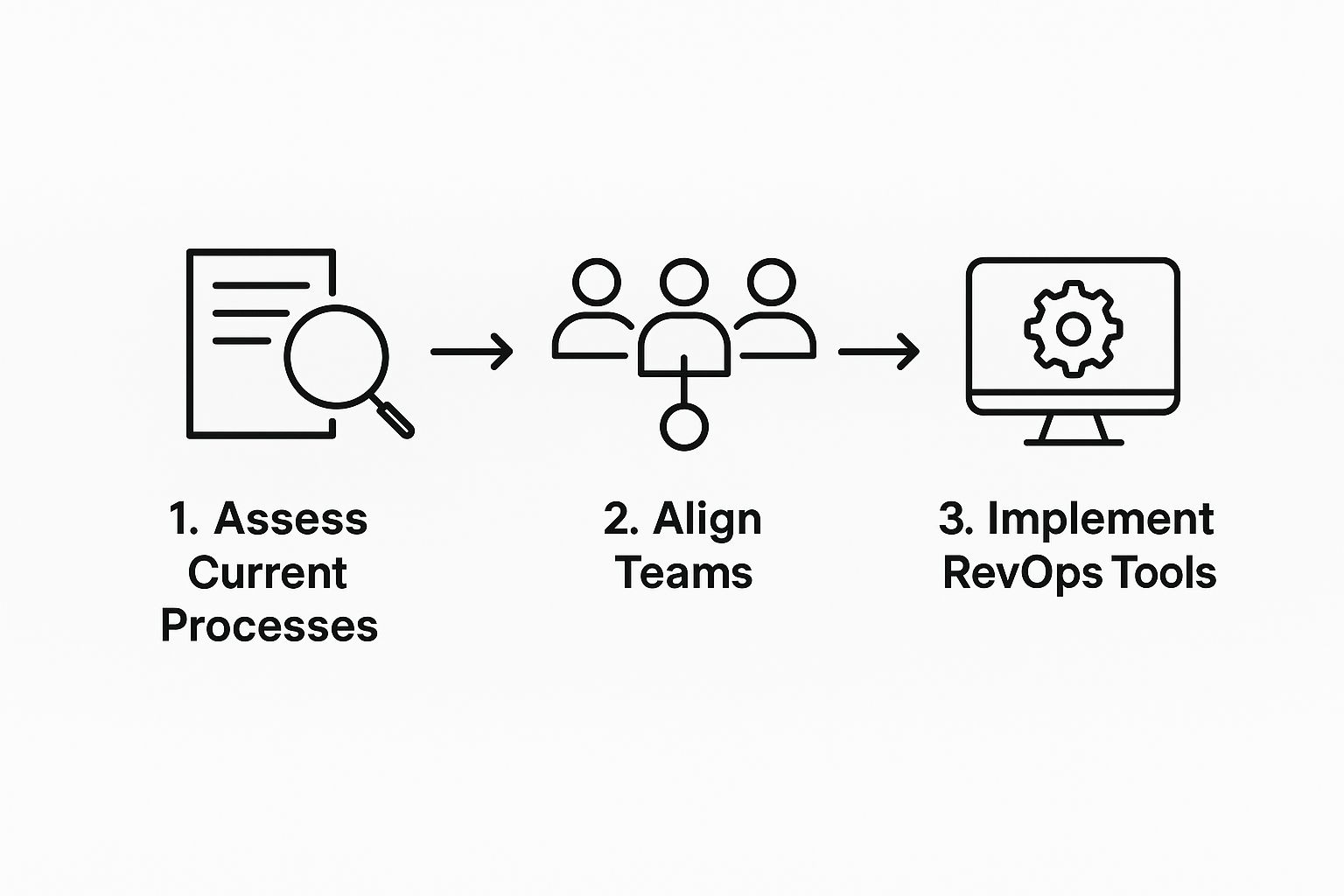
The image above really drives this home—implementation is the final piece, but it’s worthless without the critical assessment and alignment that comes first.
Stage 2: Design and Architect
Now that you have a crystal-clear picture of your challenges, it’s time to play architect. This is the fun part. You get to design the ideal future state for your revenue operations.
The centerpiece of this phase is mapping out the ideal customer journey. Don't just slap a few band-aids on your old process. Design a brand new one from scratch, with the customer's experience at the absolute center. What should it feel like for them at every single step?
Once you have that vision, you can work backward to design the integrated processes and tech stack to make it a reality. This means defining clear Service Level Agreements (SLAs) for lead handoffs, standardizing your sales methodology, and architecting data flows so your CRM can finally become the single source of truth everyone claims it is.
Stage 3: Implement and Enable
This is where the rubber meets the road. The implementation stage is where you start the technical rollout of your newly designed systems and workflows. It might involve reconfiguring your CRM, plugging in new tools, or building out slick new automations.
But the tech side is only half the battle. Enablement is the other, arguably more important, half. You can build the most perfect, elegant system in the world, but if nobody uses it correctly, it’s a complete failure. You have to invest heavily in training your teams on this new, unified way of working.
Successful enablement looks like this:
- Comprehensive Training: Run workshops that don’t just show people how to use the new tools, but explain why these changes were made and how it benefits them.
- Clear Documentation: Create simple, accessible playbooks and resource hubs that teams can turn to when they have a question.
- Ongoing Support: Designate a clear point of contact for feedback and questions. Make it easy for people to get help.
If you’re looking to get a head start on improving your sales workflows, our guide on sales process optimization has practical strategies that fit perfectly into this stage.
Stage 4: Optimize and Iterate
Here’s the thing about RevOps: it's never "done." It’s a continuous cycle of improvement. Your market will shift, your customers will change, and your business will evolve. Your RevOps framework has to evolve right along with it.
This final stage is a perpetual loop of monitoring, gathering feedback, and making smart, data-driven tweaks. You'll need to establish your core RevOps KPIs—things like pipeline velocity, customer acquisition cost (CAC), and net revenue retention (NRR)—and watch them like a hawk.
Schedule regular meetings with team leads to review the numbers and have honest conversations about what’s working and what isn’t. You want to build a culture where feedback is seen as a gift, not a criticism. This continuous loop is what keeps your revenue engine fine-tuned and humming for years to come.
To make this all a bit more concrete, here's a simple way to think about your implementation journey.
Your Phased RevOps Implementation Plan
This table breaks down the entire process into a clear, phased approach. It outlines what you need to achieve at each stage and what you should have to show for it before moving on.
| Phase | Key Objective | Primary Deliverables |
|---|---|---|
| Phase 1: Audit | Understand the current state and identify key friction points. | Stakeholder interviews, process maps, tech stack audit, executive buy-in presentation. |
| Phase 2: Design | Architect the ideal future state focused on the customer experience. | Ideal customer journey map, documented SLAs, revised process flows, tech stack architecture. |
| Phase 3: Implement | Roll out new systems and train teams on the new way of working. | Configured tech stack, automated workflows, training materials, documentation & playbooks. |
| Phase 4: Optimize | Establish a cycle of continuous, data-driven improvement. | Core KPI dashboard, regular performance review cadence, documented feedback loop. |
By following a structured plan like this, you move from a reactive, chaotic state to a proactive, predictable one—which is exactly what RevOps is all about.
Aligning Your Tech Stack For Revenue Growth
Think of your technology as the central nervous system of your entire RevOps framework. It’s the digital plumbing that connects your people and processes, allowing that smooth, predictable flow of data you need for real growth. When it works, your teams get a single, unified view of the customer. But when it's disjointed, you get friction, manual work, and operational chaos.
The goal isn't to buy every shiny new tool that hits the market. It’s about building a tightly integrated ecosystem where information is shared automatically and intelligently. This is how you ensure every team member, no matter their department, has the context they need to deliver a seamless customer experience.

Making Your CRM The Undisputed Source Of Truth
At the heart of any modern RevOps tech stack sits the Customer Relationship Management (CRM) system. This isn't just another piece of software; it must be treated as the undisputed source of truth for all customer data. Every key interaction, every data point, and every status update should live here.
When your CRM is the central hub, everything else—marketing automation, customer success platforms, BI tools—orbits around it. These tools should constantly feed data into the CRM and pull insights from it, guaranteeing consistency across the board. This is how you finally kill the dreaded "dueling spreadsheets" problem and get everyone working from the same playbook.
A huge part of this alignment comes from embracing the benefits of data integration, which is what ultimately creates that unified view of your customers.
Evaluating Tools With An Integration-First Mindset
As you build or refine your stack, you have to shift how you evaluate new tools. It's no longer about a cool list of standalone features; it’s about deep, native integration capabilities. A tool might look amazing on its own, but if it can't connect to your core systems, it will inevitably create another data silo and undermine your entire RevOps effort.
Before you bring any new technology on board, ask these critical questions:
- Does it integrate seamlessly with our CRM? This is non-negotiable. If it can’t talk to your source of truth, it’s a non-starter.
- Can it support our ideal customer journey? The technology has to serve your process, not force you to change your process to fit the tool.
- Is it scalable? Will the tool grow with you, or will it break under the weight of more users, data, and complexity?
This disciplined approach ensures your technology actively supports your revenue goals instead of just adding to the noise. For instance, a smart scheduling tool like Distro integrates directly with your CRM and inbound forms, making it a critical piece of the RevOps puzzle. It automates a key workflow, making sure insights from your inbound lead generation efforts are captured and acted upon immediately.
Industry analysis shows that companies with a structured Revenue Operations Framework report up to 20-30% improvements in overall revenue efficiency. This is largely because integrated tech breaks down silos and powers data-driven decisions. By 2025, over 60% of high-growth companies will have adopted a RevOps framework.
Creating A 360-Degree Customer View
The ultimate prize for aligning your tech stack is a true 360-degree view of the customer, accessible to everyone who needs it. This means a sales rep can see a prospect’s recent marketing engagement, and a customer success manager can review the original sales notes to understand what the customer was trying to achieve from day one.
This holistic view completely changes customer interactions. Conversations become more relevant. Support becomes more proactive. And opportunities for expansion are suddenly much easier to spot. When your technology works in concert, it doesn't just make your internal processes more efficient—it creates a fundamentally better, more profitable customer experience.
Common Questions About RevOps Frameworks
As companies start kicking the tires on what a RevOps framework can do for them, a lot of practical, real-world questions pop up. It's one thing to talk about it in theory, but moving to practice can feel like a huge leap. The good news? The answers are usually more straightforward than you'd expect.
This section gets right into the nitty-gritty, tackling the most common questions leaders and teams have when they're thinking about making this shift. We'll give you clear, direct answers to help you navigate your own RevOps journey with a lot more confidence.

What Is The Difference Between RevOps And Sales Ops?
This is easily the most common question we hear, and the distinction is critical. The easiest way to think about it is like this: Sales Ops is a specialist, laser-focused on making one team—the sales department—run better. They handle things like territory planning, quota setting, and managing the sales-specific tool stack.
RevOps, on the other hand, is the general contractor overseeing the entire build. It takes a much wider, more holistic view, pulling Sales Ops, Marketing Ops, and Customer Success Ops together under one roof with a single, shared strategy.
While Sales Ops works to make the sales team more efficient, the RevOps framework aims to make the entire customer lifecycle—from the first ad they see to their renewal—more effective and profitable.
In short, Sales Ops helps sellers sell better. RevOps helps the entire company get better at generating and keeping revenue. It’s a classic case of scope: one optimizes a part, while the other optimizes the whole system.
How Do I Know If My Company Is Ready For A RevOps Framework?
You don’t need to wait for a five-alarm fire to know it's time for a RevOps framework. The warning signs are usually simmering just below the surface, causing friction and quietly putting the brakes on growth. A good rule of thumb is that your company is ready when the pain of staying the same becomes greater than the pain of change.
Keep an eye out for these telltale signs:
- Constant Friction: Sales and marketing are always pointing fingers at each other over lead quality, and both teams are blaming the other for missed targets.
- Conflicting Data: Your leaders show up to meetings with different reports that tell completely different stories about how the business is actually doing.
- High Customer Churn: You're bleeding customers, often because the handoff from sales to customer success is clunky, impersonal, or just plain broken.
- Inaccurate Forecasts: Your revenue forecasts feel more like a shot in the dark than a science, making it impossible to plan for the future with any real certainty.
If your teams feel like they're working on separate islands and your customer journey has more gaps than a leaky bucket, it's the perfect time to build a framework and get everyone aligned.
Can A Small Business Implement A RevOps Framework?
Absolutely. In fact, small businesses have a massive advantage here. When you implement a RevOps framework from the beginning, you're building for scale from day one. You get to completely sidestep the entrenched silos and messy, duct-taped tech stacks that bigger companies spend millions trying to untangle later on.
RevOps is a mindset long before it’s a department. For a small business, it might just start with one person championing the cause—asking the right questions, pushing for shared goals, and making sure every new process or tool is chosen with the entire customer lifecycle in mind.
Taking this proactive approach means that as you grow, your marketing, sales, and service efforts are already built on a unified foundation. You're building a scalable engine from the get-go, not trying to re-engineer a broken one when you're already flying.
What Are The Most Important Metrics In A RevOps Framework?
A successful RevOps framework fundamentally changes what you measure. It forces the company to look beyond siloed, department-specific metrics (like MQLs for marketing or calls made for sales) and rallies everyone around holistic KPIs that show the true health of the revenue engine.
These are the metrics that tell the complete story of how well your company is acquiring, serving, and growing its customer base. The most critical ones usually include:
- Customer Lifetime Value (CLV): This is the total revenue you can expect from a single customer over the entire relationship. It immediately shifts the focus from just closing the initial deal to nurturing long-term value.
- Customer Acquisition Cost (CAC): This is the all-in cost of your sales and marketing efforts to land one new customer. A healthy business model demands that your CLV is significantly higher than your CAC.
- Sales Cycle Length: This measures the average time it takes to close a deal, from the very first touchpoint to the final signature. RevOps constantly looks for ways to shorten this by removing operational friction.
- Net Revenue Retention (NRR): This shows you what percentage of recurring revenue you’re keeping from your existing customers, factoring in both churn (lost customers) and expansion (upsells/cross-sells). An NRR over 100% is a huge green flag—it means you're growing even without signing a single new customer.
By focusing on these shared metrics, you make every team accountable for the ultimate goal—not just for their department, but for the entire business: creating predictable, sustainable revenue.
Are you ready to stop losing high-intent leads and start converting them into meetings? With Distro, you can automate lead routing from your demo request forms directly to the right sales rep’s calendar, ensuring no prospect ever falls through the cracks. Teams using Distro see up to 3X higher conversion rates from their inbound forms. Book your demo today and see how it works!