
Before you can fix your sales process, you have to truly understand it. Sales process optimization isn't just about chasing higher numbers; it's the nitty-gritty work of looking at your entire sales workflow, piece by piece, to make it smoother, more efficient, and ultimately, more profitable.
This means dissecting every stage—from the very first time a lead hears from you to the moment a deal is signed. The goal is to spot the snags, automate the grunt work, and give your team the tools and data they need to win.
Auditing Your Sales Workflow for Hidden Opportunities
You can't improve what you don't measure. The first real step is a no-holds-barred audit of your current sales workflow. This isn’t about pointing fingers for missed quotas. Think of it as a strategic deep dive to find untapped potential for growth. It’s like a mechanic getting under the hood—you need to know which parts are humming along and which are creating drag on the whole system.
This audit needs to go way beyond surface-level metrics like the number of closed deals. You have to map out every single touchpoint, action, and interaction a prospect has with your sales team.
You’re looking for answers to some critical questions:
- Initial Contact: How fast are we really getting back to new leads? Is everyone on the team following the same playbook?
- Qualification: Are we asking the right questions to spot the real buyers? Where are we losing the folks who aren't a good fit?
- Demonstration: How much time are reps wasting on admin tasks like scheduling calls instead of actually selling?
- Closing: What are the most common objections we hear? At what specific point in the process do our deals tend to go sideways?
Pinpointing Friction Points with Team Feedback
Your CRM data will give you the "what," but it's your sales reps who will tell you the "why." They’re on the front lines every single day, and they feel the friction that raw data can't capture. You absolutely have to sit down and talk with them. And more importantly, listen.
Your sales team knows exactly where the process is clunky. They know which manual tasks eat up their day and which communication breakdowns cause deals to stall out. Tapping into this firsthand experience is the quickest way to find the biggest opportunities for improvement.
This is where technology, especially AI, can be a game-changer. It can pull data from all your different systems and create a visual map of these friction points, as shown below.

Being able to see the bottlenecks so clearly allows you to make targeted fixes that have a real impact on your workflow and, just as importantly, the customer's experience.
Leveraging Technology for a Deeper Audit
Modern tools have made this auditing process incredibly powerful. The rise of Artificial Intelligence (AI) is completely changing the game through techniques like process mining. This technology automatically pulls data from your CRM and other tools to create a visual flowchart of your actual workflows, instantly highlighting where things are getting bogged down.
For example, IKEA used process mining to overhaul its order fulfillment process. By identifying the specific bottlenecks causing order cancellations, they managed to drastically reduce their customer drop-off rate.
At the end of the day, a well-oiled sales pipeline is the foundation of an optimized sales process. After your audit, refining this is your next big move. For some great, actionable sales pipeline management tips, check out this guide to keep the momentum going.
Automate Your Lead Management for Lightning-Fast Engagement
Those first few hours after a lead shows interest? They’re everything. I’ve seen it time and time again: a slow response doesn’t just make for a bad first impression, it actively torpedoes deals before they even start. The secret to winning at this stage is to get humans out of the way and let smart automation take the wheel.
Your one and only goal here is to shrink the time between a prospect saying "I'm interested" and them having a meeting in the calendar. It should feel instantaneous.
When a prospect hits "submit" on your demo form, the system should jump into action immediately. Forget sifting through a shared inbox or trying to figure out whose turn it is to get the next lead. Intelligent automation can—and should—connect that hot lead with the perfect sales rep in seconds. This is where automated lead routing becomes your most valuable player.
How Smart Lead Routing Works in the Real World
Picture this: a lead from a huge enterprise company in California fills out a form on your site. Instead of that lead sitting in a queue, your routing rules (which you can set up in a tool like Distro) instantly see this. The system immediately assigns the lead to the senior account executive who handles West Coast enterprise accounts.
What if she's unavailable? No problem. The system is smart enough to bounce it to the next most qualified person on the team.
This kind of intelligent distribution nails two critical things:
- Speed: The lead gets a response in minutes, not hours or—cringe—days.
- Expertise: The prospect is instantly talking to the one person on your team best equipped to understand their world.
When you stop assigning leads by hand, you do more than just improve your speed-to-lead. You ensure every high-value prospect gets the white-glove experience they expect, which has a direct and immediate impact on your conversion rates.
Ditch the Scheduling Headaches for Good
Okay, so the lead is assigned. The next place deals go to die is the scheduling back-and-forth. We’ve all been trapped in that email chain from hell: "Does Tuesday at 2 PM work for you?" It’s a momentum killer.
Automated scheduling tools fix this mess entirely. They let prospects book a meeting directly on the rep's calendar with a single click. It’s smooth, professional, and friction-free. I saw this firsthand with a steel fabrication company whose sales had gone flat. By overhauling their front-end process—a huge piece of which was smart lead handling and scheduling—they added $1.5 million to their pipeline in just nine months.
This flow chart breaks down how automating these first crucial steps—capture, qualification, and follow-up—creates a well-oiled machine.
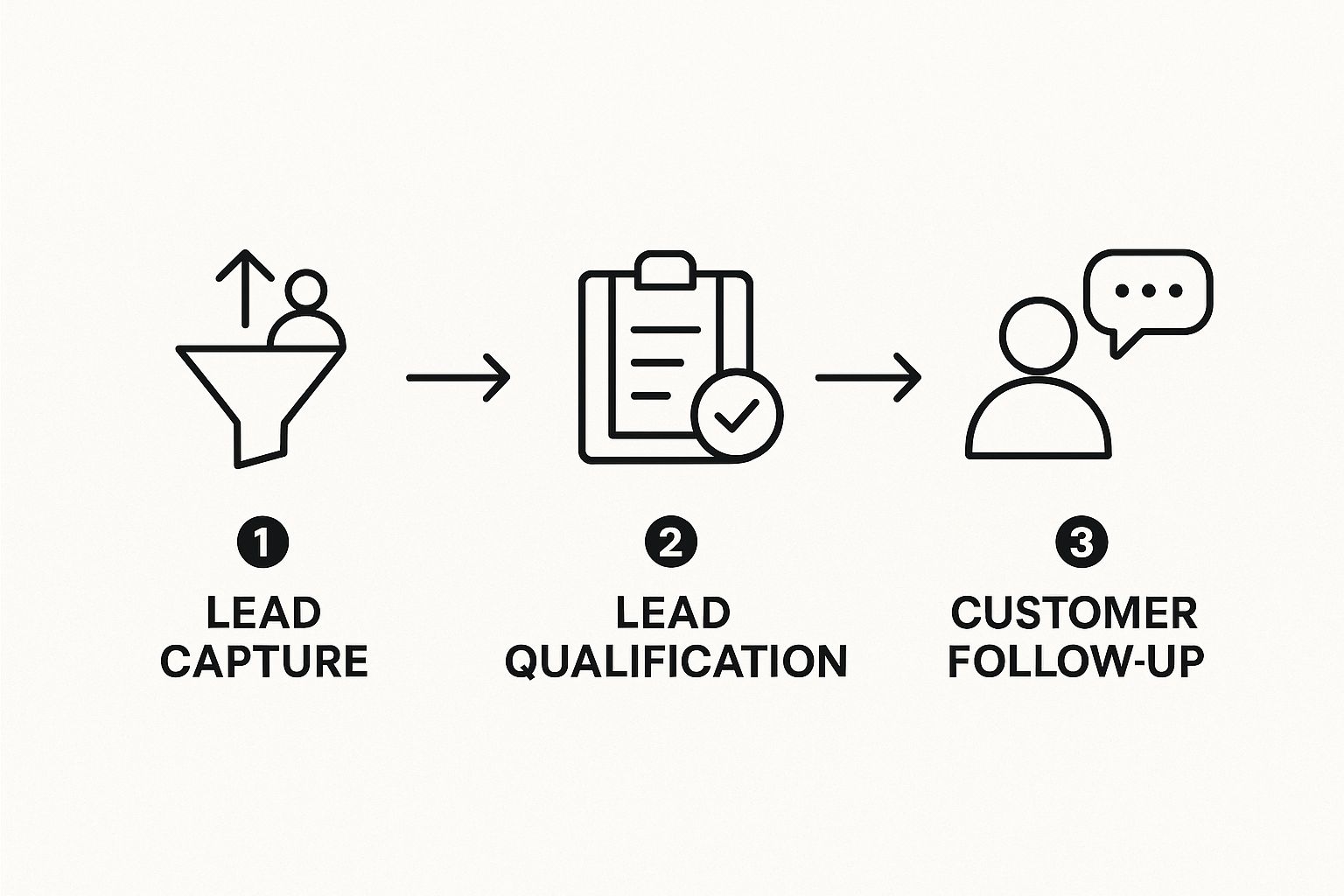
As you can see, each stage just flows into the next. Automation is the engine that keeps the lead moving forward without any of the usual manual bumps and delays.
The best part? When these tools are properly integrated with your CRM, every single interaction, from the form submission to the booked meeting, is logged automatically. This gives you a perfect, up-to-the-minute record of every lead without your reps wasting time on tedious data entry. It frees them up to do what you hired them to do: sell.
Making Your CRM the Command Center of Your Sales Operation
Your CRM should be the heartbeat of your sales operation, not just a digital Rolodex. Too many teams treat it like a passive database for contacts. Its real power is unleashed when you make it an active engine for improving your sales process. This means consciously building your sales activities around the CRM, not just logging them in it after the fact.
The ultimate goal here is to create a single source of truth. When a rep pulls up a contact record, they need to see the entire story—every email, every call, every meeting. That context is what transforms a generic follow-up into a meaningful, well-timed conversation.
Mirroring Your Sales Process in the CRM
Your CRM pipeline can't be some generic, out-of-the-box template. It needs to be a perfect mirror of your actual sales journey, with stages that match the real-world steps your team takes to close a deal. Ditch the default stages like "Qualified" or "Proposal" and get specific.
Think about stages that tell you what's actually happening:
- Discovery Call Booked: The first meeting is officially on the calendar.
- Needs Analysis Completed: The rep has dug in and documented the prospect's real pain points.
- Demo Delivered: The prospect has seen your product do its thing.
- Proposal Sent: The formal offer is in their hands, and the ball is in their court.
This level of customization does more than just keep you organized. It gives you a clear, at-a-glance dashboard of where every single deal stands. You can instantly spot bottlenecks and figure out where your reps might need a bit of coaching.
Building Automated Workflows for Peak Efficiency
This is where your CRM truly comes to life. Automated workflows get rid of the mind-numbing manual work and make sure no lead ever slips through the cracks. They act like a tireless assistant for your sales team, triggering the right action at the right time. For some great ideas, you can check out our guide on effective CRM workflow examples.
A well-implemented CRM is the central nervous system connecting your team's day-to-day actions to real, measurable business outcomes. It's what drives efficiency and growth across the entire organization.
The numbers don't lie. Properly adopting a CRM isn't just about convenience; it has a massive impact on key sales metrics. We've compiled some data to show just how significant these gains can be.
Impact of CRM Adoption on Sales Metrics
This table shows the average performance boost businesses see after they go all-in on their CRM.
| Metric | Average Improvement |
|---|---|
| Sales | +29% |
| Sales Productivity | +34% |
| Forecast Accuracy | +42% |
These aren't just minor upticks; they represent a fundamental shift in performance.

It’s no coincidence that companies fully embracing CRM applications see a 29% increase in sales, a 34% jump in sales productivity, and a whopping 42% improvement in forecast accuracy. With the global CRM market expected to reach $80 billion by 2025, it's crystal clear that businesses are betting on this technology as a core pillar of their success.
Using Sales Analytics to Drive Informed Decisions
Gut feelings can sometimes point you in the right direction, but they can't build a sustainable growth engine. For that, you need cold, hard data.
Optimizing your sales process is all about shifting from "I think this works" to "I know this works because the numbers prove it." This is where sales analytics becomes your most powerful tool, turning hunches into informed, strategic decisions.
The first step is moving beyond just tracking total revenue. While crucial, revenue is a lagging indicator—it tells you what already happened. To get ahead of the curve, you need to dig into the performance metrics that show you what’s happening right now and what’s likely to happen next.
Key Metrics That Truly Matter
To get a real, unfiltered view of your pipeline's health, you need to track a balanced set of Key Performance Indicators (KPIs). These metrics give you the real-time visibility needed to pinpoint exactly where deals are slowing down or falling apart.
Start by building a dashboard that puts these core metrics front and center:
- Sales Velocity: This is the ultimate health metric for your pipeline. It tells you how quickly deals are moving from first touch to closed-won. If your velocity is slowing down, it's a huge red flag that there's friction somewhere in your process.
- Win Rate by Stage: Don't just settle for an overall win rate. Breaking it down by each stage of your sales cycle is where the magic happens. You’ll see exactly where you're losing deals. Is there a massive drop-off after the demo? Your presentation might need a major overhaul.
- Sales Cycle Length: How many days does it take to close an average deal? Tracking this helps you set realistic forecasts and, more importantly, spot deals that are dragging on for too long. This allows you to jump in and help before they go completely cold.
A well-designed analytics dashboard isn't just a report; it's a strategic command center. It turns raw data into a clear story, showing you precisely where to focus your coaching efforts and process improvements for the biggest impact.
For a deeper dive into how analytics can boost your team's output, check out our guide on how to improve sales productivity, which offers more strategies for turning data into action.
Conducting Strategic Pipeline Reviews
When you’re armed with this data, your pipeline review meetings can finally stop being boring status updates and start becoming high-impact strategic sessions.
Instead of just asking reps, "What's the update on this deal?" you can get straight to the point: "I'm seeing deals stall out in the proposal stage across the board. What objections are you hearing most often?"
This data-driven approach lets you forecast with far greater accuracy and make proactive adjustments to your strategy. This screenshot shows exactly how a modern analytics tool visualizes performance metrics to make these conversations easier.
The visualization clearly breaks down key metrics, enabling leaders to spot trends and drill down into specific areas needing attention, like win rates or average deal size.
This kind of real-time analysis is what sets great sales teams apart. You can spot inefficiencies long before they snowball into major problems. Key metrics—like win rates, sales velocity, and quota attainment—are tracked meticulously to uncover hidden opportunities. As the experts say, sustainable growth isn't just about the quantity of deals, but maximizing the quality of every single one. This analytical rigor is the foundation of any effective sales process.
Building a Culture of Continuous Sales Improvement
 Optimizing your sales process isn't a one-and-done project you can check off a list. It’s a complete shift in your team's DNA—a move from "this is just how we do things" to "how can we do this better?" This commitment is what separates the merely good sales teams from the truly great ones.
When you commit to getting better every single day, you transform your entire operation. Your sales org becomes a dynamic, agile force that can pivot with market changes and consistently find smarter, more efficient ways to work. It all starts by creating an environment where feedback isn't just welcomed, but actively hunted down.
Creating Effective Feedback Loops
Your reps are on the front lines. They hear every objection, feel every point of friction in your follow-up process, and know exactly which email templates are getting ignored. If you want to tap into this goldmine of insight, you have to build genuine feedback loops where they feel safe sharing what’s really happening out there.
This goes way beyond a digital suggestion box. It's about setting up regular, structured forums for reps to share their battlefield observations without any fear of criticism.
- Weekly Huddles: Carve out 15 minutes in your weekly sales meeting just for "process friction." Ask a simple question: "What slowed you down this week?"
- Shared Channels: A dedicated Slack or Teams channel is perfect for this. Reps can drop real-time suggestions, flag an outdated script, or share a new objection they're hearing.
- One-on-One Coaching: Use your coaching sessions to do more than just review pipeline. Ask reps for their ideas on improving the process. You'll be surprised what you learn.
The most powerful optimization ideas almost always come from the people executing the process every day. When your team feels heard and sees their feedback put into action, they become invested in making the whole system better for everyone.
This kind of collaboration is a cornerstone of operational excellence. For a deeper dive into creating this environment, check out these sales operations best practices that will help you build a truly high-performing team.
Testing and Iterating for Peak Performance
Once you've got a steady stream of feedback coming in, it's time to start treating your sales process like a science experiment. The goal is to get away from guesswork and move toward data-backed decisions through consistent A/B testing. Stop assuming you know what works best—test it.
For instance, you could split your team to test two different call scripts for a week. Which one books more demos? Simple. The same logic applies to email cadences. Does a 5-email sequence outperform a 7-email one? Let the numbers tell the story. This data-driven approach pulls subjectivity out of the equation and ensures your sales process optimization is based on what actually resonates with your buyers.
Of course, none of this matters if your team isn't equipped to use the tools and processes you've so carefully refined. Ongoing training isn't a luxury; it's non-negotiable. When you roll out a new CRM feature or an updated cadence, you have to provide hands-on training and clear documentation so everyone is on the same page. This builds confidence, drives adoption, and makes sure your hard-won improvements actually stick.
Your Sales Optimization Questions Answered
Even with a solid roadmap, you’re bound to have questions when you start digging into something as critical as your sales process. Let's tackle some of the most common ones we hear from teams ready to fine-tune their approach.
How Long Does Sales Process Optimization Take?
This is always the first question, and the honest answer is: it’s not a one-and-done project. It's a continuous part of your growth.
You can absolutely score some big "quick wins" in the first 90 days. Focusing on high-impact areas like automating your lead routing or tightening up your initial email cadences can show results fast. We saw a steel fabrication company, for instance, add $1.5 million to its pipeline in just nine months by completely overhauling its front-end sales process.
But true optimization means building a culture of constant improvement. Your market, your product, and your customers are always evolving—your sales process has to keep up. Think of it as a cycle: audit, implement, measure, and refine. It never really stops.
What Is the Biggest Mistake Companies Make?
The single biggest mistake? Forgetting about the people. It happens all the time. Companies get excited and invest in shiny new tech—a CRM, automation tools—but they completely miss the most important step: getting buy-in from the sales team.
They roll out a new system without enough training, without explaining why it's happening, and without building any way for reps to give feedback.
Technology is just a tool. It’s useless if the people who are supposed to use it see it as a burden rather than a benefit. The most successful optimization projects are collaborative, incorporating feedback from reps on the front lines.
Is Optimization Only for Big Sales Teams?
Not at all. In fact, you could argue small teams stand to gain the most.
When you don't have a dedicated operations person, your team gets bogged down by manual work like assigning leads or endless data entry. Putting even basic automation in place can free up a massive chunk of their time to focus on what they were hired to do: talk to prospects and close deals.
For a small team, sales process optimization might just mean zeroing in on a few key things:
- Automated Scheduling: Finally killing the endless back-and-forth emails to book a discovery call.
- Simple Lead Routing: Making sure every new lead gets a response immediately, even with a basic round-robin setup.
- Templated Follow-ups: Building a consistent and effective messaging strategy for every part of the funnel.
The principles are the same no matter your team's size. The goal is always to build a more efficient, repeatable, and effective system for turning leads into customers. It’s about working smarter, not just harder—and that’s just as true for a team of two as it is for a team of two hundred.
Ready to stop losing leads to slow response times and manual errors? Distro automatically routes and schedules high-intent prospects with the right reps in seconds, tripling demo conversion rates. See how it works.