Inbound lead generation isn't about chasing down customers. It's the art of attracting them with content and experiences so valuable they want to find you. Think of it as creating a magnet for your ideal buyers through channels like blogs, search, and social media.
Instead of interrupting their day with ads, you offer something genuinely useful. In return, they willingly give you their contact information. This entire approach is built on trust, which naturally leads to higher-quality leads who are already sold on your expertise.
Why Inbound Is Your New Growth Engine

Let's be real: the old marketing playbook is broken. Today’s buyers are masters at ignoring disruptive ads. They have ad blockers, they screen their calls, and they skip commercials. The power has shifted from the seller to the buyer, who is now firmly in control of what they see and hear.
This is where inbound lead generation becomes less of a "strategy" and more of a necessity for survival.
Instead of shouting at potential customers with ads they never asked for (the classic outbound or 'push' method), inbound marketing is all about 'pulling' them in. It’s a fundamental pivot from interruption to attraction. You stop being a nuisance and start being a resource.
The Core Philosophy of Inbound
At its heart, the inbound methodology is simple: provide value first. By creating content that directly addresses the problems and questions of your ideal customer, you naturally draw them toward your brand.
This has some massive advantages over old-school outbound tactics:
- You build trust and credibility. Consistently offering helpful advice through blog posts, guides, or webinars establishes your brand as a go-to authority.
- You attract qualified prospects. Inbound targets people who are already searching for solutions. They're problem-aware and far more likely to be a great fit for what you offer.
- You foster long-term relationships. The process doesn't just stop at capturing a lead. Inbound is about nurturing that connection over time, turning leads into happy customers and customers into brand advocates.
By focusing on becoming a company that people genuinely want to engage with, you build a growth engine that's both sustainable and scalable. Inbound isn't about chasing leads; it's about making your business so magnetic that leads come directly to you.
The Business Case for Inbound
This isn't just a feel-good philosophy; the numbers back it up. Inbound marketing is consistently more effective and cost-efficient than traditional outbound methods.
Research shows that inbound tactics generate 54% more leads than outbound, often while costing significantly less. In fact, a deep dive into inbound marketing statistics reveals that the ROI heavily favors this approach.
To put it in perspective, let's look at the two strategies side-by-side.
Inbound vs Outbound Lead Generation At a Glance
This table breaks down the core differences between inbound and outbound lead generation, making it clear why so many businesses are shifting their focus.
| Attribute | Inbound Leads Generation | Outbound Lead Generation |
|---|---|---|
| Method | Attracts customers through valuable content (pull) | Pushes messages out to a broad audience (push) |
| Channels | SEO, blogs, social media, content marketing, webinars | Cold calls, email blasts, direct mail, trade shows, TV ads |
| Cost | 61% lower cost per lead on average | Higher cost, often requires significant ad spend |
| Lead Quality | Higher quality, prospects are actively seeking solutions | Lower quality, leads are often uninterested or unqualified |
| ROI | Higher ROI reported by 46% of marketers | Lower ROI, with only 12% of marketers favoring it |
| Customer Relationship | Builds trust and long-term relationships | Can be perceived as disruptive and intrusive |
As you can see, the data paints a very clear picture.
The inbound approach consistently delivers higher quality leads at a lower cost, which creates a more sustainable and predictable growth model for your business. It effectively transforms marketing from a cost center into a reliable revenue driver.
Building Your Inbound Lead Generation Blueprint
Alright, let's move past the theory and get our hands dirty. This is where a real inbound lead generation strategy starts to take shape. Think of it less like a single, grand plan and more like a series of deliberate, connected steps. This blueprint is your foundation, making sure every blog post, every social update, and every ad serves one clear, unified purpose.
Without this kind of framework, your marketing can feel completely random. A blog post here, a tweet there—it's disjointed, with no real path for turning someone's casual interest into an actual business opportunity. Building a blueprint forces you to get serious about who you're trying to reach and what they actually need from you to take the next step.
Define Your Ideal Customer Profile and Personas
Before you can attract anyone, you have to know exactly who you're looking for. This all starts with your Ideal Customer Profile (ICP). Just think of it as a super-detailed description of the perfect company for your product. You'll want to lock down details like their industry, company size, annual revenue, and where they're located.
Once you’ve nailed down the company profile, you can zoom in on the actual people inside those companies by creating buyer personas. These are basically semi-fictional characters based on real data and solid market research that represent your ideal customers. A good persona goes way beyond basic demographics; it digs into what motivates them, what keeps them up at night, and what their professional goals are.
To really bring them to life, ask yourself questions like:
- What are their biggest headaches at work?
- Where do they hang out online to find answers to those problems?
- What does a "win" look like in their role?
- What’s going to make them skeptical about a solution like ours?
Answering these gives you the insights you need to create content that feels like it was written just for them. It makes all your lead generation efforts hit so much harder.
Map the Buyer’s Journey
Okay, so you know who you're talking to. Now, what's their journey from "I have a problem" to "I'm ready to buy"? This path is never a straight line, but it usually breaks down into three key stages: Awareness, Consideration, and Decision.
- Awareness Stage: The buyer knows they have a problem, but they might not have a name for it yet. They're just starting to look for educational content to help them understand what's going on.
- Consideration Stage: Now they've put a name to their problem and are actively researching different ways to solve it. They're comparing various approaches and methods.
- Decision Stage: The buyer has picked a type of solution and is now looking at specific vendors or products. They need proof that you're the best choice out there.
Mapping your content to each stage is a non-negotiable. A blog post like "What is Lead Routing?" is perfect for the Awareness stage. But a detailed comparison guide or a customer case study? That's pure gold for the Decision stage. This way, you’re always delivering the right information at the exact moment they need it.
This whole process is a logical flow: defining your personas sets the stage for creating targeted content, and that content is what fuels your ability to capture valuable inbound leads.
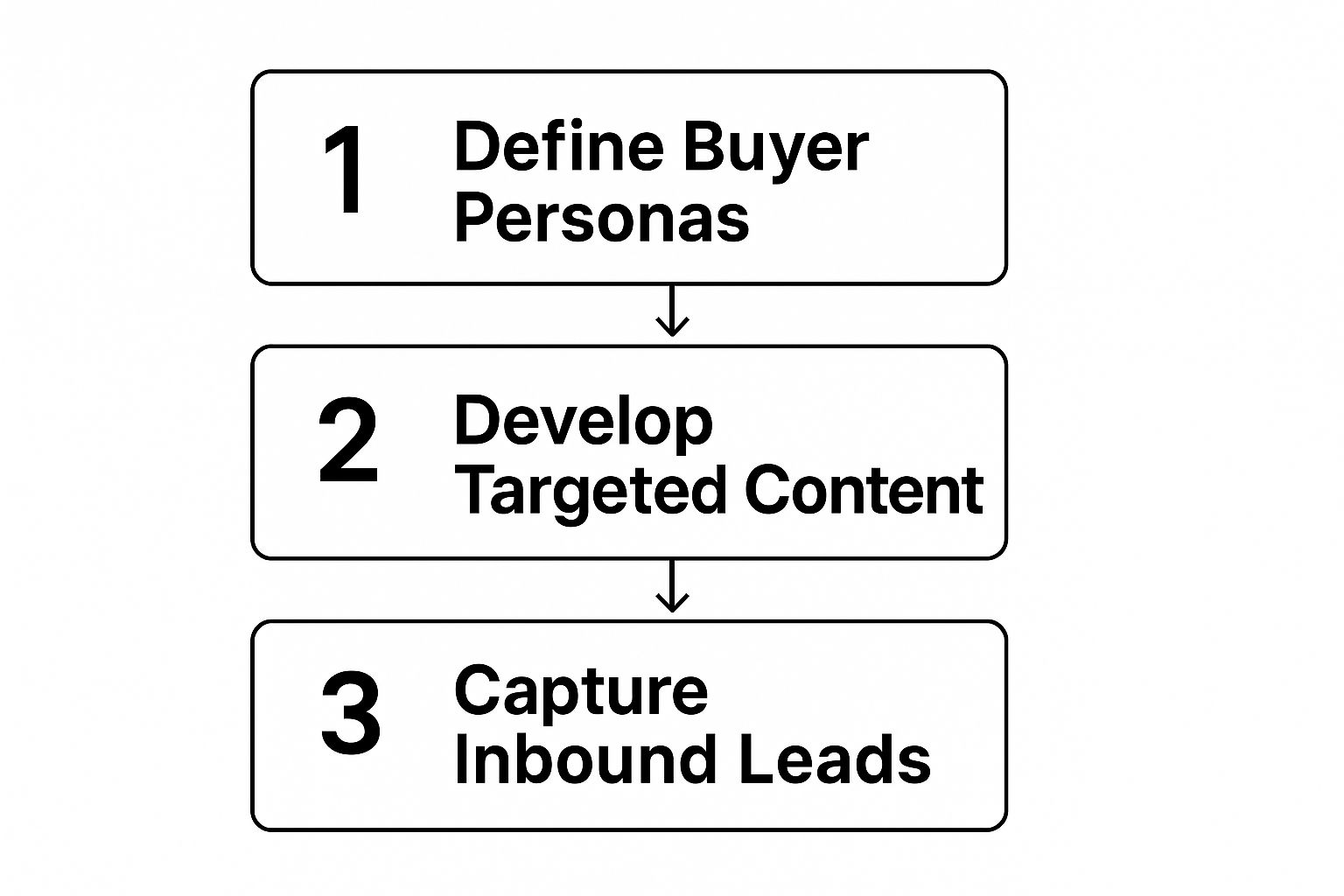
As you can see, a winning inbound process isn't random; each step builds on the last one to create a system that just works.
Set Meaningful Goals and KPIs
Let's be real: a blueprint without goals is just a collection of nice ideas. To make your plan something you can actually execute, you have to define what success looks like with clear Key Performance Indicators (KPIs). Fuzzy goals like "get more leads" aren't going to cut it. You need specific, measurable targets.
Your goals need to be the bridge between your marketing activities and actual business outcomes. This changes the conversation from "we got 1,000 blog views" to "we generated 50 qualified leads that resulted in $100,000 in new pipeline."
Here are the key KPIs you should be tracking for any inbound program:
- Marketing Qualified Leads (MQLs): The number of leads who have engaged with your marketing content and, crucially, fit your target profile.
- Sales Qualified Leads (SQLs): How many of those MQLs does the sales team agree have real potential to become customers?
- Lead-to-Customer Conversion Rate: The bottom-line percentage of leads that end up as paying customers.
- Customer Acquisition Cost (CAC): The total cost of your marketing and sales efforts divided by the number of new customers you brought in.
Tracking these numbers is how you measure ROI and spot where you need to make improvements. And if you're looking to go even deeper on how to attract the right kind of prospects, it's worth checking out this guide on effective B2B lead generation strategies. It can give you some great ideas for refining your own approach.
Creating Content That Attracks and Converts

With your strategic blueprint in place, it's time to build the engine that drives your entire inbound lead machine: high-value content. This isn't just about churning out blog posts to hit a quota. It’s about crafting resources that act as magnets, pulling your ideal customers into your orbit by genuinely solving their problems.
Think of it this way: effective content is the bridge that turns a stranger with a question into a qualified lead for your sales team. Every single piece you create needs a purpose, designed to meet your audience exactly where they are.
Aligning Content Formats with the Buyer's Journey
The content someone needs when they’re first becoming aware of a problem is worlds apart from what they’re looking for when they're ready to buy. A mismatch here is a surefire way to lose their attention. You wouldn't launch into a hard sales pitch before you've even introduced yourself, right?
Here’s a practical breakdown of what works best at each stage:
Awareness Stage Content: The goal is to educate and inform, not sell. People are just trying to understand their problem. Think high-level, helpful stuff.
- Blog Posts: Perfect for answering those "what is" or "how to" questions.
- Videos & Podcasts: Great for introducing concepts in an engaging way and building that initial brand familiarity.
- Infographics: These make complex ideas simple and are super easy to share.
Consideration Stage Content: Now, they’re looking at solutions. Your content should help them compare options and see why your approach makes sense.
- Webinars: A deeper dive that positions you as an expert.
- E-books & Guides: Comprehensive resources that build serious authority and provide tons of value.
- Case Studies: Nothing beats real-world proof showing how others solved the exact same problem.
Decision Stage Content: They’re ready to pick a provider. Your content needs to build confidence and make choosing you a no-brainer.
- Free Trials or Demos: Hands-on experience is often the final push they need.
- Comparison Sheets: Make it easy for them. Show how you stack up against the competition.
- Customer Testimonials: Social proof is powerful. It validates their choice and calms any last-minute nerves.
The data backs this up, big time. A staggering 85% of B2B marketers point to content as their primary source for lead generation. And 54% of marketers believe early-stage engagement through blogs, podcasts, and videos is the most valuable use of their content.
Fueling Discovery with Keyword Research and SEO
Creating brilliant content is only half the battle. If no one can find it, it might as well not exist. This is where keyword research and on-page Search Engine Optimization (SEO) become your best friends.
Keyword research isn't just about chasing high-volume terms. It's about getting inside your customer's head and understanding the exact language they use when they're searching for help. Tools like Ahrefs or Semrush are invaluable for finding terms that have decent search volume and, more importantly, match what the user is actually trying to do.
My advice? Focus on long-tail keywords—phrases of three or more words. Instead of a broad term like "lead routing," zero in on something specific like "how to automate B2B lead routing." The competition is lower, and the traffic you get will be far more qualified.
Pro Tip: Please, don't just stuff keywords into your content. Weave them naturally into your headings, paragraphs, and image alt text. Your first priority is always writing for a human. When you create genuinely helpful content that solves a problem, the search engines tend to reward you anyway.
For more hands-on advice, check out these actionable SEO content writing tips.
Turning Readers into Leads with CTAs and Landing Pages
Every piece of content you publish needs a clear next step. That's the job of your Call-to-Action (CTA). A CTA is just a prompt—a button, a link, an image—that guides your reader toward a conversion.
It needs to be compelling and, crucially, relevant. If someone just read a 2,000-word article on improving sales response times, the perfect CTA is something like, "Download Our Guide to Instant Lead Routing," not a generic "Contact Us."
That CTA should click through to a dedicated landing page. A great landing page has one job and one job only: convert that visitor into a lead. To make that happen, it needs:
- A punchy headline that matches the CTA.
- A quick summary of what they're getting and why it's valuable.
- A simple form asking only for what you absolutely need.
- Zero distractions. No navigation, no extra links.
By creating valuable, discoverable content and pairing it with a clean conversion path, you build a reliable system for successful inbound lead generation. It's a methodical process, but it's the foundation of scalable growth.
Driving Targeted Traffic to Your Content
Look, creating great content is a huge win. Pat yourself on the back. But its value is basically zero until the right people actually see it.
Hitting "publish" isn't the finish line. It's the starting gun. Now the real work begins: getting your content in front of your ideal customer.
You can't just cross your fingers and hope organic search does all the heavy lifting, especially right out of the gate. You've got to be proactive to get the ball rolling, spark some initial engagement, and show the search engines that your content is worth paying attention to. A solid promotion plan for effective inbound leads generation is a mix of quick wins and long-term, sustainable traffic.
Get on Social Where Your Audience Actually Lives
Let's be real: not all social platforms are created equal for B2B. Sure, you can have a presence everywhere, but you need to go deep where it counts. Focus on the networks where potential customers are actively looking for professional advice.
For most B2B companies, that hub is LinkedIn. It's so much more than a job board; it's a powerhouse for distributing content and building up your authority in the space.
A winning LinkedIn strategy isn't just about dropping links and running. It's about starting real conversations. Here’s a simple playbook:
- Share your content with a hot take: Don't just post the title and a link. Pull out a surprising stat, ask a provocative question, or share a key insight from the article to make people stop scrolling.
- Tag relevant experts or companies: If you mentioned someone in your post, tag them. This encourages them to share it, expanding your reach well beyond your own network.
- Jump into relevant groups: Find the online communities where your ideal customers are hanging out and talking about their problems. Share your content as a helpful solution, not a sales pitch.
- Chop it up: Turn that blog post into a carousel of key tips, a short video, or a simple text post with a killer graphic. This gives you more mileage from every single piece of content you create.
The platform's laser focus on B2B is what makes it so powerful. In fact, about 40% of B2B marketers say LinkedIn is their most effective channel for generating high-quality leads.
With over 587 million organic visits in 2024 and 40% of users checking out business pages every week, the opportunity for organic inbound lead generation is massive. If you're still not convinced, check out these powerful LinkedIn lead generation statistics to see just how critical the platform has become.
Don’t Forget Your Email List
Your email list is pure gold. These are people who have already raised their hand and said, "Yes, I want to hear from you." Forgetting about them when you launch new content is a massive missed opportunity.
When you publish a new guide, webinar, or deep-dive article, your subscribers should be the first to know. This drives a wave of high-quality traffic right away and keeps the relationship warm by consistently delivering value. A simple, well-written email can re-engage leads and keep your brand at the front of their minds.
Build Authority for the Long Haul with SEO
While social and email give you those crucial traffic spikes, Search Engine Optimization (SEO) is the foundation for steady, long-term inbound leads. It's the engine that works for you 24/7, pulling in qualified prospects at the exact moment they're searching for solutions.
SEO isn't a one-and-done task. It's a continuous process of making sure your website is technically solid and your content is relevant. It’s all about making it dead simple for search engines to find, understand, and trust what you've published.
Two pillars of any strong SEO strategy are:
- Technical Site Health: This means your site needs to be fast, mobile-friendly, secure, and free of annoying errors like broken links. A technically sound website is a better experience for users, and search engines reward that with better rankings.
- Quality Backlink Building: Backlinks are basically votes of confidence from other websites. When a reputable site links to your content, it tells search engines that your information is credible. Actively building these links through guest posting or digital PR is absolutely essential for building authority.
By combining the immediate hit from social and email with the lasting power of SEO, you create a complete traffic strategy that gets your content seen by the most people possible.
Nurturing and Routing Leads for Maximum Conversion

Getting an inbound lead is a great start, but it’s just that—a start. What you do in the moments immediately after someone fills out a form is where the real money is made or lost.
Let's face it, an inbound lead is a direct signal of interest. Someone just found your content valuable enough to hand over their personal information. The clock is now ticking, loudly. How you manage, prioritize, and engage with that person will make or break your conversion rates.
This is the exact spot where so many inbound strategies fall apart. Without a rock-solid system for routing and nurturing, even the best leads go cold, getting lost in a messy spreadsheet or a crowded inbox.
Prioritizing Your Best Opportunities with Lead Scoring
We all know not all leads are created equal. Someone who grabbed an introductory guide is in a totally different headspace than someone who just requested a demo. That's where lead scoring comes in. It's simply a way of assigning a numerical value to each lead based on who they are and what they do, helping you see at a glance who's sales-ready and who needs a bit more time.
Think of it as a priority filter for your sales team. This system typically looks at two kinds of data:
- Explicit Data (Fit): This is the stuff they tell you directly—job title, company size, industry, location. You're basically asking, "Does this person fit our Ideal Customer Profile (ICP)?"
- Implicit Data (Intent): This is all about behavior. Did they visit your pricing page multiple times? Did they attend a webinar? Open every email? These actions scream buying intent.
By combining these scores, you can set a clear threshold. For example, maybe any lead scoring over 100 gets flagged as a Marketing Qualified Lead (MQL) and is immediately passed to sales. It’s a data-driven way to make sure your reps are spending their time on the deals most likely to close.
The Need for Speed: Instant Lead Routing
Once a lead is qualified, speed is everything. It's your single greatest competitive advantage. In fact, studies show that contacting a new lead within five minutes can boost your odds of converting them by a wild 100x. Wait just 30 minutes, and those odds plummet.
A hot lead cools down fast. The longer they wait, the more time they have to check out your competitors, lose interest, or just get pulled into another meeting. Instant engagement isn't a "nice-to-have"; it's a requirement for modern sales.
This is where automated lead routing tools like Distro become an absolute game-changer. Instead of a sales manager manually digging through a CRM queue to assign leads, an automated system can instantly route that lead to the right rep based on rules you've already set.
You can route leads based on things like:
- Territory: Send leads to reps based on their geographic region.
- Company Size: Make sure your enterprise-level leads go straight to your senior AEs.
- Round Robin: Distribute leads evenly across a team to keep workloads fair and balanced.
Automating this single step removes the biggest bottleneck in the entire inbound funnel. To really dial in your own strategy, you can dig into these detailed lead routing best practices.
Guiding Prospects with Automated Nurture Sequences
So what about all those leads who aren't quite ready to talk to sales? You can’t just ignore them. This is where lead nurturing shines. Automated email nurture sequences let you stay top-of-mind by delivering a steady stream of valuable, relevant content over time.
Don't just send generic email blasts. Segment your leads based on their interests or what they downloaded. If someone grabbed your e-book on SEO, your nurture sequence should follow up with related blog posts, relevant case studies, and maybe an invitation to a webinar on the same topic.
The goal here is to gently guide them through their buying journey, building trust and positioning your brand as the expert they can't ignore. This methodical approach ensures no opportunity is wasted and every lead gets the right message at the right time.
Optimizing Your Inbound Strategy with Data
An inbound strategy isn't something you set and forget. The truly successful ones are living, breathing things that are constantly being refined by data. This is the final, crucial loop that separates the good programs from the great ones.
You can't manage what you don't measure, and your inbound efforts are no exception.
Monitoring performance isn’t about chasing vanity metrics like page views. It’s about drawing a clear line from your marketing activities straight to bottom-line results. To really nail this, you need to track key performance indicators (KPIs), which are often easiest to grasp when laid out in comprehensive marketing KPI dashboard examples. This is how you spot bottlenecks before they become major problems and uncover hidden opportunities for growth.
Focusing on Metrics That Matter
Your CRM and analytics tools are goldmines of information. The key is knowing where to dig. Start by tracking the entire funnel, from the very top to the bottom, to see exactly where prospects are dropping off.
A few key metrics you absolutely have to watch include:
- Traffic-to-Lead Conversion Rate: This tells you how effective your content is at turning anonymous website visitors into actual, known contacts.
- Lead-to-MQL Rate: This one is all about lead quality. It answers the question, "Are we attracting the right kind of people?"
- Customer Acquisition Cost (CAC): This is the ultimate measure of efficiency. How much are you actually spending to bring in a new customer through your inbound channels?
A landing page with tons of traffic but a rock-bottom conversion rate is a massive red flag. It’s an immediate signal that your offer, your copy, or your form needs a serious overhaul—fast.
Embracing a Culture of Testing
Once you’ve identified the weak spots in your funnel, it’s time to start experimenting. Systematic A/B testing is hands-down the most reliable way to improve performance over time.
Don't try to change everything at once. Test one variable at a time on your landing pages, CTAs, and emails to see what truly resonates with your audience.
For a much deeper dive into refining your entire process, check out our complete guide on generating inbound leads.
By building a culture around data-driven decisions, you stop guessing and start building a predictable, ever-improving system for generating inbound leads.
Got Questions? We've Got Answers
Even with the best game plan, you're bound to hit a few head-scratchers when you're getting an inbound strategy off the ground. Let's tackle some of the most common questions we hear from marketing and sales teams.
How Long Does It Take to See Results From Inbound Leads Generation?
This is the big one, isn't it? The short answer is: inbound is a long game, not an overnight miracle. You might get a few quick wins from a social media push or a well-timed email, but building a predictable, organic lead machine takes patience.
Realistically, you're looking at three to six months to build serious momentum, especially with SEO and content. The secret sauce is consistency. Every blog post, every keyword you rank for, adds another layer to your foundation. It's an asset that compounds over time, eventually creating a steady flow of leads without you having to pour money into ads constantly.
What Is the Difference Between an MQL and an SQL?
Nailing this down is absolutely critical if you want marketing and sales to be friends. These two acronyms represent completely different points in the buyer's journey, and mixing them up causes a lot of friction.
- An MQL (Marketing Qualified Lead) is someone who's shown interest by engaging with your content—maybe they downloaded an ebook or signed up for a webinar. They're warmer than a random visitor but aren't waving their credit card around just yet.
- An SQL (Sales Qualified Lead) has gone a step further. They've been vetted and have shown clear intent to buy, like by requesting a demo or filling out a "contact sales" form. This is the green light for your sales team to jump in.
Here's a simple way to think about it: MQLs are exploring the "what" and "why," while SQLs are ready to discuss the "how" and "how much." Getting this right means your reps spend their time on conversations that actually lead to revenue.
Can Small Businesses Use an Inbound Leads Generation Strategy?
Absolutely. In fact, inbound can be a small business's secret weapon. You don't need a massive budget to make it work; you just need to be smart and focused. Instead of trying to boil the ocean, pick a niche you can own.
The key is creating genuinely helpful, high-quality content that speaks directly to your ideal customer's biggest pain points. Forget trying to be on every social media platform. Pick one or two where your audience actually hangs out and go deep there. For small businesses, consistency and providing real value will always beat a huge budget.
Ready to stop letting hot leads go cold? Distro instantly routes qualified prospects to the right salesperson's calendar, turning your demo request forms into booked meetings. See how it works.