A winning lead generation strategy b2b isn't about chasing down every possible prospect. It's about building a precise system designed to attract, engage, and convert only the right accounts. Modern strategies have shifted focus from sheer volume to quality and intent, creating a predictable pipeline that actually fuels revenue growth. This whole approach hinges on deeply understanding your target customer and making sure marketing and sales are on the same page from day one.
Building Your B2B Lead Generation Framework
Let's get one thing straight: random acts of marketing don't work. A high-performing B2B lead generation strategy is built on a solid, repeatable framework. This isn’t just some textbook theory; it's the blueprint for creating a scalable growth engine that gets you past vanity metrics and focuses squarely on what drives the business forward.
And the entire foundation of this process? It starts with an almost obsessive focus on defining who you're trying to reach.
This flow shows the core journey: identifying the right accounts, grabbing their interest with something valuable, and then nurturing them toward a sale.
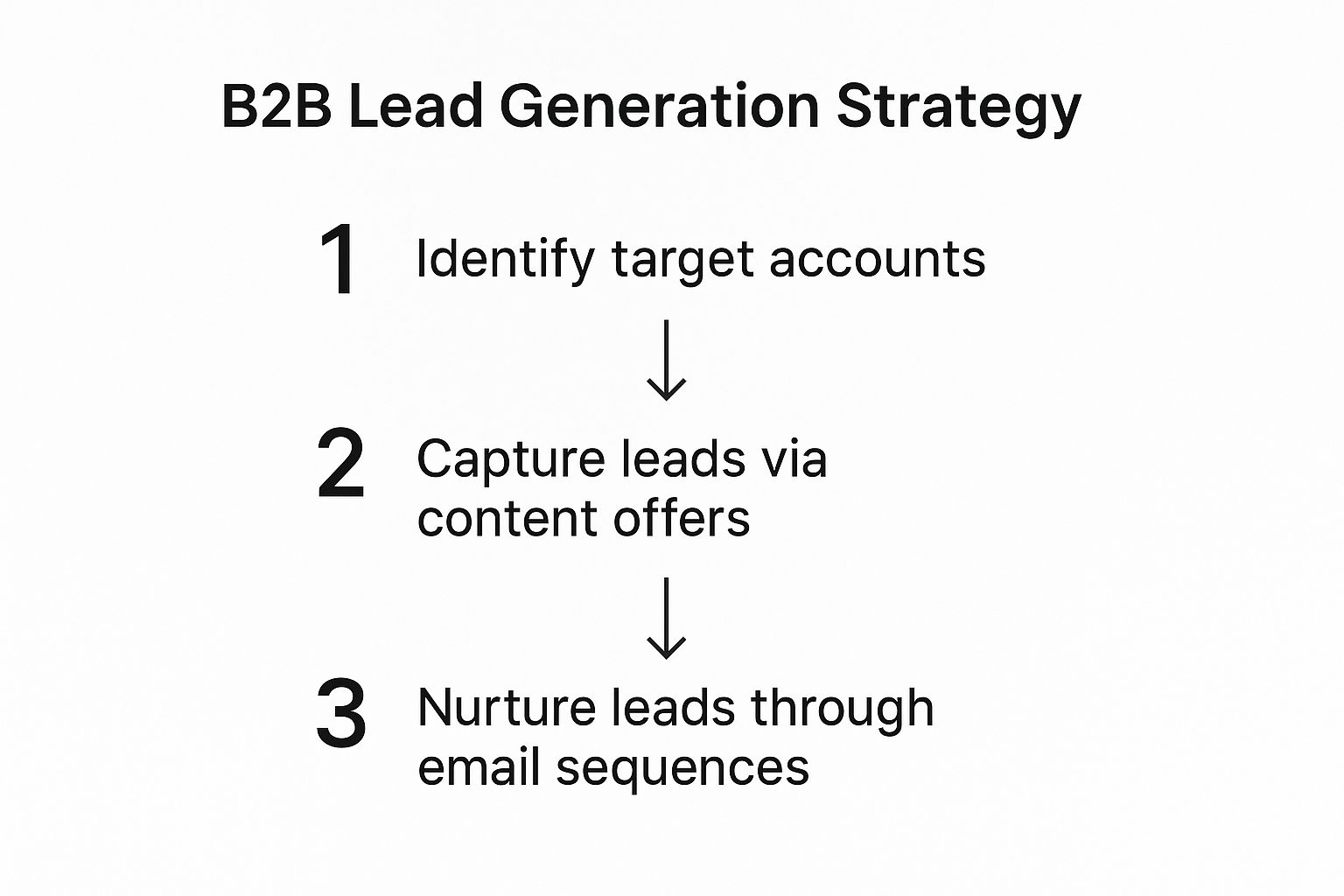
What the graphic makes clear is that a successful strategy is a connected system, not just a bunch of isolated tactics. Each step needs to flow logically into the next to create a smooth and effective experience for your future customers.
Define Your Ideal Customer Profile with Precision
The first and most critical piece of the puzzle is your Ideal Customer Profile (ICP). This goes so much deeper than basic details like industry or company size. A truly powerful ICP gets into the nitty-gritty: the target company's tech stack, their annual revenue, team structure, and—most importantly—the specific business pains your product solves.
Without a razor-sharp ICP, your marketing is just noise, and your sales team will burn hours on calls that go absolutely nowhere. Think of your ICP as the targeting system for your entire growth machine.
Map The Complex B2B Buyer Journey
Unlike a simple B2C purchase, B2B decisions almost always involve a buying committee, not just one person. Your framework has to account for this reality. You need to map out the typical journey these accounts take, from the first flicker of problem awareness all the way to picking a vendor.
Your journey map should answer a few key questions:
- Who's involved? Pinpoint the key players: the champion who fights for you, the economic buyer who holds the purse strings, the end-user, and the technical validator.
- What content do they need? Each person needs different information at different times. A CFO wants to see the ROI data. An IT manager needs the technical specs.
- Where do they hang out? Figure out where these people look for information. Is it LinkedIn, niche industry forums, trade publications, or peer review sites?
For a deeper dive into actually attracting prospects through these channels, check out our guide on inbound lead generation.
A classic mistake I see all the time is creating content for a generic "lead" instead of for the specific people on the buying committee. A whitepaper that impresses an engineer will probably put a VP of Sales to sleep. You have to tailor your assets.
An integral part of any good B2B framework is offering compelling Top Lead Magnet Ideas to capture a prospect's information. These targeted resources, like a well-researched report or an interactive calculator, are the currency you use to turn anonymous website visitors into known contacts.
To build a truly modern B2B lead generation engine, you need a few core components working in harmony. Here’s a quick breakdown of the essential pillars.
Core Components of a Modern B2B Lead Strategy
| Pillar | Objective | Key Metric |
|---|---|---|
| Ideal Customer Profile (ICP) | To focus all efforts on high-value, best-fit accounts. | ICP Account Penetration Rate |
| Channel Mix | To reach target personas where they are most active and receptive. | Cost Per Lead (CPL) by Channel |
| Content & Offers | To provide value in exchange for contact information and engagement. | Lead-to-MQL Conversion Rate |
| Lead Nurturing | To build trust and guide prospects through the buying journey. | Sales Cycle Length |
| Sales & Marketing Alignment | To ensure seamless handoffs and consistent messaging. | MQL-to-SQL Conversion Rate |
Getting these pillars right from the start prevents the silos and inefficiencies that sink most lead gen efforts. They form the bedrock of a scalable and predictable revenue machine.
Foster Marketing and Sales Alignment From Day One
The stats really drive home why alignment is so crucial. About 50% of marketers say lead generation is their top priority, and on average, businesses pull in around 1,877 leads every month. But that comes at a steep cost of nearly $198 per lead.
Even with all that effort, a staggering 44% of sales reps are often too swamped to follow up effectively. That highlights a massive, costly gap between marketing's work and sales' execution.
Real alignment isn't about a few weekly meetings. It's about having shared goals, common definitions, and integrated systems. Both teams have to agree on exactly what a Marketing-Qualified Lead (MQL) and a Sales-Qualified Lead (SQL) look like. This shared language is what stops the finger-pointing and ensures marketing hands off leads who are genuinely ready for a sales conversation. This alone makes your entire lead generation strategy b2b dramatically more efficient and effective.
Choosing Your High-Impact B2B Channels

Okay, you’ve nailed down your Ideal Customer Profile (ICP). Now for the real question: where do you actually find these people?
Spreading your budget and team's energy thin across every channel is a classic mistake. It’s a fast track to mediocre results everywhere. The real wins come from making smart, concentrated bets on the platforms where your ideal customers are already looking for answers.
The game here is to build a balanced channel mix that meets prospects at every step of their journey—from "I have a problem" to "Here's my credit card." It’s not about being everywhere; it's about being effective where it counts.
Inbound vs. Outbound: A Strategic Mix
A bulletproof B2B strategy almost never leans on just one approach. It’s about blending the patient, asset-building power of inbound marketing with the get-it-done precision of outbound.
Inbound Channels: Think of these as magnets. You’re attracting prospects by creating valuable resources they're actively searching for. We’re talking content marketing, technical SEO, and building a community. The leads are often fantastic, but be prepared—it can take 6-12 months to see significant momentum.
Outbound Channels: This is the spear. You're proactively reaching out to a curated list of prospects. Cold email, targeted LinkedIn outreach, and pay-per-click (PPC) ads are prime examples. Outbound can deliver results fast, but it demands a razor-sharp understanding of your ICP to avoid getting tuned out.
A solid strategy might involve using SEO to build a long-term foundation of organic traffic while simultaneously running a hyper-targeted LinkedIn ad campaign to reach key decision-makers about a new feature.
If you want to go deeper on building a proactive outreach machine, check out our guide on outbound lead generation.
Deep Dive into Core B2B Channels
Let’s get into the weeds of the most impactful channels. Remember, not every channel is right for every business. Always filter your choices through the lens of your ICP and sales cycle.
Content Marketing and Technical SEO
This duo is the foundation of modern inbound. Creating genuinely helpful content—in-depth guides, original research, practical blog posts—positions your company as the go-to expert. Technical SEO is what makes sure that content actually gets discovered by search engines when your prospects come looking.
A SaaS company selling project management software, for instance, could write the definitive guide on "How to Run Your First Agile Sprint." That article will naturally attract marketing managers and team leads who are already problem-aware, making them high-intent, warm leads. It’s no surprise that 70% of marketers are actively investing in content.
I’ve seen companies build their entire sales pipeline on the back of just one or two incredibly well-researched, high-ranking blog posts. It’s not about volume; it’s about creating the definitive resource for a specific problem your ICP faces.
LinkedIn Marketing
For anyone in B2B, LinkedIn is non-negotiable. It's so much more than a social network—it's a professional database, a content hub, and an advertising machine all rolled into one.
Here’s how you can use it:
- Organic Content: Share valuable insights from your company page and, more importantly, from the personal profiles of your key team members.
- Targeted Outreach: Connect directly with decision-makers at your target accounts.
- Paid Ads: Run campaigns with surgical precision, targeting by job title, company size, industry, or even specific company names.
A professional services firm could build its entire lead gen engine on the backs of its partners' LinkedIn profiles. By consistently posting insightful commentary and engaging in relevant discussions, they build trust and attract inbound inquiries without a massive ad spend.
Targeted Paid Advertising
While SEO is a long game, paid ads on platforms like Google and LinkedIn can start delivering leads almost instantly. The secret to a positive ROI isn't a huge budget; it's precision targeting.
On Google Ads, you can bid on high-intent keywords like "[your competitor] alternatives" to snatch up prospects who are at the very bottom of the funnel.
On LinkedIn Ads, you can put a compelling whitepaper in front of every VP of Engineering at a Fortune 500 manufacturing company. It’s a direct, measurable way to fill your pipeline. The key is to obsessively track your Cost Per Lead (CPL) and make sure it works with the lifetime value of a customer from that channel. A CPL that seems high on the surface can be an absolute bargain if those leads close at a fantastic rate.
Mastering Account-Based Marketing For High-Value Targets
When you're chasing large, high-value enterprise deals, a broad, volume-based approach just doesn't cut it. It’s like trying to catch a whale with a standard fishing net—a massive waste of energy and resources. This is exactly where an Account-Based Marketing (ABM) strategy becomes your ace in the hole for lead generation strategy b2b.
ABM essentially flips the old-school marketing funnel on its head. Instead of casting a wide net for as many individual leads as you can get, you start by hand-picking a select group of high-potential companies. From there, you treat each of those companies as its own market, rolling out a highly personalized marketing and sales blitz to win them over.
Shifting From A Lead-Centric To An Account-Centric Model
The real game-changer with ABM is moving your focus from individuals to entire accounts. Let's be honest, B2B buying decisions are almost never made by one person. It’s a committee of stakeholders, and each one has their own set of priorities, pressures, and pain points.
A traditional lead gen model might get you a download from a junior engineer. That's a start, I guess. But an ABM model goes way beyond that. It focuses on engaging that engineer, their manager, the VP of Engineering, and even the CFO—all at the same time, with coordinated messaging that actually makes sense to each of them. It's an approach that acknowledges the messy, complex reality of how enterprise sales actually happen.
The data backs this up, too. There’s a reason ABM is such a dominant force in B2B growth. Companies that go all-in on ABM have seen some pretty incredible results, like a 14% increase in pipeline conversions and a 28% improvement in overall account management. This strategy also drives a 25% jump in Marketing Qualified Leads (MQLs) getting the nod from sales, which tells you it’s a massive boost for alignment. You can discover more about these powerful B2B trends and see how they're shaping modern playbooks.
That alignment is the secret sauce. When marketing and sales are rowing in the same direction, targeting the same list of accounts with one unified plan, the results are simply on another level.
Identifying And Prioritizing Your Target Accounts
Your ABM strategy will live or die by the quality of your target account list. This isn't something you can knock out in an afternoon. It demands some serious collaboration between your sales, marketing, and leadership teams.
Here’s how to build a list that has some real teeth:
- Lean on Your ICP: Your Ideal Customer Profile is your starting block. Which companies are a perfect match for the firmographic and technographic criteria you’ve already worked so hard to define?
- Bring in Intent Data: Use tools that can tell you which companies are actively sniffing around for solutions like yours. When a company suddenly starts bingeing content on "enterprise data integration," that's a signal you can't ignore.
- Talk to Your Sales Reps: Your reps are on the front lines. They know which accounts have the budget, the right problems, and are actually likely to close. Their street-level intel is pure gold.
Once you’ve got a long list, you need to prioritize. Tiering your accounts into groups (think Tier 1 for a hyper-personalized "one-to-one" approach, and Tier 2 for a "one-to-few" cluster approach) is the key to spending your resources wisely.
Creating Hyper-Personalized Campaigns
Generic, one-size-fits-all messaging has no place in ABM. The whole point is to make your target accounts feel like you built your solution specifically for them.
This means you’ve got to create bespoke content and experiences tailored to the key decision-makers inside each target company. For example, let's say you're a software company going after a big retail chain. Your ABM play might look a little something like this:
The ABM Play in Action
| Target Persona | Personalized Tactic | Desired Outcome |
|---|---|---|
| VP of Logistics | Run a LinkedIn ad campaign highlighting a case study on how a similar retailer slashed shipping costs by 22%. | Land a discovery call to dig into their specific logistics challenges. |
| Chief Technology Officer | Send a personalized email from your CTO with a technical deep-dive on how your platform plugs into their existing ERP system. | Schedule a technical demo with their engineering team. |
| Chief Financial Officer | Mail a high-quality, printed report showing a customized ROI projection for their business, built from their public financial data. | Get on the CFO's radar as a financially sound solution. |
This kind of coordinated, multi-touch attack ensures every key player on the buying committee gets a message that speaks directly to their role and what keeps them up at night. It proves you’ve done your homework and you actually understand their business on a deep level.
This is the kind of personalization that separates a winning ABM program from all the noise. It’s how you build the deep, trusting relationships you need to speed up major sales cycles and close the deals that will truly move the needle for your business.
Using AI And Automation To Scale Your Efforts

Relying on manual processes for lead management today is like trying to win a Grand Prix on foot. Your competitors are in race cars, and you're just not going to keep up. Technology isn't a "nice-to-have" anymore; it's the engine that powers a scalable and efficient B2B lead generation strategy.
The right automation and AI tools make your entire process smarter, faster, and far more responsive. They handle the repetitive, soul-crushing tasks that bog down your team, freeing them up to focus on what humans do best: building relationships and closing deals. It’s all about working smarter, not harder, to create a better experience for your future customers.
Leverage AI For Predictive Lead Scoring
Are you tired of your sales team complaining about low-quality leads? I’ve been there. Predictive lead scoring is the fix. Old-school scoring models, with their simple, arbitrary point systems, just don't cut it anymore. AI-powered scoring, on the other hand, digs through massive datasets to find the true signals of a sales-ready lead.
These systems look way beyond basic firmographics. They analyze behavioral data—which pages a prospect visited, how long they stayed, what content they downloaded—to build a dynamic score that actually reflects intent. This ensures your sales reps spend their valuable time only on prospects who are genuinely ready for a conversation.
This approach is fundamentally changing how we approach B2B lead generation. By integrating AI, companies can pinpoint high-intent prospects with incredible accuracy and engage them at the perfect moment. The result is smarter targeting and much higher conversion rates. You can read the full research on B2B lead generation trends to see just how big of a shift this is.
I once worked with a company whose sales team was drowning in MQLs but struggling to hit quota. After implementing an AI scoring tool, their lead volume actually dropped by 30%, but their MQL-to-SQL conversion rate more than doubled. It was proof they'd been wasting a massive amount of time on the wrong leads.
Build Automated Lead Nurturing Sequences
Let's be real: not every lead is ready to buy the second they download a whitepaper. This is where automated lead nurturing becomes your secret weapon. Instead of letting those valuable leads go cold, you can use marketing automation to guide them through their buying journey with personalized, relevant content.
And I don't mean generic email blasts. A smart nurturing sequence delivers the right content at the right time, triggered by a lead's behavior.
For example:
- A lead downloads a top-of-funnel ebook? A few days later, they automatically get an email with a link to a related case study.
- They visit your pricing page? That action can trigger an entirely different workflow that sends them an invitation for a product demo.
This automated process builds trust and keeps your brand top-of-mind. It warms up leads until they're ready for a sales conversation, all without requiring constant manual effort from your team.
Implement Intelligent Lead Routing
What happens when a high-intent lead finally fills out your "Request a Demo" form? In a manual world, that lead might sit in an inbox for hours—or even days—waiting for someone to assign it. By the time a rep follows up, the prospect's interest has plummeted.
This is where intelligent lead routing tools like Distro are an absolute game-changer. These systems instantly route new leads to the right sales rep based on a set of rules you define. This guarantees immediate follow-up when a prospect's interest is at its absolute peak.
Common Lead Routing Rules
| Rule Type | Description | Example Scenario |
|---|---|---|
| Territory-Based | Assigns leads based on their geographic location. | A lead from California is automatically sent to the West Coast sales team. |
| Company Size | Routes leads based on the number of employees. | Leads from companies with over 500 employees go to the enterprise sales reps. |
| Industry-Specific | Assigns leads to reps who specialize in a certain vertical. | A lead from a healthcare company is routed to the healthcare industry expert. |
| Round Robin | Distributes leads evenly among a group of reps. | Ensures fair lead distribution for an inbound sales team. |
By automating this process, you obliterate manual bottlenecks and dramatically slash your speed-to-lead time. This one change can have a massive impact on your conversion rates, turning your demo request form from a lead graveyard into a high-powered conversion machine.
Measuring Success and Optimizing For Revenue
A B2B lead generation strategy without measurement is just expensive guesswork. Firing up campaigns and running plays is only half the battle. The real, sustainable growth comes from digging into the data to understand what’s working, what isn't, and—most importantly—why.
It’s time to look past vanity metrics like clicks and social media likes. We need to focus on the numbers that actually impact the bottom line.
This is all about creating a closed-loop system, where data from your sales outcomes constantly feeds back into and refines your marketing efforts. This isn’t just about pulling reports; it’s about building a well-oiled engine for long-term growth by making smarter decisions, quarter after quarter.
Focusing On The Metrics That Matter
To truly optimize for revenue, you have to track the metrics that connect your marketing activities directly to financial results. Stop worrying about impressions and start obsessing over the numbers your CFO actually cares about. This kind of clarity is what lets you spot bottlenecks in your funnel, double down on your most profitable channels, and justify your budget with cold, hard data.
Here are the essential metrics to build your dashboard around:
- Cost Per Lead (CPL): Simple enough—this tells you how much you're spending to get one lead from a specific channel. But remember, a low CPL isn't always a good thing if those leads never close.
- Customer Acquisition Cost (CAC): This is the big one. It's the total cost of sales and marketing needed to land one new customer. It’s the ultimate measure of your go-to-market efficiency.
- Lead-to-Customer Conversion Rate: What percentage of your leads actually sign on the dotted line? This metric cuts right to the chase and reveals the true quality of the leads your strategy is bringing in.
- Pipeline Velocity: How quickly are leads moving through your sales funnel, from that first touchpoint to a closed deal? A faster velocity means a shorter sales cycle and quicker revenue recognition.
When you build a dashboard that shows these key performance indicators (KPIs) in real-time, you get an immediate health check on your entire funnel. It turns abstract data into a clear story about your business.
The Power Of A Robust Analytics Framework
Having the right metrics is one thing, but you need a framework to actually analyze them. The goal is to move from just collecting data to generating actionable insights. This means running regular performance reviews and building a culture where data-driven iteration is the norm.
Proving the value of your social media efforts, for example, is notoriously tricky in B2B. Learning how to measure social media ROI is critical for justifying investments and making smart decisions about where to spend your time and money. This kind of channel-specific analysis is vital.
A classic mistake I see all the time is treating all leads as equal. A lead from a highly targeted webinar might have a 5x higher conversion rate than a lead from a broad, top-of-funnel content download. If you're not tracking this, you might incorrectly pour your budget into the lower-performing channel just because it generates more volume.
This level of detail is also where you can really hone your qualification process. By analyzing the behavior and firmographics of leads that actually convert into high-value customers, you can continuously improve your lead scoring model. For a much deeper dive on this, our article on lead scoring best practices gives you a detailed roadmap for building a system that really works.
Ultimately, your analytics framework should empower you to answer critical business questions with confidence:
- Which marketing channel delivers customers with the highest lifetime value (LTV)?
- Where are the biggest drop-off points in our sales funnel?
- How does our content strategy impact the speed of the sales cycle?
Answering these questions is what transforms your B2B lead generation from a set of disconnected tactics into a cohesive, revenue-focused operation. You stop guessing and start engineering predictable growth. This disciplined approach is how you ensure every dollar and hour you invest is optimized for maximum impact.
B2B Lead Generation Strategy FAQ

Even when you have a solid framework in place, questions always seem to bubble up once you start putting a new plan into action. This section is all about tackling some of the most common questions we get about building and running a B2B lead gen strategy. Think of it as a quick reference guide to help you clear those common hurdles.
What Is the Most Effective B2B Lead Generation Strategy?
I wish I could give you a silver bullet answer, but there really isn't a single "best" strategy that works for everyone. The most effective approach is always, always a multi-channel plan that’s built specifically around your Ideal Customer Profile (ICP) and business model. What crushes it for a SaaS startup is going to look very different from what an established professional services firm needs.
For most B2B companies I've worked with, a winning strategy is a smart mix of a few key approaches:
- Inbound Marketing: This is your long game. You use great content and SEO to pull in prospects who are already out there looking for what you offer.
- Account-Based Marketing (ABM): Instead of casting a wide net, you get hyper-focused on a curated list of high-value accounts and hit them with personalized campaigns.
- Targeted Outbound: Think surgical precision, not a shotgun blast. Using platforms like LinkedIn for proactive, relevant outreach to the exact decision-makers you want to talk to.
The real secret sauce is to test these channels, obsessively track your ROI, and then have the discipline to double down on what’s actually working for your audience. It's a constant cycle of testing, learning, and optimizing.
How Can I Improve the Quality of My B2B Leads?
This is a big one. Improving lead quality is a common goal, and thankfully, it's completely achievable. The key is to shift your mindset from "more leads" to "the right leads."
It all starts with your ICP. Take another hard look at it. If it's too broad or vague, your targeting will be off, and you'll keep attracting people who are a poor fit. Get specific.
Next up, level up your content. Stop creating surface-level fluff. Instead, build resources that dive deep into the very specific, nagging pain points your ideal customers have. This simple change acts as a natural filter, weeding out the casual browsers and pulling in serious, problem-aware buyers.
A critical mistake is judging lead quality solely by volume. I'd rather have 10 highly-qualified leads from a niche webinar than 100 lukewarm leads from a generic ebook download. The former will have a much higher impact on revenue.
Finally, you need a smart lead scoring system. This lets you automatically qualify leads based on who they are (firmographics like company size and industry) and what they do (behaviors like visiting your pricing page). And don't forget to create a tight feedback loop with your sales team—they're on the front lines and can give you the real-world intel needed to constantly refine what a "good lead" actually looks like.
How Long Does It Take to See Results From B2B Lead Gen?
This is where setting realistic expectations is crucial. The time it takes to see results can vary wildly depending on the channels you’re using.
If you need leads now, paid advertising on platforms like Google Ads or LinkedIn can deliver. You can literally start generating leads within days, sometimes even hours, of launching a campaign. These channels are perfect for getting some immediate activity into your pipeline.
On the other hand, organic strategies like SEO and content marketing are long-term investments. Think of them as building an asset. It often takes a good 6 to 12 months to see a consistent, meaningful flow of inbound leads. Why? Because it takes time for your content to climb the search rankings and build the authority needed to attract high-quality traffic.
The most resilient B2B strategies I’ve seen always blend short-term tactics for quick wins with these long-term plays for sustainable, predictable growth.
What Are the Most Important Metrics to Track?
It’s easy to get caught up in counting total leads, but that’s often just a vanity metric. If you want to know if your strategy is actually working, you have to track the numbers that connect directly to business impact and, ultimately, revenue.
For any lead generation strategy b2b, these are the metrics that truly matter:
- Customer Acquisition Cost (CAC): How much are you spending in sales and marketing to land one new customer?
- Lead-to-Customer Conversion Rate: What percentage of your leads eventually become paying customers? This is a huge indicator of lead quality.
- MQL vs. SQL Ratio: What's the handoff rate between marketing-qualified and sales-qualified leads? This tells you a lot about your marketing and sales alignment.
- Pipeline Velocity: How fast are leads moving through your sales funnel from initial contact to closed deal?
Tracking these numbers gives you the real story. It tells you if your strategy isn't just generating noise, but efficiently generating revenue.
Ready to stop letting high-intent leads slip through the cracks? Distro automatically routes prospects from your demo forms to the right sales rep’s calendar in seconds, eliminating manual work and maximizing your conversion rates. See how you can 3X your demo request conversions at https://distro.so.