You're generating interest and getting leads in the door. That's great. But how many of those potential customers actually pull out their wallets and buy something?
The lead conversion rate is the one metric that cuts through the noise and answers that exact question. It measures the percentage of leads who become paying customers, making it a critical health check for your marketing and sales efforts.
Understanding Your Lead Conversion Rate
Think of your marketing like casting a net to catch fish (leads). Your lead conversion rate tells you how many of those fish you actually managed to bring onto the boat (customers). It’s not just about getting attention; it's about turning that attention into real business.
When this number is high, it's a fantastic sign. It means your messaging, your product, and your sales process are all clicking. This metric is the ultimate reality check, moving you past vanity metrics like website traffic or social media likes and forcing you to focus on what really drives growth: getting new customers.
Lead Conversion Rate at a Glance
For a quick reference, here's a breakdown of what the lead conversion rate is all about and why it's so vital for your business.
| Concept | Explanation |
|---|---|
| What It Is | The percentage of your leads that complete a desired action, turning into actual customers. |
| How to Calculate It | (Total Number of New Customers / Total Number of Leads) x 100 |
| Why It's Critical | It directly measures the effectiveness of your sales and marketing, showing if you're turning interest into revenue. |
In short, it’s the bridge between "people are interested" and "people are buying."
Why This Metric Is So Important
So, why obsess over this one number? Because it gives you direct feedback on the quality of your leads, the performance of your sales team, and the overall health of your entire customer acquisition strategy. A consistently low rate, for instance, might scream that there’s a major disconnect between what your marketing promises and what people experience in the sales process.
Specifically, a strong lead conversion rate helps you:
- Maximize Marketing ROI: It’s proof that you're not just throwing money at ads to get clicks, but are actually turning that spend into revenue.
- Improve Sales Efficiency: It helps you spot which lead sources or campaigns are golden, so your team can stop wasting time on duds and focus their energy where it really counts.
- Diagnose Funnel Weaknesses: A sudden drop can be an alarm bell for all sorts of issues—a broken form, an unconvincing offer, or painfully slow follow-up times.
A healthy lead conversion rate is the heartbeat of a sustainable business. It proves you have a repeatable process for turning interest into income, which is the foundation for scaling your operations and achieving long-term success.
Setting Realistic Expectations
Before you start aiming for 100% (we can all dream), it's important to get some context. The reality is that performance varies wildly depending on your industry and business model.
The average lead conversion rate across all industries is about 2.9%. But that's just an average. Some sectors naturally do better. Professional services, for example, pull in a solid 4.6%, while the dental and cosmetic space averages around 3.1%.
Diving into these numbers helps you set goals that are ambitious but achievable. You can find more detailed benchmarks in these lead generation statistics on wisernotify.com to see how you stack up.
Alright, let's get down to the nitty-gritty of calculating your lead conversion rate. Before you can start improving anything, you need a solid, reliable way to measure where you stand right now.
The good news? The basic formula is refreshingly simple. The real trick is in getting crystal clear on what each number in that formula actually means for your business.
The core math looks like this:
(Total Number of New Customers / Total Number of Leads) x 100 = Lead Conversion Rate (%)
This little equation is powerful. It takes your raw activity and turns it into a single percentage that tells a story about how well your sales and marketing engines are working together.
Breaking Down the Formula
To get a number you can actually trust, consistency is everything. Let's look at the two pieces of the puzzle:
- Total Number of Leads: This is the pool of people who showed some kind of initial interest within a set timeframe, like a single month or quarter. Think of anyone who filled out a contact form, signed up for your webinar, or asked for a demo.
- Total Number of New Customers: This is the number of people from that exact same group of leads who took the final step you wanted them to take.
Here's where things can get messy. The most common mistake we see is a fuzzy definition of a "conversion." If you run a software company, does a conversion happen when someone signs up for a free trial, or only when they pull out their credit card and become a paying subscriber? For an agency, is it a signed contract or the first paid invoice?
You have to pick one, define it clearly, and stick to it. Otherwise, your numbers will be all over the place.
A Practical Example in Action
Let's imagine a B2B software company wants to figure out its lead conversion rate for the last quarter.
- Count the Leads: They dig into their CRM and find that 2,000 people requested a free trial of their product. That's their "Total Number of Leads."
- Count the New Customers: Looking at that same group of 2,000 trial users, they see that 80 of them upgraded to a paid subscription during that quarter.
- Do the Math: (80 New Customers / 2,000 Leads) x 100 = 4%
Boom. They have a solid 4% lead conversion rate. This isn't just a vanity metric; it's a real benchmark. Now they can track it over time and see exactly how any changes to their trial experience, follow-up emails, or sales process affect their results.
Without this number, any effort to improve is just a shot in the dark. With it, you're making decisions based on data, not guesswork.
Key Factors That Influence Your Conversion Rate

Ever wonder why some leads practically beg to become customers while others just... fizzle out? Your lead conversion rate isn't some isolated number on a dashboard. It’s the end result of a whole chain of events, and a single weak link can send even your most promising prospects running for the hills.
It all starts with the quality of the lead itself. Let's be honest, not all leads are created equal. A prospect who found you by searching for the exact problem you solve is worlds apart from someone who idly clicked a broad social media ad. It’s simple: higher-intent leads, the ones actively looking for a solution like yours, will always convert better.
This is exactly why you need to get obsessive about your lead sources. Figure out where your best customers are coming from, and then pour your resources into those channels. It's about quality, not just quantity.
The Speed of Your Follow-Up
The moment a lead shows interest, a clock starts ticking. Loudly. The single biggest factor that determines if a lead converts is how fast you follow up. A prospect’s interest is at its absolute peak the second they hit "submit" on your form. Every minute you wait, that interest cools.
This is a massive—and I mean massive—stumbling block for most companies. The average organization is pulling in around 1,877 leads per month. With a mean cost per lead hovering near $200, every single one of those is precious. And yet, a mind-boggling 41% of companies admit they struggle with timely follow-ups. Making matters worse, nearly half of all sales reps feel too swamped to chase down every lead.
You can dig into more of the data behind the challenge of timely lead management on explodingtopics.com.
A lead is like a spark. If you don't act on it immediately, it goes out. The goal is to engage that spark when it's brightest, turning initial curiosity into a real conversation before it has a chance to fade.
The Alignment of Your Message and Offer
Another deal-breaker is the gap between what your marketing promises and what your sales team delivers. Does the experience on your landing page actually match the ad that got them there? Is your value prop crystal clear and consistent at every single touchpoint?
Any disconnect creates friction and kills trust. For example, if your ad screams "free consultation" but your form is a 15-field monster with a clunky interface, you're putting a huge roadblock right in their path.
A few other critical pieces of the puzzle include:
- Lead Qualification: How well do you sift through the noise to find the gold? Nailing your lead scoring best practices is non-negotiable for focusing your sales team where it counts.
- Value Proposition: Can you explain the problem you solve and why you’re the best choice in a way that’s impossible to ignore?
- Social Proof: Are you using testimonials, case studies, and reviews? This stuff builds credibility and makes prospects feel safer saying "yes."
At the end of the day, a high lead conversion rate isn’t magic. It's the product of a well-oiled machine where lead quality, lightning-fast response times, and a seamless customer experience all work in perfect sync.
Proven Strategies to Improve Your Conversion Rate
Knowing what factors influence your lead conversion rate is one thing. Actually improving it is where the real growth happens. To move beyond theory, you need a set of battle-tested strategies that can turn a flicker of interest into a firm commitment. This isn't about generic advice—it's about specific, repeatable tactics that top-performing teams use day in and day out.
The core idea is simple: make it as easy and compelling as possible for a qualified lead to take the next step. Every part of your process, from your lead capture forms to your follow-up cadence, should be engineered to reduce friction and build trust.
Optimize Your Lead Capture and Forms
Your form is often the first real point of contact. If it's long, confusing, or asks for too much information too soon, you're killing your conversion rate before the race even starts. Think of your form as a conversation starter, not an interrogation.
- Simplify Your Fields: Only ask for what is absolutely necessary. You can always gather more details later. A shorter form almost always converts better.
- Add Social Proof: Including a short testimonial, a customer logo, or a star rating right next to your form can do wonders for trust and encourage more submissions.
- Use Clear Calls-to-Action (CTAs): Ditch the generic "Submit." Use action-oriented language that tells people what they're getting, like "Get Your Free Demo" or "Download the Guide."
Nurture Leads with Personalized Communication
Not every lead is ready to buy the second they reach out. That's where a smart lead nurturing sequence comes into play. By providing value over time through targeted emails or content, you can build a relationship and stay top-of-mind until they're ready to make a move.
This approach recognizes that different channels have varying levels of effectiveness. This infographic breaks down the typical conversion rates you can expect from popular lead sources.
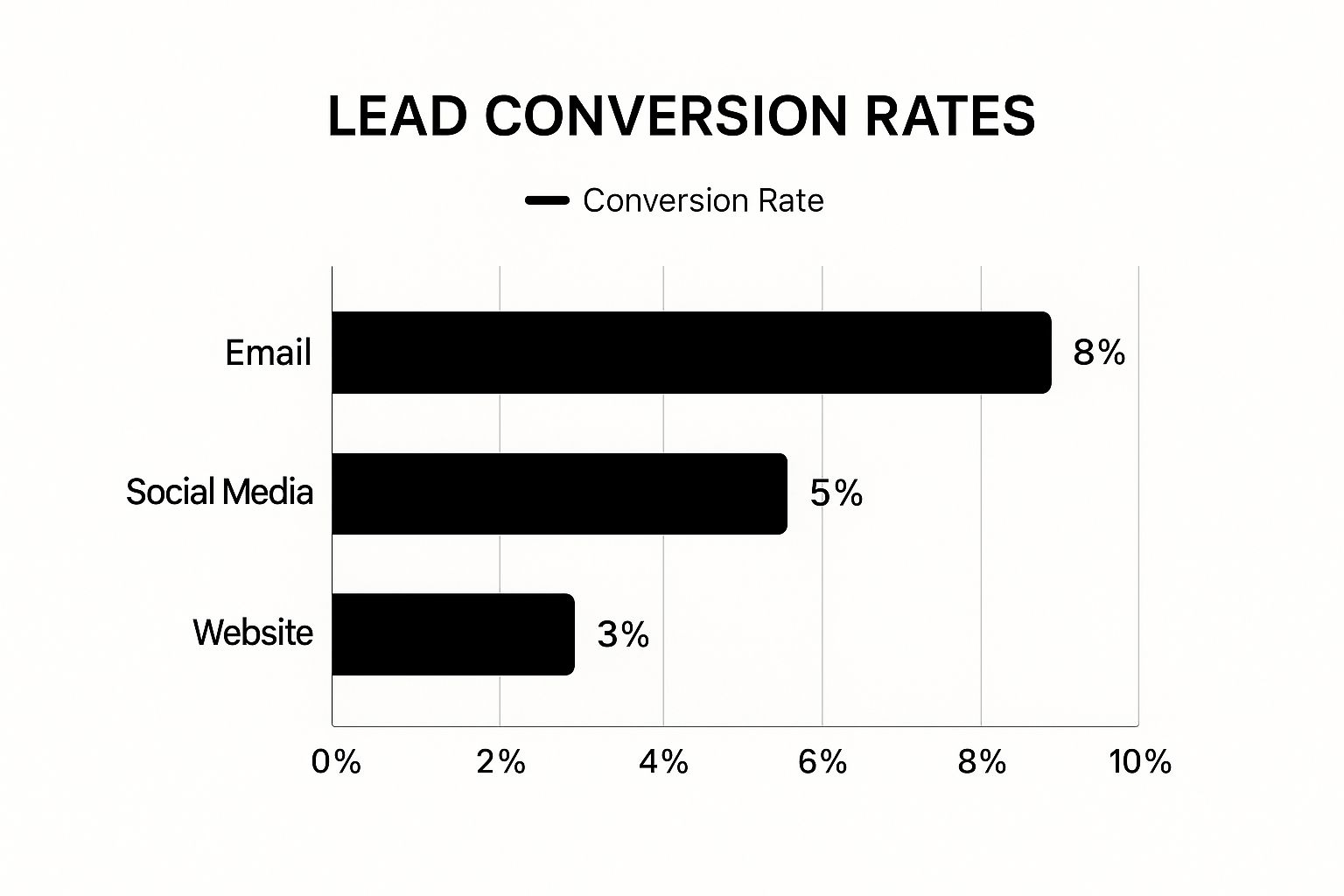
As the data shows, channels like email marketing often deliver higher conversion rates. This makes sense—you're usually engaging a warmer audience that has already opted in and shown interest.
The goal of nurturing isn't just to sell; it's to educate, build trust, and prove your value. When the time comes to buy, a well-nurtured lead will already see you as the obvious choice.
While this guide focuses on lead conversion, remember that many of the same principles apply to your website as a whole. You can dive deeper into proven website conversion rate improvement strategies to get more ideas.
Implement Intelligent Scheduling and Instant Engagement
The single most powerful strategy? Speed.
Engaging with leads the moment their interest peaks is an absolute game-changer. This is where modern scheduling tools that allow for instant booking become indispensable. By letting high-intent prospects book a meeting directly on a sales rep's calendar, you eliminate the back-and-forth delays that kill deals.
These tools can even intelligently route leads to the right person based on territory or team availability, ensuring no opportunity ever slips through the cracks. This direct path from interest to conversation is crucial for boosting your lead-to-sale conversion rate.
The methods marketers use to turn leads into customers are constantly evolving. Based on recent industry surveys, here’s a look at the most popular tactics currently in use.
| Lead Conversion Methods by Popularity | | :--- | :--- | | Conversion Method | Percentage of Marketers Using It | | Email Marketing & Nurturing | 81% | | Content Marketing (Blogs, Guides) | 75% | | Social Media Engagement | 64% | | SEO and Organic Search | 61% | | Webinars and Virtual Events | 49% | | Retargeting Ads | 45% | | Live Chat & Chatbots | 38% |
This data confirms that a multi-pronged approach, led by personalized communication like email and valuable content, is what the pros rely on. The rise of automation and AI is only making these strategies more powerful.
In fact, the global average eCommerce conversion rate has hit 3.34%, with much of that growth credited to AI-driven personalization and better mobile experiences. A striking 68% of CRO professionals now use AI tools, reporting an average 23% lift in conversions by tailoring content to individual users.
Benchmarking Your Performance Against Industry Standards

Once you’ve got a firm grasp on your own numbers, the natural next question is, "So... how are we doing?" Benchmarking your lead conversion rate against industry standards is how you get the answer. It gives you crucial context, helping you figure out if your performance is strong or if there’s a massive opportunity staring you in the face.
Think of it like checking your car's fuel efficiency. Knowing you get 25 miles per gallon is useful information. But knowing the average for your car model is 35 MPG? That tells you there might be an issue worth looking into. Industry benchmarks are the exact same thing for your sales and marketing engine. They aren't a rigid scorecard; they're a diagnostic tool.
Finding The Right Context
You wouldn't compare apples to oranges, right? Well, comparing your B2B SaaS company to an eCommerce apparel brand is just as pointless. A complex, high-value B2B sale with a six-month cycle is going to have a completely different conversion dynamic than a $20 t-shirt impulse buy.
To get a clear picture, you need benchmarks that actually mirror your business reality.
For instance, the overall average website traffic-to-lead conversion rate is around 2.9%. But watch how dramatically that number shifts when you slice it by industry:
- Pest Control: A high 3.7%, largely because the customer need is urgent.
- Manufacturing: Converts at 3.1%, as buyers often have a clear idea of what they need.
- B2B SaaS: Averages around 2.5%, reflecting a more considered, longer purchase decision.
- Healthcare: Sits lower at 2.1%, often due to complex regulations and compliance hurdles.
These numbers prove why context is king. A 2.5% rate could be fantastic for a healthcare tech company, but it might signal some serious room for improvement in the manufacturing space. A great way to get your bearings is to explore what experts consider good sales conversion rate benchmarks for a wider view.
Benchmarks aren't there to judge your performance. They’re a starting point for asking smarter questions, like: "Why is our rate different?" and "What can we learn from the top performers in our field?"
Using Benchmarks To Set Realistic Goals
The real power of benchmarking isn't just seeing where you stand—it's using that info to set realistic, high-impact goals. If your industry's average is 3% and you're stuck at 1%, aiming for 10% overnight is just a recipe for frustration.
A much smarter goal? First, hit 2%. Then, push for the industry average.
This data-informed approach helps you build a much smarter growth strategy. It gives you the ammo you need to justify investments in things like improving your inbound lead generation process or adopting new tools. When you understand the standard, you can build a clear, achievable path toward becoming a leader in your own right.
Alright, let's put what we've learned into action. Knowing the "what" and "why" behind lead conversion is one thing, but actually improving your numbers is where the real work begins. This isn't about finding a single magic bullet; it's about building a system of continuous improvement. Think of it as a loop, not a straight line.
The goal here is simple: turn more of your hard-won leads into happy, paying customers. We'll do this by systematically hunting down and eliminating friction points while making your value crystal clear at every step. This checklist will give you a structured way to get started.
The Continuous Improvement Checklist
This isn't a one-and-done task. It's a cycle. Get to the end, and then start right back at the beginning. Small, consistent tweaks are what lead to massive wins over time.
Map and Audit Your Funnel: First things first, you need to know exactly what your current process looks like. Whiteboard out every single step a lead takes, from the moment they land on your site to when a deal is signed. Where are the biggest leaks? Are leads ghosting you after filling out that super-long contact form? Is there a black hole of silence between a form submission and a sales rep's first email? Your CRM and analytics tools are your best friends for spotting these drop-off points.
Define and Track What Matters: Get crystal clear on what a "conversion" actually means for you. Is it a demo booked? A free trial sign-up? A signed contract? Whatever it is, make sure you can track it accurately. Set up a dedicated dashboard that shines a spotlight on your lead conversion rate. Make it visible to everyone on the marketing and sales teams so you're all chasing the same number.
Optimize the Make-or-Break Moments: Don't try to fix everything at once. Focus your efforts on the touchpoints that have the biggest impact. Start A/B testing the obvious stuff: your landing page headlines, the text on your call-to-action (CTA) buttons, and the number of fields in your forms. It might sound small, but changing a button from "Submit" to "Get My Free Quote" can make a world of difference.
Treat every part of your funnel as a hypothesis to be tested. The question isn't "Is this perfect?" but rather, "Can this be better?" Continuous, small improvements compound into major gains over time.
- Engage While the Iron Is Hot: If there’s one lever you can pull for immediate impact, it’s speed. The time it takes you to respond to a new lead can make or break the deal. Use tools like intelligent schedulers that let high-intent leads book a meeting instantly, right on your website. This completely cuts out the back-and-forth emails and connects your sales team with a hot prospect the second they're most interested.
By following this game plan, you're not just guessing anymore. You’re making smart, data-backed decisions that will consistently push your lead conversion rate up and to the right, fueling real, sustainable growth.
Of course, even when you have a solid handle on the basics, real-world questions always pop up. Let's tackle a few of the most common ones that teams run into when they start trying to nail their conversion rates.
What Is a Good Lead Conversion Rate?
This is the million-dollar question, isn't it? The honest answer is: it completely depends. A “good” lead conversion rate isn’t some universal number pulled from the sky. It’s tied directly to your industry, business model, and where your leads are coming from.
The overall average might be around 2.9%, but that’s just a blended number. Some industries, like professional services, can see rates as high as 4.6%. The best thing you can do is benchmark against your specific industry, but obsess over improving your own numbers.
Your most important competitor is your past performance. Aiming to continuously beat your own conversion rate month-over-month is the surest path to sustainable growth and a healthier sales pipeline.
Focusing on your own upward trend is a much better sign of success than chasing a generic average that might not even be relevant to your business.
How Can I Improve Lead Quality?
If you want better leads, it all starts with smarter marketing. You have to get hyper-specific. Stop casting a wide net and start creating targeted ad campaigns and content that speaks directly to your ideal customer's biggest headaches.
When you're crystal clear about who you help and what problem you solve, you naturally weed out the tire-kickers and poor-fit prospects from the get-go.
From there, a solid lead scoring system is non-negotiable. This is how you give your sales team a roadmap, pointing them directly to the prospects who are most engaged and ready to talk. By focusing their energy on the warmest opportunities, your overall conversion rate will naturally climb. It’s just common sense.
What Is the Best Time to Follow Up with a Lead?
Instantly. Or as close to instantly as humanly possible.
Study after study shows the same thing: your odds of converting a lead plummet after the first five minutes. A prospect’s interest is at its absolute peak the moment they hit "submit" on a form or request a demo. Every second you wait, that interest cools.
This is where automation tools are an absolute game-changer. But if you're still relying on manual follow-up, your team's number one priority has to be getting in touch with new leads within the first hour. You have to capitalize on that peak interest before it completely fades away.
Stop letting valuable, high-intent leads slip through the cracks. Distro automatically routes inbound leads to the right sales rep and gets meetings booked instantly, turning more demo requests into qualified pipeline. See how it works at https://distro.so.