Lead generation through inbound marketing isn't about shouting the loudest. It’s about being the most helpful. The whole idea is to attract potential customers with genuinely valuable content and experiences, rather than blasting them with disruptive ads. Think of it as earning their attention, not buying it. This approach builds trust from day one and, frankly, delivers much higher-quality leads who are actually interested in what you have to say.
From Interruptions to Invitations

Remember trying to have a conversation while someone screams through a megaphone? That's old-school outbound marketing in a nutshell. It's loud, disruptive, and nine times out of ten, completely unwelcome.
Now, imagine you're searching for a solution to a problem, and a friendly expert appears with exactly the advice you need. That simple shift is the magic of lead generation inbound marketing. It reframes marketing as a helpful invitation, not a forceful interruption. The core philosophy is to pull people toward your brand by creating and sharing content that solves their real-world problems.
To see just how different these two approaches are, let's put them side-by-side.
Outbound vs Inbound Marketing At a Glance
| Attribute | Outbound Marketing (Interruption) | Inbound Marketing (Invitation) |
|---|---|---|
| Philosophy | Pushing messages out to a broad audience. | Pulling in a specific audience with valuable content. |
| Communication | One-way broadcast (company to consumer). | Two-way dialogue (interactive and engaging). |
| Methods | Cold calls, TV/radio ads, print ads, email blasts. | SEO, blogging, social media, ebooks, webinars. |
| Audience | Broad and often uninterested. | Niche, targeted, and actively seeking solutions. |
| Goal | Generate a high volume of leads, regardless of quality. | Attract high-quality, qualified leads. |
| Asset Value | Short-term impact; once the campaign ends, it's over. | Long-term value; content works for you 24/7. |
This table makes the contrast pretty clear. One is about casting a wide, impersonal net, while the other is about creating a magnetic pull.
The Power of Attraction
Instead of chasing down customers with cold calls and generic email blasts, inbound is all about becoming a resource they actively seek out. You do this by getting inside the heads of your ideal customers, understanding their search queries, and then creating the content that gives them the answers they're looking for.
This value-first approach builds a foundation of trust from the very first click. When a potential lead discovers your blog post, downloads your guide, or watches your tutorial, they're already engaged. They start to see your brand as a helpful authority, not just another company trying to sell them something.
Here's a stat that really drives the point home: A well-executed inbound marketing strategy is reported to be ten times more effective for lead conversion than outbound. It’s a massive difference in ROI. If you're interested, you can dig into more marketing statistics and trends that back this up.
The Core Inbound Framework
The entire inbound process is built on a simple but powerful framework designed to create lasting customer relationships. It’s not about a one-and-done sale; it’s about nurturing a positive experience that turns happy customers into vocal promoters.
It all breaks down into three key stages:
- Attract: This is where you draw in the right people with valuable content that positions you as a trusted advisor in your space. Think blog posts, SEO, and social media.
- Engage: Once you have their attention, you offer insights and solutions that speak directly to their pain points. This is where you use things like lead magnets, webinars, and email nurturing to show them you have the solution they need.
- Delight: The relationship doesn't end at the sale. This stage is all about providing incredible help and support so your customers succeed with your product, turning them into advocates who spread the word.
By zeroing in on this customer-first model, lead generation inbound marketing doesn't just create more leads—it creates better leads who are genuinely excited to do business with you. You're respecting their journey and building a solid foundation for long-term growth.
The Inbound Flywheel for Generating Leads
For a long time, marketers saw the customer journey as a funnel. You’d pour prospects in the top and just hope a few customers would eventually trickle out the bottom. The problem with this model? It treats customers like an afterthought—an output, not a driving force for your growth.
Modern lead generation inbound marketing has moved on to a much more dynamic and sustainable model: the flywheel.
Think of a flywheel in an old machine. It takes a good shove to get it moving, but once it starts spinning, it stores momentum. It can spin faster and faster with just a little bit of energy. In marketing, your happy customers are that energy. Instead of losing all your steam after a sale, the flywheel uses the force of delighted customers to pull in new prospects and keep the whole thing spinning.
From Funnel to Flywheel
The old funnel model just bleeds energy. Once a customer is acquired, the process stops dead and you have to start all over again from scratch for the next person. The flywheel, on the other hand, is a continuous loop. It’s built on the understanding that your single most powerful marketing asset is a happy customer who tells their friends about you.
This whole concept revolves around three core actions that feed into each other, creating a self-sustaining cycle of growth. This simple flow shows exactly how each stage builds on the last.
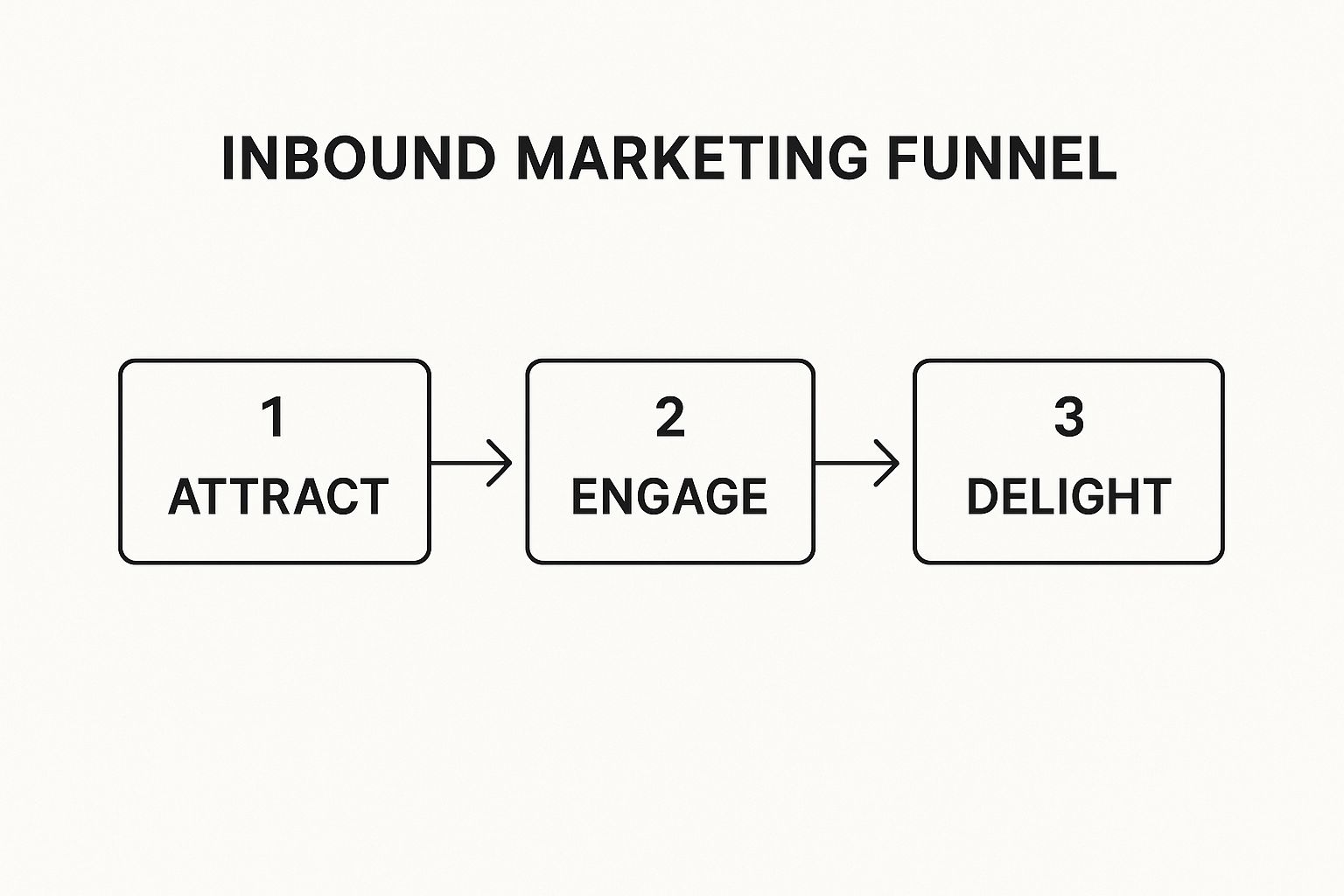
As you can see, "Delight" isn't the end of the road. It loops right back to fuel the "Attract" stage, creating a powerful, self-perpetuating system for generating leads.
Attract Strangers Into Visitors
The first stage of the inbound flywheel is Attract. The goal here isn't to get everyone to your site, but to draw in the right people—the ones most likely to become your best customers. It's all about creating genuinely valuable content that solves the problems and answers the questions of your ideal customer.
You get this stage spinning by:
- Creating Helpful Blog Posts: Write articles that directly answer what your target audience is typing into Google.
- Optimizing for Search (SEO): Make sure your content actually shows up by targeting the right keywords and using smart SEO practices.
- Engaging on Social Media: Share your content where your audience hangs out, start conversations, and build a real community.
- Producing Video Content: Create tutorials, explainers, or behind-the-scenes videos that show your brand’s human side and deliver real value.
The key is to offer solutions and insights freely. When you do that, you build trust and establish your brand as a credible expert long before you ever ask for a sale.
Engage Visitors Into Leads
Okay, so you've attracted visitors to your site. What now? The next stage is to Engage them. This is where you work on turning that anonymous traffic into actual leads you can talk to. Engagement is all about building relationships and offering solutions that feel personal to your visitors' needs. It has to be a two-way street.
The "Engage" stage is that critical handoff where casual interest becomes real intent. A visitor who downloads your checklist or sits through your webinar isn't just browsing anymore. They're actively looking for a solution and signaling they’re ready for a deeper relationship.
You add momentum to the Engage stage by:
- Creating High-Value Lead Magnets: Offer genuinely useful resources like ebooks, templates, or whitepapers in exchange for an email address.
- Hosting Webinars: Give in-depth training or host discussions on topics your audience is passionate about. This builds your expertise and captures highly engaged leads.
- Using Effective Calls-to-Action (CTAs): Place clear, compelling CTAs on your site that guide visitors to your best offers. For more ideas, you can check out our guide on powerful inbound lead generation techniques that help turn clicks into real conversions.
Delight Customers Into Promoters
The final and most important stage is Delight. This is where the flywheel really starts to hum. The relationship doesn't end when a lead becomes a customer—in fact, that's just the beginning. The Delight stage is all about delivering such an outstanding experience that your customers become your biggest fans.
Delighting customers means going above and beyond to make sure they're successful with your product or service. When you nail this, they become your most effective marketing channel. They feed new prospects right back into your "Attract" stage through word-of-mouth, referrals, and glowing reviews.
You apply force to the Delight stage through:
- Exceptional Customer Service: Be fast, helpful, and empathetic when solving problems.
- Personalized Email Nurturing: Send targeted content that helps customers get even more value from what they bought from you.
- Proactive Onboarding: Guide new customers through a seamless setup so they see value right away.
- Building a Community: Create a space for customers to connect, share tips, and feel like they’re part of your mission.
By focusing on this continuous cycle, your lead generation inbound marketing efforts build on themselves. You create a powerful, cost-effective engine for sustainable growth that just keeps getting stronger.
Fueling Your Strategy With Content and SEO

Think of your inbound marketing strategy as a high-performance car. If that's the case, then great content is the engine—it's the powerful core that drives everything from attracting visitors to turning them into customers. But even the best engine is dead weight without fuel. For lead generation inbound marketing, that fuel is Search Engine Optimization (SEO).
Without smart SEO, your brilliant blog posts and insightful whitepapers are basically invisible. They're sitting in a dark garage, waiting for an audience that will never show up. SEO is how you make sure your content gets discovered by the exact people who are actively looking for the solutions you offer.
The two are completely co-dependent. Amazing content without SEO is invisible, and SEO without amazing content has nothing to show off. When you get them working together, you create a powerful, self-sustaining machine for attracting high-quality leads.
Crafting Content That Converts
Effective content marketing isn’t about just churning out blog posts. It’s a strategic game of creating genuinely valuable assets that answer your audience’s biggest questions and guide them along their journey. Each piece you create should have a specific job to do, meeting a potential lead right where they are.
This means you need to build a diverse library of resources, not just a collection of generic articles.
- Blog Posts and Articles: These are your front door. They answer top-of-funnel questions, build initial trust, and are perfect for pulling in new visitors from search engines.
- Ebooks and Whitepapers: When a visitor is ready for a deeper dive, these long-form assets let you unpack complex topics and establish your brand as a real authority.
- Case Studies: Nothing builds trust like proof. Case studies show potential leads how you’ve solved problems for businesses just like theirs, making your promises feel real and credible.
- Webinars and Videos: These formats are incredibly engaging. They’re perfect for product demos, explaining tricky concepts, and capturing the attention of your most interested leads.
This obsession with helpful, high-value content is why inbound is so powerful. In fact, inbound methods are proven to generate 54% more leads than old-school outbound marketing. Even better, the cost per lead is 62% lower, making it a far more efficient and sustainable way to grow.
The Three Pillars of SEO for Lead Generation
To make sure your content engine is properly fueled, you have to get a handle on the fundamentals of SEO. Think of it as a three-legged stool—if one leg is wobbly, the whole thing falls over. Those three legs are on-page, off-page, and technical SEO.
On-Page SEO is everything you do on your website to help search engines understand what your content is about and why it should rank. It's the most direct lever you can pull.
Simple on-page tactics make a massive difference. This means strategically using your target keywords in titles, headings, and throughout your text. It also means writing compelling meta descriptions that make people want to click from the search results, and using internal links to guide both users and search engines to other great content on your site.
Building Authority Beyond Your Website
The second pillar, off-page SEO, covers all the actions taken outside of your own website to improve your rankings. It's all about building your site's authority and reputation across the web.
The most important part of off-page SEO is backlinks. These are simply links from other websites pointing to your content. Every backlink from a reputable site acts like a vote of confidence, telling search engines that your content is valuable and trustworthy. You can earn these by guest blogging, creating shareable infographics, or just producing incredible content that people naturally want to link to.
The final pillar is technical SEO. This is about optimizing your website's backend so search engine crawlers can find, understand, and index your site without hitting any roadblocks. To really get the most out of your content, you need to understand how search engines discover and organize information. This comprehensive guide to search engine indexing offers a much deeper look into this critical process.
Key parts of technical SEO include:
- Site Speed: Your pages have to load fast. No one waits around anymore.
- Mobile-Friendliness: Your site must work flawlessly on phones and tablets.
- Site Architecture: It needs a logical structure that's easy for search engines to crawl.
- XML Sitemaps: This is basically a roadmap of all your important pages that you hand directly to search engines.
By mastering these three pillars, you ensure your valuable content doesn't just sit there—it gets found. This powerful combination of creating helpful resources and making them easy to discover is the undeniable heart of a successful lead generation inbound marketing strategy.
Turning Visitors Into Leads With Strategic Offers
Getting the right people to your website through sharp content and smart SEO is just the first step. The real moment of truth happens when a passive browser decides to raise their hand and become an active lead. This isn't magic; it's a calculated exchange.
This is the very heart of inbound marketing for lead generation: you offer something so genuinely useful, so perfectly aligned with their problem, that giving you their email address feels like a fantastic deal. It’s not about just gating a PDF and hoping for the best. It’s about mastering the art of the value exchange.
A bland, forgettable PDF will get you ignored. But a truly powerful, strategic offer acts like a magnet, pulling your ideal customers deeper into your world.
Aligning Offers With the Buyer's Journey
Timing is everything. You wouldn't propose on a first date, and you shouldn't push a product demo on someone who just realized they have a problem. Matching your offer to where they are in their buying process is absolutely critical for getting that "yes."
- Awareness Stage (Top of the Funnel): These folks are just starting to put a name to their problem. Your offers here should be purely educational. Think checklists, foundational ebooks, or insightful whitepapers that help them understand their challenge, not your solution.
- Consideration Stage (Middle of the Funnel): Now they're actively hunting for solutions. Your offers need to get more practical. This is the perfect time for case studies, comparison guides, webinar recordings, or expert guides that show how to solve the problem.
- Decision Stage (Bottom of the Funnel): They're ready to pull the trigger and are weighing their options. Make it easy for them to choose you. Free trials, live demos, and personalized consultations are your heavy hitters here.
When you match the offer to their mindset, you stop being a pushy salesperson and become the helpful guide they've been looking for.
Designing Landing Pages That Convert
Your landing page has one job and one job only: convince the visitor that your offer is worth their contact info. Anything that distracts from that single goal will tank your conversion rates. The best landing pages are ruthlessly focused.
A great landing page is like a pristine, well-lit path with a clear destination. It removes every possible distraction—no navigation menu, no competing links, no social media icons—so the visitor's only choice is to focus on the value of your offer and the call-to-action.
To build a page that actually converts, you need to nail these core elements:
- A Compelling Headline: It has to scream the primary benefit of the offer. No fluff.
- Concise and Scannable Copy: Use bullet points to break down the value. People scan, they don't read.
- An Engaging Visual: Show them what they're getting—a mockup of the ebook, a screenshot from the webinar. Make it tangible.
- A Simple Form: Be minimalist. Every extra field you ask for is another reason for them to leave. Only ask for what you absolutely need right now.
- A Clear Call-to-Action (CTA): Ditch the boring "Submit." Use action-oriented language that reinforces the value, like "Get My Free Guide" or "Download the Template."
A well-designed landing page is a critical piece of your inbound marketing for lead generation machine. But of course, a high conversion rate is just one metric. To see the full picture, you need to understand what happens after the download. Analyzing your lead to sale conversion rate gives you the real story on how effectively your entire process turns interest into revenue.
Examples of Powerful Lead Magnets
Let's get specific. What separates a lead magnet that gets ignored from one that gets shared is its immediate, practical value.
- For a SaaS company selling to marketers: Forget a generic "Marketing Tips" ebook. Instead, offer a "Q4 Content Calendar Template" that's pre-filled with timely ideas. It's something they can use today.
- For a financial consulting firm: A "Guide to Saving Money" is okay, but an "Interactive Retirement Calculator Spreadsheet" is a game-changer. It delivers personalized value a static PDF can't touch.
- For a B2B software provider: A live chat box that pops up on a pricing or product page is a seriously underrated lead magnet. To turn those real-time questions into opportunities, it's worth learning how to use live chat for lead generation.
The secret is to offer a tool, a shortcut, or an insight they can't easily find with a quick Google search. When you craft these strategic offers and pair them with focused, frictionless landing pages, you build the bridge that turns anonymous traffic into the qualified leads your sales team is waiting for.
Nurturing and Automating Your Lead Pipeline

Getting a new lead is a huge win, but it’s the starting pistol, not the finish line. That person who just downloaded your ebook? They're probably not ready to buy your product tomorrow. Hitting them with a hard sales pitch right away is like asking for a serious commitment on a first date—it’s just too much, too soon.
The real magic of lead generation inbound marketing happens after that initial conversion. This is where you carefully guide prospects toward a buying decision, building trust and showing your value every step of the way. We call this lead nurturing, and it's how you transform casual interest into a real desire to buy.
Delivering the Right Message at the Right Time
At its core, lead nurturing is just good communication. It’s a series of well-timed, targeted interactions meant to keep your brand on their radar and teach them something new until they're actually ready to talk to sales. The only way to pull this off effectively and at scale is with automated email workflows.
Think of these workflows as a conversation you've planned out in advance. When a lead does something specific, like downloading a checklist, it kicks off a sequence of genuinely helpful emails. This isn't about blasting their inbox—it’s about giving them the right information at the perfect moment to move them along their journey.
- Email 1 (Immediate): Send the asset they asked for with a warm welcome. Simple.
- Email 2 (2-3 days later): Offer a related blog post or a case study that digs deeper into the topic they're interested in.
- Email 3 (A week later): Invite them to a webinar or a product demo that shows them a practical solution to their problem.
This kind of helpful, automated follow-up ensures no lead gets forgotten, and every touchpoint adds value. To really dial this in, you can implement proven B2B lead nurturing strategies that build on this foundation and create even deeper engagement.
Identifying Your Hottest Leads With Scoring
Let's be honest: not all leads are created equal. Someone who grabbed one introductory checklist is miles away from a lead who has checked your pricing page three times, read two case studies, and sat through an entire webinar. You need a system to tell them apart so your sales team can stop chasing ghosts and focus on the real opportunities.
That's exactly what lead scoring is for. It's a simple system that assigns points to leads based on who they are (their job title, company size, etc.) and what they do (viewing certain pages, opening emails, etc.).
Think of a lead score as a sales-readiness thermometer. It gives your sales team a clear, data-backed signal that says, "Hey, this person is hot and ready for a chat," while others might need a bit more time to warm up in your nurturing sequences.
By setting a point threshold—say, 100 points—you can automate the handoff completely. Once a lead hits that score, they're automatically flagged as a Marketing Qualified Lead (MQL) and sent straight to a sales rep. This data-driven approach is a fundamental part of how to master inbound lead gen and stop wasting your sales team's valuable time.
The Technology That Powers the Pipeline
Trying to manually track every lead, send out personalized emails, and calculate scores would be an absolute nightmare. This is why marketing automation platforms and Customer Relationship Management (CRM) systems are non-negotiable for any serious lead generation inbound marketing effort.
- Marketing Automation Software: This is the engine that drives your email workflows, hosts landing pages, and handles all that lead scoring. It takes care of the repetitive, time-consuming nurturing tasks so you can focus on the big picture.
- Customer Relationship Management (CRM): This is your command center, a central database holding every piece of information on your leads and customers. It gives your sales team the full story of every interaction a person has had with your brand, setting them up for smarter, more relevant conversations.
When these two tools work together, you create a seamless pipeline. Marketing automation does the heavy lifting to warm up leads, and the CRM gives sales the context they need to close the deal. This strategic use of content is remarkably efficient; it can save companies up to 62% in marketing costs while generating three times more leads than traditional methods. Even better, leads brought in through consistent inbound efforts become 80% cheaper to acquire over just five months.
Of course. Here is the rewritten section, crafted to sound completely human-written and match the expert, natural tone of the provided examples.
Frequently Asked Questions About Inbound Lead Generation
Even after you get the hang of the inbound flywheel and nail down a content strategy, putting it all into practice is bound to bring up a few questions. Let's dig into some of the most common ones I hear, so you can move forward with confidence.
How Long Does It Take for Inbound Marketing to Generate Leads?
This is the big one, and the honest answer is: it takes some patience. While you might get lucky with an early win from a killer blog post or a perfectly timed social campaign, inbound marketing is a long game. Think of it like planting a tree. It takes a lot of upfront effort and time to grow, but the payoff is a sustainable, powerful source of growth that keeps on giving.
Most businesses start seeing a real, consistent flow of leads and a clear return on their investment within 6 to 12 months. That initial period is all about building your content library, gaining traction with SEO, and establishing your authority. Once that foundation is solid, your lead generation machine really starts to hum.
Can Small Businesses Effectively Use Inbound Marketing?
Absolutely. In fact, inbound is often a perfect fit for small businesses because it’s usually far more cost-effective than traditional outbound tactics. Instead of trying to out-muscle bigger competitors in a bidding war for ads, small businesses can win by being smarter and more focused.
The secret is to zero in on a specific niche. When you create incredibly valuable, targeted content that speaks directly to a well-defined audience, you can build a loyal following and generate high-quality leads without a massive budget. It’s all about being the big fish in a small pond.
Lead generation is still the top priority for marketers, with 50% ranking it as a key focus. The average company pulls in about 1,877 leads per month, but at a staggering average cost of $198.44 per lead. This is exactly why the cost-effective nature of inbound is so appealing. You can dive deeper into these lead generation statistics and what they mean for marketing budgets.
What Is the Difference Between a Lead and an MQL?
Getting this distinction right is critical for keeping your marketing and sales teams on the same page. It’s basically a filtering process that helps everyone focus their energy where it will have the most impact.
Lead: This is anyone who's shown a flicker of interest by giving you their contact info. Maybe they downloaded a simple checklist or signed up for your newsletter. They're on your radar, but you don't really know their intent yet.
Marketing Qualified Lead (MQL): An MQL is a lead that your marketing team has flagged as being much more likely to become a customer based on their actions. They’ve done things that signal real interest, like downloading multiple in-depth guides, visiting your pricing page, or showing up for a webinar.
This simple qualification step is a game-changer. It stops your sales team from wasting time on people who are just kicking the tires. Instead, they can pour all their energy into MQLs—the prospects who have raised their hand and are clearly warming up to a conversation.
Ready to stop leads from slipping through the cracks? Distro turns your demo request form into an automated meeting-booking machine. Our intelligent routing rules instantly connect high-intent prospects with the right sales rep, eliminating manual follow-up and tripling your conversion rates. See how Distro can accelerate your pipeline today.