Let’s start with a simple idea: inbound lead generation is all about attracting customers to your brand with genuinely valuable content, instead of blasting them with ads. Think of it like a powerful magnet, pulling interested people toward you and creating a natural path for them to become high-quality leads.
Why Inbound Lead Gen Wins in Today's Market

Imagine trying to sell something by shouting through a megaphone in a crowded park. That's the old way—outbound marketing. Sure, you might catch a few ears, but most people will just tune you out.
Now, picture setting up a comfortable booth offering free, genuinely helpful advice about a problem your product solves. People who actually have that problem will seek you out. That’s the heart of inbound lead generation.
The Shift in Consumer Power
Let's be honest, today's buyers hold all the cards. They have instant access to information and have become masters at ignoring traditional advertising. Cold calls get an eye-roll, and most promotional emails go straight to spam. People don't want to be sold to; they want to solve their problems.
Inbound marketing focuses on creating quality content that pulls people toward your company and product, where they naturally want to be. Outbound marketing interrupts your audience with content they don’t always want.
This is the fundamental reason inbound lead gen is so effective. Instead of fighting for attention, you earn it by becoming a trusted resource. You're there with answers, guidance, and solutions when they need them most.
Building Trust Through Value
When a potential customer stumbles upon your blog post that solves a nagging issue, or downloads an ebook that walks them through a complex process, something important happens: a relationship begins. You've offered them real value without asking for anything in return, and that builds a foundation of trust.
This approach naturally creates a self-selecting audience. The people who engage with your content are already showing a genuine interest in what you do. This makes them infinitely more qualified than a name you bought off a list.
A smart inbound strategy always focuses on:
- Solving Problems First: Your primary goal isn't to sell; it's to be helpful. Sales become the natural outcome of the trust you build.
- Earning Attention: You create content so useful that people actively look for it and even share it with others.
- Creating High-Quality Leads: By attracting people with specific needs, the leads you generate are inherently more interested and way easier to convert.
Ultimately, inbound lead generation isn't just another marketing tactic; it's a customer-centric way of thinking. It aligns your entire business with how modern buyers actually think and behave, making it a much more sustainable and cost-effective way to grow. You stop chasing leads and start attracting customers who are already looking for you.
An effective inbound lead generation strategy isn't a one-off tactic. It’s a complete system built on four key stages. Think of it as the blueprint for guiding someone from a curious stranger all the way to a vocal brand advocate. It’s how you turn that initial spark of interest into genuine, lasting loyalty.
The whole thing works like a well-oiled machine, where each part smoothly feeds into the next. To build a program that brings in a steady stream of high-quality leads, you have to nail these four pillars: Attract, Convert, Close, and Delight.
Attract: The Right Audience
The first step is all about getting the right people to your digital doorstep. You're not just throwing a wide net and hoping for the best. Instead, you're creating and positioning content to pull in prospects who are already looking for the exact solutions you offer. The goal is to be seen as a helpful resource, not just another advertiser.
So, what does this look like in practice?
- Search Engine Optimization (SEO): This is foundational. You optimize your website and content to show up when your ideal customers type specific keywords into Google.
- Blogging: You create genuinely helpful articles that dig into your audience's biggest questions and pain points.
- Social Media: You hang out where your community does, sharing valuable stuff and actually building relationships, not just broadcasting ads.
Convert: Visitors Into Leads
Okay, so people are showing up. Great. Now what? The next job is to turn those anonymous visitors into actual leads. This is the moment of truth, where someone raises their hand and signals they're interested by giving you their contact info, usually an email address.
This conversion happens when you offer them something valuable in return. We’re talking about a fair trade. Think compelling offers and crystal-clear conversion paths. Things like landing pages with a single, focused call-to-action (CTA), downloadable ebooks or whitepapers, and webinar sign-ups are the classic tools for the job.
Close: Leads Into Customers
You’ve got a list of interested leads. Now the real work begins. The Close stage is all about nurturing those leads until they’re actually ready to buy. Let's be real—not everyone who downloads an ebook is ready to pull out their credit card that same day. This is where you build on that initial flicker of trust.
The heart of this stage is lead nurturing. By using targeted email marketing, a solid CRM, and marketing automation, you can deliver the right message at exactly the right time. You're gently guiding them down the path to a sale.
This focused communication is what bridges the gap between your marketing efforts and your sales team, making for a much smoother handoff when a lead is finally qualified and ready for a real conversation. A solid nurturing process can make a massive difference in your conversion rates.
The image below gives you a clear picture of how an inbound funnel works, showing the natural drop-off as a large pool of visitors gets refined into a smaller group of highly qualified leads.
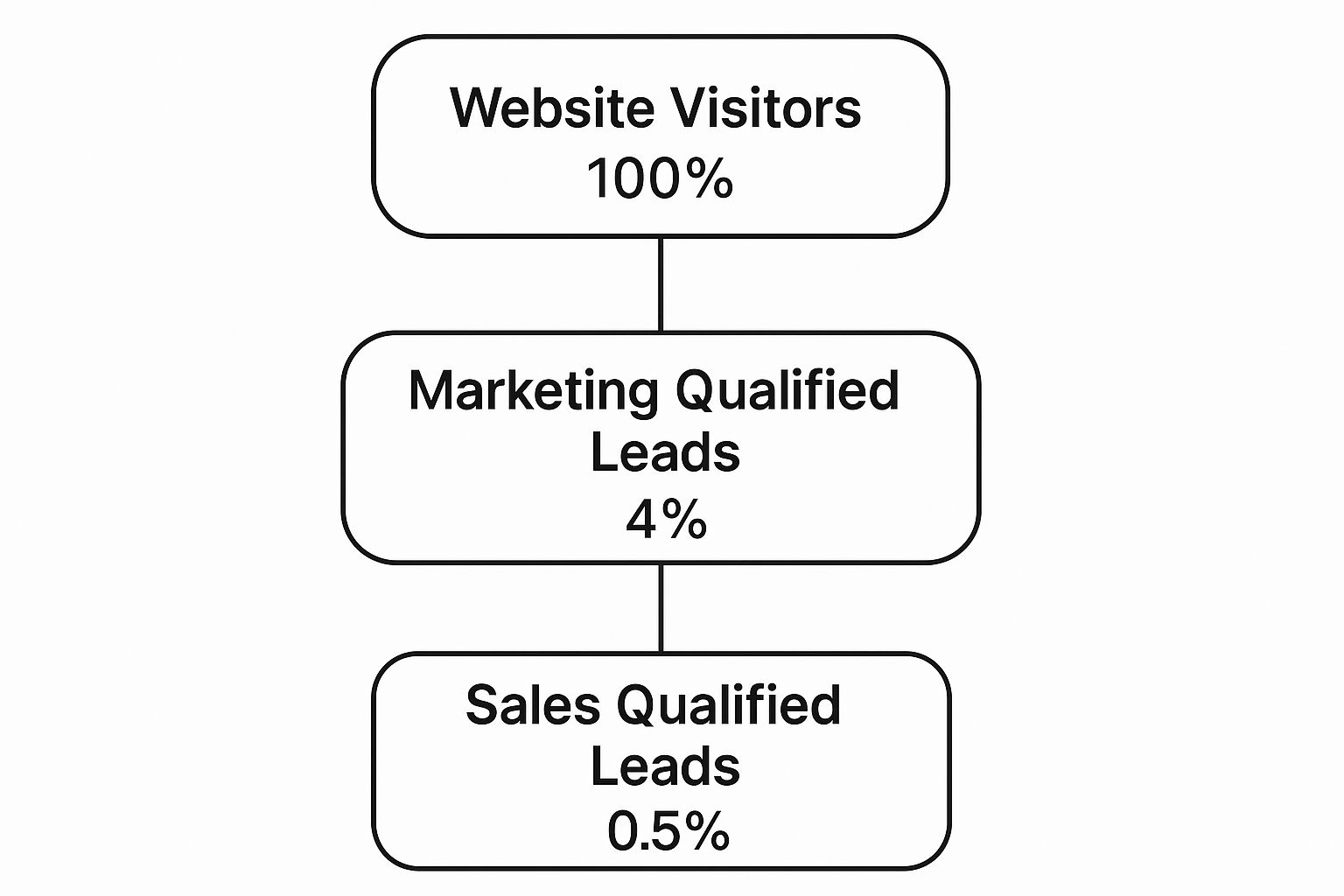
This visual really drives home how important it is to be efficient at every single step. You're trying to maximize that tiny percentage of visitors who will eventually become ready to talk to sales.
Delight: Customers Into Promoters
The journey isn't over when the deal is signed. The final pillar, Delight, is about creating such a standout experience after the sale that your customers become your biggest fans. They become promoters. These are the people who leave glowing reviews, refer new business, and generate the kind of social proof you just can't buy.
This is where incredible customer service and providing ongoing value shine. By continuing to support and engage your customers, you create a powerful flywheel. Your happy customer base actually starts to fuel your new growth. This brings the whole process full circle, turning your customers into your most effective marketing channel.
Building Your Inbound Engine From the Ground Up

Alright, let's move from theory to action. This is where a real inbound lead gen strategy comes to life. Building this "engine" isn't a shot in the dark; it's a deliberate process, kind of like building a house. You need a solid foundation and a clear blueprint. Each step logically builds on the one before it, creating a system that pulls in and qualifies potential customers on repeat.
The whole thing starts not with your product, but with your audience. You have to get inside their heads and understand who you're talking to before you can create anything that actually connects. Nail this first, and all your other efforts will hit their mark.
Define Your Ideal Customer Personas
Before you type a single word of copy, you need a crystal-clear picture of who you're writing for. An Ideal Customer Persona (ICP) is your North Star here. It’s a detailed, semi-fictional profile of your perfect customer, pieced together from real data and smart market research. This goes way beyond basic demographics.
Get specific. What are their job titles? What daily headaches are they dealing with? What are their career goals, and where do they hang out online for advice? Figure out what problems are keeping them up at night. Answering these questions gives your marketing a purpose and a personality. Without a persona, you’re just shouting into an empty room.
Conduct Smart Keyword Research
Once you know who you're after, the next move is to figure out what they’re looking for. Keyword research is all about uncovering the exact words and phrases your ideal customers are typing into Google when they're searching for answers.
This isn't about mindlessly stuffing keywords into your pages. The real magic is in understanding user intent—the "why" behind every search. Are they just gathering information? Comparing different tools? Or are they ready to pull out their credit card?
When your content matches their intent, you attract the right kind of traffic. For a deeper look at this, check out these 9 Smart Ways to Increase Organic Traffic to really give your efforts a boost.
Create and Distribute High-Value Content
With your personas and keywords locked in, it's time to create the fuel for your inbound engine: genuinely valuable content. This content needs to directly tackle the pain points and questions you've already identified. The most effective assets usually include:
- Blog Posts: These are the workhorses of content marketing. They're perfect for answering niche questions and ranking for those valuable long-tail keywords.
- Ebooks and Whitepapers: These are your gated, high-value assets. You offer a deep, comprehensive solution in exchange for a visitor's contact info. It's a fair trade.
- Case Studies: Nothing builds trust like social proof. Case studies show prospects how you've already helped people just like them solve the exact same problems.
A content calendar is your best friend here. It keeps you organized and ensures you're publishing consistently, which is key to building an audience that trusts you.
Design High-Converting Landing Pages
A landing page has one job and one job only: turn a visitor into a lead. It’s a laser-focused page, stripped of all distractions, built around a single offer—like an ebook download or a webinar sign-up. To be effective, your landing page needs a killer headline, copy that screams value, and a form that's simple to fill out.
Every piece of gated content needs its own dedicated landing page. This focused approach is a non-negotiable part of generating inbound leads because it removes all friction and points the user toward one specific action. That clarity is what makes your conversion rates climb.
Measuring What Matters for Inbound Growth
Running an inbound strategy without tracking the right metrics is a bit like driving blind. Sure, you're moving, but you have no idea if you're headed in the right direction or about to run out of gas.
To actually prove your work is valuable—and to make smarter decisions down the road—you have to track the right numbers. This means getting past the vanity metrics like social media likes and zeroing in on the KPIs that show the real health of your funnel. It's not just about collecting data; it's about turning that data into action. When you know your numbers, you can justify your budget, prove ROI, and keep tuning your inbound engine for better, more predictable results.
Let’s break down the metrics that truly matter.
Core Inbound Funnel Metrics
First things first, you need to know how good you are at turning website traffic into actual business opportunities. These initial metrics give you a bird's-eye view of your funnel's performance, quickly showing you where things are working and where they're breaking down.
- Visitor-to-Lead Conversion Rate: This is the absolute bedrock of inbound measurement. It tells you what percentage of your website visitors actually fill out a form and become a lead. If this rate is low, it’s a big red flag that something might be off with your offers, landing pages, or calls-to-action.
- Lead-to-Customer Conversion Rate: This one tracks how many of your hard-earned leads go on to become paying customers. It’s a direct reflection of your lead quality and how effective your sales and nurturing processes are. If this number is low, it could point to a disconnect between your marketing and sales teams.
The goal is to understand the complete journey. Simply attracting traffic isn't enough. You must diagnose how efficiently that traffic moves through each stage, from anonymous visitor to delighted customer.
Getting a handle on this data is critical, especially when you consider the sheer volume of interactions. On average, organizations generate around 1,877 leads per month, and the global average cost per lead is nearly $198. And since 97% of people ignore cold calls, a finely-tuned inbound funnel that delivers high-quality, cost-effective leads is more essential than ever. You can explore more lead generation statistics on ExplodingTopics.com.
Unpacking Your Cost and ROI
Beyond just conversion rates, you have to get a grip on the financial side of your inbound efforts. This is what connects your marketing activities directly to revenue—the thing your leadership team really cares about.
Cost Per Lead (CPL) is a simple but incredibly powerful metric. Just divide your total marketing spend by the number of new leads you generated in a given period. It tells you exactly what it costs to get one new lead in the door.
From there, you have Customer Acquisition Cost (CAC), which takes it a step further. This measures the total cost to acquire a new customer, factoring in all sales and marketing expenses. Comparing your CAC to the Lifetime Value (LTV) of a customer is the ultimate test of a profitable business model. A healthy business will always, always have an LTV that's significantly higher than its CAC.
Scaling Your Strategy With Tech and Automation
Trying to manage a growing inbound lead program by hand is a fast track to burnout. As the leads start pouring in, you’ll find it’s nearly impossible to track every interaction, personalize your follow-ups, and make sure every hot lead gets to sales on time.
This is the point where technology and automation stop being a “nice-to-have” and become absolutely essential.
Think of your tech stack as the central nervous system for your entire inbound strategy. It’s what connects all the moving parts, takes repetitive tasks off your plate, and gives you the data you need to make smart decisions. Without it, you’re just creating inefficiencies and letting good leads slip through the cracks.
Automating the Nurturing Process
Marketing automation platforms like HubSpot or Marketo are complete game-changers for scaling your efforts. These tools let you build out sophisticated, automated email sequences that nurture leads based on their behavior, not a rigid schedule.
Instead of your team manually sending one-off emails, you can deliver the right content at just the right moment.
For example, a new lead downloads an introductory ebook. That action can automatically trigger a series of helpful emails with related blog posts and case studies, eventually leading to an invitation for a demo. This guarantees every lead gets a consistent, personalized experience that gently guides them down the funnel—all without overwhelming your team.
A well-integrated tech stack is the key to scaling your inbound program successfully. It empowers your team to manage complex workflows efficiently, ensuring no lead ever gets lost.
And this automation goes way beyond just email. To really streamline things, consider how a dedicated lead generation chatbot can engage visitors on your website 24/7, ask the right qualifying questions, and even book meetings for your sales team while they sleep.
The CRM as Your Single Source of Truth
The most critical piece of your tech puzzle is the Customer Relationship Management (CRM) system. It needs to be the single source of truth for every single interaction a lead has with your company.
Every email they open, every page they visit, every form they fill out—it all gets logged in one central place.
Having this complete, unified view of each lead is vital for a few big reasons:
- Sales and Marketing Alignment: When both teams are looking at the same data, the handoff from marketing to sales becomes seamless. No more confusion or crossed wires.
- Deep Personalization: Your sales reps can see a lead’s entire history at a glance. This allows for highly relevant and informed conversations, not generic sales pitches.
- Accurate Reporting: With all your data in one spot, you can finally track the ROI of your inbound efforts accurately and see what's truly working.
Ultimately, automation and a solid CRM help you handle a much higher volume of leads with far less manual effort. This frees up your team to focus on what they do best: building relationships and closing deals.
You can learn more about the differences between prospects you attract versus those you chase by reading our guide on inbound leads vs outbound leads.
The Future of Inbound Lead Gen With AI
The world of inbound lead generation is making a big shift. We're moving away from a reactive model and toward a proactive one, with Artificial Intelligence (AI) clearing the path. This isn't about robots taking over; it's about giving your team a serious upgrade—letting them anticipate what a customer needs, sometimes even before the customer knows it themselves.
The key to this whole evolution is sitting right under your nose: your own company data. Most businesses have mountains of it but rarely tap into its true potential. This internal information is a goldmine for creating deeply segmented and hyper-personalized experiences that go way beyond basic demographics. AI can dig through all that data to spot the subtle behavioral patterns and high-intent signals that a human would likely miss.
The global market for lead generation solutions hit $3.1 billion in 2021 and is expected to skyrocket to $15.5 billion by 2031. But get this: a whopping 87% of marketers say their company's data is a massively underused resource. You can check out the full findings on lead generation trends at UpLead to see just how big this opportunity is.
Predictive Analytics and Intelligent Scoring
One of the most powerful ways AI is shaking up inbound lead gen is through predictive lead scoring. Old-school scoring models look backward, tallying up past actions like whether a prospect downloaded an ebook. AI-powered models do that and more—they forecast what a prospect is likely to do next.
Predictive analytics can chew through thousands of data points, everything from website engagement to firmographic details, to calculate the odds of a lead actually converting. This gives sales teams a crystal-clear roadmap for where to focus their energy, zeroing in on prospects who are statistically primed to close. It’s almost like having a crystal ball for your sales pipeline.
Imagine an AI system flags that leads from a certain industry who check out your pricing page right after reading a case study are 90% more likely to book a demo in the next 48 hours. That's a game-changer. It’s the perfect signal for your sales team to reach out at the exact right moment.
This kind of proactive engagement is completely changing the customer experience. If you want to see what's on the horizon, it's worth digging into discussions on how generative AI is transforming sales journeys. The future of inbound isn’t just about getting leads in the door; it's about understanding them and anticipating their very next move.
Of course. Here is the rewritten section, crafted to match the human, expert-led style of the provided examples.
Answering Your Top Inbound Lead Gen Questions
Even with a clear strategy, actually getting started with inbound lead generation always brings up a few practical, "what-if" questions. Let's tackle the big ones I hear all the time so you can move forward with confidence.
Most people first want to know how long it takes to see real results. Unlike paid ads, which can give you an instant (but fleeting) traffic spike, inbound is a long game. I always tell people to think of it like planting a garden—it needs consistent effort and time to grow. Generally, you can expect to see real, meaningful traction in three to six months as your content gets indexed by search engines and starts pulling in organic traffic.
That timeline, of course, depends entirely on how consistently you're publishing high-quality stuff.
How Should I Budget for Inbound Marketing?
Your inbound budget will look pretty different from a traditional ad spend. Instead of a massive upfront cost, the investment is spread out over time. It typically covers content creation (writing, design, video), the software you'll need (like a CRM and marketing automation platform), and any people costs, whether that's in-house staff or an agency.
A great way to frame this is to work backward from the value of a new customer. If landing one customer is worth $5,000 to your business, how much does it make sense to invest to acquire them? This question shifts the conversation from cost to investment.
The best inbound programs don't see their budget as a cost center. They treat it as a direct investment in a revenue-generating asset—their content library and the trust they're building with their audience.
How Do We Align Sales and Marketing?
This is the big one. This is where so many inbound strategies completely fall apart. If sales and marketing aren't on the same page, you're just creating friction. The absolute key is to establish a shared, crystal-clear definition of what a qualified lead actually is.
The best way to do this is with a Service Level Agreement (SLA). This isn't just corporate paperwork; it's a mutual pact that outlines:
- Marketing's role: The specific volume and quality of leads they commit to delivering every month.
- Sales' role: The exact speed and process they'll use to follow up on those marketing-qualified leads.
This shared accountability creates a seamless handoff. Marketing knows they're generating the right kind of opportunities, and sales knows they have a system to work them efficiently. Suddenly, you have one unified team focused on the only thing that matters: growing revenue.
Ready to stop letting high-intent leads slip through the cracks? Distro helps you convert more inbound leads by instantly routing them to the right sales rep's calendar. See how you can triple your demo conversion rates.