
Let's start by getting on the same page. A lead conversion rate is simply the percentage of your leads who actually end up becoming paying customers. Think of it as a crucial health check for your entire sales and marketing operation. It tells you, in no uncertain terms, how good you are at turning a flicker of interest into real, tangible revenue.
What Are Lead Conversion Rates And Why They Matter

Before you can even think about improving your numbers, you have to understand them. Your lead conversion rate isn't just a vanity metric; it’s a direct reflection of how efficient your funnel is and, frankly, the quality of leads you're attracting in the first place. Without this baseline, you’re flying blind and likely bleeding money from leaks in your sales process you can't even see.
Calculating it is pretty straightforward. Here’s the formula we all use:
(Total Number of New Customers ÷ Total Number of Leads) x 100 = Lead Conversion Rate %
So, if you pulled in 500 leads last quarter and 25 of them signed on the dotted line, your conversion rate is 5%. Simple, right? This gives you a clear performance benchmark to work from.
The Nuances of Lead Qualification
But here's where it gets a little more interesting. Not all leads are created equal. To get a truly useful picture of your performance, you need to break down how leads move through your pipeline.
- Leads: This is your widest net. Anyone who has shown a spark of interest—maybe they downloaded an ebook or filled out a basic "contact us" form.
- Marketing Qualified Leads (MQLs): These are leads your marketing team has flagged as being more likely to buy. They've shown deeper engagement, like attending a webinar or repeatedly visiting your pricing page.
- Sales Qualified Leads (SQLs): These are the MQLs that your sales team has reviewed and agreed are ready for a direct sales conversation. They're legit opportunities.
By analyzing the conversion rates between these stages (Lead to MQL, MQL to SQL, and SQL to Customer), you can pinpoint exactly where things are breaking down. For instance, a ton of MQLs but a measly SQL rate often points to a serious disconnect between what marketing is promising and what sales actually needs to close a deal. For a deeper dive, you can check out our detailed guide on the lead conversion rate journey.
What Is a Good Lead Conversion Rate?
This is the million-dollar question, and the answer is... it depends. What's "good" is heavily influenced by your industry, business model, and even where your leads are coming from.
Still, having some benchmarks helps you know if you're in the right ballpark. Globally, the average lead conversion rate hovers around 2.9%, but that number can be misleading because it varies so much. If you're serious about growing revenue, it's critical to learn how to increase sales conversion with tactics that fit your specific market.
To give you some context, here's a quick look at how different industries stack up based on recent data.
Lead Conversion Rate Benchmarks by Industry
This table offers a snapshot of average lead conversion rates. See how your numbers compare.
| Industry | Average Lead Conversion Rate |
|---|---|
| Professional & Financial Services | 4.6% |
| Healthcare | 3.1% |
| B2B SaaS | 2.5% |
| B2C & E-commerce | 1.8% |
As you can see, the numbers are all over the place. Professional services might hit 4.6%, while a competitive e-commerce business might feel great about 1.8%. The key takeaway is that knowing where you stand is the first step toward setting realistic goals that will actually move the needle for your business.
Find the Leaks: How to Run a Full-Funnel Audit
A low lead conversion rate isn't the root problem. It's a symptom. The real issue is almost always a leak somewhere in your marketing and sales funnel, and to fix it, you have to find it first. This means going beyond a single metric and digging into every stage of your prospect's journey.
Think of it like being a plumber. You need to map the entire path from the first touchpoint to the final sale, following the flow to find the cracks. Every handoff point is a potential place where pressure drops and leads trickle out.
This is the basic flow most companies follow, from website traffic all the way to a closed deal.
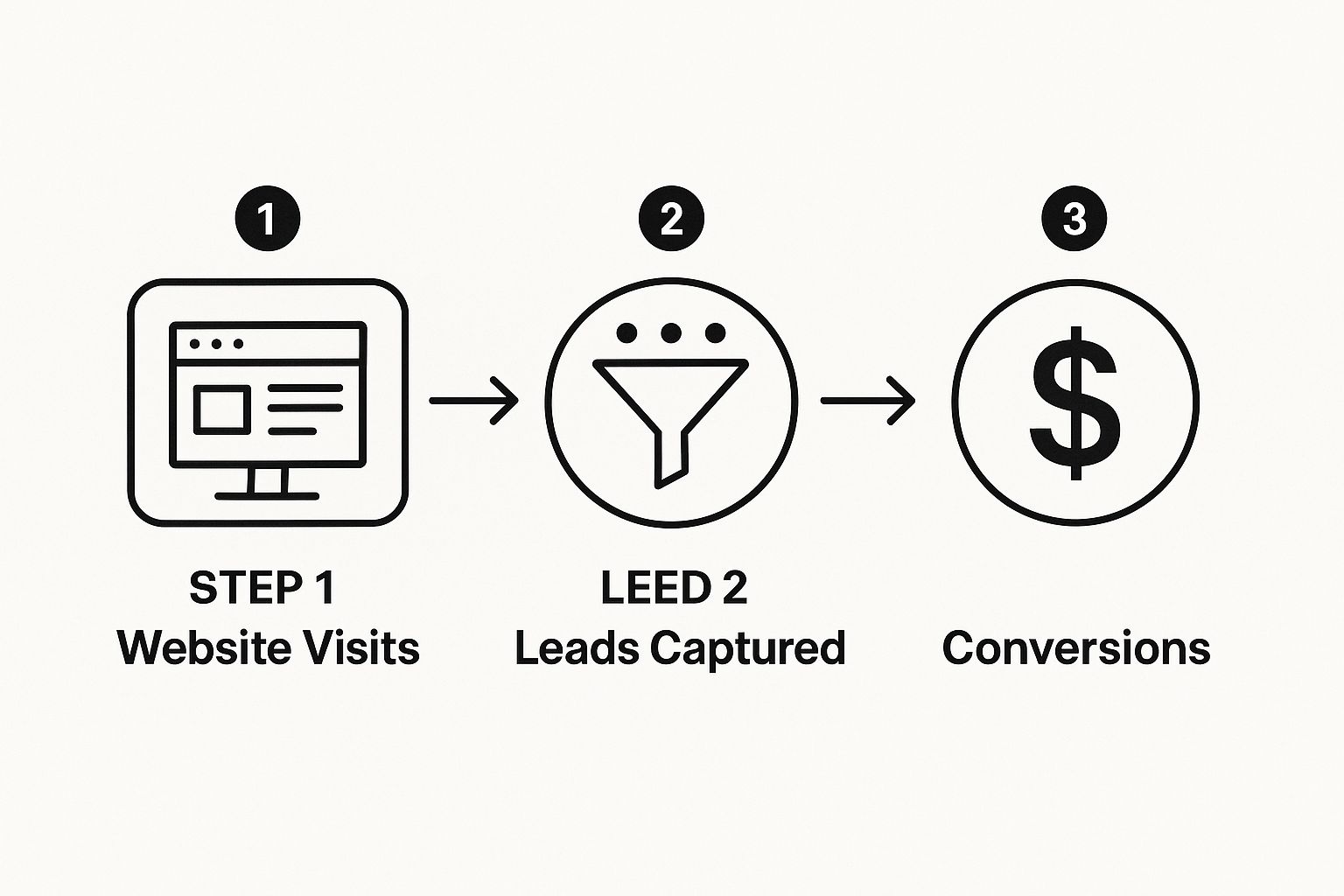
Each arrow in that diagram represents a potential leak where you could be losing good prospects before they even get a chance to talk to your sales team.
Start at the Top: Analyzing Your Initial Touchpoints
The first place to look is right at the beginning. Are your landing pages actually grabbing people's attention, or are they causing them to bounce? A high bounce rate on a key landing page is a massive red flag. It usually points to a disconnect between your ad copy and the page itself, or just a plain confusing user experience.
Conversion rates on dedicated landing pages are a critical benchmark. The median rate was 6.6% across all industries in Q4 2024, far outpacing general website conversion rates, which sit around 2-3%. This shows how a focused experience dramatically improves your chances of converting interest. You can learn more about these lead conversion benchmarks on thunderbit.com.
Don't forget to check your form abandonment rates, either. If you see a lot of people starting to fill out a demo request but never hitting "submit," you've got a problem. The form might be too long, ask for sensitive info way too early, or—a classic mistake—it's just broken on mobile.
Dig into the Middle: How Are You Nurturing Leads?
Once a lead is in your system, the game shifts to nurturing. This is where you need to examine how prospects are (or aren't) engaging with your follow-up. Your email platform and CRM are absolute goldmines for this kind of diagnostic data.
Here are the key metrics to investigate:
- Email Open and Click-Through Rates: If these are low, it’s a pretty clear sign your subject lines aren't compelling or the content inside isn't hitting the mark.
- Demo No-Show Rates: Seeing a high percentage of missed meetings? This often means there's too much time between the initial request and the scheduled call. That initial spark of interest fades fast.
- MQL to SQL Conversion Rate: This one is the poster child for sales and marketing misalignment. When you see a huge drop-off here, it almost always means marketing is sending over leads that sales considers unqualified.
Get on the Ground: Talk to Your Sales Team
Your CRM data can show you what is happening, but it rarely tells you why. For that, you need to get qualitative feedback straight from the people on the front lines. Your sales reps know exactly why deals are stalling out or getting lost.
Ask them direct, targeted questions to uncover that hidden friction:
- "What's the most common objection you hear from the leads marketing sends over?"
- "Where in the process do you feel like we lose the most promising opportunities?"
- "If you could change one thing about the leads you get, what would it be?"
The answers you get, combined with the hard data from your audit, will give you a crystal-clear map of where your funnel is leaking. From there, you'll know exactly what you need to patch up first to boost your overall lead conversion rates.
Smarter Lead Nurturing And Automated Routing

Treating every lead the same way is a surefire path to disappointing results. Once you’ve figured out where your funnel is leaking, your next job is to build a much smarter system for nurturing and routing those leads. This is where automation moves from being a buzzword to your best friend for boosting lead conversion rates.
The days of generic, one-size-fits-all email blasts are long gone. Effective nurturing is all about getting the right message to the right person at just the right moment. This requires setting up automated sequences that trigger based on what a lead actually does, not just their job title.
Let's say a prospect downloads your whitepaper on "AI for Sales Teams." Your automated follow-up shouldn’t be a generic company newsletter. Instead, it should immediately offer them a related case study or a blog post on a similar topic. That kind of relevance builds trust and gently nudges them down the funnel.
Introducing Lead Scoring To Find Hot Prospects
Lead scoring is what powers this kind of intelligent automation. It's a simple concept: you assign points to leads based on who they are and what actions they take. This process automatically brings your most engaged, sales-ready prospects to the surface so your team can focus their energy where it counts.
Here’s what a basic scoring model might look like in practice:
- Downloaded an Ebook: +5 points
- Visited the Pricing Page: +10 points
- Attended a Webinar: +15 points
- Requested a Demo: +50 points (This one's a big deal!)
When a lead hits a certain point threshold—maybe 75 points—they can be automatically sent over to a sales rep for immediate follow-up. A system like this ensures your best leads never go cold.
The Power Of Smart Segmentation And Routing
With a scoring system in place, you can start segmenting leads for truly personalized messaging. Grouping prospects by industry, company size, or specific pain points lets you create nurturing campaigns that speak their language. A startup founder cares about different things than an enterprise VP, and your messaging needs to reflect that.
This segmentation then fuels your routing strategy. Instead of a basic round-robin assignment, you can build rules that send leads to the rep who is best equipped to handle them. For some great ideas on this, check out these proven B2B lead nurturing strategies.
A critical insight: Inefficient nurturing is a massive source of lost revenue. Recent analysis shows that up to 70% of leads are lost simply due to poor follow-up. Technology like AI and automation is no longer optional for improving lead conversion rates—it's essential.
Ultimately, the goal is a seamless handoff from marketing to sales. When you have a smart system, the right leads get to the right reps faster, armed with all the context they need for a productive conversation. This is where you can truly dial in your process with lead routing best practices that stop valuable opportunities from falling through the cracks.
Optimizing Your High-Intent Conversion Points
There are certain moments in the buyer's journey that just matter more. These are your high-intent conversion points—the digital equivalent of a prospect walking into your store and asking for the manager. We're talking about your landing pages, demo request forms, and pricing pages.
Nailing these touchpoints is where you get the most bang for your buck. A small tweak here can lead to a huge jump in qualified leads. Think about it: any bit of friction on these pages can send a perfectly good prospect running for the hills.
Data backs this up. A study looking at different page types found that dedicated landing pages for products (3.2%) and services (3.3%) convert much better than general blog content (2.1%). This isn't a surprise, but it's a stark reminder to focus your energy where the intent is highest.
Crafting Pages That Actually Convert
Let's start with your landing page. The single most crucial piece of real estate is your headline. It has one job: to instantly confirm to the visitor, "Yes, you're in the right place." It needs to be sharp, clear, and perfectly match the promise made in the ad or link that brought them there. A wishy-washy headline is a one-way ticket to a high bounce rate.
Next, let's talk about your forms. The name of the game is reducing friction. Be ruthless. Only ask for the information you absolutely need to get a conversation started. Every extra field is just another reason for someone to give up and leave. For a demo request, you can almost always get by with "Name," "Work Email," and "Company Name."
Your form isn't just a box to collect data; it's a critical moment in the user experience. Making it feel easy and unintimidating is the difference between a new lead and a lost opportunity. It's the final handshake before the real conversation begins.
Designing High-Impact Pricing and Demo Pages
Your pricing page needs to do more than list prices. It needs to sell the value and build confidence. Don't just list features—tie them directly to the real-world benefits your customers will see. Sprinkling in some social proof, like customer logos or a quick testimonial near your pricing tiers, can go a long way in reassuring prospects they're making a smart move.
When it comes to your demo request page, your call-to-action (CTA) button has to be compelling. Ditch the generic "Submit." Nobody gets excited to "submit" anything. Try something that feels more active and highlights the benefit, like "Get a Personalized Demo" or "Schedule My Strategy Call." It's a tiny change in wording that can have a surprisingly big impact.
To get started, you don't have to overhaul everything at once. Simple A/B tests can give you hard data on what your audience actually responds to, taking the guesswork out of optimization.
Here are a few ideas to kick things off.
High-Impact A/B Testing Ideas for Conversion Points
This table gives you some concrete starting points for testing different elements on your key conversion pages. The goal is to see what drives more engagement and, ultimately, more form fills.
| Element to Test | Variation A (Control) | Variation B (Challenger) |
|---|---|---|
| Form Headline | "Request a Demo" | "See How [Your Product] Works in 15 Min" |
| CTA Button | "Submit" | "Book My Demo Now" |
| Social Proof | No logos or testimonials | Displaying logos of well-known customers |
| Form Fields | 6 fields (name, email, phone, company, role, size) | 3 fields (name, email, company) |
Running these kinds of tests consistently will give you a stream of data-backed insights. It’s how you stop guessing what works and start building a clear, effective strategy for turning more of your best visitors into real sales opportunities for your team.
Aligning Sales and Marketing for Higher Conversions
I've seen it time and time again: a major, yet frequently ignored, reason for poor lead conversion rates is a deep-seated disconnect between sales and marketing. When these two teams operate in their own bubbles, leads get fumbled, real opportunities are missed, and frustration just builds on both sides.
Getting these teams aligned isn't just some corporate feel-good initiative; it’s a strategic imperative for turning raw interest into actual revenue.
The first move is to get everyone speaking the same language. What does a "qualified lead" really mean at your company? Without a concrete, agreed-upon definition, you get a classic scenario: marketing celebrates generating hundreds of leads that the sales team sees as completely useless. That friction is a conversion killer.
You need to get both teams in a room to hammer out a profile of your ideal lead. Marketing brings the data on engagement and digital behavior, while sales provides the boots-on-the-ground reality of which conversations actually lead to closed deals. This collaboration is the bedrock of an effective pipeline.
Building a Practical Service Level Agreement
Once you’re on the same page about what a good lead looks like, it's time to formalize the handoff with a service-level agreement (SLA). Think of this less as corporate red tape and more as a practical playbook that clarifies who does what, and when. It sets crystal-clear expectations for both sides.
An effective SLA should nail down:
- Lead Handoff Criteria: When does a lead officially move from marketing's court to sales? This is usually tied to a lead score hitting a certain threshold or a specific action, like a demo request.
- Follow-Up Timelines: How fast is a rep expected to contact a new lead? This is mission-critical, as a lead’s value drops like a rock with every hour that passes. A common standard to shoot for is a follow-up within 24 hours.
- Nurturing Protocol: What's the plan if a lead isn't quite ready to pull the trigger? The SLA needs to spell out the process for sending that lead back to marketing for more nurturing.
This simple agreement gets rid of the guesswork. Marketing knows exactly what they need to deliver, and sales understands their responsibility to jump on those leads immediately. This clarity is everything when you're trying to improve your overall lead to sale conversion rate and create a seamless journey for your prospects.
Creating an Unbreakable Feedback Loop
Finally, true alignment demands constant communication. A one-off meeting just won't cut it. You have to build a consistent feedback loop where sales can regularly share what they're hearing on the front lines directly with the marketing team. This is a non-negotiable part of refining your strategy.
A common mistake is for marketing to operate based solely on analytics data without understanding the qualitative context. Sales reps hear the objections, the pain points, and the buying signals that never show up in a dashboard. This feedback is pure gold.
Set up a brief, recurring meeting—weekly or bi-weekly works well—where a couple of reps can talk about the leads they've worked. Were they a good fit? Were their problems what marketing thought they were? This direct intel allows marketing to quickly tweak campaigns, messaging, and targeting to attract much better prospects, preventing perfectly good opportunities from slipping through the cracks.
Frequently Asked Questions
Even with a solid game plan, you're bound to run into questions when you're trying to bump up your lead conversion rates. It's a tangled process with a ton of moving pieces, so we've gathered some of the most common questions we hear from teams just like yours.
These aren't textbook answers. They come from years of being in the trenches, fine-tuning funnels, and seeing what actually works.
How Long Until I Actually See Any Improvement?
This is the big one, and the honest answer is... it depends. How fast you see results is all about where your biggest leaks are and how quickly you can plug them.
Some tweaks give you feedback almost instantly. A simple A/B test on a call-to-action for a high-traffic landing page, for example, could show a clear lift in just a couple of weeks. You might see more demo requests hitting your inbox almost right away.
But the more fundamental fixes need time to bake.
- Lead Nurturing: If you're building out a new email sequence from scratch, you're probably looking at 2-3 months before you have enough data to see a real impact on your sales-qualified lead numbers.
- Sales & Marketing Alignment: Getting these two teams on the same page with something like a service-level agreement (SLA) is a slower burn. The real payoff often doesn't show up for a quarter or two, once lead quality improves and follow-up is consistently solid.
The key takeaway here is that optimizing lead conversion rates is a marathon, not a sprint. Quick wins are awesome for morale, but the huge, lasting gains come from a steady, long-term focus on improving the entire system.
Should I Focus on Getting More Leads or Converting the Ones I Have?
When the pressure's on to grow revenue, the knee-jerk reaction is to turn on the lead-gen firehose. The problem is, that's like trying to fill a leaky bucket by just pouring in more water. It's messy, expensive, and you end up wasting most of it.
Your first move should almost always be fixing the leaks by improving your existing conversion process.
Think about it: it's way more cost-effective to get better at converting the leads you're already paying for. Once you’ve tightened up your funnel and your conversion rates are looking healthy, then you can confidently pour more budget into lead generation, knowing every dollar you spend will go that much further.
What's the Biggest Mistake I Should Avoid?
The single biggest blunder we see companies make is getting tunnel vision on one tiny piece of the funnel. They'll obsess over a CTA button color or a landing page headline while completely ignoring what happens after a lead converts.
A low conversion rate is almost never a single, isolated issue. It’s a systemic problem.
More often than not, the real culprit is a mix of things:
- Low-quality leads are being fed into the system from poorly targeted marketing campaigns.
- The sales team is slow or spotty with their follow-up.
- There’s a huge gap between the promise marketing makes and the actual experience sales delivers.
Fixing your lead conversion rates means taking a hard look at the entire journey, from that very first ad click all the way to the final handshake.
Ready to stop leads from slipping through the cracks and turn more demo requests into booked meetings? Distro helps you automatically route high-intent prospects to the right sales rep’s calendar in seconds. See how much your conversion rates can improve.