
Your lead-to-sale conversion rate is the bottom-line metric for your GTM team. It’s the percentage of leads who actually end up becoming paying customers. Think of it as the ultimate report card for how well your marketing and sales teams are working together to generate real, tangible revenue.
What Lead to Sale Conversion Rate Really Tells You

Imagine your business is a relay race. Marketing gets the baton—the lead—and has to pass it smoothly to sales. Your lead-to-sale conversion rate is the measure of how many of those batons actually make it across the finish line as a closed deal. It’s not just some number on a dashboard; it’s a direct reflection of your company’s go-to-market health.
This one metric tells a powerful story about your entire revenue engine. A high rate? It probably means marketing is bringing in the right people and the sales team knows how to close them. A low rate, on the other hand, signals a pretty serious disconnect somewhere in the process.
Your lead-to-sale conversion rate is the clearest indicator of alignment between your marketing efforts and your sales results. It reveals exactly how efficiently you turn interest into income.
Getting a handle on this number is absolutely crucial for sustainable growth. It cuts through the noise of vanity metrics like website traffic or social media followers and forces you to focus on what actually pays the bills: revenue.
Breaking Down the Formula
The math itself is simple, but the real value is in what each part of the formula represents. Here's the basic calculation:
(Number of New Customers / Total Number of Leads) x 100 = Lead to Sale Conversion Rate
Let’s unpack those components:
- Number of New Customers: This is a straightforward count of leads who signed a contract or made a purchase within a set timeframe. This is the finish line.
- Total Number of Leads: This includes every single potential customer who entered your pipeline during that same period. This is the starting line.
So, if your marketing team pulled in 500 leads last quarter and sales managed to close 25 of them, your math would look like this: (25 / 500) x 100. That gives you a 5% lead-to-sale conversion rate.
This percentage gives you a clear, objective benchmark for performance. It helps you spot what’s working and what’s not, shuffle resources around more effectively, and make decisions based on data, not gut feelings. Without tracking this, you’re basically flying blind, guessing at the real ROI of your marketing and sales spend. Tracking it gives you the visibility you need to fine-tune your whole revenue operation.
Calculating Your Conversion Rate Accurately

A wobbly calculation leads to wobbly strategies. While the basic formula is pretty simple, getting to a number you can actually trust comes down to one thing: clear, consistent definitions for your key terms.
Without this solid foundation, your lead-to-sale conversion rate is just a vanity metric. It feels good to look at, but it won’t be a reliable tool for growth.
First things first, you have to nail down what a "lead" is and what counts as a "sale" for your business. These definitions can be worlds apart from one company to the next. For a B2B SaaS company, a lead might be a demo request, and a sale is a signed annual contract. For an e-commerce store, a lead might just be a newsletter subscriber, while a sale is a completed checkout.
A "lead" isn't universal. It’s a person who has taken a specific, predefined action that signals sales-readiness for your business. Agreeing on this definition across marketing and sales is the first step toward a meaningful metric.
Once your definitions are locked in, you can build a process you can repeat month after month.
Building a Reliable Calculation Process
To get trustworthy data, you need to stamp out any ambiguity. This means picking a consistent time frame and sidestepping the common data traps that can throw off your results and send you down the wrong path.
Sticking to a consistent time frame is how you spot real trends. Whether you calculate your rate monthly or quarterly, just pick one and stay with it. This is the only way to make fair comparisons over time and see the true impact of your strategic changes.
Here are the essential steps for an accurate calculation:
- Define Your Terms: Get sales and marketing in a room (virtual or otherwise) and agree on the exact definitions of a "lead" and a "sale." Write them down. Make them official.
- Choose Your Time Frame: Select a consistent period for measurement (like monthly or quarterly). This is non-negotiable for accurate trend analysis.
- Gather Your Data: Pull the total number of new leads and the total number of closed sales from that specific time frame. Make sure your data is clean and comes from a single source of truth, like your CRM.
Avoiding Common Calculation Mistakes
Bad data in, bad insights out. A few common slip-ups can easily torpedo the value of your lead-to-sale conversion rate. The most common offender is misattribution—giving credit for a sale to the wrong lead or source. This happens all the time with long sales cycles where a prospect interacts with a dozen different campaigns.
Another huge pitfall is using messy or incomplete data. If your CRM is a jungle of duplicate entries or outdated info, your numbers will be wrong from the get-go.
To really get this right, mastering how to analyze data in Excel or within your CRM is a critical skill. By building a clean, repeatable process, you create a powerful feedback loop that lets your teams make smart, informed decisions based on numbers they can actually trust.
Alright, you’ve done the math and have your lead-to-sale conversion rate. The first question that probably pops into your head is, "So... is that any good?"
This is where industry benchmarks come in. They give your number some much-needed context, transforming it from an isolated metric into a real measure of your performance. Understanding how you stack up against the competition helps you set realistic goals and figure out where you stand in the market.
But here's the thing: your conversion rate doesn't exist in a bubble. A 2025 global study shows an average of roughly 2.9% across all industries. Think about that for a second. That means, on average, fewer than three out of every 100 leads actually become paying customers.
Of course, this varies wildly depending on your field. Take a look at the table below to see how different industries compare.
Average Lead to Sale Conversion Rate by Industry
| Industry | Average Lead-to-Sale Conversion Rate |
|---|---|
| Professional Services | 4.6% |
| Dental and Cosmetic | 3.1% |
| Pet Care | 2.2% - 2.53% |
| E-commerce | 1.84% |
As you can see, some sectors naturally have higher conversion rates. Professional services lead the pack, while e-commerce has a tougher climb. You can explore more about these industry-specific statistics to get a clearer picture for your specific market.
But let’s be clear: the goal isn't just to chase some universal benchmark. It's about using these numbers as a starting point to drive real improvement internally and understand what’s actually achievable in your space.
Simply obsessing over a generic number is far less important than using these benchmarks to diagnose what’s really going on inside your sales funnel.
Pinpointing Performance Gaps
A single, low conversion rate can mask a whole host of underlying problems. To find the real culprit, you have to break down the customer journey and see exactly where leads are falling through the cracks. This is where tracking micro-conversions becomes your secret weapon.
Instead of just looking at the final lead-to-sale number, start measuring the steps in between:
- Lead-to-Opportunity Rate: What percentage of your leads are actually good enough to be considered a real sales opportunity? A low number here might mean your lead quality is poor or your qualification process is off.
- Opportunity-to-Demo Rate: Of those qualified opportunities, how many people show up for a demo or meeting? If this rate is tanking, you could have some serious friction in your scheduling process.
- Demo-to-Proposal Rate: After a demo, how many prospects get a formal proposal? A drop-off here is a huge red flag that your demos aren't hitting the mark or communicating value effectively.
By dissecting each stage, you stop asking, "Why is our conversion rate so low?" and start asking much better questions, like, "Why are we losing so many opportunities before they even see a demo?" This focused approach lets you apply targeted fixes where they'll make the biggest difference—like streamlining how you book meetings.
The chart below shows just how much your approach to lead management can move the needle on conversions.
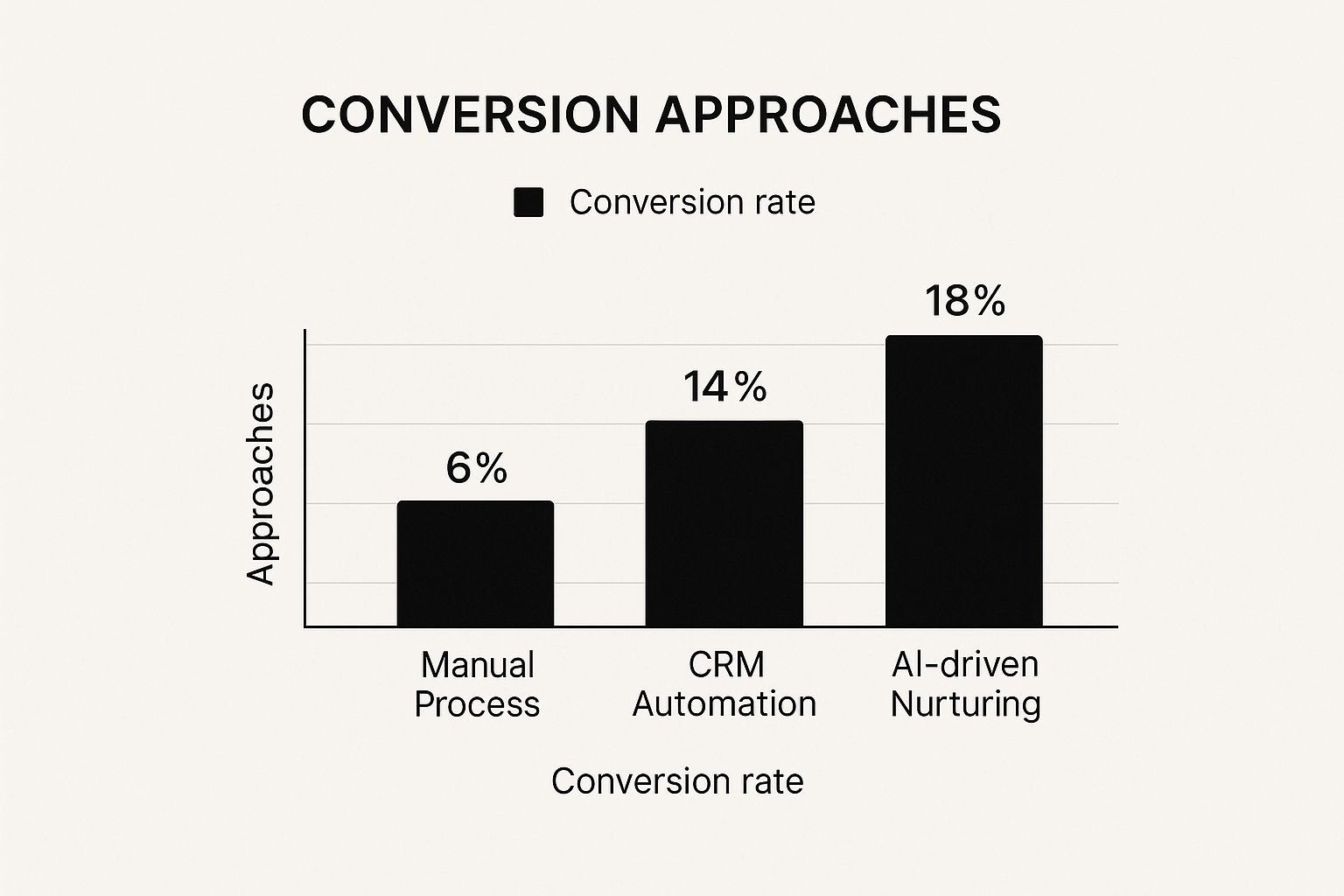
The data is pretty stark. Moving away from clunky manual processes and toward smarter, AI-driven strategies can give your conversion rates a massive lift. Every step you take to refine your technology and process pays off, proving just how powerful an optimized lead management system can be.
Why Lead Source Quality Is So Important

Here’s a hard truth: not all leads are created equal. Where a prospect comes from—their lead source—has a massive impact on your final lead to sale conversion rate.
Think of it like fishing. You could cast a wide net in the open ocean (like running broad paid ads) and see what you pull in. Or, you could drop a line in a stocked pond where you know the fish are hungry and biting (like a targeted email campaign). You’ll get a very different catch, and one is a much better use of your time.
The quality and intent of a lead are almost always tied directly to its origin. A prospect who finds you through a specific organic search for a problem they're facing is usually much closer to buying than someone who just stumbles across a random social media post. Getting a handle on these differences is the first step to truly optimizing your budget and your team's effort.
The source of a lead is one of the strongest predictors of its likelihood to convert. Focusing only on lead volume without considering quality is a recipe for a bloated pipeline and a discouraged sales team.
By digging into performance by channel, you can stop throwing money at low-performing sources and double down on the ones that consistently bring in high-quality prospects who are actually ready for a sales conversation.
How Different Channels Perform
When you look at the data, it becomes crystal clear that some channels are just better at producing sales-ready leads. Take e-commerce, for example. The global average conversion rate might hover somewhere between 2% and 4%, but that number hides some pretty dramatic differences between traffic sources.
Organic search, for instance, converts at a respectable 3.6%. But email marketing blows it out of the water, clocking in at a powerful 5.9%. Meanwhile, paid search and social media lag behind at 2.5% and 1.8%, respectively.
So why the huge gap? Channels like email marketing are built on a pre-warmed audience. These folks already know you and (hopefully) trust your brand. They’ve opted in to hear from you, which makes them far more receptive to whatever you’re offering.
Optimizing Your Lead Sources
To actually improve your overall lead to sale conversion rate, you have to stop treating all your sources the same. Think of each one as a unique funnel with its own quirks and optimization strategy.
Here’s a practical way to start breaking it down:
- Analyze Attribution: Don't just look at the first touchpoint. Use marketing attribution models to see which channels really contribute to closed-won deals throughout the entire buyer journey.
- Segment Your Leads: This is non-negotiable. As soon as a lead comes in, tag it with its original source in your CRM. This simple step allows you to track their journey accurately and compare conversion rates apples-to-apples.
- Implement Lead Scoring: Start assigning points to leads based on their source and the actions they take. A lead from a high-converting channel like a demo request should absolutely get a higher score than someone who downloaded a general, top-of-funnel ebook. This is how you help your sales team prioritize their time on the leads most likely to close.
When you identify your most valuable sources and figure out what makes them so successful, you can start making smarter marketing decisions. It’s not just about focusing on the winning channels; it’s about building systems, like implementing lead scoring best practices, to make sure your very best leads get the immediate attention they deserve.
Improve Conversions with Strategic Lead Nurturing
Getting a lead is just the starting pistol. The real race is won in the follow-up. A smart, systematic lead nurturing strategy is your single most powerful tool for improving your lead-to-sale conversion rate. It’s how you build relationships and trust with prospects who aren't quite ready to buy today.
Think about it: most leads simply aren’t prepared to make a purchase the moment they hit your pipeline. If you just ignore them until they raise their hand again, you're practically handing them over to more attentive competitors. Consistent, value-driven engagement is what turns mild interest into a signed contract.
This isn’t just a hunch; the data is crystal clear. Companies that really nail lead nurturing close 50% more sales while spending 33% less to convert each lead. Nurtured leads also create 20% more sales opportunities and speed through the sales cycle 23% faster than those left on their own. And yet, a shocking 65% of marketers have no lead nurturing strategy at all. That’s a massive opportunity just sitting on the table.
From Theory to Actionable Tactics
Effective lead nurturing isn’t about blasting out random “just checking in” emails. It’s about delivering the right message at the right time, guiding prospects toward a solution. You want to be a helpful guide, not a pushy salesperson.
Here are a few practical ways to build a strong nurturing system:
- Targeted Email Sequences: Set up automated email workflows based on what a lead does, like downloading a whitepaper. Every email should offer more value, not just another sales pitch.
- Valuable Content Offers: Don't just sling blog posts. Offer things like case studies, webinars, or ROI calculators that directly address the pain points relevant to their stage in the buying journey.
- Timely and Personalized Outreach: Use your CRM data to get personal. Mention their industry, a specific interest they’ve shown, or a problem they’ve mentioned. It shows you’re actually paying attention.
By consistently providing value, you stay top-of-mind. When that prospect is finally ready to pull the trigger, you'll be the first person they think of.
The most common mistake in sales is a lack of follow-up. Turning this weakness into your strength is the fastest way to improve your conversion numbers.
The Role of Nurturing in the Final Stages
Lead nurturing doesn’t stop once a prospect agrees to a meeting. It keeps going through the entire sales process, right up to the final proposal. All that trust and rapport you’ve built makes the final negotiation stages so much smoother.
Beyond just general nurturing, the quality of your sales proposal is critical. For a deeper dive on sealing the deal, you should learn how to write a winning proposal. Every interaction is part of the nurturing process. To see how this fits into the bigger picture, check out our complete guide on how to improve sales conversion rate with a more holistic approach.
Using Automation to Increase Your Conversion Rate
If you want to scale up your lead nurturing and really capitalize on those high-intent moments, you have to bring in the machines. Automation is what separates a clunky, inefficient sales process from one that’s responsive, efficient, and directly boosts your lead to sale conversion rate. It gets the manual busywork out of the way so your team can focus on what they're actually good at: closing deals.
Think about it. Where do most companies lose leads? It’s almost always in that dead space between a prospect showing interest and them actually talking to a salesperson. Manually assigning leads and scheduling meetings is just too slow. Every minute you waste is another opportunity for a hot lead to go cold or wander over to a competitor.
Remove Friction with Instant Scheduling
This is where tools like automated scheduling come in. They tackle this problem head-on. By hooking directly into your demo request forms, they can book a meeting for a qualified lead with the right rep instantly. This catches prospects right at their peak moment of interest, which massively reduces the odds of a no-show.
Here's a look at how Distro lets you embed scheduling right into your process, so high-intent leads can book a meeting on the spot.
That immediate confirmation keeps the momentum going, all without anyone on your team lifting a finger.
But good automation does more than just book meetings. It can handle other critical tasks that push conversions higher. For example, you can use it to:
- Intelligently route leads to the right person based on territory, company size, or any other rules you set.
- Trigger personalized email sequences based on what a lead does, making sure they get the right information at the right time.
- Deploy chatbots to engage website visitors 24/7. They can answer basic questions and qualify prospects while your team is offline. To see just how effective this can be, you can explore how chatbots boost sales.
Automation doesn't replace great salespeople; it makes them better. It clears their path of administrative tasks so they can spend more time building relationships and having strategic conversations.
When you put smart automation in place, you’re basically building a more effective go-to-market engine. You can explore a whole range of possibilities in our guide to sales process automation. The takeaway is simple: a faster, more responsive process translates directly to a higher conversion rate.
Frequently Asked Questions
Digging into the nuances of your lead-to-sale conversion rate is where the real improvements happen. Here are a few answers to the questions we hear all the time.
Is a High Conversion Rate Always Good?
Not always. It's counterintuitive, I know. A super high conversion rate might look fantastic on a dashboard, but it can actually be a red flag that your marketing is too narrow. You might just be reaching the most obvious, ready-to-buy prospects while missing out on a much larger audience.
The real goal is finding a healthy balance. You absolutely want a strong conversion rate that shows your sales process is efficient. But you also need a steady stream of new leads to keep the growth engine running long-term. An unusually high rate could mean your lead qualification is way too strict, and you're leaving potential money on the table.
A strong lead to sale conversion rate indicates efficiency. A healthy lead volume ensures sustainability. You need both to succeed.
How Often Should I Calculate This Rate?
Consistency is way more important than the specific frequency, but a monthly calculation is a solid rule of thumb for most businesses. That cadence is short enough to let you spot new trends and see the impact of recent changes, like a new ad campaign or a tweak to your sales strategy.
A quarterly check-in works too. It smooths out any random monthly spikes or dips and gives you a broader perspective on performance. The most important thing is to pick a schedule and stick with it so you can make accurate, year-over-year comparisons.
Can a Low Rate Still Be a Good Sign?
Believe it or not, yes. Let's say you just expanded your marketing efforts to target a brand new, top-of-funnel audience. Your lead volume might shoot up, causing your lead-to-sale conversion rate to take a temporary dip.
That's not necessarily a bad thing at all. It means you're successfully filling the top of your funnel with new prospects. The crucial part is having strong lead nurturing and qualification processes ready to guide these newer, colder leads toward a sale over time.
Ready to stop letting hot leads go cold? Distro automatically routes and schedules high-intent prospects with the right rep instantly, helping you capture interest when it's highest. See how you can 3X your demo request form conversions at distro.so.