
You can't hire the right salespeople if you don't know what "right" looks like for your business. This whole process starts long before you even think about posting a job opening.
It all comes down to defining the exact outcomes you need, creating a detailed role profile that speaks to the right people, and building an interview process that shows you who can actually deliver. Nail this foundational blueprint, and you're well on your way to building a sales team that crushes its goals.
Building Your Sales Role Blueprint

Before you can find the perfect fit, you have to define what “perfect” actually means for your company, your product, and your stage of growth. A generic job description for a "Sales Representative" will only attract generic candidates. It’s a waste of everyone’s time.
Your real goal is to create a precise blueprint that acts as a powerful filter. It should pull in the high-performers who are genuinely excited by the challenge while politely deterring everyone else.
This means you need to think beyond a simple list of responsibilities. Start with outcomes. What does this person absolutely have to achieve in their first 90 days to be a success? What are the 2-3 key performance indicators (KPIs) that will tell you they’re making a real impact? Answering these questions forces you to build a role profile based on results, not just a checklist of daily activities.
Defining Your Ideal Candidate Profile
The profile is more than a list of skills; it's about the specific context they’ll be walking into. I’ve seen salespeople who were absolute legends selling $2M enterprise deals completely flounder with a high-volume, $20k sales cycle—and vice versa. They are different sports. Your blueprint has to specify the arena they’ll be playing in.
To help you get specific, I've put together a table comparing some common sales roles. Use it to get clear on what you truly need.
Key Sales Role Profiles Compared
This table contrasts the primary responsibilities and required skills for different types of sales roles to help you define your specific needs.
| Sales Role | Primary Focus | Key Skills | Ideal For |
|---|---|---|---|
| Sales Development Rep (SDR) | Generating new leads and qualifying prospects at the top of the funnel. | Cold calling, email outreach, resilience, CRM proficiency. | Companies needing to build a consistent pipeline of new opportunities. |
| Account Executive (AE) | Closing new business deals by managing the full sales cycle from qualified lead to signed contract. | Demoing, negotiation, relationship building, closing techniques. | Businesses with a qualified lead flow ready for conversion. |
| Account Manager (AM) | Nurturing and growing existing customer accounts, focusing on retention and upsells. | Client relations, problem-solving, strategic account planning. | Companies focused on maximizing lifetime value and reducing churn. |
| Enterprise Sales Rep | Managing long, complex sales cycles for high-value deals with multiple stakeholders. | C-level communication, complex deal structuring, project management. | B2B companies selling six-figure (or larger) solutions to large organizations. |
This table should give you a starting point. Now, you can layer on your company's specific context.
Think about these critical components for your own ideal profile:
- Deal Size and Complexity: Have they proven they can successfully manage deals in your target ACV range? Experience with complex, multi-stakeholder sales is a totally different skill set from quick, transactional selling.
- Target Buyer Experience: Hiring someone who has already sold to your exact buyer (e.g., CFOs, VPs of HR, IT Directors) is a massive advantage. It dramatically shortens their ramp-up time because they already speak the language.
- Core Competencies: List the absolute non-negotiables. These include hard skills like proficiency in your specific CRM and soft skills like resilience, coachability, and intellectual curiosity.
A huge mistake I see founders make, especially when hiring their first salesperson, is hiring just one. The problem is you learn nothing, whether they succeed or fail. Was it the rep, the pitch, or the market? Who knows. Hiring two reps from the start lets you run a constant A/B test on everything—pitches, personas, and strategies. The data you get is invaluable for scaling.
Articulating Culture and Expectations
Finally, your blueprint needs to honestly reflect your company culture. The demand for specialized sales talent is exploding across sectors like SaaS, renewable energy, and fintech. Top candidates have options. They aren't just looking for a job; they're looking for the right environment.
Ultimately, this detailed preparation ensures you’re not just filling a seat—you're making a strategic investment that will pay dividends for years. As more teams go remote, writing all of this down becomes even more critical for alignment.
If you’re building a distributed team, check out this a complete guide on how to hire remote employees for a more comprehensive framework. It’s incredibly useful.
Sourcing Talent Beyond the Job Boards
Let’s be honest. Posting a job and just waiting for the résumés to roll in is a recipe for a flooded inbox full of mostly mediocre candidates. The best salespeople—the ones who truly move the needle—are usually passive candidates. They aren't scrolling job boards because they're too busy crushing their quotas. Your job is to go out and find them.
This requires a fundamental shift in your approach. You need to stop being a passive recipient of applications and start actively hunting for talent. This means looking far beyond the usual job boards and developing comprehensive talent acquisition strategies to uncover those hidden gems. This is how you build a pipeline of A-players, not just fill an empty chair.
Activate Your Internal and External Networks
Your most powerful sourcing tool is probably sitting right next to you: your own team. A solid employee referral program can be a goldmine, delivering high-quality candidates who are already vouched for by someone you trust. But simply dangling a cash bonus isn't going to cut it.
For a referral program to really work, you have to actively champion it. Make it incredibly easy for your team to participate. Share that detailed role profile you built and be crystal clear about the type of person you’re looking for. A great referral program doesn't just bring in skilled people; it brings in people who are a natural fit for your culture.
Once you’ve tapped your internal network, it's time to look outward.
- LinkedIn Sales Navigator: This is your best friend for targeted searches. You can zero in on reps based on their company, role, and even how long they've been there, making it easier to spot people who sell to your ideal customers.
- Niche Communities: Get active in relevant Slack channels or online forums. This is where top performers often hang out, sharing insights and talking shop.
- Industry Events: Even virtual conferences are fantastic for connecting with salespeople who are genuinely invested in their careers and professional development.
When you do reach out, make it personal. Mention a post they shared or a connection you have in common. The goal isn't a hard pitch. It's to start a conversation and build a relationship, even if the timing isn't right just yet.
Remember this: When you’re hiring salespeople, you’re selling a career opportunity. Your job description shouldn't be a dry, boring list of requirements. Frame it like a marketing document. Highlight the challenge, the potential for real impact, and what makes joining your team a great move.
Find Talent with Modern Skills
The sales role itself is evolving. Fast. Companies are leaning more heavily on data-driven strategies, blurring the lines that once separated sales and marketing. This new reality puts a premium on salespeople who are not just good with people, but also comfortable with technology and able to use data to guide their every move.
The most in-demand roles now often require skills in marketing analytics and even SEO, reflecting a major shift toward more technical, digitally-savvy sales pros. You can discover more insights about these in-demand jobs to get a better sense of where the industry is heading.
So, when you're out there sourcing, look for signals that a candidate gets the modern sales playbook. Do they talk about the sales tech they use? Do they mention using data in their LinkedIn profile? Finding that perfect blend of classic sales grit and modern technical know-how is the key to hiring someone who won't just succeed today, but will help you win tomorrow.
Designing an Interview That Reveals True Potential
A great resume is just an entry ticket. I’ve seen countless candidates with impressive backgrounds who couldn't sell their way out of a paper bag. The interview is where you separate the talkers from the true performers.
Your goal is to design a process that uncovers the core traits of a successful salesperson. It's time to move beyond lazy questions like “What are your biggest strengths?” and create an environment that reveals character, skill, and coachability under pressure.
To really understand how to hire salespeople who will thrive, you have to see them in action. This means structuring an interview process with multiple stages and formats that test different competencies.
Go Beyond Standard Questions
Standard interviews are predictable, and polished candidates have rehearsed answers. To get to the truth, you need to use behavioral and situational questions that force them to draw from real experience.
- Behavioral Questions: These focus on past actions. Ask, “Tell me about a time you lost a deal you were sure you would win. What did you do next?” This reveals resilience and accountability far better than just asking if they’re resilient.
- Situational Questions: These present a hypothetical work scenario. Try something like, “A prospect you’ve been nurturing for weeks just went dark. Walk me through your next three steps.” This tests their problem-solving instincts and strategic thinking on the fly.
These types of questions prevent generic responses and give you a real window into how they actually operate.
The best salespeople I’ve ever hired are the ones I’d buy from myself. If you don't feel a sense of trust and competence when they’re “selling” you in the interview, your customers certainly won’t either. This is the ultimate litmus test.
Implement a Practical Sales Role-Play
A role-play is the single most effective way to assess a salesperson's ability. It’s non-negotiable in my hiring process. This isn’t about tricking them; it’s about observing their natural instincts in a simulated sales environment.
Keep the scenario simple but relevant. Give them a one-pager on your product and a brief description of a target customer persona a few days in advance. During the interview, have them run a mock discovery call or present a mini-pitch.
During the role-play, watch for these key indicators:
- Question Quality: Do they ask insightful questions to understand the "customer's" pain, or do they jump straight into pitching features?
- Active Listening: Do they adapt their pitch based on what you say, or do they stick to a rigid script?
- Handling Objections: How do they react to pushback? Do they get defensive, or do they address the concern with curiosity and confidence?
How they prepare for and perform in this exercise tells you more than their resume ever could. It reveals their work ethic, their questioning skills, and how they handle real-world pressure.
Finally, make sure your interview loop includes more than just sales leadership. Involving a peer from the sales team and a key cross-functional partner (like someone from marketing or customer success) provides a more holistic view. They will evaluate the candidate from different perspectives, helping you find someone who is not only a great seller but a great future teammate.
Using Modern Tools for Smarter Screening
In a cut-throat hiring market, speed and precision aren't just nice-to-haves; they're everything. If you're still relying on manually sifting through stacks of resumes, you're already behind. The point of using modern tools isn't just to move faster, but to make genuinely smarter, data-backed decisions about who even gets a first conversation.
It all starts with a well-executed phone screen. This isn't just a friendly chat—it’s a rapid qualification step. In a tight 15-20 minutes, a good recruiter can confirm a candidate's core experience, lock down salary expectations, and get a real feel for their communication skills. This one simple step saves your sales leaders from burning hours on interviews with people who were never going to be a fit.
Bringing in Assessments and AI
Once you've cleared that initial hurdle, assessment tools can give you objective data on the things a resume can't possibly tell you. We're talking about cognitive ability, how they tackle problems, and crucial personality traits like resilience and coachability. No, it's not a substitute for a real interview, but it provides hard data points that help you build a much clearer picture of a candidate's actual potential.
This infographic breaks down a typical multi-stage process that balances human interaction with structured, data-driven evaluation.
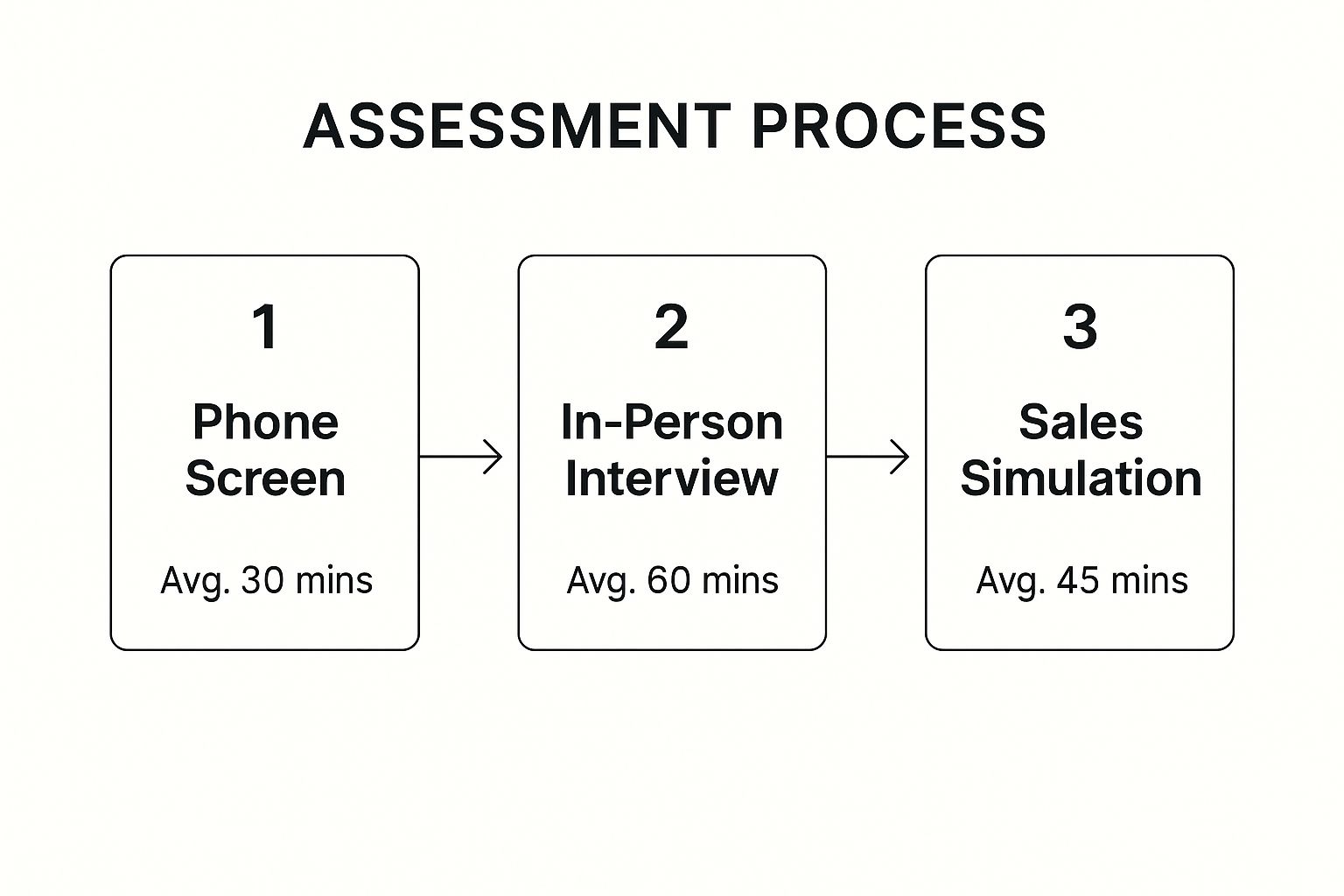
As you can see, each stage builds on the last. You invest more time and resources only as candidates continue to prove they're worth it.
The Role of Automation
The recruitment world is changing fast, thanks to platforms offering AI hiring and intelligent assessment capabilities. Think about it: these systems can chew through thousands of resumes in minutes, flagging the keywords and experience patterns that match exactly what you're looking for.
This isn't just about screening, either. Automation can completely take over the scheduling nightmare. Tools that sync with your team's calendars to book interviews automatically eliminate that soul-crushing email chain of "Does Tuesday at 2 PM work for you?"
This frees up your hiring managers and recruiters to do what they do best: have meaningful, high-value conversations with top candidates. By automating the grunt work, you not only speed up the entire process but also sharpen your team's focus—a fantastic way to improve sales productivity before a new hire even walks in the door. The right tools help you build a smarter, more efficient engine for finding and closing the best salespeople out there.
To keep your evaluations consistent and objective, a simple checklist can be incredibly powerful. It forces you to score every candidate on the same criteria, removing gut feelings and personal bias from the equation.
Here's a basic template you can adapt for your own process:
Sales Candidate Evaluation Checklist
| Attribute | Evaluation Method | Rating (1-5) | Notes |
|---|---|---|---|
| Relevant Experience | Resume Review, Phone Screen | Did they work in a similar sales cycle/deal size? | |
| Communication Skills | Phone Screen, Interview | Clarity, confidence, active listening. | |
| Coachability | Interview Questions, Role-Play | How do they react to constructive feedback? | |
| Problem-Solving | Situational Interview Questions | Can they think on their feet and offer solutions? | |
| Resilience/Grit | Behavioral Questions | Ask about a time they lost a deal and what they did. | |
| Curiosity | Candidate's Questions | Are their questions insightful and well-researched? | |
| Culture Fit | Team Interview, Values Alignment | Do their values and work style align with the team's? |
Using a structured tool like this ensures that when you and your team debrief, you're all speaking the same language and comparing apples to apples. It's a small change that makes a huge difference in the quality and consistency of your hires.
You’ve navigated the interviews, checked the references, and found your person. The finish line is in sight, but this is exactly where so many hiring managers stumble. A clumsy offer can undo weeks of hard work, sending your top choice right into the arms of a competitor. Honestly, learning how to hire salespeople effectively means nailing this final, critical stage.
Think of extending an offer as a sales process in its own right. You're not just offering a job; you're selling a career opportunity. Your candidate is the most important prospect you’ll close all quarter.
Before you even think about picking up the phone, get every component of your offer finalized and approved. Any hesitation or lack of clarity at this point just screams disorganization.
Structuring a Competitive Compensation Package
Let's be real: great salespeople are driven by performance, and their compensation needs to reflect that. A truly compelling offer isn't just about the base salary—it's about the total earning potential. The goal is to strike that perfect balance between security and a high-upside incentive.
Your offer should clearly break down these key elements:
- Base Salary: This is their stability. It needs to be competitive for the role and your location. It shows you value their expertise and time, regardless of how a particular month shakes out.
- On-Target Earnings (OTE): This is the number that gets top candidates excited. It represents their total potential income if they hit 100% of their quota, combining base and commission. Make it realistic, but make it motivating.
- Commission Structure: Transparency is everything here. Is it a percentage of revenue? Profit? Contract value? Explain exactly how commissions are earned and when they get paid out—is it when the contract is signed, or when the customer pays? The details matter.
- Accelerators and Bonuses: A-players don't just want to hit their quota; they want to blow it out of the water. Show them what happens when they exceed it. Accelerators (higher commission rates for over-performance) or special bonuses are powerful magnets for true top performers.
Always, always present the offer over the phone or a video call. An email just feels impersonal and transactional. A real conversation lets you share your genuine excitement, walk them through the comp plan, and tackle any questions on the spot.
Selling the Full Opportunity
While the money is obviously critical, don't let it be the only thing you talk about.
Take them back to why they were so pumped about the role in the first place. Remind them of the impact they'll have, the company's vision, and the path for their career growth. This isn't just another sales job; it's a specific opportunity with your team.
Make sure to reinforce the non-monetary benefits that make your company a great place to be. This could be your culture, a professional development budget, access to strong leadership, or the fact that they'll be selling a product they can truly believe in. Your goal is to make the decision about more than just the numbers on a spreadsheet. It’s about them joining a winning team where they can do their best work and absolutely crush it. That's the final touch that often seals the deal.
Setting Your New Hire Up for Success
 The contract is signed, and you're breathing a sigh of relief. But the real work is just beginning. Honestly, the biggest mistake I see managers make when they hire salespeople is assuming their job is done once the offer letter is accepted.
A great hire can flame out in spectacular fashion without a structured, supportive onboarding process.
A weak start is a recipe for high churn and a frustratingly long ramp-up period. Your goal isn't just to get them a laptop and a login; it's to immerse them in your world and arm them for success from day one. This upfront investment pays for itself over and over through higher retention and a much faster time-to-quota.
Building a Strong 30-60-90 Day Plan
A well-defined 30-60-90 day plan is the bedrock of any solid onboarding. It kills ambiguity and hands your new hire a clear roadmap, showing them exactly what’s expected and how to get there. Think of it as a living document that guides their first three months.
Here’s a practical breakdown of what each phase should cover:
- First 30 Days (Immersion): The entire focus is on learning. This means deep-dive product training, truly understanding your ideal customer profile, and shadowing calls with your top-performing reps. It's about absorbing knowledge, not hitting a number.
- Next 30 Days (Application): The training wheels start to come off. The new rep should begin actively participating in calls, managing their own pipeline (with close supervision, of course), and taking ownership of initial follow-ups.
- Final 30 Days (Execution): By now, the new hire should be operating much more independently. They should be running their own discovery calls, managing deals, and starting to hit early performance targets. This phase is all about building momentum and confidence.
Your onboarding program is the single best tool you have for reducing new hire churn. A structured process shows you're invested in their success, which builds loyalty far more effectively than any perk or bonus.
Creating an Environment for Early Wins
Confidence is currency in sales. One of the most powerful things you can do for a new hire is to engineer opportunities for them to get some quick, early wins.
No, this doesn't mean handing them a guaranteed closed-won deal on a silver platter.
It's about being strategic. Maybe you assign them some warmer, inbound leads or give them a chance to work on a smaller, more straightforward deal. A quick victory, no matter the size, delivers a massive psychological boost. It proves to them—and just as importantly, to the rest of the team—that they can succeed here.
To really nail this, assign them a mentor who isn’t their direct manager. A peer mentor provides a safe space for asking the "dumb" questions and learning the unwritten rules of the office. This relationship accelerates their integration into the team culture and can dramatically shorten their learning curve.
Ultimately, a great onboarding program acts as a multiplier, turning a good hire into a great one by providing the right structure and support. It's a critical component you can master to improve your sales acceleration formula and see results faster.
Common Questions About Hiring Salespeople
Even with a solid plan in hand, you're bound to run into some tricky questions when you're hiring salespeople. I see it all the time.
One of the most common ones I hear is about the magic number for an initial hiring round. My answer is always the same: hire two reps at once, never just one. Think of it as your first A/B test. Hiring a pair lets you immediately compare everything—from the nuances of a pitch to how different personas respond—and gives you invaluable, real-world data on what actually works.
Another question that frequently pops up is how to handle a new hire's first few weeks. It's absolutely critical to have a structured onboarding process that gets them up to speed on your company's specific way of doing things. If you're looking to build out a scalable framework for this, you'll find some great guidance in these sales operations best practices.
Ready to stop losing high-intent leads? Distro automatically routes prospects from your demo forms to the right salesperson's calendar in seconds. See how our intelligent scheduling can 3X your meeting conversion rates at https://distro.so.