
Handling objections isn't about having a snappy comeback for everything a prospect throws at you. It’s about shifting your entire mindset from being defensive to being collaborative.
The first step is to actually listen and understand the real concern hiding behind their words. Instead of treating an objection like a "no," see it for what it truly is: a request for more information. This simple shift opens the door for you to empathize, clarify what’s really holding them back, and then work with them to find a solution. That's how trust is built.
Why Prospects Really Raise Objections

Before you start memorizing scripts, you have to get a handle on the human element driving these objections. When a prospect says, “It’s too expensive,” it’s rarely just about the number on the proposal. More often than not, it's a coded message for, “I don’t see enough value here to justify this cost.”
Likewise, “We’re happy with our current solution” often translates to, “I’m afraid of the risk and headache involved in making a switch.”
These statements are almost never the final word. Think of them as signals of engagement—proof that your prospect is actually thinking through your offer and weighing the pros and cons. Apathy is the real deal-killer. An objection, on the other hand, is an invitation to a deeper conversation. Once you learn to decode what's really being said, you can address the root of their hesitation.
Decoding the Psychology of Common Objections
Every single objection is tied to a core human emotion or a very practical concern. The trick is to look past the surface-level comment and pinpoint the real barrier. When you get what’s driving them, you can respond with empathy instead of a hard sell.
Here are a few common psychological triggers I see all the time:
- Fear of Change: People love the comfort of the status quo, even if it’s wildly inefficient. The idea of bringing in a new system, training the team, and messing with established workflows can feel completely overwhelming.
- Risk Aversion: Making a big purchasing decision comes with a healthy dose of fear. What if this doesn't deliver? What if I look bad for choosing this? What if it creates more problems than it solves?
- Lack of Trust: If a prospect doesn't trust you, your company, or your product, they will naturally hesitate. This is especially true if they’ve been burned by a similar solution in the past.
An objection isn't a wall; it's a hurdle. It’s not there to stop you, but to test if you have the right information and empathy to help the prospect get over it. Seeing objections as opportunities for clarification changes the entire dynamic.
The Fear of Switching and Internal Resistance
One of the biggest, yet often unspoken, objections is the internal battle your prospect is facing. They aren’t just buying a product; they’re trying to champion a change within their own company. This is where understanding strategies for implementing change management effectively becomes incredibly valuable.
Your main contact has to sell this purchase to their boss, their team, and probably the finance department. They're asking themselves, "Will my team hate this? Will this decision come back to bite me if it fails?"
Your job is to arm them with the confidence and the data they need to be a successful advocate internally. Give them clear ROI projections, relevant case studies, and a straightforward implementation plan. By doing this, you help them overcome not just their own objections, but the potential objections of their entire team. That’s when a sales process transforms into a true partnership.
A Framework to Confidently Handle Any Objection
Having a repeatable framework is the difference between reacting defensively and responding strategically. When you're not fumbling for the perfect answer on the spot, you can lean on a proven process that keeps you in control of the conversation. The LAER model—Listen, Acknowledge, Explore, and Respond—is a simple but incredibly powerful structure for systematically dismantling any sales objection that comes your way.
This approach stops those knee-jerk reactions cold and gives you a calm, confident process for any conversation. It's not just theory; sellers who get this right can see a close rate as high as 64%. A solid process simply translates to more wins.
Listen Fully Before Formulating a Response
When a prospect throws out an objection, your first instinct is to jump in and counter it. Fight that urge. Interjecting too quickly just tells them you're more interested in defending your product than understanding their actual concern.
True active listening means you're absorbing their words without already building your rebuttal in your head. You have to silence your internal monologue and give them your complete, undivided attention. Focus on what they're actually saying, not what you think they're about to say.
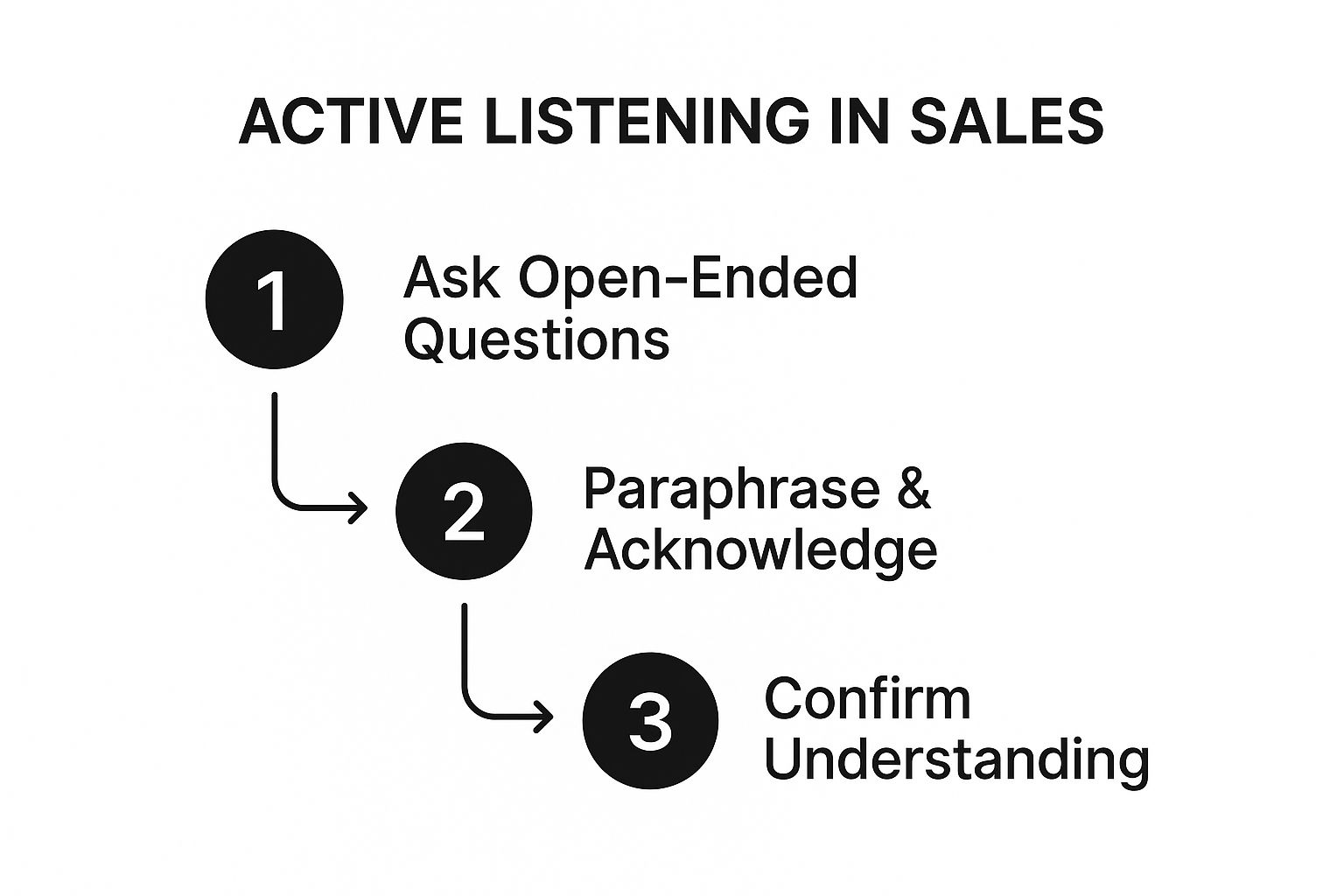
As you can see, listening isn't a passive activity. It’s a structured process designed to get you to total clarity before you even think about responding.
Acknowledge and Validate Their Concern
Okay, you've listened. Now, you need to show the prospect they've been heard. Acknowledging their point of view isn't the same as agreeing with them—it's about validating that their feeling or perspective is legitimate. This small act of empathy can completely de-escalate a tense moment and build some serious rapport.
You can pull this off with a few simple, powerful phrases:
- “That’s a completely fair point.”
- “I can definitely see why you’d feel that way.”
- “Thanks for bringing that up. It’s an important thing to consider.”
This step is a bridge. It moves the conversation away from a potential conflict and toward a collaborative problem-solving session. By validating their concern, you make the prospect feel respected, which in turn makes them far more open to what you have to say next. There's a lot of overlap here with best practices for handling customer complaints effectively, where empathy is key to turning a negative into a positive.
Acknowledging an objection is like letting the air out of a balloon. It releases that initial tension and allows for a more rational, open discussion to follow. You can’t address a concern that the prospect is still holding onto tightly.
Explore the Root of the Objection
The initial objection is almost always just the tip of the iceberg. "It’s too expensive" can mean anything from "I don't see the ROI" to "My boss hasn't approved the budget for this quarter." The "Explore" phase is your chance to dig deeper with smart, open-ended questions to get to the real issue.
Your goal is to avoid any question that can be shut down with a simple "yes" or "no." Instead, use prompts that force the prospect to elaborate.
Try asking questions like these:
- “When you say the price is high, could you help me understand what you’re comparing it to?”
- “Could you walk me through what your decision-making process for a new tool typically looks like?”
- “What other priorities are you juggling right now that might make the timing a challenge?”
You're not interrogating them; you're trying to understand. Every answer they give provides more context, which is exactly what you need to tailor your response perfectly.
Respond with a Tailored Solution
Only after you have listened, acknowledged, and explored should you even think about responding. By this point, you aren't just guessing what the problem is—you should know. Your response needs to directly address the specific, underlying concern you uncovered.
If the real issue was a perceived lack of ROI, you hit them with case studies and hard data. If they were worried about implementation, you walk them through your onboarding support and customer success process. This customized approach is lightyears more effective than any generic, one-size-fits-all script. Honing your framework here has a massive impact, and you can find more strategies in our guide on how to improve sales productivity.
How Your Delivery Shapes the Conversation

Having the perfect script is only half the battle. What you say matters, but how you say it can instantly change the entire dynamic of a sales conversation—especially when things get tense after an objection.
Your delivery—your tone, your pacing, the way you use silence—sends powerful subconscious signals to your prospect. A rushed, high-pitched response screams panic and a lack of confidence. On the other hand, a calm, measured delivery communicates control, thoughtfulness, and authority.
It shows the prospect that their concern hasn't rattled you and that you're prepared to address it like a trusted advisor, not just another defensive salesperson. This subtle shift can be the difference between making a concern worse and actually resolving it.
The Power of the Strategic Pause
When a prospect hits you with an objection, the natural human reaction is to jump in immediately with a rebuttal. We feel this overwhelming need to fill the silence and correct what we see as a misunderstanding. But the most successful sales pros I know do the exact opposite: they embrace the pause.
This isn't a sign of hesitation or uncertainty; it's a calculated move. A deliberate pause of just a few seconds before you respond accomplishes a few critical things. First, it forces you to actually listen instead of just waiting for your turn to talk. Second, it gives you a moment to pull together a thoughtful, strategic response instead of a reactive, emotional one.
Finally, it communicates respect. That silence tells them you're taking their concern seriously and giving it the consideration it deserves. It’s a subtle yet powerful way to de-escalate the situation and re-establish your credibility.
Mastering Your Pacing and Tone
Your speaking pace and vocal tone are just as crucial as the words you choose. When faced with an objection, so many reps start speaking faster and at a higher pitch, which immediately puts the prospect on the defensive. That vocal shift signals anxiety and can make your response sound like a desperate pitch instead of a helpful solution.
The key is to consciously slow down. Maintaining a calm, steady speaking pace helps you stay in control of your emotions and the conversation. It projects confidence and makes your words carry more weight. Think about how a doctor delivers a diagnosis—their calm and deliberate tone inspires trust, even when the news is serious.
By mastering your vocal delivery, you're not just handling an objection; you're managing the emotional climate of the conversation. A calm tone and measured pace can transform a moment of conflict into an opportunity for collaboration.
Practicing this can feel unnatural at first. Recording your calls and listening back is an invaluable exercise to pinpoint exactly where you tend to speed up or sound defensive. Using a good Speech To Text Software can help you analyze your calls and train yourself to improve.
What Top Performers Do Differently
The difference in delivery between elite reps and average ones isn't just anecdotal—it's backed by data. An analysis of sales calls reveals clear patterns that set top performers apart when they handle objections. Their whole approach is less about arguing and more about understanding, and you can hear it in the way they speak and listen.
Elite sales reps ask clarifying questions 54.3% of the time after an objection, a massive jump from the 31% rate seen in average reps. This questioning approach not only makes the buyer feel heard but also gives the seller the critical info they need to address the real root of the concern.
Even more telling, these top reps pause five times longer after an objection than their peers, using that time to carefully dissect the issue. They also maintain a calm speaking pace of around 176 words per minute, demonstrating complete control.
This data proves that effective objection handling is a skill built on deliberate communication habits. It’s about being more inquisitive, more patient, and more composed.
Practical Exercises to Improve Your Delivery
Improving your vocal delivery requires conscious practice, just like any other skill. Here are a few exercises you can start using to build muscle memory for staying calm under pressure.
- The "Three-Second" Rule: The next time you face an objection on a call, force yourself to take a deep breath and silently count to three before saying anything. This simple action will break the habit of jumping in too quickly.
- Record and Review: Use a call recording tool to listen to your own sales calls. Pay specific attention to moments when objections come up. Do you speed up? Does your pitch get higher? Self-awareness is the first step to improvement.
- Role-Play with a Colleague: Practice handling common objections with a teammate. Ask them for honest feedback not just on what you said, but on how you said it. This controlled environment is perfect for refining your tone and pacing.
By focusing on these subtle yet powerful elements of communication, you can transform how your responses are received, turning potential deal-breakers into opportunities to build trust and move the conversation forward.
Proven Scripts for the Most Common Sales Objections

Knowing the theory is one thing, but sales conversations live and die by the words you choose. When the pressure's on, having a few battle-tested scripts in your back pocket makes all the difference.
Think of these less as rigid lines to memorize and more as flexible starting points. The real key is to adapt them to your personality and the specific flow of the conversation. It's about moving past generic rebuttals to address the real, often unspoken, concern hiding behind the objection.
Let's break down word-for-word strategies for the objections you hear every single day.
Tackling Price and Budget Objections
Price objections are, without a doubt, the most common hurdle we face. But here's the thing I've learned over the years: it's rarely just about the money. More often than not, it’s a proxy for value.
When a prospect says, "it's too expensive," what they're really saying is, "I don't see how the value justifies this cost... yet." Your entire job in that moment is to reframe the conversation around the return on their investment and the outcomes they'll achieve, not just the price tag.
Objection: "Your price is too high."
Response 1 (The Anchor): "I appreciate you sharing that. 'Too high' can be relative, so could you help me understand what you're comparing us to? It helps me see if we're looking at an apples-to-apples situation."
Response 2 (The Value Pivot): "That's a fair point. Forgetting about price for just a moment, do you feel like our solution can actually solve the problem we've been discussing?"
Notice how these responses aren't defensive. They open the door and invite the prospect to give you more context. That information is pure gold—it tells you exactly where you need to either differentiate your offering or double down on the value they might have missed.
Price is only an issue in the absence of value. Your first goal isn't to justify the price, but to build such a compelling case for the value that the price becomes a secondary consideration. This subtle shift can completely change the dynamic of the negotiation.
A rock-solid value proposition is your best defense against price objections and is a critical part of boosting your sales conversion rates across the board.
Navigating Timing and Urgency Objections
"Now isn't a good time." "Call me next quarter." These timing objections often feel like a polite way of saying "no," and sometimes they are. But they can also be legitimate concerns about competing priorities or not having the bandwidth for implementation.
Your goal here is to gently probe for the real reason and create a sense of urgency by highlighting the cost of doing nothing.
Objection: "We have too much going on right now."
Response 1 (The Priority Question): "I understand completely. A lot of our best customers felt the same way before they started. Can I ask what some of the other big priorities are on your plate right now?"
Response 2 (The Cost of Delay): "That makes sense. Given the challenges you mentioned with [prospect's pain point], what do you think the impact will be if you wait another three to six months to address it?"
These scripts show you're listening, but they also subtly challenge the idea that waiting is a zero-cost decision. You're helping them see that kicking the can down the road has its own price tag—whether in lost efficiency, missed revenue, or giving a competitor an edge.
Responding to Competitor and Existing Solution Objections
Hearing "we're already working with someone else" can feel like hitting a brick wall. But I've learned to see it as an opportunity. It confirms the prospect has an identified need and a budget for it. Your job isn't to trash-talk the competition; it's to position your solution as a superior alternative by uncovering dissatisfaction.
Objections about an existing tool are a big deal, making up around 7.9% of all common objections in one major study. A rookie mistake is to directly attack their current choice, which just makes them defensive. A much better approach is to agree with them, and then ask questions that guide them to discover the hidden pains on their own.
Objection: "We're happy with our current provider, [Competitor X]."
Response 1 (The "Perfect World" Question): "That's great to hear; they're a solid company. That said, no solution is ever perfect. If you could wave a magic wand and change one or two things about your experience with them, what would they be?"
Response 2 (The Uncovering Question): "I'm glad that's working for you. Typically when we talk to companies using [Competitor X], they mention challenges with [common pain point 1] or [common pain point 2]. Have you run into either of those?"
See the pattern? You avoid a direct fight. Instead, you create an opening for a conversation about the small frustrations and gaps in their current setup—gaps your product is perfectly designed to fill.
Handling Authority and Gatekeeper Objections
Every now and then, you'll find yourself talking to someone who is genuinely interested but doesn't hold the purse strings. Objections like "I'm not the right person" or "I need to talk to my boss" are your cue to shift gears.
Your strategy changes from selling to enabling. Your new goal is to turn this person into your internal champion.
Objection: "I'm not the decision-maker."
Response 1 (The Collaborative Approach): "Thanks for letting me know. Who is the right person to speak with? Better yet, would you be open to us having a joint conversation with them so we can answer all their questions at once?"
Response 2 (The Empowerment Angle): "I understand. Based on our chat, what do you think their main questions or concerns will be? I'd love to help you get the info they'll need to see the value here."
By offering to help them build the business case, you provide real value and make it far more likely that your message gets delivered accurately to the person with signing authority. You just turned a potential dead end into a strategic ally inside their company.
Effective Responses to Common Sales Objections
To help you put all this into practice, here's a quick-reference table. It breaks down the most common objections you'll face, what's really behind them, and a proven strategy to address the root cause of their concern. Think of it as a cheat sheet for your next tough call.
| Objection Category | Example Objection | Underlying Concern | Effective Response Strategy |
|---|---|---|---|
| Price & Budget | "It's too expensive." | Perceived lack of value or ROI | Pivot from price to value. Ask comparison questions to reframe cost against outcomes and benefits. |
| Timing & Urgency | "Now isn't a good time." | Competing priorities; fear of change | Acknowledge their busyness, then explore the cost of inaction. Help them quantify the pain of waiting. |
| Competitor | "We're happy with our current provider." | Loyalty; avoidance of switching costs | Validate their choice, then probe for minor frustrations or gaps. Position your solution as the answer to those specific pains. |
| Authority | "I'm not the decision-maker." | Lack of influence or buying power | Shift from selling to enabling. Empower them to be your internal champion by helping them build the business case for their boss. |
Use these strategies as a starting point. The more you internalize the why behind each response, the more natural and effective you'll become at navigating these conversations and moving deals forward.
Get Ahead of Objections Before They Happen
The best sales pros I know share a secret: the easiest objection to handle is the one that never comes up. Of course, knowing how to handle pushback is a critical skill, but the real art lies in building a case so strong, so packed with value, that the usual concerns just melt away before they're even spoken.
This isn't about manipulation. It's about leading a masterful conversation that anticipates and smooths out the friction points from the get-go. This proactive mindset means you stop reacting to objections and start preventing them, taking control of the narrative from the very first handshake. Do this right, and you'll find your sales cycles get a whole lot smoother, with fewer last-minute surprises.
Use Discovery Calls to Uncover Roadblocks Early
Think of your discovery call as more than just a qualification checkpoint. It’s your best opportunity to preemptively dismantle future objections. This is your chance to dig deep—beyond the surface-level pain points—and really understand the anxieties, internal politics, or budget constraints that could kill a deal down the road.
Instead of just asking about their needs, start asking questions that shine a light on potential hurdles.
- "What does your typical approval process for a new tool like this look like?"
- "Besides yourself, who else will be involved in evaluating this decision?"
- "What are the other major initiatives competing for budget this quarter?"
Asking these questions upfront accomplishes two things. First, it drags potential roadblocks out into the open where you can deal with them head-on. Second, it positions you as a strategic partner who gets their world, not just another vendor trying to push a product. It shows you’ve been around the block.
Build a Fortress of Value Around Price
Let's be honest, the "it's too expensive" objection is almost never about the price. It's about value. It’s code for, "I don't see why it's worth that much." The best defense here is an overwhelming offense of ROI. Your job is to make the price feel like a completely logical, necessary investment.
Don't wait for them to ask about cost; justify it at every turn. Weave value-centric language into your entire process. Stop talking about features and start talking about outcomes.
Tying every feature back to a specific, tangible business outcome is the key to making your price tag feel like an investment, not an expense. When a prospect clearly sees how your solution generates revenue or cuts costs, the price objection often fades away on its own.
For example, when you show off an automation feature, immediately follow up with its real-world impact: "This feature will save your team approximately 10 hours per week, which translates to over $25,000 in reclaimed productivity annually." This constant reinforcement of value is a huge part of effective lead nurturing. You can learn more by exploring our detailed guide on what is lead nurturing and how it builds a foundation for smoother sales conversations.
Leverage Social Proof to Establish Credibility
Trust-based objections—like "I've never heard of your company" or "How do I know this will work for us?"—can be completely neutralized before they even have a chance to form. The trick is to strategically drop social proof and case studies into the conversation early and often.
Don't hold your success stories back for the final proposal. Pepper them into your conversations naturally.
- During discovery: "That's an interesting challenge. We worked with a company in your space, [Competitor's Peer], who faced the exact same issue. Here's how we helped them solve it..."
- In your demo: "This feature is actually what helped [Similar Company] achieve a 40% increase in their team's efficiency within the first quarter."
When you proactively share relevant, data-backed success stories, you stop selling a product and start selling a proven outcome. This builds a powerful sense of security, answering your prospect's unspoken questions about credibility long before they ever feel the need to ask them out loud.
Common Questions About Handling Objections
Even with a solid framework, some situations just feel... tricky. Let's get into the nitty-gritty and tackle a few of the common curveballs that pop up when you're in the trenches.
What if the Objection Comes from a Group?
Handling an objection from one person is a chess match. Facing pushback from an entire committee? That can feel more like a firing squad.
When a group raises an objection, the absolute key is to avoid getting dragged into a chaotic debate where everyone's talking over each other. Your first move is to isolate the primary speaker or, if you can, the most senior person in the room.
Acknowledge the point, then gently redirect your follow-up to one person. Something like, "That's a valid point. Susan, could you help me understand what a successful implementation would look like from your team's perspective?" This simple move puts you back in control, letting you address the concern with one person who can speak for the group.
How Should I Handle a Persistent Prospect?
Ever had a prospect who keeps circling back to the same objection, no matter how many times you address it? They might keep hammering on price after you've already laid out the value, or fixate on a minor feature gap.
This isn't just persistence—it's usually a signal that you haven't uncovered the real issue. The objection they keep repeating is just a smokescreen.
When a prospect fixates on a single objection, it's rarely about the objection itself. It's a sign of a deeper, unstated fear. Maybe they lack the authority to sign off, or they're worried about the personal risk of championing a new solution.
Instead of answering the same question for the fourth time, you need to pivot. Try asking a direct but empathetic question to get to the heart of it:
- "We've discussed the price a few times, and I'm getting the sense there might be something else at play. Is there anything else holding you back from moving forward?"
This opens the door for a much more honest conversation.
When Is It Time to Walk Away?
Knowing how to handle objections in sales is a critical skill, but knowing when to throw in the towel is just as important. You can't win every single deal, and pouring time into a prospect who will never buy is a massive drain on your pipeline.
It’s probably time to walk away if you see these red flags:
- They refuse to connect you with the decision-maker. If your champion can't—or won't—get you a meeting with the person holding the purse strings, the deal is likely dead in the water.
- Their objections are illogical or constantly changing. When a prospect's concerns don't make sense, or they invent a new one every time you solve the last, they're likely just searching for an out.
- They've gone completely dark. Following up is part of the job, but if a prospect has ignored multiple attempts to connect over several weeks, it’s time to move on.
At Distro, we think the best way to handle objections is to get ahead of them. Our platform turns high-intent prospects into meetings instantly, connecting your sales team with qualified leads in seconds—before they have a chance to second-guess. This dramatically increases conversion rates. Learn how Distro can help you accelerate your sales cycle.