
The Sales Acceleration Formula isn't some rigid, textbook equation. It’s more like a strategic blueprint for building a high-performance, predictable sales engine. It’s all about using data and technology to turn the art of selling into a science, creating a process for growth that you can actually scale and count on.
What Is The Sales Acceleration Formula?
Think of your sales organization less like a collection of individual artists and more like a finely tuned engine. Every single component has to be engineered, measured, and optimized for maximum output. That’s the big idea behind the sales acceleration formula.
This framework was pioneered by Mark Roberge while he was busy building HubSpot from a small startup into a powerhouse. It forces you to move beyond gut feelings and old-school sales wisdom, instead applying a data-driven, scientific approach to scaling your revenue.
It’s a model built on four interconnected pillars: how you hire, how you train, how you generate demand, and how you manage the sales process itself. Instead of just cracking the whip for more activity, the formula hones in on improving the quality and efficiency of every single stage. It fundamentally treats sales growth as an engineering problem—one that can be solved with the right inputs and processes.
The Science Behind Predictable Revenue
At its core, the sales acceleration formula is about creating a predictable system.
Imagine trying to build a championship sports team. You wouldn’t just go out and recruit the most famous players. You'd scout for specific, often overlooked attributes like coachability and work ethic. You’d train them in a consistent system and design plays that put them in the absolute best position to score.
This framework applies that exact same logic to sales. It synchronizes every piece of your go-to-market strategy to create a machine that spits out consistent, reliable results. The focus shifts from simply closing deals to building a scalable process you can replicate and improve month after month, year after year.
By quantifying and standardizing your approach, you move from hoping for success to engineering it. The goal is to build a system where the outcomes are a predictable result of the inputs you control.
To truly understand how this works in practice, it's helpful to break down the formula's core components. Each pillar represents a critical lever you can pull to increase your sales velocity and drive predictable growth.
Below is a table that outlines these four foundational pillars and what they're designed to achieve.
| Pillar | Strategic Goal | Key Focus Areas |
|---|---|---|
| Lead Quality & Quantity | Fuel the engine with high-potential opportunities. | - Lead Scoring - Routing Efficiency - MQL-to-SQL Conversion |
| Response Time & Cadence | Engage leads instantly and consistently. | - Speed to Lead - Automated Follow-up - Multi-channel Outreach |
| Conversion Rate | Maximize the value of every single interaction. | - Demo Effectiveness - Sales Rep Training - Objection Handling |
| Pipeline Velocity | Shorten the sales cycle and close deals faster. | - Deal Stage Analysis - Sales Cycle Length - Win Rate Optimization |
Each of these pillars works together. Improving one has a ripple effect on the others, creating a powerful flywheel that accelerates your entire revenue engine.
Core Components of Sales Velocity
A central concept within this whole framework is sales velocity—a metric that measures how fast you're actually making money. The infographic below really brings its key drivers to life.
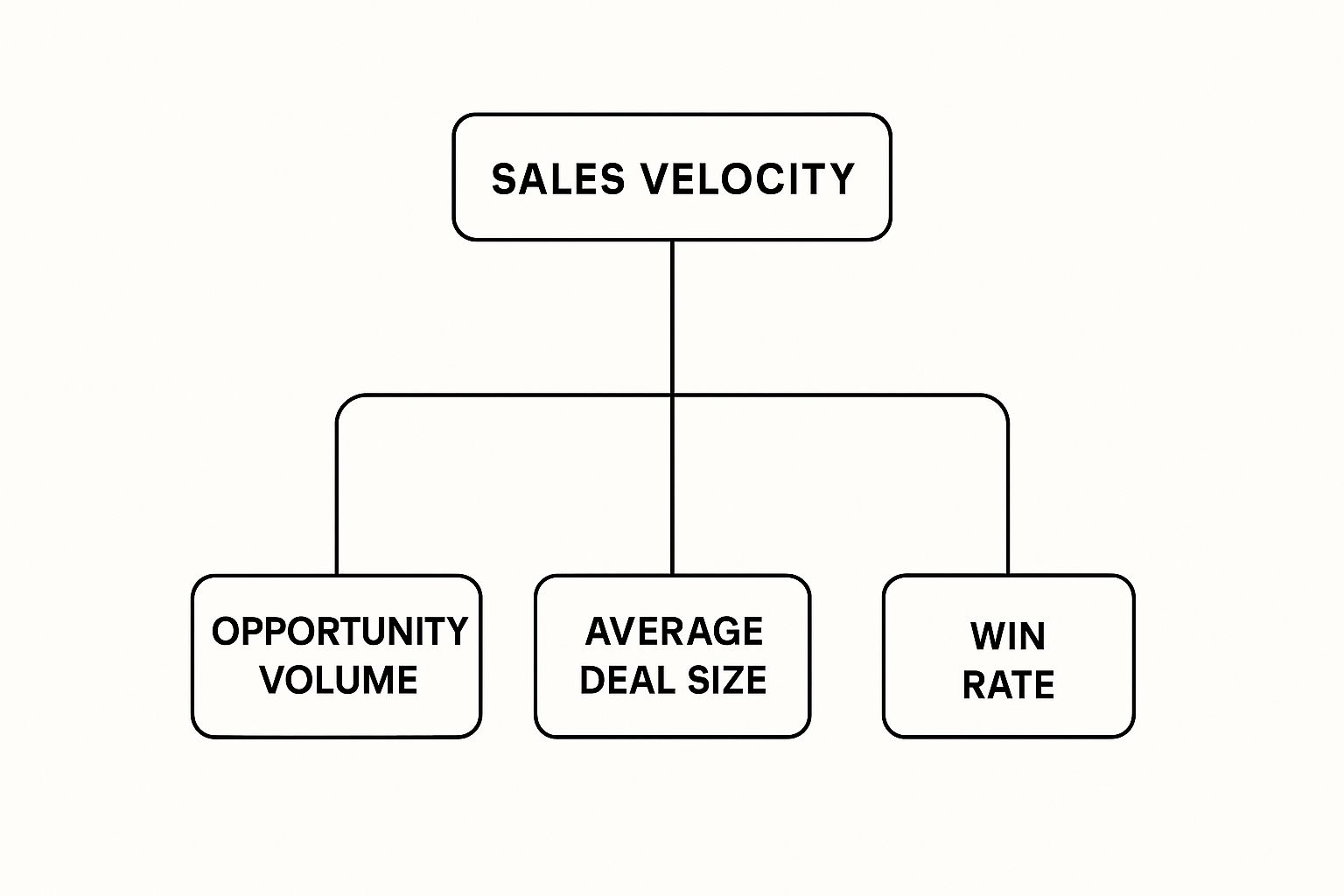
As you can see, cranking up your revenue speed boils down to improving one or more of these three levers: getting more opportunities, increasing their value, or closing them faster and more effectively. The sales acceleration formula gives you the methodology to systematically dial up each one.
Build Your Team with Data-Driven Hiring
The first pillar of the sales acceleration formula has nothing to do with fancy software or clever tactics. It’s all about people. Specifically, hiring the right people from day one.
So often, hiring managers get swayed by a candidate’s previous sales gigs or a charismatic interview. But that approach is hit-or-miss, at best. A data-driven process, on the other hand, can turn hiring from a guessing game into a repeatable science.
It’s a mindset shift. You stop looking at a long resume and start focusing on a core set of innate traits. Think of it like a baseball scout who ignores a player’s minor league batting average. Instead, they measure raw speed, swing mechanics, and athletic potential. That scout knows those fundamentals are what really predict future success. The same logic applies to building a world-class sales team.
Identifying Your Core Hiring Traits
According to Mark Roberge’s blueprint, certain built-in qualities are far better predictors of sales success than a history of closing deals. These are the traits that are incredibly difficult, if not impossible, to teach. Your job is to screen for them relentlessly.
Here are the five key characteristics to zero in on:
- Coachability: How willing are they to take feedback, learn, and actually change their approach?
- Curiosity: Do they have a genuine drive to ask sharp questions and truly understand a prospect’s problems?
- Prior Success: Can they show a history of excelling in any competitive environment, not just a previous sales role?
- Intelligence: Can they pick up complex ideas quickly and explain them in simple terms?
- Work Ethic: Is there a fire in their belly? A real commitment to putting in the hard work needed to win?
When you build your hiring process around these five traits, you end up with a team of adaptable, high-potential people you can mold into top performers for your specific sales environment. This methodical approach is the first real step toward engineering predictable growth.
Creating a Hiring Scorecard
To put this into practice, you need a tool that strips out subjectivity and gut feelings. That's where a hiring scorecard comes in. It’s a simple document that lists your must-have traits and lets you rate every candidate on a consistent scale (like 1-10) during interviews.
This forces everyone on the hiring team to evaluate candidates against the same objective yardstick. A charming personality can no longer mask a lack of curiosity or an unwillingness to be coached. Your scorecard should be built around your ideal sales profile, weighing the traits you value most.
A scorecard does more than just rank candidates; it forces a disciplined, data-first conversation. The discussion shifts from, "I really liked them," to, "They scored a 9 on coachability but only a 4 on curiosity. Let's talk about that."
This data-centric method is critical because a tiny fraction of elite reps often drive the lion's share of revenue. Research from a Sales Benchmark Index study found that just 13% of salespeople generate 87% of all revenue. That’s a far steeper curve than the old 80/20 rule. Focusing your hiring on finding and landing this top-tier talent is one of the most powerful moves you can make for growth.
Structuring Interviews to Test for Traits
Your interview process has to be designed to actually test for these characteristics, not just ask about them. Asking, "Are you coachable?" is pointless. You need to create scenarios that reveal their true colors.
Try these practical techniques in your interviews:
- The Role-Play Test: Give the candidate a quick brief on your product and ask them to sell it back to you. After their pitch, give them direct, critical feedback. Then, ask them to do it again, incorporating your suggestions on the spot. This is a real-time test of their coachability.
- The Curiosity Challenge: Pay attention to the questions they ask you. A truly curious candidate will dig deep. They’ll want to understand the "why" behind your business, your customers, and your processes, not just surface-level stuff.
- The Past Success Deep Dive: Ask them to walk you through a time they achieved something significant (in any field). Don’t just listen for a lucky outcome; listen for evidence of a repeatable process, persistence, and a killer work ethic.
When you engineer your recruitment this way, you ensure every new hire has the foundational DNA for success. For a detailed look at taking this even further, a comprehensive AI recruiting guide can show you how technology can add even more precision to this process.
Nail Your Training for Predictable Success

Once you’ve hired a team of coachable, curious, and hungry people, the next piece of the sales acceleration formula is making sure they all operate with the same level of excellence. Raw talent is a great starting point, but it often leads to inconsistent results. The real key is a metrics-driven training program that sets up every new hire for predictable success.
Think of it like an airline's flight school. Every single pilot, no matter their natural skill, has to master the exact same pre-flight checklists and emergency protocols. Why? This hardcore standardization guarantees a consistent, safe outcome on every flight. The same idea applies to scaling a sales team—you need a process that ensures every rep delivers the same core message and sticks to a proven playbook.
This flips sales training on its head. It’s no longer a one-and-done onboarding event but a continuous, data-backed process. You're building a machine where every part—every salesperson—is tuned for peak performance.
Build Your Sales Playbook
The heart of your training program has to be a comprehensive sales playbook. This isn't just some dusty product manual. It's a living, breathing guide that documents every single piece of your sales process. It's the one source of truth that lets you scale your team's skills predictably.
A great playbook takes the secret sauce from your top performers and bottles it up for everyone to use. It makes sure every team member, from the greenest hire to the most seasoned vet, is on the same page about how to talk to prospects.
A solid sales playbook must include:
- Deep Buyer Personas: Go way beyond basic demographics. You need to map out their specific pain points, their goals, what drives them, and even the exact language they use to talk about their problems.
- The Buyer's Journey: Clearly map out the stages a prospect moves through, from first becoming aware of you to signing on the dotted line. Define what information they need at each step.
- A Core Sales Presentation: Document a standard presentation or demo script. Reps should absolutely personalize it, but the key value props and core message must be rock solid and consistent.
- Objection Handling Guide: Make a list of the most common objections and give your team proven, effective ways to respond. This preps them for tough conversations and builds their confidence.
The point of a playbook isn't to churn out sales robots. It's to provide a proven foundation of what works. This frees up your reps to focus their creativity on what really matters: building genuine relationships, not reinventing the sales process from scratch.
Foster a Culture of Constant Improvement
A killer training program doesn't stop after week four. In fact, the Salesforce State of Sales Report found that 76% of sales reps say ongoing enablement is what really helps them crush their quota. The sales acceleration formula is all about a culture of continuous refinement.
This means using technology and peer feedback to constantly sharpen your team’s skills. Call recording software, for instance, is a game-changer. Managers can review calls to give specific, actionable feedback, and reps can listen to their own calls to self-correct.
On top of that, peer-to-peer feedback creates a powerful, collaborative learning loop. When reps share their winning calls and give each other constructive criticism, the entire team gets better. This data-driven coaching cycle ensures your training program is always evolving and keeping your team's skills sharp. Embedding these habits will seriously improve sales productivity and keep your team firing on all cylinders.
Generate High-Quality Inbound Demand
A finely tuned sales engine is useless without high-quality fuel. This is where the third pillar of the sales acceleration formula comes in: generating a predictable stream of top-notch inbound demand. It’s all about a deliberate shift away from relying solely on cold outreach and instead attracting buyers who are already looking for a solution like yours.
Think of it like fishing. You could spend all day casting a wide net, hoping to snag something valuable (that's cold outreach). Or, you could figure out the perfect, irresistible bait and drop your line exactly where you know the best fish are swimming. That's inbound marketing. It’s a far more efficient and rewarding approach.

Ultimately, inbound demand generation is about making your company so helpful and visible that qualified prospects find you all on their own. You do this by creating valuable content that speaks directly to their pain points and questions.
The Power of Inbound Marketing
Inbound marketing is the art of pulling customers in, not pushing your message out. It’s about building a digital presence that acts as a magnet for your ideal buyers. When someone has a problem and their first instinct is to search online, your content needs to be right there waiting with the answer.
This method completely flips the old-school sales dynamic. Instead of your reps chasing down leads who might not even be interested, you get a steady flow of prospects who have already raised their hands. They’ve read your blog, downloaded your guide, or watched your webinar. They're already educated and engaged.
The core of an effective inbound strategy usually involves:
- Content Marketing: Creating blog posts, ebooks, case studies, and videos that solve real problems for your audience.
- Search Engine Optimization (SEO): Making sure your awesome content actually shows up when people search for relevant terms.
- Social Media Engagement: Building a community and sharing your expertise on the platforms where your audience hangs out.
This approach doesn’t just bring in leads; it brings in better-qualified leads, a critical piece of the sales acceleration puzzle. It’s a foundational step, and you can learn more about building your strategy with our guide to effective inbound lead generation.
The Critical Role of a Service Level Agreement
To make this inbound engine truly fire on all cylinders, you need more than just great content. You need a rock-solid pact between your marketing and sales teams, formalized in what’s known as a Service Level Agreement (SLA).
An SLA isn't just some dusty corporate document; it's a mutual commitment that aligns both teams toward the same revenue goal. It mathematically connects marketing's efforts to sales outcomes, creating a pipeline you can actually measure and predict.
An SLA transforms the marketing-sales relationship from one of friction to one of shared accountability. Marketing commits to delivering a specific number of qualified leads, and sales commits to following up on them within a specific timeframe.
This two-way street is what makes the whole process predictable. Here’s how it usually breaks down:
- Marketing's Commitment: The marketing team agrees to deliver a set number of Marketing Qualified Leads (MQLs) each month. This holds them accountable for producing tangible results that fuel the sales team.
- Sales's Commitment: In return, the sales team agrees to contact every single one of those MQLs within a pre-defined window (say, under 5 hours). This ensures that no valuable, hard-earned lead goes to waste.
This agreement makes the ROI of your marketing spend crystal clear. Of course, to make sure the inbound demand you’re generating is truly high-quality, you need robust tracking. For e-commerce businesses, understanding specific setups like how to set up Magento 2 Google Ads conversion tracking can provide the hard data needed to prove a campaign’s worth.
By creating this closed-loop system, you build the predictable pipeline of opportunities needed to feed the powerful sales machine you’ve so carefully engineered.
Manage a Data-Driven Sales Process
The last piece of the sales acceleration formula is what ties everything together: technology and data. You can hire the sharpest reps, train them perfectly, and get a firehose of inbound leads, but you'll still leak revenue if you can't manage the process with precision. Shifting to a data-driven sales process means you stop guessing and start operating with surgical accuracy.
Think of it like the mission control center for your entire sales engine. A pilot wouldn't fly without a dashboard showing airspeed, altitude, and fuel levels. In the same way, a sales leader needs a dashboard showing lead response time, contact rate, and pipeline velocity. These numbers tell the real story of what’s working—and more importantly, what’s broken.
Without data, you’re flying blind. You might feel like your team is busy, but are they busy with the right things? By tracking the right key performance indicators (KPIs), you can pinpoint bottlenecks before they become disasters, keep your team accountable, and make smart, continuous improvements.
Why Speed Is Your Ultimate Advantage
In inbound sales, speed isn't just a nice-to-have. It’s your single biggest competitive edge.
When a prospect takes the time to fill out a demo request form, their intent is at an all-time high. They're actively looking for a solution right now. But that peak interest starts to decay with every minute that ticks by without a response. If your competitor gets in touch while your lead is still waiting, you’ve probably already lost the deal. The first one to respond usually wins.
This is exactly why tracking and relentlessly optimizing your lead response time is one of the highest-impact things you can do for your business.
A data-driven process makes speed something you can actually measure and manage. It turns a vague idea like "we should follow up faster" into a concrete goal: "our team's average response time must be under five minutes."
This obsession with speed was a cornerstone of how Mark Roberge implemented The Sales Acceleration Formula at HubSpot. For instance, he built dashboards that would automatically flag any new lead that hadn't been contacted within an hour. The system also kept an eye on free trial users who weren't getting enough follow-up calls. This level of tracking forced timely engagement and had a massive impact on their conversion rates.
Tracking the Metrics That Actually Matter
To run a truly data-driven sales process, you have to look past the vanity metrics. You need to focus on the KPIs that have a direct line to your pipeline velocity—the numbers that show how efficiently you’re turning leads into paying customers.
Here are the essentials to keep on your dashboard:
- Lead Response Time: This is the average time it takes a rep to make that first contact after a lead hits your system. It's your number one lever for conversions.
- Contact Rate: What percentage of new leads does your team actually manage to connect with? If this number is low, it could point to poor lead quality or an outreach strategy that just isn't working.
- Demo Conversion Rate: Of the initial calls or demos your team conducts, what percentage turns into a qualified sales opportunity? This is a great way to measure how effective your reps' presentations are.
- Pipeline Velocity: How fast are deals moving through your sales pipeline? This is the ultimate health metric for your entire sales process.
When you track these KPIs, you build a culture of accountability and constant improvement. When a number starts to slip, you can dig in to find the root cause and fix it immediately, instead of waiting until the end of the quarter to realize you missed your target. To get ahead of the curve, many are turning to predictive data analytics to forecast trends and optimize performance.
Eliminating Bottlenecks with Technology
Let's be real: trying to track all of this manually is a nightmare. It's time-consuming, frustrating, and just begging for human error. This is where technology becomes your best friend.
Tools like Distro are built specifically to automate and optimize the most critical—and often slowest—part of the process: getting the right lead to the right rep, instantly.
Distro plugs right into your demo request forms. The second a high-intent lead hits submit, it uses intelligent routing rules—based on things like territory, company size, or a simple round-robin—to book a meeting directly on the correct rep's calendar.
This simple, automated step completely eliminates the manual assignment bottleneck and absolutely crushes your lead response time. Instead of a hot lead sitting in a queue for hours, they get an instant booking confirmation. This is the sales acceleration formula in action: using technology to build a faster, more efficient, and truly data-driven process. For more on this, check out our guide on implementing sales operations best practices.
Putting The Sales Acceleration Formula Into Action
Knowing the theory behind the sales acceleration formula is one thing. Actually putting it into practice without derailing your entire sales org? That’s a whole different ball game.
The key is to avoid getting overwhelmed. You don't need to blow up your entire sales process overnight.
Think of it as a series of small, consistent wins. The journey from a chaotic, reactive sales floor to a predictable revenue engine starts with one manageable step. By homing in on one area at a time, you build momentum, show your team some quick wins, and make the whole framework feel a lot less intimidating.
Start With a Single Metric
The best way to get started is to pick one high-impact metric and throw all your initial energy at it. This gives you a crystal-clear, measurable goal and a fast feedback loop on whether your efforts are working.
A great place to begin is often with the biggest bottleneck in your current process. For a lot of teams, that bottleneck is lead response time. Every single minute a hot lead sits in the queue, your chances of ever closing them plummet. Fix that one number, and you'll see an immediate, tangible impact.
Another fantastic starting point is to create your very first hiring scorecard. By simply writing down the traits you're looking for in new reps—like genuine curiosity or coachability—you start bringing data into the most fundamental process you have. That single document can completely change the DNA of your sales team over time.
Choosing Your First Actionable Step
Not sure where to jump in? Here are a few dead-simple, practical first steps that can kickstart your journey with the sales acceleration formula. Just pick the one that speaks to your biggest headache right now.
- Set up a basic SLA: Get your marketing and sales leads in a room. Agree on a simple Service Level Agreement. Maybe marketing commits to delivering 20 MQLs a month, and sales commits to calling them within 8 business hours. Write it down and track it. That's it.
- Time your follow-up: For one week, grab a stopwatch (or just your phone) and manually track the time between a new lead coming in and the first sales touch. The results will probably be shocking and will give you all the ammo you need to justify an investment in automation.
- Create a "one-page" playbook: Don't try to write a 100-page sales bible. Start by documenting your top three customer pain points and the single best question to ask to uncover each one. This tiny asset gives your reps immediate, practical guidance they can use on their very next call.
The goal isn't perfection; it's progress. Sales acceleration is built through a series of small, deliberate improvements that compound over time. A single successful change builds the confidence and buy-in needed for the next one.
This step-by-step approach lets you prove the value of working smarter without having to tear down your entire system at once. Once you nail one area, you move on to the next, layering on improvements to build your high-performance sales machine piece by piece. Small, consistent steps are what build lasting success.
Of course. Here is the rewritten section, designed to sound like it was written by an experienced human expert, following all the provided guidelines and examples.
Your Questions, Answered
Alright, even with the best blueprint, trying something new in your sales org is going to bring up some real-world questions. I get it. Let's tackle some of the most common ones I hear about the sales acceleration formula so you can see how it actually plays out on the ground.
Is This Formula Just for Big Companies?
Not a chance. It’s easy to look at an example from a giant like HubSpot and think, "We don't have that kind of scale." But the core ideas here are universal. Whether you're a startup or a small business, you can get a huge lift from applying the formula in a way that fits your world.
Think about it: a five-person sales team can absolutely create a simple hiring scorecard. You're not building a massive HR machine; you're just agreeing on what matters most, like coachability and a solid work ethic. You can draft a one-page sales playbook that nails your value prop. The whole point is to start making data-driven decisions, no matter how small your team is. It's about progress, not trying to achieve perfection overnight.
How Much Tech Do I Really Need to Buy?
You don't need to go out and buy a massive, wallet-busting tech stack to make this work. There's really only one non-negotiable piece of the puzzle: a solid CRM. That’s your single source of truth for all things customer-related, and you can't track your pipeline or interactions without it.
After that, you can start layering in other tools as you identify specific needs. Maybe you add a sales automation tool to handle follow-ups, or a call recording platform like Gong to level up your coaching. The formula isn't about buying software for the sake of it. It's about finding your biggest bottleneck and then finding the right tool to fix that one problem.
One of the biggest myths about the sales acceleration formula is that it's this rigid, complicated system. It's not. Think of it as a flexible framework. You adapt the principles to what’s happening in your business, focusing on constant, informed improvement instead of following some strict, unforgiving rulebook.
How Do I Get My Team on Board with This?
Any time you introduce change, you're going to get some pushback. That’s especially true with seasoned reps who have their own tried-and-true methods. The secret to getting their buy-in is to make it all about them.
You have to frame these changes not as micromanagement, but as a way to help them close more deals and, frankly, make more money. Show them how a faster response to a new lead translates directly into more conversations. Demonstrate how a clear playbook helps them get past the most common objections they hear every day. A great tactic is to start with a small pilot group of reps who are open to trying it, track their successes, and then use that story as proof to win over the rest of the team.
Ready to stop talking about bottlenecks and actually eliminate your biggest one? Putting the sales acceleration formula into practice is easier than you think. Distro gets your inbound leads routed and booked on the right rep’s calendar the second they fill out a form. You'll crush your response time and make sure no high-intent prospect ever gets left behind.
See exactly how it works at https://distro.so.