
Ever heard the old fishing analogy? You can spend all day chasing individual fish with a spear, or you can find the right spot, use the right bait, cast a wide net, and let the fish come to you. The first is outbound marketing. The second is inbound marketing lead generation.
Inbound is all about creating valuable content and experiences that naturally pull your ideal customers toward your brand. It’s a complete shift in thinking.
The Philosophy of Inbound Lead Generation

At its core, inbound flips the old advertising playbook on its head. Forget about blasting interruptive messages at a massive, uninterested audience. The focus here is on earning attention, not demanding it.
This customer-first approach is built on a simple but incredibly powerful idea: provide real value upfront. When you do that, you build trust and attract people who are already looking for what you offer. Think of yourself as a helpful guide, not a pushy salesperson.
You’re creating useful blog posts, insightful guides, and engaging videos that directly address your audience’s pain points. This content acts like a magnet, drawing in potential customers who are actively searching for the very solutions you provide.
And it works. Inbound marketing tactics generate a staggering 54% more leads than traditional outbound marketing. Why? Because people have gotten incredibly good at tuning out disruptive ads. You can dig into more of these knockout inbound marketing stats to see the full picture.
Inbound vs Outbound Lead Generation At a Glance
To really grasp the difference, it helps to see the two approaches side-by-side. Outbound is about pushing your message out, while inbound is about pulling customers in. This table breaks down the fundamental differences in strategy, methods, and goals.
| Characteristic | Inbound Marketing (Pull) | Outbound Marketing (Push) |
|---|---|---|
| Core Principle | Earning attention through value and trust. | Buying attention through interruption. |
| Communication | Two-way, conversational, and helpful. | One-way, broadcasting a message. |
| Primary Methods | SEO, content marketing, social media, blogging. | Cold calls, email blasts, print/TV ads. |
| Targeting | Attracts specific, self-qualified prospects. | Targets a broad, often undefined audience. |
| Lead Quality | Higher quality, warmer leads. | Lower quality, colder leads. |
| Customer Focus | Addresses customer needs and problems first. | Pushes the company's product or service. |
| ROI | Generally higher and more sustainable over time. | Often lower and dependent on continuous ad spend. |
| Asset Type | Creates long-term, compounding assets (content). | Relies on temporary, campaign-based assets (ads). |
As you can see, inbound is a long-term game focused on building relationships and assets, whereas outbound is often about short-term, high-volume tactics.
How the Inbound Process Works
The inbound methodology isn’t just a random collection of tactics; it’s a structured framework designed to guide a total stranger into becoming a delighted customer. Understanding these three stages is the key to building an effective lead generation engine.
Attract: This first stage is all about pulling in the right kind of traffic. Through content marketing, search engine optimization (SEO), and social media, you make your business discoverable to your ideal customer. The goal is simple: bring people to your digital doorstep by answering their questions.
Engage: Once you've attracted visitors, it's time to turn them into leads. This is where you offer something more substantial—like an ebook, a webinar, or a handy checklist—in exchange for their contact info. That simple trade turns an anonymous visitor into a known contact, officially kicking off the lead generation process.
Delight: Getting a lead is just the start. The delight stage is about nurturing that new relationship with ongoing, valuable communication. Using email marketing, proactive support, and personalized content, you build loyalty and turn happy customers into your brand's biggest cheerleaders.
The whole point of inbound is to create marketing that people actually love. When you focus on being genuinely helpful at every step, you build a sustainable growth engine that doesn't depend on constantly paying for attention.
Why Inbound Is So Effective Today
This approach resonates so deeply because it aligns perfectly with how modern buyers make decisions. People research, compare, and educate themselves online long before they even think about talking to a salesperson. A smart inbound strategy meets them exactly where they are on that journey.
By consistently putting out high-quality content, you establish your brand as a credible, trustworthy authority in your field. This not only attracts leads but also makes the sales process infinitely smoother. Why? Because your prospects arrive already educated, engaged, and trusting in your expertise.
Ultimately, inbound lead generation is about building relationships, not just collecting contacts.
Building Your Inbound Lead Generation Engine
A powerful inbound strategy isn't a single action; it's a well-oiled engine with core components all working in sync. To really get a handle on inbound marketing lead generation, you need to understand how these pillars connect and support each other. Think of it like building a high-performance vehicle designed specifically to attract and capture your ideal customers.
And at the heart of it all is the fuel that makes the whole thing go.
Content Marketing: The High-Octane Fuel
Content marketing is the very core of your inbound engine. It’s the high-octane fuel that attracts, engages, and ultimately converts your audience. This isn't about blasting out sales pitches; it's about producing genuinely valuable material like blog posts, in-depth guides, case studies, and videos.
Each piece of content you create should zero in on a specific pain point or question your ideal customer has. A B2B software company might create a whitepaper on improving operational efficiency. A B2C brand could publish a video tutorial solving a common household problem. By providing answers and solutions for free, you build trust and establish your brand as a helpful authority.
This value-first approach is what pulls prospects toward you, making them far more receptive to your message long before you ask for anything in return.
SEO: The Strategic GPS System
Creating amazing content is one thing, but it’s pointless if no one can find it. That's where Search Engine Optimization (SEO) comes in. If content is your fuel, SEO is the strategic GPS that guides the right audience directly to your digital doorstep. It’s all about optimizing your website and content to rank higher on search engines like Google for the right keywords.
When a potential customer searches for "how to solve [their problem]," you want your content to be the first thing they see. This breaks down into a few key activities:
- Keyword Research: Pinpointing the exact terms and phrases your audience is typing into search bars.
- On-Page SEO: Weaving those keywords naturally into your content, page titles, and meta descriptions.
- Technical SEO: Making sure your site is fast, mobile-friendly, and easy for search engines to crawl and understand.
A solid SEO strategy ensures your valuable content doesn't just sit there. It gets out there and actively reaches people who are already looking for your solutions, creating a steady stream of highly qualified organic traffic. For a deeper dive, check out our comprehensive guide on powerful inbound lead generation techniques.
Social Media: The Distribution Network
With your fuel (content) and GPS (SEO) in place, you need a way to amplify your message and actually talk to your community. Social media is your distribution network, broadcasting your content to a wider audience and sparking conversations around your brand.
It’s not just about mindlessly posting links to your latest blog. It’s about sharing your content in a way that feels native to each platform—maybe that’s a quick tip on X, a visual guide on Pinterest, or an in-depth discussion in a LinkedIn group.
Social media transforms one-way content broadcasting into a two-way dialogue. It allows you to listen to your audience, answer their questions in real-time, and build a loyal community that feels connected to your brand.
Landing Pages: The Conversion Stations
Okay, so you've attracted visitors with great content, made it easy for them to find you with SEO, and engaged them on social media. Now what? You need a place to actually convert them into leads. That’s the job of a landing page. Think of them as the dedicated conversion stations of your inbound engine.
These are simple, hyper-focused web pages with one single, solitary goal: to capture a visitor's information in exchange for a valuable offer, often called a lead magnet. This could be an ebook, a webinar registration, a template, or a free consultation. Unlike a busy homepage with dozens of links and distractions, a landing page strips everything else away, making the decision to convert crystal clear and easy.
A well-designed landing page, paired with a compelling offer, is the final, critical step that turns an anonymous visitor into a quantifiable lead for your sales team.
Creating Content That Converts Visitors Into Leads

Great content does more than just fill a page; it’s a strategic tool designed to spur action. The most powerful inbound marketing lead generation programs are built on a foundation of content that doesn't just attract eyeballs but skillfully guides visitors toward becoming leads. The real secret? Creating the right content for the right person at the right time.
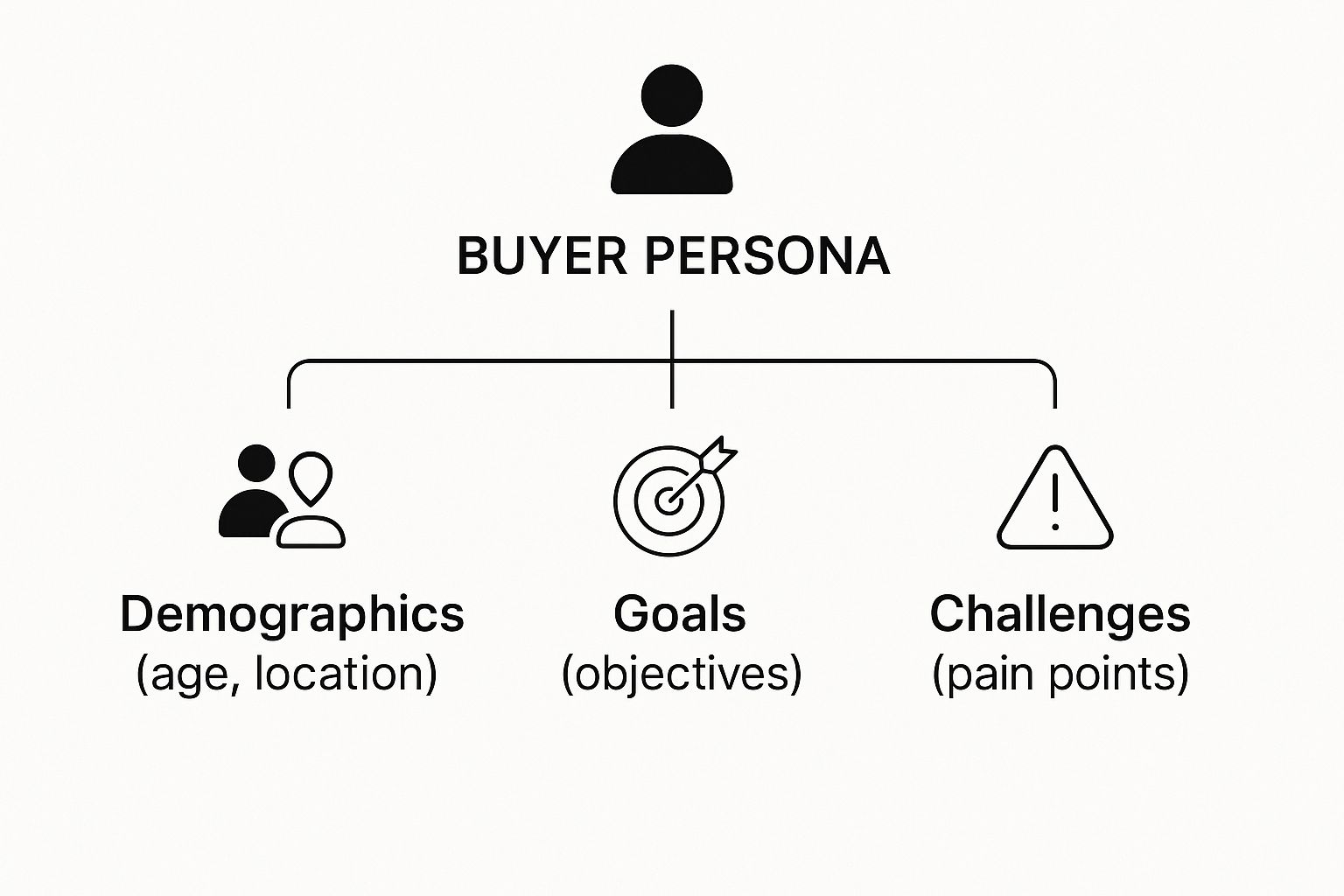
This isn't about churning out random blog posts. It’s about mapping every single piece of content to a specific stage of the buyer's journey. When you understand your prospect’s mindset at each phase, you can give them exactly what they need to take the next step with confidence. This approach is all about building trust by delivering massive value before you ever ask for a dime.
Mapping Content to the Buyer's Journey
The buyer’s journey usually breaks down into three key stages: Awareness, Consideration, and Decision. Each stage calls for a completely different type of content to be effective. Think of it like a conversation: first, you introduce yourself, then you build a relationship, and only then do you propose a solution.
Awareness Stage (Top of Funnel): At this point, your prospects know they have a problem or a question, but they might not have the words for it yet. Your job is to educate and inform, not to sell. The best content here answers their "why," "what," and "how" questions.
Consideration Stage (Middle of Funnel): Now we're getting somewhere. Your prospect has put a name to their problem and is actively researching potential solutions. They're comparing different products and approaches, so your content needs to position your offering as a top contender.
Decision Stage (Bottom of Funnel): In the final stretch, the prospect has narrowed down their options and is ready to pull the trigger. They just need that last bit of reassurance or a compelling offer to feel good about their choice. Your content here should make it incredibly easy and appealing to choose you.
The most successful content strategies meet buyers exactly where they are. By providing targeted value at each stage of their journey, you transform your website from a simple brochure into a powerful, automated lead generation machine.
This strategic alignment is precisely why content marketing is such a beast for inbound lead generation. In fact, it can save businesses up to 62% more than traditional marketing while pulling in three times as many leads. A huge part of this is that over 70% of search engine users click on organic results instead of paid ads because they're looking for quality content that actually solves their problems.
The Anatomy of a High-Converting CTA
No piece of content is truly complete without a compelling Call-to-Action (CTA). Your CTA is the bridge connecting your content to your lead capture form. It's the big, bright sign that tells your reader exactly what to do next. A weak or confusing CTA can stop even the most interested prospect dead in their tracks.
A great CTA has a few non-negotiable components:
- Action-Oriented Language: Kick things off with strong verbs like "Download," "Get," "Register," or "Start." Be direct and crystal clear about the action you want them to take.
- Clear Value Proposition: The user needs to know what’s in it for them. Instead of a generic "Click Here," try something like "Get Your Free Marketing Template."
- Sense of Urgency (When Appropriate): Phrases like "Limited-Time Offer" or "Register Before Spots Fill Up" can give people the nudge they need to act now.
- Visually Striking Design: Your CTA button has to pop. Use contrasting colors and clean, readable text to make sure it stands out from the rest of the page.
Of course, for your valuable content to actually reach the right audience and convert them, you need to optimize it for search engines. This is where robust SEO tools like Rank Math become essential. They help drive qualified traffic to your pages, giving your well-crafted CTAs the best possible chance to succeed. By combining strong content, smart SEO, and clear CTAs, you create a seamless path from discovery to conversion.
Getting traffic to your site with awesome content is a huge win, but let’s be real—it's just the start. The real magic of inbound marketing lead generation kicks in when you turn that traffic into qualified leads and, eventually, happy customers. This is where a well-oiled conversion funnel comes into play, a system that works around the clock to capture interest and build relationships.
The whole thing starts the second a visitor decides they need that valuable thing you’re offering, whether it’s a killer checklist or a game-changing ebook. To make that exchange happen, you need a high-converting landing page. This isn't just another page on your website; it's a dedicated, distraction-free space with one job and one job only: capturing lead info.
Designing for Conversion with Landing Pages and Lead Magnets
Think of your landing page as a short, focused conversation. You need a headline that matches the promise you made in your call-to-action (CTA), some quick copy that hammers home the value of your offer, and a dead-simple form. The real star of the show, though, is the lead magnet—an irresistible piece of content you give away in exchange for an email address.
The best lead magnets solve a very specific problem for your audience. Some of the tried-and-true formats include:
- Checklists and Templates: Simple, actionable tools that make your audience's life easier.
- Ebooks and Whitepapers: Deep dives that show off your expertise and educate potential customers.
- Webinar Registrations: Access to expert insights and a chance for live interaction.
- Free Trials or Demos: A hands-on test drive of your product, perfect for people who are close to making a decision.
Your goal is to make the offer so good that visitors feel like they’re getting an absolute steal. To really crank up your results, it’s critical to implement proven strategies to improve website conversion rates and make it incredibly easy for every visitor to take that next step.
From Lead Capture to Relationship Building
Okay, so someone filled out your form. Congrats, you have a new lead! But the journey is far from over. This is where lead nurturing enters the picture, and marketing automation becomes your best friend. Very few leads are ready to buy on the spot; they need a little guidance.
Lead nurturing is all about building a relationship by sending relevant, helpful content over time. The easiest and most effective way to do this is with automated email workflows. These are just pre-built email sequences that get triggered when a lead takes an action, like downloading that lead magnet.
A great nurturing sequence doesn't feel like marketing. It feels like a helpful, ongoing conversation that anticipates the lead's needs and guides them through their decision-making process.
For instance, a new lead might get a welcome email, then a related blog post a few days later, followed by a case study, and maybe eventually an invite to a demo. Each touchpoint adds more value and nudges them a little further down the funnel. Automation makes sure this happens for every single lead, so you don't have to lift a finger. This system is non-negotiable, especially when you consider the average cost per lead is a whopping $198.44. You can't afford to let those leads go cold. Plus, with 44% of sales reps saying they’re too swamped for fast follow-up, automation is the only way to plug that gap and actually convert leads.
This automated process is what separates the casual browsers from the serious buyers. By seeing what they click on and engage with, you can pinpoint exactly when a lead is hot enough to hand over to your sales team. A well-tuned funnel doesn't just capture leads—it qualifies them, nurtures them, and has a direct impact on your lead-to-sale conversion rate, fueling real, sustainable growth.
Measuring Your Inbound Marketing Success

You can’t improve what you don’t measure. It’s an old saying, but it’s the absolute truth in marketing. While seeing website traffic go up feels like a win, successful inbound marketing lead generation is about understanding what actually moves the needle for your business.
It’s time to push past vanity metrics like page views and dig into the Key Performance Indicators (KPIs) that tell you the real story. Think of it like a diagnostic checkup for your marketing engine—it helps you spot bottlenecks, prove your return on investment, and make smarter decisions down the road. Without the data, you’re just flying blind.
Core Metrics That Actually Matter
Getting a clear picture of your performance doesn't require a hundred different data points. In fact, it's better to start with a simple, focused dashboard that connects your marketing activities directly to business outcomes. You can set this up easily with standard tools like Google Analytics.
To get started, focus on these three foundational KPIs:
Visitor-to-Lead Conversion Rate: This is your MVP metric. It's the percentage of people who visit your site and become a lead by filling out a form. A strong conversion rate is the single best indicator that your content, CTAs, and landing pages are hitting the mark.
Cost Per Lead (CPL): Simple math with a big impact. Divide your total marketing spend by the number of leads you generated over a certain period. This tells you exactly how much it costs to acquire each new lead, revealing just how efficient your inbound machine really is.
Lead-to-Customer Rate: The ultimate test of lead quality. This metric shows how many of your hard-earned leads actually convert into paying customers. It's also a great way to see how well your marketing and sales teams are working together.
A high visitor count is meaningless if none of those people ever convert. You have to move past the surface-level numbers. Focusing on conversion rates and costs gives you actionable insights that drive real, sustainable growth.
But what about which leads to focus on? A well-rounded measurement strategy doesn't just look at numbers; it looks at quality. To help you track these KPIs effectively, here’s a breakdown of what to include in your dashboard.
Key Metrics for Your Inbound Lead Generation Dashboard
This table outlines the most important KPIs to track for evaluating the health and effectiveness of your inbound lead generation efforts.
| Metric | What It Measures | Why It's Important |
|---|---|---|
| Visitor-to-Lead Conversion Rate | The percentage of website visitors who convert into leads (e.g., by filling out a form). | Directly shows the effectiveness of your landing pages, CTAs, and offers. It's a primary indicator of content-market fit. |
| Cost Per Lead (CPL) | The total marketing cost divided by the number of new leads acquired. | Measures the financial efficiency of your lead generation campaigns. A lower CPL means a better return on your marketing spend. |
| Marketing Qualified Leads (MQLs) | The number of leads deemed ready for the sales team based on specific criteria. | Helps gauge the quality of incoming leads and ensures the sales team's time is spent on high-potential prospects. |
| Lead-to-Customer Rate | The percentage of leads that ultimately become paying customers. | The ultimate measure of lead quality and sales alignment. It connects marketing efforts directly to revenue. |
| Channel-Specific Conversion Rates | Conversion rates broken down by source (e.g., organic search, social media, email). | Identifies which channels are driving the most valuable traffic, allowing you to double down on what's working. |
| Time to Conversion | The average time it takes for a visitor to become a lead, and for a lead to become a customer. | Understanding the length of your sales cycle helps you optimize your nurturing sequences and sales follow-up strategy. |
Tracking these metrics gives you a 360-degree view of your inbound performance, helping you make data-backed decisions that truly impact the bottom line.
Identifying Sales-Ready Leads with Scoring
Let's be honest: not all leads are created equal. Some are just window shopping, while others are ready to pull out their credit card. So, how can you possibly tell the difference?
The answer is lead scoring. This is a powerful system for automatically qualifying leads by assigning points based on their behavior and attributes. For instance, a prospect who downloads a pricing guide (a strong buying signal) gets a higher score than someone who just subscribed to your blog. You can also assign points for demographic info, like their job title or company size.
This system is a game-changer. It allows your sales team to stop chasing cold leads and pour their energy into conversations that are far more likely to close. Once a lead hits a certain score, they're automatically flagged as a Marketing Qualified Lead (MQL) and sent straight to sales for immediate follow-up.
For a deeper dive into the entire process, from attracting visitors to closing deals, check out our guide on generating high-quality inbound leads. By measuring the right things and qualifying leads the right way, you can build a more efficient funnel, shrink your sales cycle, and prove the undeniable value of your inbound strategy.
Of course. Here is the rewritten section, following all the provided guidelines for tone, style, and formatting.
Common Questions About Inbound Lead Generation
Shifting from outbound sales to an inbound way of thinking always brings up a bunch of practical questions. The theory behind inbound marketing lead generation is pretty simple—attract, engage, and delight—but putting it into practice means you need a clear idea of what to expect.
Let's dig into some of the most common questions that pop up when businesses start their inbound journey. These answers should clear up a few myths, set the right expectations, and give you the confidence to dive in.
How Long Does Inbound Marketing Take to Show Results?
This is usually the first thing everyone wants to know, and for good reason. Unlike running a paid ad campaign, which can start sending traffic your way almost instantly, inbound marketing is a long game. Think of it like planting a tree instead of buying a bouquet. The flowers look great right away but are gone in a week; the tree takes time to grow but will give you fruit and shade for years to come.
Inbound marketing is all about building sustainable assets—a rich library of helpful content, real authority with search engines, and a loyal audience. These things simply don't happen overnight.
Most businesses start to see a noticeable, steady climb in organic traffic and lead flow within 6 to 12 months of consistent effort. The results build on themselves. The more high-quality content you create and the more authority you establish, the faster your growth will accelerate over time.
But that timeline isn't set in stone. It can change based on a few things:
- Industry Competition: If you're in a crowded space with big, established players, it's going to take longer to carve out your spot and get noticed.
- Content Consistency: Publishing one great, SEO-focused blog post a month will get you there, but much slower than publishing one every week. Consistency is everything.
- SEO Effectiveness: How well you do your keyword research and on-page SEO directly impacts how quickly Google finds and starts ranking your content.
The real takeaway here is to be patient and persistent. That initial grind builds the foundation for compounding returns, which eventually leads to a predictable and much more cost-effective stream of leads.
Can Inbound Work for Both B2B and B2C Companies?
Absolutely. The core idea of inbound—pulling customers in by offering them value—is universal. It works no matter who you're selling to, because at the end of the day, you're always marketing to a human who has a problem they need to solve. Where things get different is in the specific tactics and channels you use for B2B versus B2C.
With a B2B company, the sales cycle is usually longer and involves a whole committee of decision-makers. The inbound strategy here is all about building authority and earning trust with deeply educational content.
- B2B Tactics: Think detailed whitepapers, comprehensive case studies, industry reports, and expert-led webinars. The whole point is to become a trusted advisor who can guide leads through a complex buying journey.
For a B2C company, the sales cycle is often way shorter and driven more by emotion. The inbound strategy is usually geared toward building a community, creating fun experiences, and inspiring someone to take action right away.
- B2C Tactics: This could look like "how-to" blog posts, entertaining videos, social media contests, or partnerships with influencers. The content tends to be lighter and more focused on showing how the brand fits into a customer's lifestyle.
So while the execution looks different, the principle is identical. Both start by truly understanding what the target audience needs and creating content that actually helps them.
What Is the Difference Between Lead Generation and Demand Generation?
This is a really common point of confusion, but getting the distinction right is critical for making sure your marketing efforts are aligned. They're closely related and definitely work together, but they tackle two different stages of the marketing funnel.
Imagine you sell a new kind of smart home device. Demand generation is all about making people aware that their home could be smarter and more efficient in the first place. You're creating interest for the entire category of solutions, answering the question, "Why do I even need this?"
Lead generation, on the other hand, is the specific act of capturing the contact info of the people who are now interested. It's the moment an anonymous person curious about smart homes becomes a known contact in your system. Lead generation answers the question, "Okay, I'm interested. Tell me more about your specific device."
To put it simply: Demand generation creates the market, while inbound lead generation captures it. Demand gen makes someone aware of the game; lead gen gets them to sign up for your team.
You can't have truly effective lead generation if no one wants what you're selling. They're two sides of the same coin, working in tandem to guide someone from "I've never heard of this" to "I'm ready to learn more."
Do I Need a Big Budget for Inbound Lead Generation?
Not at all, and that’s one of its biggest strengths. Inbound marketing is incredibly scalable and can absolutely be started on a shoestring budget. Unlike outbound, which often demands a big ad spend just to get in the game, you can kick off inbound with an investment of your time and expertise.
Your initial focus should be on just one or two high-impact channels you can manage consistently. For instance, you could commit to publishing one well-researched, SEO-optimized blog post every single week and promoting it on the one social media platform where you know your audience hangs out.
At the start, your greatest resource is your own expertise and creativity. As your strategy starts to work and you can prove a positive return on investment (ROI), you can then smartly reinvest those profits to scale up. Maybe that means buying some marketing automation software, hiring a freelance writer, or trying out new formats like video. Inbound lets you grow your budget right alongside your business.
Ready to stop chasing leads and start attracting them? Distro helps B2B sales teams convert more inbound leads by automatically routing high-intent prospects to the right rep’s calendar in real-time. Eliminate manual lead assignment, slash response times, and 3x your demo request conversions. See how Distro works.