
At its core, the difference between demand generation and lead generation is pretty straightforward. Demand generation is all about creating awareness and a desire for what you offer. Lead generation, on the other hand, is about capturing contact details from people who are already showing interest.
Think of it this way: demand gen makes people thirsty, while lead gen offers them a glass of water.
Unpacking the Core Strategic Differences
Even though demand and lead gen work hand-in-hand, they play very different roles in your marketing and sales funnel. It's a bit like the distinction between distinguishing between copywriting and content writing—both are crucial for messaging, but they have different jobs.
Demand generation casts a wide net, focusing on building awareness and genuine interest with a broad audience at the top of the funnel. In contrast, lead generation hones in on a much smaller group of prospects who are already engaged, aiming to convert them into qualified leads for the sales team.
Demand Generation: The Foundation of Awareness
Demand generation is the long game. The entire point is to educate your market, establish your brand as an authority, and create a preference for your solution—and even your entire product category.
This strategy hinges on the idea that by consistently offering high-value, ungated content—like insightful blog posts, podcasts, and active social media discussions—you build trust. Success isn't measured by how many forms get filled out, but by the growth of your audience, how engaged they are, and an increase in people searching for your brand by name.
Lead Generation: The Mechanism for Conversion
Lead generation, on the other hand, is much more direct and transactional. It's designed to capitalize on the awareness and trust you've painstakingly built through your demand gen efforts.
Here, you’re using gated content—think webinars, demos, or in-depth whitepapers—to persuade an interested person to trade their contact information for something valuable. The goal is to pinpoint individuals with clear buying intent and turn them into Marketing Qualified Leads (MQLs) for your sales team. This approach is all about conversion. If you want to get even more specific, you can dig into the differences between various lead types, like we cover in our guide on inbound vs outbound leads.
The infographic below really nails the primary focus and KPIs for each strategy.
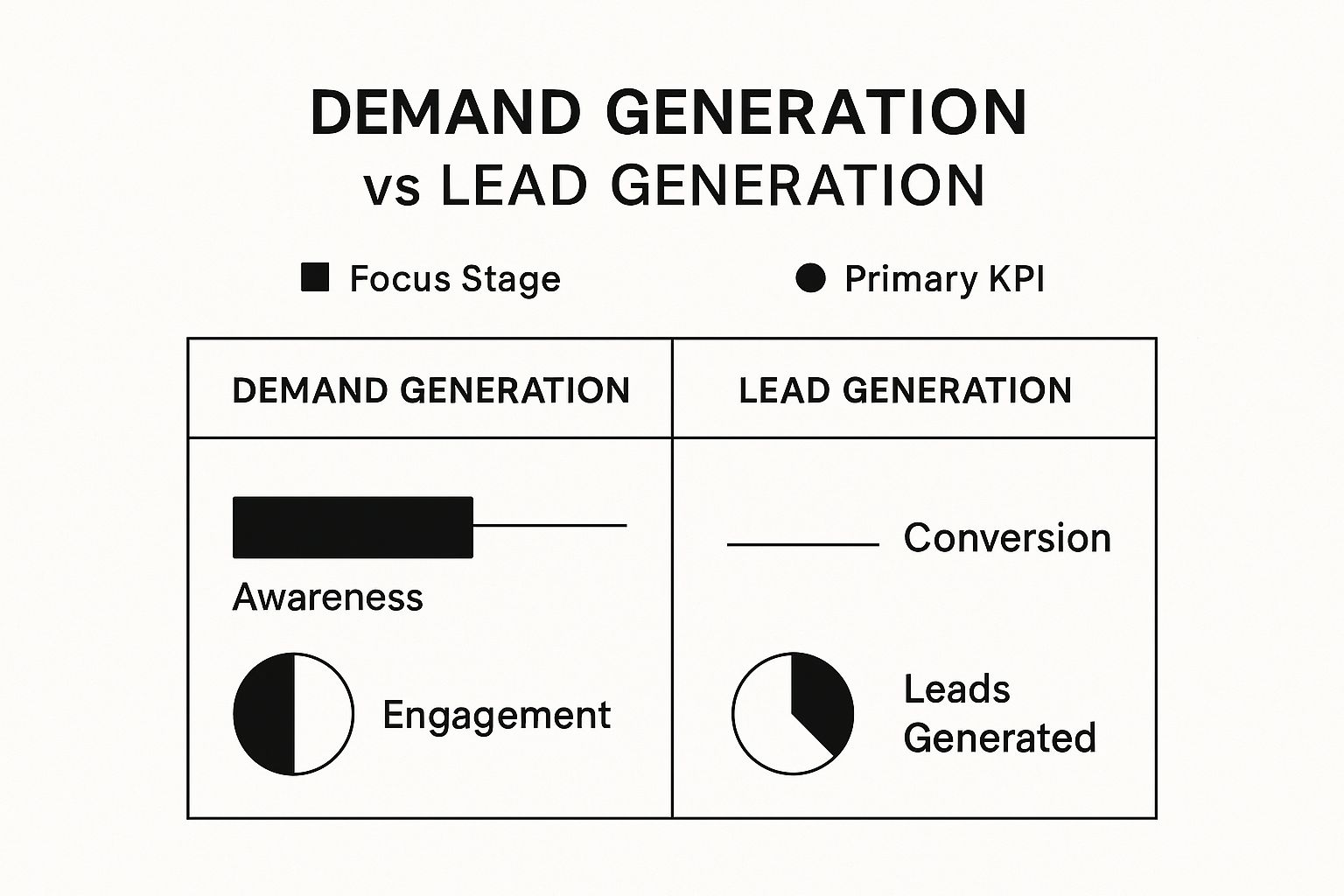
As you can see, demand gen owns the top of the funnel—awareness and engagement—while lead gen is laser-focused on bottom-of-funnel conversions.
To make the comparison crystal clear, here’s a high-level breakdown of how these two strategies differ in practice.
Core Strategic Differences: Demand vs. Lead Gen
| Attribute | Demand Generation (Creating Desire) | Lead Generation (Capturing Intent) |
|---|---|---|
| Primary Goal | Build brand awareness, educate the market, and create demand for your category or solution. | Convert interested prospects into qualified leads by capturing their contact information. |
| Audience | Broad, often unaware of their specific problem or your solution. | Narrow, problem-aware individuals actively seeking solutions and showing buying intent. |
| Key Metrics | Website traffic, social engagement, share of voice, branded search volume, content consumption. | MQLs, SQLs, Cost Per Lead (CPL), conversion rates, demo requests. |
| Tactics | Ungated content: blogs, podcasts, videos, social media, community building, PR. | Gated content: eBooks, webinars, demo requests, free trials, ROI calculators. |
| Timeline | Long-term, focused on building a sustainable audience and brand trust over time. | Short-term, focused on immediate actions and generating a pipeline for sales. |
Ultimately, a successful go-to-market strategy doesn't choose one over the other. It understands that demand generation builds the audience, and lead generation converts that audience into a pipeline.
An Inside Look at Demand Generation Strategy

We've drawn a line in the sand between demand gen and lead gen, but now it's time to really dig into what a demand generation strategy looks like in the wild. This isn't about chasing quick wins or filling a pipeline with lukewarm leads. It's a long game—an investment in becoming an indispensable thought leader in your space.
The goal here isn't to sell a product; it's to make your market smarter.
Effective demand generation shifts the entire conversation from "buy now" to "learn now." You're focused on educating your target audience about the problems they're facing, and sometimes, the problems they don't even know they have yet. By consistently delivering real value without asking for anything in return, you build a deep foundation of trust and authority.
This approach organically transforms your brand from just another vendor into a trusted advisor. When a future buyer finally realizes they need a solution, your name is already top of mind because you've spent months—or even years—helping them understand their own challenges.
Core Tactics for Building Authority
Demand generation runs on high-value, ungated content. The whole point is to remove every bit of friction between your audience and your expertise.
Some of the most popular tactics include:
- In-depth Blog Posts & Articles: Publishing comprehensive, SEO-friendly content that genuinely answers your audience's most burning questions.
- Podcasts and Video Series: Offering accessible, on-demand insights that build a more personal connection with your listeners and viewers.
- Original Research and Reports: Conducting your own unique studies and sharing the findings to become a primary source of data for your entire industry.
- Community Engagement: Actively participating in the forums, social media groups, and online communities where your audience actually spends their time.
Notice a theme? None of these are designed to capture leads directly. Instead, they create a loyal following of people who see your brand as the go-to resource for industry knowledge. If you're looking for tactics more focused on immediate conversion, you can find them in our guide to https://www.distro.so/blog/inbound-lead-generation.
Measuring What Truly Matters
Because demand generation isn't about form fills, the way you measure it has to be different. Success isn't counted in MQLs; it's measured in genuine market influence. For teams already in the trenches, figuring out the right KPIs can be one of the biggest demand generation challenges.
The real signal of a successful demand generation strategy is when your audience starts seeking you out. It’s the shift from you finding them to them finding you.
Key performance indicators that point to growing market authority include:
- Growth in Direct & Organic Traffic: Are more people typing your URL directly into their browser or finding you through non-branded searches related to your expertise? That's a great sign.
- Increased Branded Search Volume: A rise in people specifically searching for your company name indicates strong brand recall and awareness.
- Higher Share of Voice (SOV): Your brand’s visibility in conversations across the market is growing when compared to your competitors.
These metrics show you're not just reaching an audience; you're building one that trusts and values your perspective.
Demand Gen in Action: A Cybersecurity Scenario
Let's make this real. Imagine a B2B cybersecurity firm that’s developed a brand-new category of threat detection software. The problem is, the market doesn't even know this category exists, so traditional lead gen would fall flat—no one is searching for their solution.
Instead, they launch a demand generation campaign. They produce a series of top-notch, ungated webinars and podcast episodes with their best security analysts discussing emerging cyber threats. They don't pitch their product. They just educate IT managers on how to spot new vulnerabilities.
Over several months, their content earns a reputation for being the sharpest in the industry. Direct traffic to their site jumps by 40%, and mentions of their brand on security forums go through the roof.
When they finally introduce their unique threat-detection solution, the audience is already educated on the problem and trusts them to provide the answer. That's the power of creating demand, not just capturing it.
Deconstructing Your Lead Generation Engine

While demand generation is busy building your audience, the lead generation engine is the machinery that turns that audience into real, tangible opportunities for your sales team. This is where the game shifts from broad awareness to specific, targeted action. The goal is simple: systematically convert anonymous visitors into identifiable contacts who are actually ready for a sales conversation.
Lead gen isn't just about throwing a bunch of tactics at the wall to see what sticks; it's a deliberate process. It's designed to capitalize on the awareness and trust you’ve already built by offering a clear value exchange. This is the moment a prospect decides to raise their hand and say, "I'm interested," moving from a passive browser to an active participant in their own buying journey.
Gated Assets as Intent Signals
At the heart of most lead gen strategies, you'll find gated assets. Unlike the free-for-all content used in demand gen, these resources require prospects to hand over their contact info for access. The key distinction in a solid demand gen vs lead gen strategy is knowing why you’re gating something in the first place.
Every gated asset should correspond to a specific signal of buyer intent:
- In-depth Whitepapers: These attract people who are digging deep for a comprehensive solution to a problem they've already defined. This signals they’re in a serious research phase.
- ROI Calculators: When someone starts playing with an ROI calculator, they've moved past basic research. They're actively trying to build a business case for a purchase.
- Demo Requests: This is the ultimate "I'm ready" signal. Requesting a demo is an explicit ask to see how your product solves their specific problem, placing them squarely at the bottom of the funnel.
The decision to gate content isn’t about being stingy; it’s a strategic choice to filter for intent. An effective lead gen engine doesn't just vacuum up contacts. It qualifies interest by seeing what a prospect is willing to trade their information for.
This exchange is the foundational transaction of lead generation. It’s how you pinpoint the most promising people within the wider audience your demand gen efforts have so carefully cultivated.
The Metrics That Define Success
Measuring lead generation is far more direct and conversion-focused than demand gen. Here, you’re tracking how efficiently you can turn raw interest into actual sales pipeline. A few critical metrics will give you a clear-eyed view of your engine's health and performance.
You absolutely have to monitor KPIs like these:
- MQL to SQL Conversion Rate: This is the ultimate stress test for lead quality. It tells you what percentage of marketing-qualified leads your sales team actually accepts as sales-qualified. A high rate means marketing and sales are perfectly aligned.
- Cost Per Acquisition (CPA): This metric cuts right to the chase, calculating the total cost to land a single paying customer from your lead gen campaigns. It paints a clear ROI picture and helps you spend your budget wisely.
- Pipeline Velocity: This tracks how fast leads move through your sales pipeline, from the first touchpoint to a closed deal. A zippy velocity points to an efficient and effective nurturing and sales process.
Lead Generation in Action: A Fintech Example
Let's bring this to life with a real-world scenario. Imagine a B2B fintech company wants to capture high-intent leads from finance managers and CFOs at mid-market companies. They know this crowd is constantly looking for better ways to handle financial modeling and forecasting.
Instead of a broad, splashy campaign, they run a hyper-targeted lead generation campaign on LinkedIn. The hook? A free, downloadable "Advanced Financial Modeling Template" for Excel—a seriously valuable and practical tool for their exact audience. The landing page is clean and simple, focusing on the template's benefits and asking only for a business email to get it.
This campaign works because the asset is perfectly aligned with the audience’s job-to-be-done. Anyone who downloads it is signaling a direct, professional need. The fintech company then immediately follows up with an automated email nurture sequence, offering a demo of their software—which, of course, automates the very processes the template helps with. Just like that, they're turning captured leads into qualified sales opportunities.
Building a Unified Growth Funnel

The whole "demand gen vs. lead gen" debate completely misses the point. They aren't opposing forces you have to choose between. In reality, they're two connected stages of a single, unified growth funnel. An effective marketing strategy doesn’t pit them against each other; it orchestrates them to create a seamless journey from the first touchpoint to a closed deal.
Think of it like a relay race. Demand generation runs the first leg, building awareness and creating an educated, high-affinity audience. Then, it passes the baton to the lead generation team. By the time a prospect finally raises their hand to ask for a demo, they aren't cold. They show up pre-warmed, already familiar with your brand and convinced you can solve their problem.
This synergy makes your entire engine far more efficient. Your lead gen efforts become dramatically more profitable when they're fueled by a steady stream of prospects who already know and trust you.
Mapping the Customer Journey from Awareness to Action
To build a truly unified system, you have to understand how these two strategies map to the classic sales funnel. Each stage has a dominant strategy designed to move a prospect smoothly to the next phase.
The journey starts at the Top of the Funnel (TOFU), which is pure demand generation territory. The goal here is broad awareness and market education. Prospects at this stage might not even realize they have a problem, so your job is to provide value without asking for anything in return.
As people engage, they slide into the Middle of the Funnel (MOFU). This is the critical handoff point where demand gen and lead gen start to overlap. Your audience is now problem-aware and actively looking at solutions. This is where you might introduce gated content that asks for an email in exchange for deeper value.
Finally, at the Bottom of the Funnel (BOFU), lead generation takes over. These prospects are solution-aware and showing clear buying intent. The goal is simple: capture that intent and convert it into a real sales opportunity.
A truly unified funnel doesn't just pass contacts from one stage to the next. It passes context. The sales team should know exactly what content a lead consumed, signaling what problems they care about most.
This flow makes the customer journey feel natural and helpful, not abrupt and salesy.
Aligning Tactics to Funnel Stages
The specific tactics you deploy should evolve as a prospect moves through their journey. For instance, demand gen content is almost always ungated—think blog posts, podcasts, and social media videos designed to build trust with a wide audience. Lead gen, on the other hand, leans on gated assets like eBooks, webinars, or demo requests to capture contact info from people who are already engaged.
This strategic shift is crucial. Businesses consistently find that while demand gen boosts top-of-funnel metrics like website traffic and brand recall, lead gen success is measured by hard numbers like conversion rates and cost-per-lead. For a deeper dive into this, you can find great insights on demand and lead gen strategies that expand on this very topic.
To make this crystal clear, here’s a table that breaks down how these strategies align with each stage of the sales funnel.
Strategy Alignment Across the Sales Funnel
This table illustrates how demand generation and lead generation tactics align with different stages of the customer journey.
| Funnel Stage | Primary Goal | Dominant Strategy | Example Tactic |
|---|---|---|---|
| Top of Funnel (TOFU) | Create awareness and educate the market. | Demand Generation | An ungated, educational blog post or podcast episode. |
| Middle of Funnel (MOFU) | Nurture interest and identify engaged prospects. | Hybrid (Demand & Lead Gen) | A free webinar that requires registration. |
| Bottom of Funnel (BOFU) | Capture high-intent leads and drive decisions. | Lead Generation | A demo request form or a free trial signup. |
This structured approach ensures you're delivering the right message with the right call-to-action at exactly the right time.
The single most critical piece holding this all together is the handoff from marketing to sales. When a lead is finally captured, a swift and context-aware follow-up is non-negotiable. Any delay or communication breakdown at this point can cause massive lead drop-off, wasting all the hard work you put into both demand and lead gen. Tight alignment, usually powered by smart automation, ensures warm leads are engaged immediately, maximizing your shot at closing the deal.
Choosing the Right Strategy for Your Business
The old debate over demand gen vs. lead gen is a bit of a red herring. The real question isn't which one is better, but which one deserves more of your focus right now. The right mix hinges entirely on your company's context—your business stage, the maturity of your market, and the complexity of your sales cycle are what should guide your budget.
Getting this right prevents you from pouring money into tactics that just don't match up with your immediate goals. Think about it: an early-stage startup trying to invent a new category has completely different needs than an established enterprise looking to capture more market share.
Aligning Strategy with Company Stage
Your company's growth stage is probably the biggest factor in deciding where to invest. A strategy that crushes it for a market leader will almost certainly fall flat for a new challenger.
Innovative Startups: If you're building a new product category, demand generation is everything. Your audience doesn't know your solution exists—they might not even know they have the problem you solve. You have to invest heavily in educational content, thought leadership, and community building. Your entire goal is to build credibility and essentially create the market you plan to dominate.
Established Players: If you’re a well-known brand in a mature market, it's time to tilt your focus toward optimizing your lead generation engine. Your audience already gets the problem and knows solutions are out there. Your job is to snag that existing intent more effectively than your competitors and turn brand preference into actual sales opportunities.
Factoring in Market and Sales Complexity
Beyond your company stage, the nature of your market and the complexity of your sales process play a huge part. These factors directly influence how and when you should be engaging with potential buyers.
A huge piece of this puzzle is your sales cycle's timeline. Demand gen is a long-term game, an investment in brand positioning that pays dividends down the road. Lead gen, on the other hand, is all about capitalizing on short-term interest. As you'd expect, businesses that put in the work on demand gen often see much higher quality leads and better conversion rates when it's time to flip the switch.
This brings us to a simple but powerful guideline for your strategic focus.
If your average sales cycle is long and involves a whole committee of stakeholders (high ACV), lean into demand generation. If your sales cycle is short and transactional (low ACV), you can lean much more heavily on lead generation.
Practical Scenarios for Strategic Focus
Let's ground this in a few real-world examples to make the choice crystal clear.
Scenario 1: The Disruptor
- Company: A B2B SaaS company launching a groundbreaking AI-powered project management tool.
- Focus: 80% Demand Gen, 20% Lead Gen. They have to teach the market why AI is a game-changer for project management. Their budget should be funneled into podcasts, original research, and building a community around the future of work. Lead gen is on the back burner until the market is properly educated.
Scenario 2: The Market Leader
- Company: An established CRM provider fighting it out in a crowded, competitive space.
- Focus: 40% Demand Gen, 60% Lead Gen. Everyone knows what a CRM is. Their number one priority is capturing high-intent prospects who are actively comparing vendors. This means doubling down on demo requests, competitor comparison pages, and ROI calculators, while still maintaining their demand gen efforts to protect their brand authority. Improving their lead-to-sale conversion rate is a massive lever for them.
Scenario 3: The Balanced Grower
- Company: A mid-sized marketing automation platform with decent brand recognition.
- Focus: 50% Demand Gen, 50% Lead Gen. They need to keep educating the market to expand their reach, but they also have to capture leads from people who are ready to buy now. This balanced approach ensures they’re building for the future without sacrificing today's pipeline.
Ultimately, picking your strategy isn't a "set it and forget it" decision. It demands a constant, honest look at your market position and business goals, making sure your resources are always working as hard as they can for you.
Alright, we've walked through the strategic differences in the demand gen vs lead gen debate. Now, let's get practical and talk about how automation acts as the rocket fuel for both.
Think of automation, specifically tools for intelligent lead routing and instant scheduling, as the grease that keeps your entire growth engine running smoothly. It creates a seamless, frictionless path from someone's first flicker of interest all the way to a qualified sales conversation.
Automation isn't just a time-saver; it’s about stamping out the friction that absolutely murders deals. This is painfully obvious in lead generation, where every second counts. When a high-intent prospect fills out a demo request form, the clock starts ticking. Each moment of delay is an invitation for them to lose interest or, worse, find a competitor.
This is exactly where automated routing and scheduling platforms like Distro become non-negotiable.
Supercharging Your Lead Generation Engine
When it comes to lead gen, automation directly attacks the biggest revenue killer: slow response times. Instead of a hot lead languishing in a queue, waiting for someone to manually assign it, an intelligent system can qualify and route them to the right sales rep’s calendar instantly.
This immediate engagement is a one-two punch:
- It Captures Peak Intent: You connect with prospects the very moment their interest is at its highest. This massively increases the chances they’ll actually show up for the meeting.
- It Ensures Fair Distribution: Good automation uses round-robin rules and territory assignments to guarantee every rep gets a fair crack at the best leads. This keeps the whole team motivated and hitting their numbers.
The real job of lead gen automation is to make the journey from "I'm interested" to "Let's talk" feel instantaneous. It yanks human bottlenecks out of the equation so no high-value lead ever falls through the cracks.
Scaling Your Demand Generation Efforts
While the impact on lead gen is immediate and obvious, automation also plays a massive role in scaling your demand generation. Remember, creating demand means managing a ton of different content and events—webinars, virtual summits, you name it—all designed to educate a wide audience.
Automation is what makes managing all those moving parts possible. For example, after a webinar, you can use automated workflows to send personalized follow-up content based on poll responses or questions someone asked during the session. This is how you nurture a huge audience at scale, keeping them engaged for the long haul without burning out your team.
Here’s a peek at how Distro’s interface helps teams build and visualize these kinds of complex routing rules.
This visual approach lets teams build incredibly sophisticated routing logic based on any attribute a lead might have. The result is that every single inbound request gets a VIP experience. You’re not just capturing leads more efficiently; you're elevating their entire journey from the very first touchpoint.
Ultimately, when you integrate automation, you create a cohesive system where demand gen builds a well-educated audience, and lead gen converts their interest with surgical precision. This synergy doesn't just bump up a few metrics—it builds a more resilient and efficient revenue machine from top to bottom.
Frequently Asked Questions
When you're trying to nail down your growth strategy, a few common questions always pop up about the whole demand gen vs. lead gen puzzle. Let's clear up some of the most frequent ones.
Can I Do Lead Generation Without Demand Generation?
You can, but it's like trying to build a house on a shaky foundation. It's going to be much more expensive and a whole lot less effective.
Without demand gen warming up your market and building trust, your lead gen efforts are basically cold calls. You’re starting from scratch every single time, trying to convince people who’ve never heard of you to give you their time and information. A solid demand gen engine, on the other hand, continuously feeds your funnel with people who already know who you are and are interested in what you have to say. The leads are better, and they cost less to acquire.
Key Insight: Trying to do lead gen without demand gen is like asking for someone's hand in marriage on a first date. It might work once in a blue moon, but you'll get a lot further by building a relationship first.
What Is the Most Important Metric for Demand Generation?
There isn’t one single metric to rule them all. Anyone who tells you otherwise is oversimplifying things. The success of demand gen is really about measuring your growing influence and mindshare in your target market over time.
Instead of hunting for a silver bullet, you should track a "basket" of related metrics that, together, tell a story. Think about metrics like:
- Organic and Direct Website Traffic: This shows that people are actively seeking you out, not just stumbling upon you.
- Branded Search Volume: Are more people Googling your company name? That’s a great sign you're becoming top-of-mind.
- Share of Voice: How much of the conversation in your market are you owning compared to your competitors?
Looking at these together gives you a real sense of whether you’re successfully building authority and becoming a go-to name in your space.
How Do I Know When a Prospect Moves to the Lead Gen Phase?
The handoff from demand gen to lead gen happens the moment a prospect gives you a clear signal of intent. It's when they stop being an anonymous browser and take a specific action that involves handing over their contact information.
Think of it this way: someone reading your blog posts is in the demand gen phase. They're learning, consuming content, and getting familiar with you. The second they fill out a form to download a gated whitepaper or request a demo, that's a hand-raise. They've just moved into the lead gen phase, signaling they have a problem and are now actively looking for solutions.
Should My Budget Be Split 50/50 Between These Strategies?
Absolutely not. There's no magic, one-size-fits-all ratio. Your budget split between demand and lead generation should be dictated entirely by your company's stage, your market's maturity, and your immediate business goals.
For instance, an early-stage startup breaking into a brand new category might pour 70% of its budget into demand gen just to get its name out there and educate the market. On the flip side, an established player in a crowded, competitive space might dedicate 60% to lead gen to aggressively capture buyers who are already solution-aware and ready to talk.
Ready to stop lead decay in its tracks and connect every hot lead to your sales team instantly? Distro automates your lead routing and scheduling, making sure no high-intent prospect ever falls through the cracks. Find out more at https://distro.so.